01 Care guide
What kind of goldfish do I have?
Shop labels are often unreliable and young fish have not grown their distinguishing features yet. Two questions — how many tail fins, and is there a dorsal — sort the breeds into a handful of groups, and usually settle what most changes the care.
There is one species behind every fish in the breed encyclopedia, and the question people actually arrive with is simpler than the encyclopedia makes it look. It can usually be settled by looking at the fish for about ten seconds.
The label on the tank it came from is not much help, and the reason is worth understanding before anything else.
The label is a guess, and often not a good one
Often not dishonesty. Four ordinary things can make a shop label unreliable:
Juveniles genuinely look alike. A young comet and a young common are much the same fish to the eye until the comet’s tail lengthens. A young ryukin has not grown its hump. A young oranda has a barely-visible wen. Mixed in one tank, they can be scooped and sold as whatever the tank says.
“Fancy goldfish” is a category, not a breed. It covers most of the breeds in the encyclopedia, with adult sizes from about 10–12 cm to 25 cm or more and care needs that differ considerably. A tank labelled fancy goldfish is telling you almost nothing.
Colour names get used as breed names. Calico, black, chocolate and panda are colours and patterns that several different breeds can wear, and a fish sold as a “calico goldfish” might be a shubunkin, a fantail or an oranda.
A fish can be something other than a goldfish. Young koi can look like commons and comets until you notice the barbels at the corners of the mouth, which goldfish lack. A fish with whiskers is not a goldfish, and koi or goldfish? covers how to tell.
So identify from the animal. The good news is that the two questions that matter most are also the two easiest to answer.
The key at a glance
1How many tail fins, and on what body?
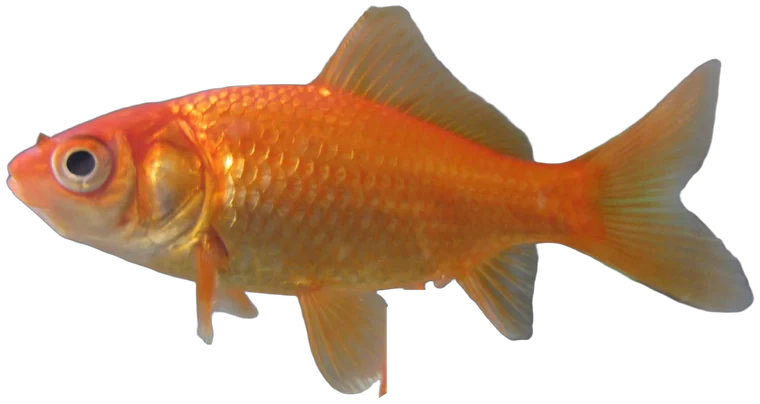
One tail, a long body
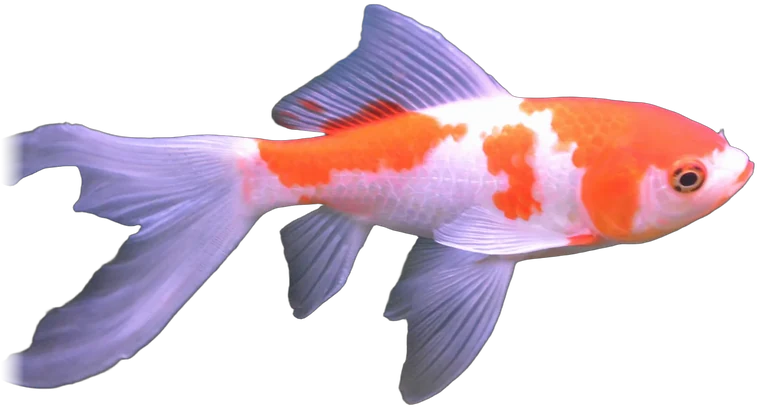
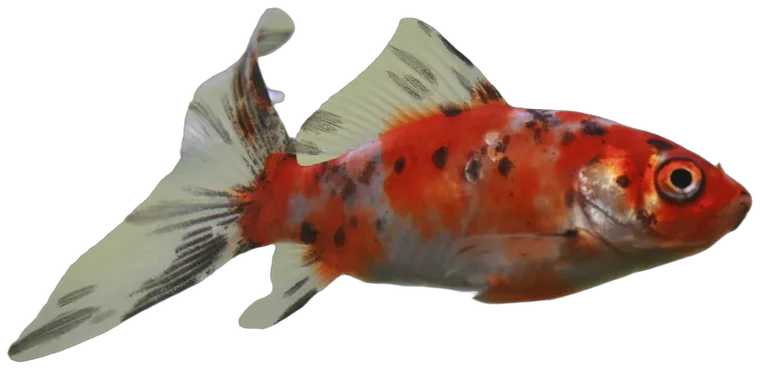
Two tails, a long body
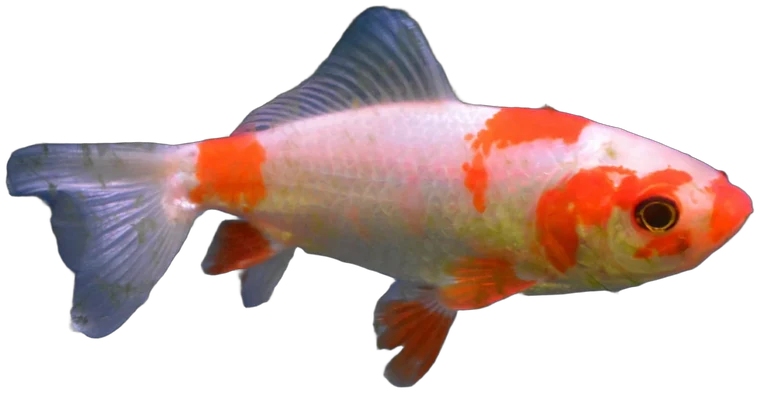
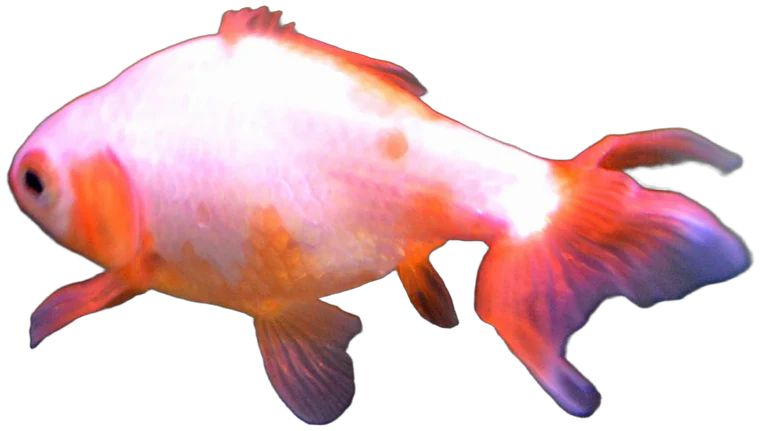
One tail, a deep body
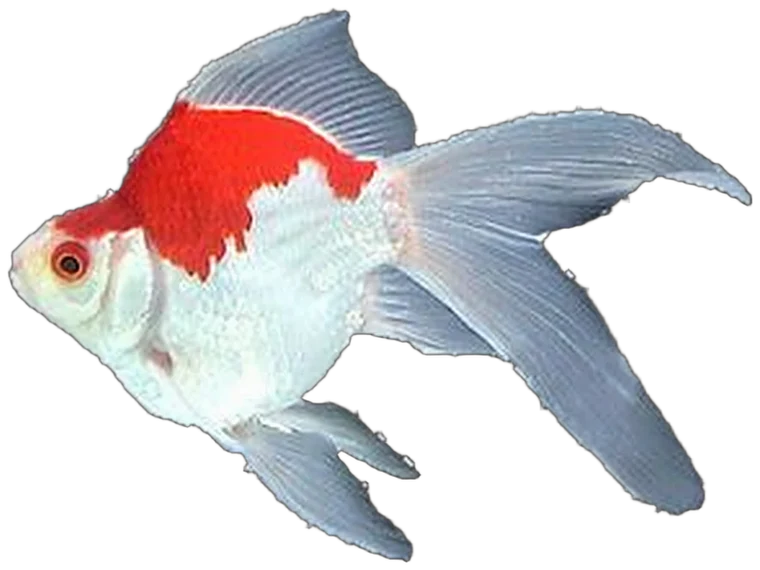
Two tails, a deep body
2Is there a dorsal fin?
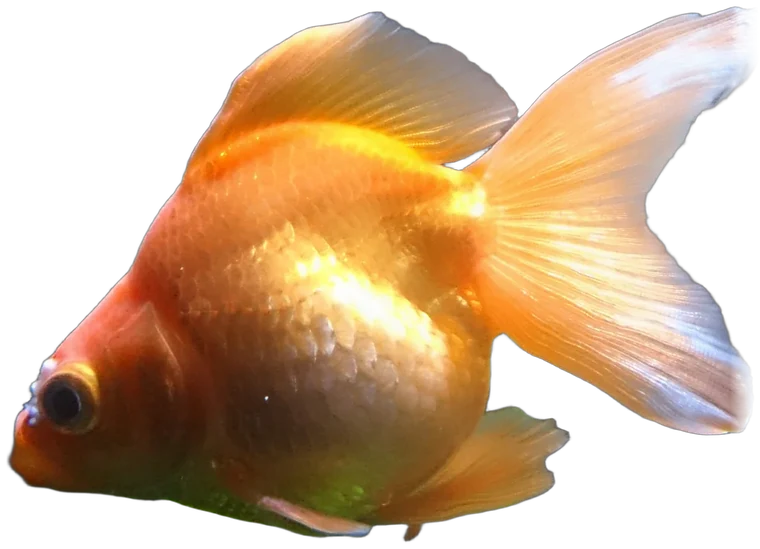
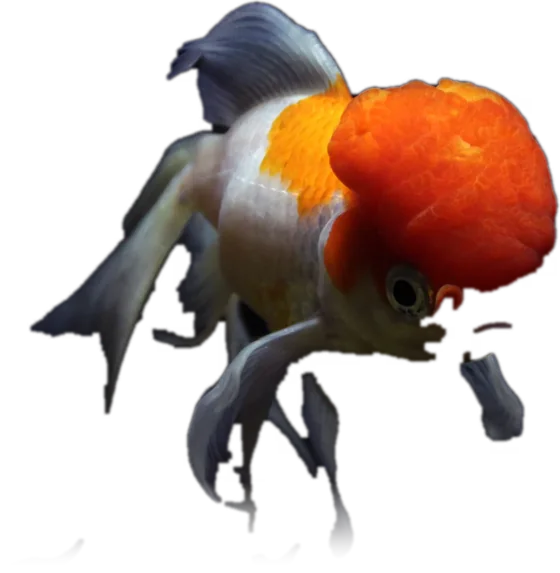
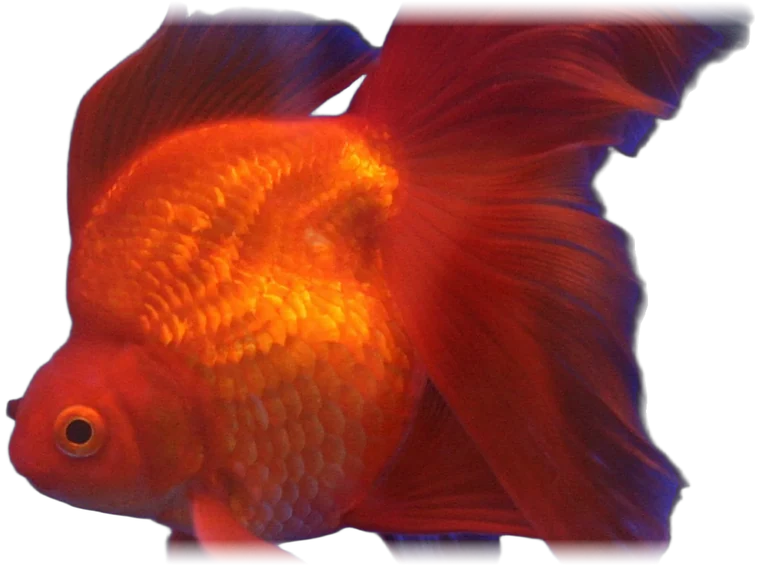
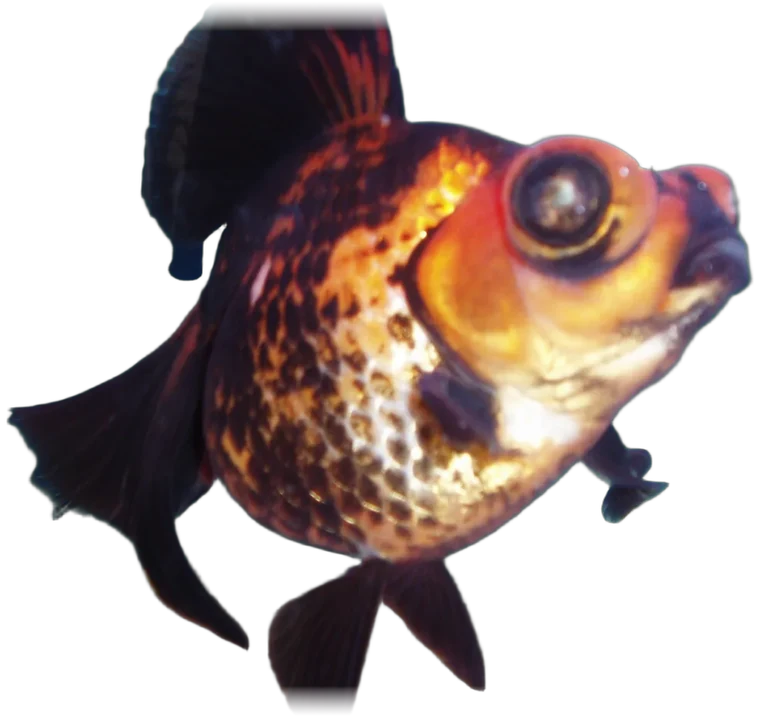
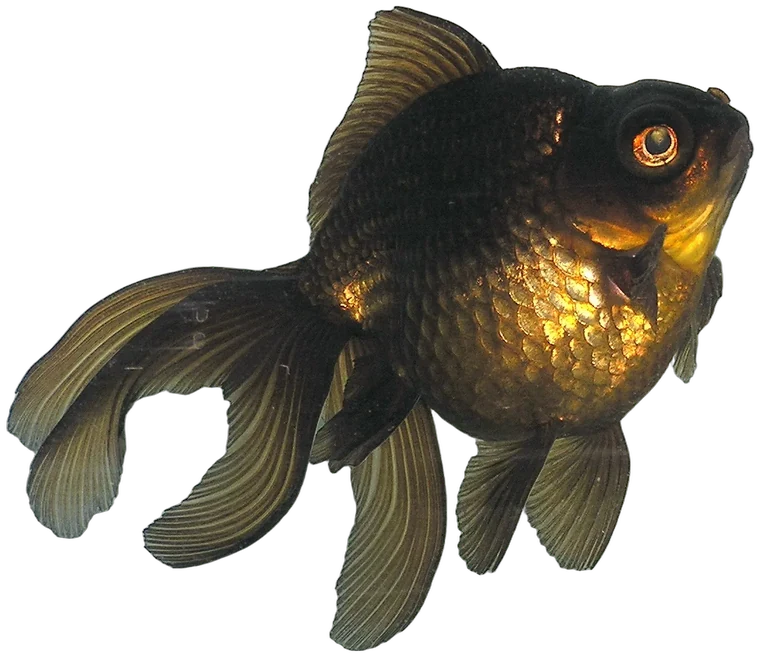
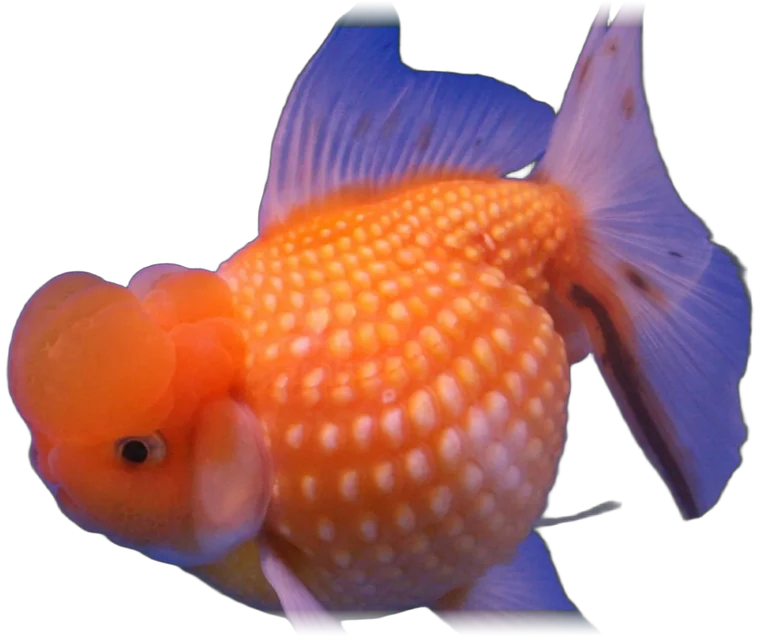
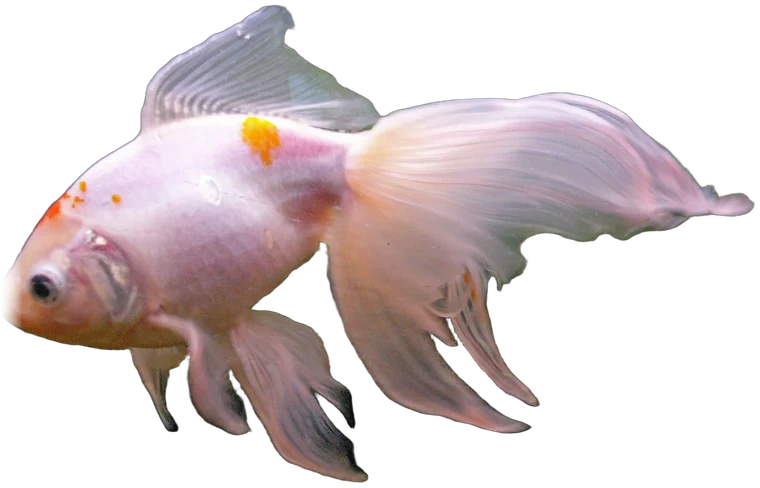
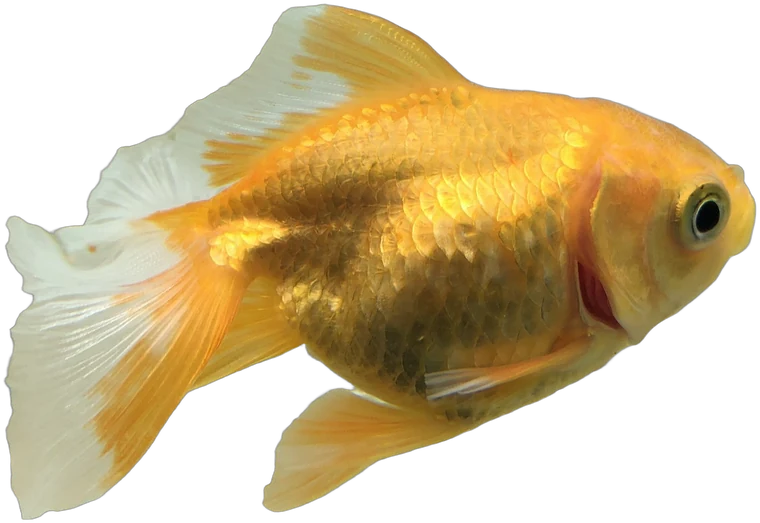
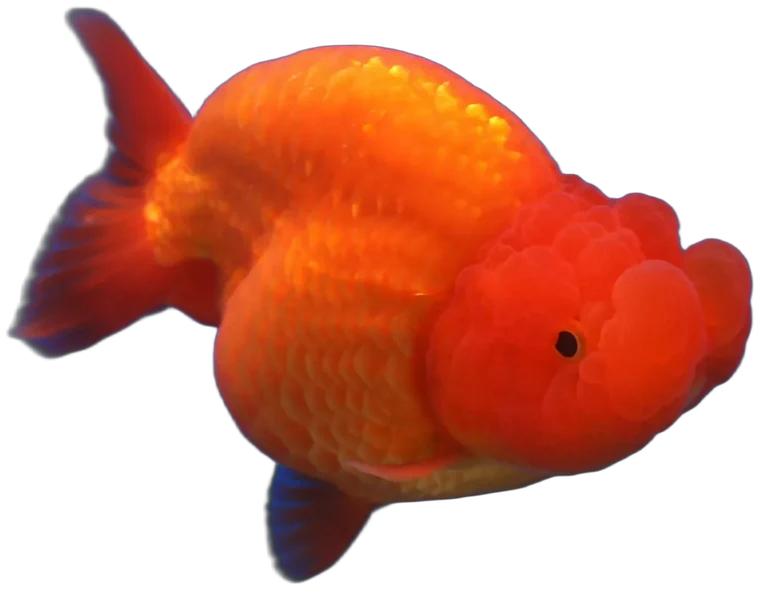
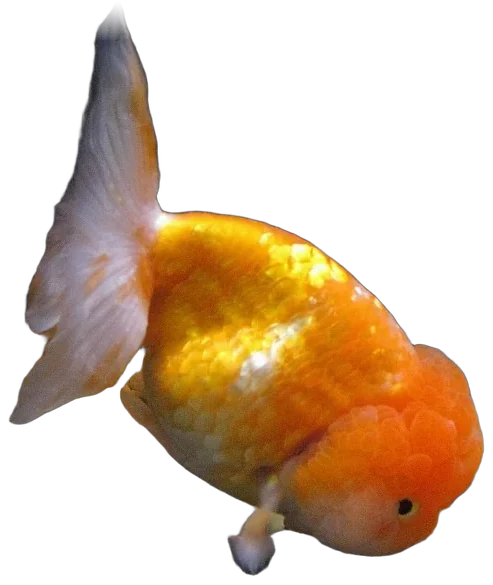
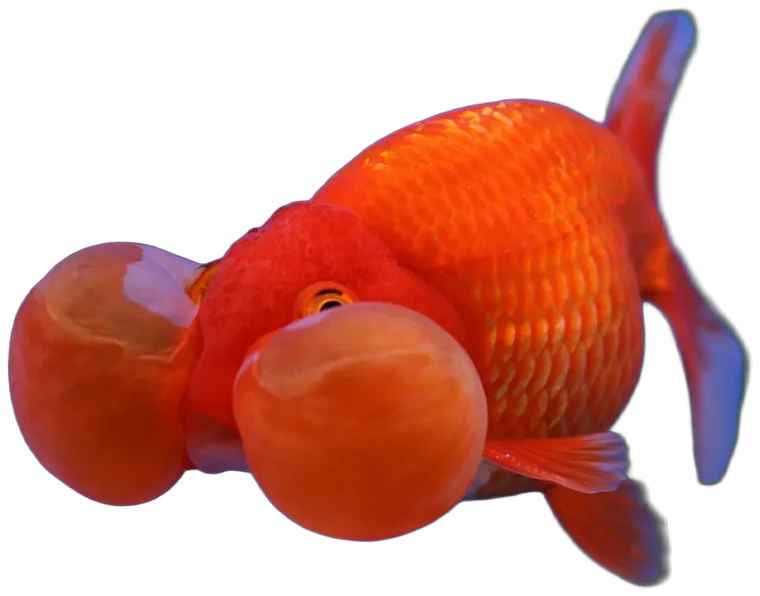
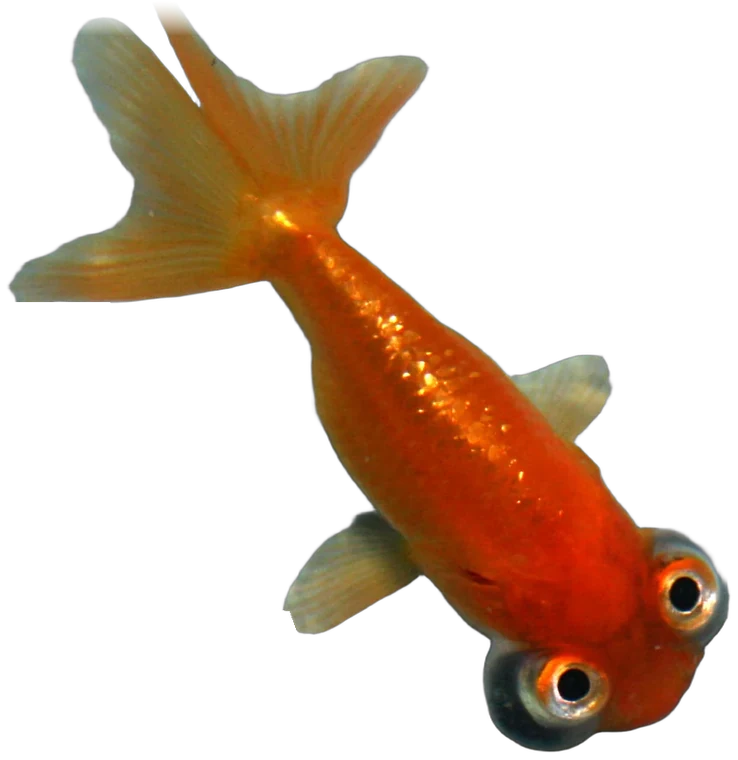
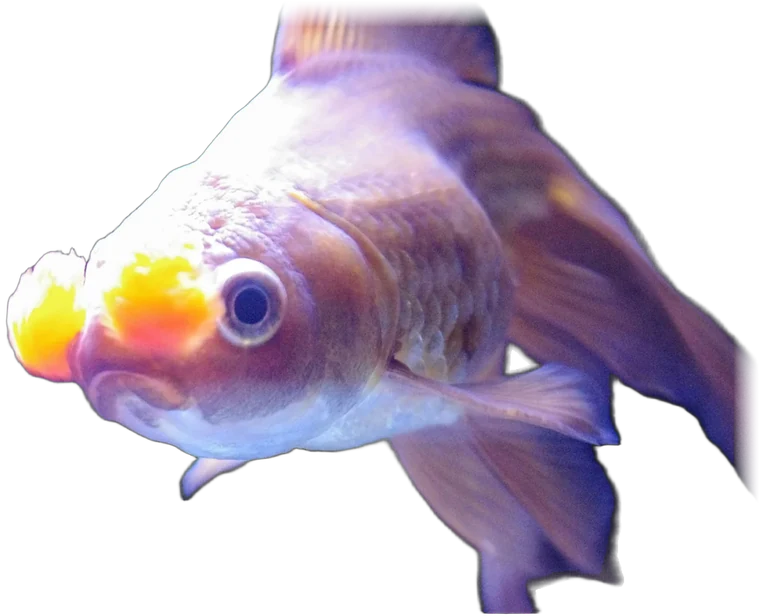
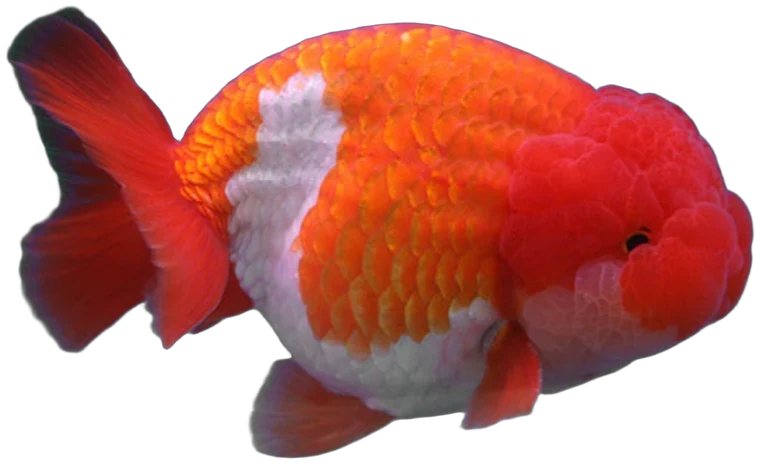
No tail at all: the meteor, which survives only as a drawing. The pompom is sold with a dorsal fin as well as without.
Question one: how many tail fins?
Look at the fish from directly behind, or from above. It takes seconds.
One tail fin — a flat, single fin like any ordinary fish — means a single-tailed goldfish: common, comet or shubunkin. These are long-bodied, fast, hardy fish that tolerate cool water and belong in a pond or a very large aquarium, where they can reach 25–35 cm.
Two tail fins — a tail divided into two lobes, with a paired anal fin — means a fancy. Egg-shaped body, 15–20 cm for most of them, and generally happier in calmer water, with sinking food a common choice. The span across the fancy breeds runs wider, from about 10–12 cm to 25 cm or more; how big do goldfish get owns the figures and each breed page carries its own. A few fancies are single-tailed (tamasaba, nymph), and the tosakin’s lobes are joined at the centre.
Then check the body, because a few breeds break the rule. The tail count is a shortcut for what really decides the care, the shape of the body, and it does not hold for every breed:
| Tail and body | What it is |
|---|---|
| One tail, long body | Common, comet or shubunkin |
| Two tails, long body | Wakin or jikin |
| One tail, deep body | Tamasaba |
| Two tails, egg-shaped or deep body | A fancy: go on to question two |
The wakin and jikin carry a double tail on a wakin-type body. The wakin swims and grows like a common, reaching 25 to 30 cm and wanting a pond or a very large tank; the jikin, which Japanese sources describe as weak in constitution and very difficult to keep, is kept with great care. The tamasaba does the opposite: a ryukin-shaped body under one undivided tail, cared for as the fancy it is. When the tail and the body disagree, go by the body, because that is what the care follows from.
Question two: is there a dorsal fin?
The fin along the top of the back. Present on most goldfish, absent in several breeds.
Goldfish anatomy
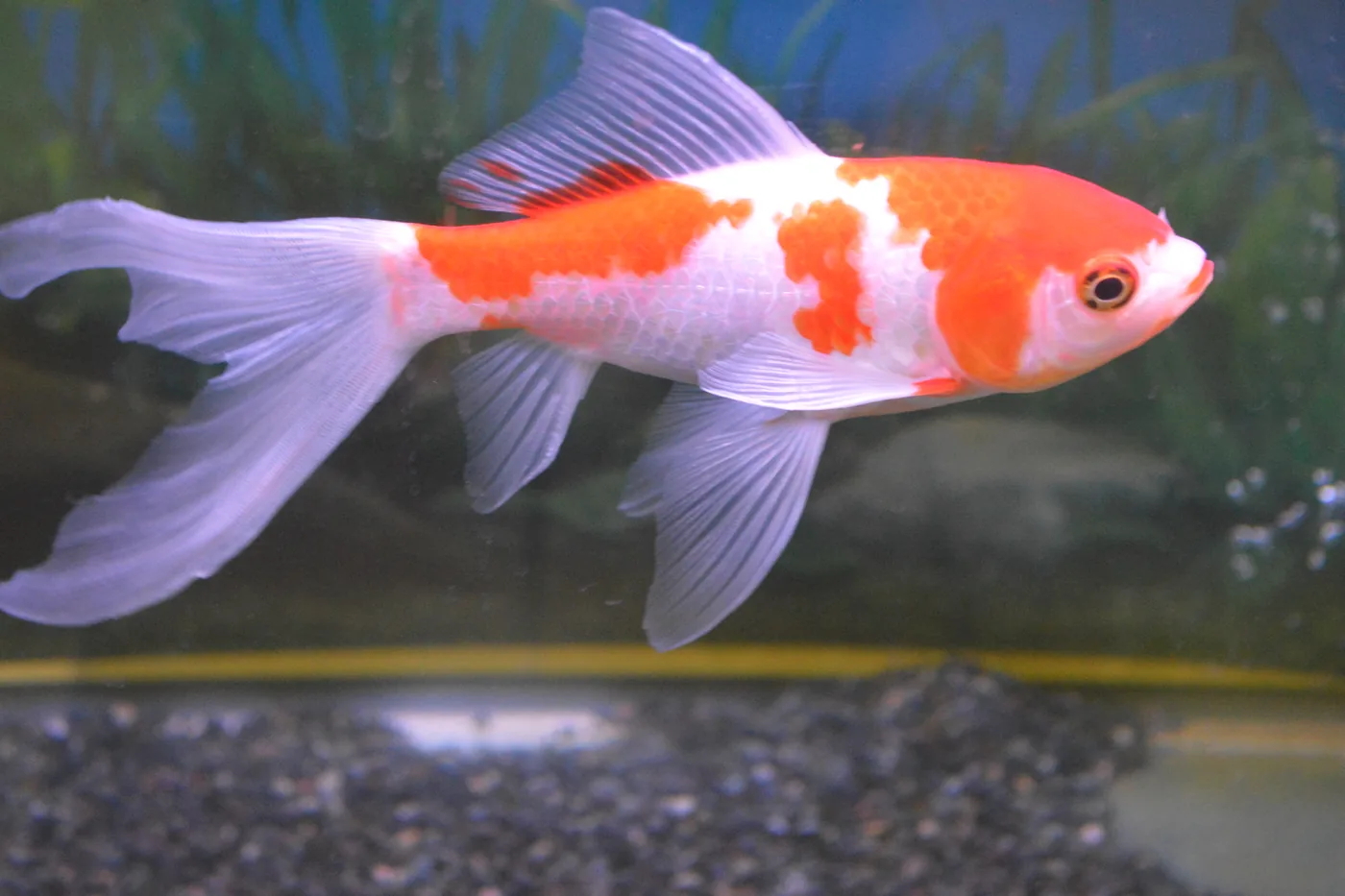
Photograph: Yatokin, CC BY-SA 4.0 · Wikimedia Commons. Numbers and lines added.
- Dorsal fin. Stability. Absent by design in ranchu, lionhead, bubble eye and celestial eye.
- Caudal fin (tail). Single in commons, comets and shubunkins; paired in most fancies and in the wakin and jikin, and single again in the tamasaba.
- Anal fin. Also paired in double-tailed breeds.
- Pelvic fins. Braking and fine position control.
- Pectoral fins. Steering, hovering and reversing; males grow breeding tubercles here in spring.
- Gill cover (operculum). Protects the gills; fast movement here is an early warning sign.
- Lateral line. Senses pressure and movement; part of why goldfish notice you before they see you.
- Eye. Goldfish see colour well, including some ultraviolet.
- Mouth. No teeth at the front; food is crushed by pharyngeal teeth in the throat.
No dorsal fin narrows it to the lionhead, ranchu, lionchu, bubble eye, celestial eye, the classic pompom or the egg-fish, which the encyclopedia does not cover. Without a dorsal fin a goldfish rolls and yaws more and accelerates poorly (measured in the egg-fish), so these breeds suit calm water and lose out to faster fish.
A dorsal fin present leaves the rest.
Two questions, and the whole encyclopedia has become a handful of small groups.
The rest of the key
From here it is a short walk. Take the branch you are already on.
Single tail — look at the tail shape, then the scales:
| What you see | What it is |
|---|---|
| Short tail, rounded lobes, shallow fork | Common goldfish |
| Long tail, deeply forked and pointed | Comet |
| Calico: mottled blue, red, black and white | Shubunkin |
Double tail, no dorsal fin — look at the head:
| What you see | What it is |
|---|---|
| Raspberry-like hood over head and cheeks | Lionhead, lionchu or ranchu |
| Fluid-filled sacs under the eyes | Bubble eye |
| Eyes turned permanently upward, no sacs | Celestial eye |
| Two soft bouquets at the nostrils, in front of the eyes | Pompom |
Double tail, dorsal fin present — look for one distinguishing feature:
| What you see | What it is |
|---|---|
| Eyes protruding on cone or globe mounts | Telescope (black = moor) |
| Hood on the head, dorsal fin still there | Oranda; a crown pearlscale carries a hood too |
| Domed, pimple-like scales over the flanks | Pearlscale |
| Sharp hump rising just behind the head | Ryukin |
| Very long tail, cut square with no fork, tall dorsal fin | Veiltail |
| Bouquets at the nostrils, dorsal fin still there | Pompom, often sold as a pompom oranda |
| Smooth egg shape, none of the above | Fantail |
The fantail is effectively the default: a double-tailed fancy with a dorsal fin and no special feature. That is not a slight — it is a hardy fancy and a sensible first one.
The pompom is the one breed that turns up on both branches. The classic form has no dorsal fin, and a dorsal-finned form is sold under the same name, so question two does not settle it. Judge it by the bouquets at the front of the face, which are enlarged nasal tissue rather than a wen, and remember that a fish can carry both bouquets and a wen.
The pairs that genuinely get confused
Eight pairs are worth telling apart.
Common and comet: mostly the tail
A common has a short single tail with rounded lobes and a shallow fork. A comet’s is long, deeply forked and pointed, sometimes approaching the length of the body. A comet is also a little slimmer (body depth about 35% of length against 40%), with pointed rather than rounded fin tips. The colours largely overlap, and the care is identical — which is why it rarely matters which of the two a fish is.
Comet and shubunkin: the scales, not the shape
A shubunkin is the calico single-tail, and it comes in London (common-shaped), Bristol (large rounded tail) and American or Japanese types, the last built like a comet. Look at the scales and colour. A comet is usually metallic, in a solid colour such as orange, red, yellow, white or red-and-white. A shubunkin is calico, a mosaic of metallic, matt and nacreous scales carrying a pattern of blue, red, black and white with fine black speckling.
Societies differ on whether a calico fish with a comet’s tail is a comet or a shubunkin; the comet standard accepts calico, where the common’s does not.
Common and wakin: look from behind
A wakin has a body similar to a common’s and a double tail, and from the side a spread double tail can pass for one fin. Look from directly behind or from above, and the two lobes separate. The difference changes nothing about the care, which follows the body: a wakin is a pond fish in the same way a common is.
Fantail and ryukin: the back
A fantail’s body rises in a smooth egg shape. A ryukin has a distinct hump beginning just behind the head, so the back climbs sharply before the dorsal fin. The ryukin is also deeper-bodied and, by some accounts, quicker to the food.
Both have a dorsal fin and a double tail, which is why young ones are easily confused — and the hump develops with growth rather than being obvious in a juvenile.
Fantail and veiltail: the end of the tail
A fantail’s tail is comparatively short, forked or notched, and spreads. A veiltail’s is long, cut square across the end with no fork at all, and the fish carries a tall dorsal fin. Many fish sold as veiltails are long-finned fantails with a fork in the tail, which is the ordinary result of a hard standard to breed to rather than a fault in the fish. Either way, the longer the fins, the gentler the tank has to be.
Ranchu and lionhead: the profile
Both lack a dorsal fin and carry a wen, so look at the outline from the side. A ranchu’s back curves in one smooth arch and drops steeply into a tucked tail set at a sharp angle, giving a short, deep, rounded shape. A lionhead’s back is flatter, its tail sits at a shallower angle, and its wen is usually larger.
The Japanese tradition judges the ranchu from above; British standards illustrate both views for both fish. The showing guide explains why that difference exists and why two societies can disagree about the same fish.
A lionchu is a cross of the two, and it sits between them: the ranchu’s arched back and steep tail set under a hood that is often heavier than a ranchu’s. Take the back and the tail set first. A fish with both is a ranchu or a lionchu, and the hood, which varies and arrives last, only separates those two when it is grown.
Telescope and black moor: the colour
The black moor is the solid-black telescope-eyed goldfish. Telescopes come in other colours, and the Bristol Aquarists’ Society keeps the moor and the globe eye as separate standards.
A moor that fades to bronze or orange has not changed breed, and fading alone is not a sign of illness. A black-and-white “panda” is a pattern rather than a breed: black persists locally into adulthood in a panda, though a panda moor may lose its pattern with age.
Oranda and lionhead: the dorsal fin
Both carry a wen and the hoods can look similar. The oranda has a dorsal fin; the lionhead has none. One glance along the back settles it, and it is a real distinction rather than a cosmetic one, because without a dorsal fin a goldfish rolls and yaws more and accelerates poorly (measured in the egg-fish).
Things that look like breed features but are not
Four regular sources of misidentification, none of them a breed.
A tail that looks single but is fused. A fancy can carry a double tail joined along the top edge, which from the side reads as one fin. Look from directly behind and check the upper edge for a divide. A fused tail on an egg-shaped body is a fancy with a fault, not a single-tail.
A dorsal fin that was damaged rather than absent. A dorsal torn down to the base can leave a fish looking like one of the dorsal-less breeds. The difference is the ridge: a lionhead or ranchu should have a smooth, unbroken back with no fin base at all (a ridge or partial fin can turn up in a dorsal-less spawn), while a damaged dorsal leaves stubs and an outline you can feel. The fin can also start growing back, usually within weeks, which can settle it.
A small fish that is actually a stunted one. Poor conditions can leave a fish small for its age; length alone does not identify a small breed. How big do goldfish get covers the distinction.
Sex. Male and female goldfish differ in shape as they mature, and a rounder female is sometimes mistaken for a deeper-bodied breed. Sexing goldfish covers what is actually reliable, which is less than most people assume.
Colour is not a breed
A common identification mistake, and an easy one to make, because shops use colour names exactly as though they were breeds.
Goldfish scales come in three finishes, and any of them can appear on most breeds:
- Metallic — the familiar reflective orange, red, white or yellow.
- Nacreous — translucent, like mother-of-pearl.
- Matt — no reflective layer, so the scale is transparent; with no pigment beneath it the fish looks flat pink.
So calico is a pattern, not a breed: a mosaic of a few metallic, mostly matt and some nacreous scales. Shubunkins, fantails, orandas, ryukins and telescopes all come in it. Black and chocolate are colours, panda and red-cap are patterns, and all four are descriptions of colouring applied to whatever body happens to be wearing them — a red-cap oranda is an oranda with a white body and a red wen, still an oranda, though the Bristol society lists it as a separate variety.
The genetics guide covers why this is: scale type behaves predictably and is genuinely heritable, while colour arrives and departs on its own schedule throughout a fish’s life.
Names the key does not cover
The key above covers every breed in the encyclopedia, though one of them it can only narrow down. The encyclopedia is not the whole of goldfish, and a few more names come up often enough to be worth placing.
Butterfly tail is seen mostly on fish with telescope eyes; the Bristol society lists it as a variety. The tail spreads flat and is meant to be viewed from above.
Tosakin is the breed the key can only narrow down. It is a Japanese fish whose tail spreads flat, joined at the centre and curled forward at its edges, and that shape reads best from above. From the side, the view this key works from, it falls among the double-tailed fish with a dorsal fin and can be mistaken for a fantail with a large tail. The tosakin page says what to look for from above. It is rarely met outside Japan, and a keeper who has one has usually gone to some trouble to find it, which finding a goldfish no shop stocks describes.
A fish with no tail at all is not a breed. There was one, by one account — the meteor, described in Philadelphia in 1917 — but there is no verified living fish since, and the only picture of it is a drawing. A goldfish missing its caudal fin may have lost it to injury, to fin rot or to persistent nipping, though a tail could also be missing from birth. Treat it as damage first and read what heals and what does not: caudal tissue regrows from the edge once the cause is gone, if the base of the fin is intact.
The showing guide has more on why breed lists differ between countries and societies in the first place, which is the underlying reason no single list is definitive.
Young fish do not look like the pictures
Almost every distinguishing feature on a fancy goldfish develops rather than being present at purchase.
| Feature | When it shows |
|---|---|
| Tail count | Fixed once the fins have formed, well before shop size — reliable |
| Dorsal fin, or its absence | Fixed once the fins have formed, well before shop size — reliable |
| Ryukin hump | Develops as the fish grows, often over months |
| Wen | Starts as a faint cap, thickens over one to two years or more |
| Telescope eyes | Often barely raised in juveniles |
| Celestial and bubble eyes | A juvenile cannot yet be told by upturned eyes or sacs; the celestial eye’s eyes reposition within about six months |
| Adult colour | Frequently bronze first, changing over months to years |
| Pearlscale doming | Can show early, and often becomes more pronounced with growth |
| Pompom bouquets | Often small or absent at first, and can keep developing for a year or more |
The practical rule: identify a juvenile by the features that cannot change. Tail count and dorsal presence are structural. Everything else is a forecast.
Many shop fancies are poor examples of their label
Worth saying plainly, because people spend a surprising amount of effort trying to force an ordinary fish into a named category.
Outside specialist breeders, a fancy goldfish often falls short of the name on the tank: a fantail body with a hint of hump, a hood that never quite becomes a proper wen, a tail that is neither one thing nor the other. The wen and body depth have not been mapped, and losing the dorsal fin involves several genes, so even a single-breed spawn throws a wide spread of shapes, which is one reason serious keepers talk about lines rather than pairs.
The right response is not to pick a name. It is to care for the most demanding feature the fish actually has:
- A deep, compressed body → watch for buoyancy trouble; many keepers soak the food or feed sinking pellets.
- Any hood tissue → the wen care routine, however small the hood.
- Protruding eyes → smooth decor and guarded intakes.
- No dorsal fin → calm water, gentle flow, deliberate feeding.
A fish with a deep body and a soft hood needs deep-body care and hood care whatever you end up calling it.
What the answer actually changes
Having identified the fish, here is what genuinely follows from it — and it is shorter than the identification process was.
Adult size and tank volume. The big one. A single-tail that can reach 30 cm and a bubble eye of 12–15 cm are not the same commitment. How big do goldfish get has the figures and the tank size guide turns them into litres.
Whether a pond is an option. Single-tails: yes, and they thrive in one. Fancies: mostly not, and the pond guide is specific about which and why.
Who it can live with. Speed and swimming ability decide this, not temperament. A slow fancy housed with comets can be outfed at meals.
How the food should be delivered. Keepers report that sinking food and a consistent feeding spot help some deep-bodied and hooded fish; there is no controlled evidence.
What to keep an eye on. Each breed has a characteristic vulnerability — buoyancy in the deep-bodied, eye damage in the telescopes and bubble eyes, hood trouble in the hooded.
When it genuinely does not matter
Most of the time.
Once you know whether you have a long-bodied single-tail or a round-bodied fancy, you usually know most of what the breed name was going to tell you. The welfare that follows — space, clean water, appropriate food, company of a similar speed — is the same argument for every one of them.
The names are worth knowing because they are a convenient handle for a set of needs, and because the history behind them is genuinely interesting. They are not worth agonising over. A fish that does not match any entry in the encyclopedia is not a mystery to be solved; it is a goldfish, and it wants what the others want.
Frequently asked questions
How do I identify my goldfish?
Start with two questions rather than a list of names. Look at the fish from directly behind: one tail fin or two? A single tail on a long body means a common, comet or shubunkin, a fish that can reach 25-35 cm in a pond or large tank and wants that much room. A double tail on a rounded body means a fancy. Then ask whether it has a dorsal fin along its back. Several breeds, among them the lionhead, ranchu, lionchu, bubble eye, celestial eye, the classic pompom and the egg-fish, have none. Those two questions do most of the work, and the few breeds whose tail and body disagree are covered on the page.
Is a black moor a different breed from a telescope?
Not in everyday use: the black moor is the solid-black telescope-eyed goldfish. Telescopes come in other colours, and the Bristol Aquarists' Society keeps the moor and the globe eye as separate standards. Black can fade to bronze or orange with age, and a moor that has faded has not changed breed or become ill - it has simply stopped being black.
Why does the shop label not match what I read online?
Often because juveniles of several breeds genuinely look alike and can be mixed in the same tank, and because fancy goldfish is a category rather than a breed. A young ryukin has not grown its hump yet, a young oranda has barely any wen, and many shop fancies are poor examples of their label. Judge by the fish, and treat the label as a starting guess.
What is the difference between a calico goldfish and a shubunkin?
Calico is a colour pattern, not a breed - a mosaic of a few metallic, mostly matt (transparent) and some nacreous scales, mottled blue, red, black and white. A shubunkin is the calico single-tail, in London (common-shaped), Bristol (large rounded tail) and American or Japanese comet-shaped types. Fantails, orandas and ryukins all come in calico too, so a calico fish with an egg-shaped body and a double tail is not a shubunkin.
Does it matter what breed my goldfish is?
The name usually matters less than the body shape behind it. What most changes your decisions is whether the fish is a long-bodied single-tail or a round-bodied fancy: that largely determines adult size, tank volume, whether a pond is suitable, which tankmates are fair, and how likely buoyancy trouble is. Get that right and the exact breed is mostly detail.
My goldfish does not match any breed exactly. What is it?
Possibly a poor example of its label, which many shop fancies are, or a cross between breeds. This is not a problem to solve. Identify the features it actually has - double tail, no dorsal, a developing wen - and care for the most demanding of them. A fish with a deep body and a heavy hood needs deep-body and hood care whatever you end up calling it.
Can I tell a goldfish's breed when it is young?
Partly. Tail count and the presence or absence of a dorsal fin are fixed once the fins have formed, well before shop size, and are reliable. Humps, wens, telescope eyes, upturned eyes, eye sacs and adult colour all develop over months to years, so a juvenile fantail and a juvenile ryukin can be genuinely indistinguishable until the ryukin's back starts to climb.