No. 14First bred in 1892, named in 1900
Shubunkin
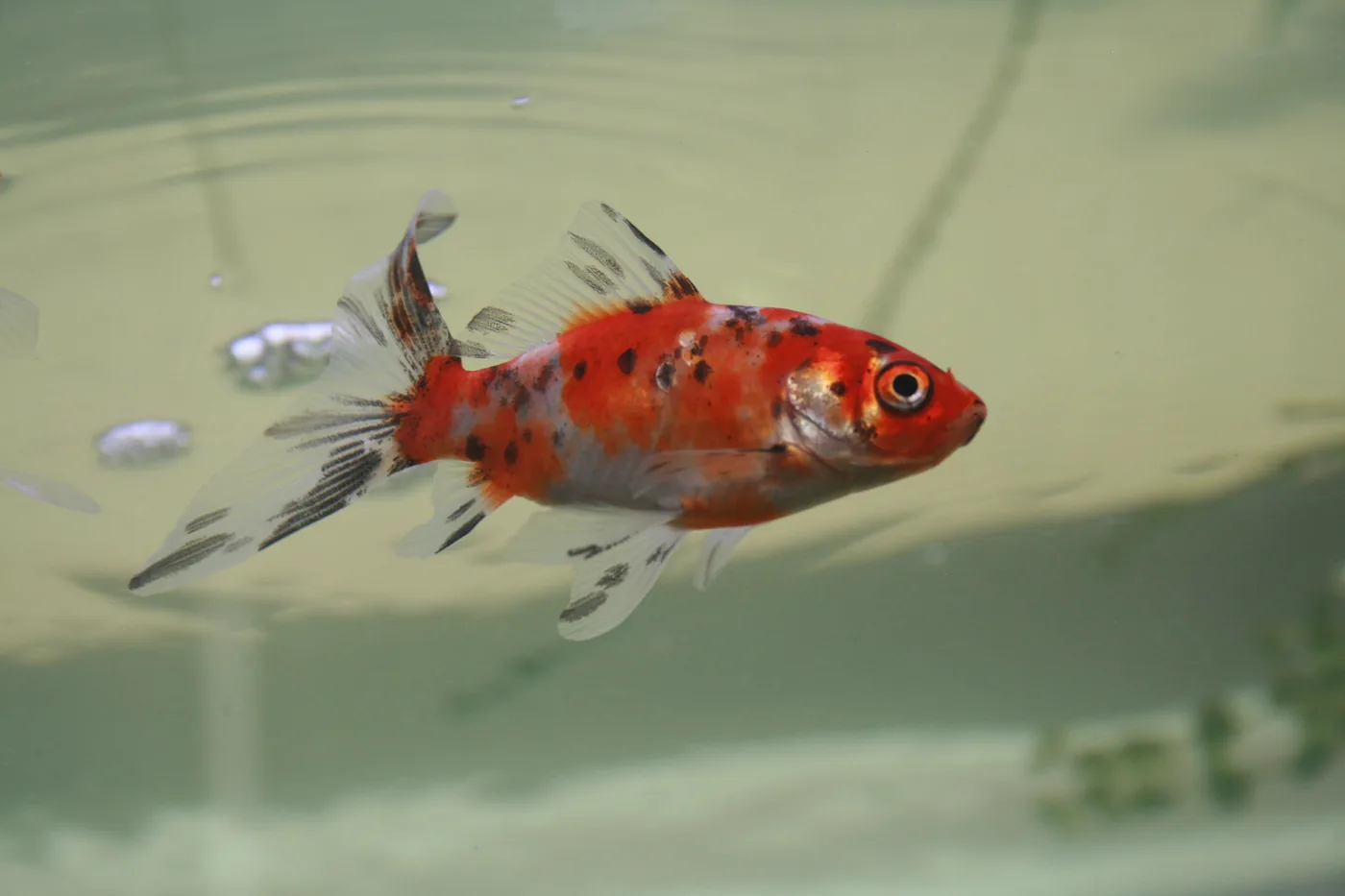
A single-tailed goldfish painted in blue, red and black on mother-of-pearl.
Also known as Calico goldfish · Speckled goldfish · Bristol shubunkin (type) · London shubunkin (type)
- Specimen
- Single-tailed goldfish, Japan
- Adult size
- 25–30 cm
- Lifespan
- 15–20 years
- Water
- 10–24 °C
- Care
- Easy
- Swimming
- Strong
- First fish needs
- 150 litres
Photograph: Michelle Jo, CC BY-SA 3.0 · Wikimedia Commons
About this pictureNo blue on this one. Blue is what breeders select for and what sets the price, and a wide even spread of it is the minority in any spawn.
About these figures Size, lifespan and water are the ranges keepers' guides give for a fish in good care, not measurements of this breed, and swimming and care are this site's own ratings of the published advice. Lifespan is where the sources differ most: how long goldfish live sets them side by side. First fish needs is a middle figure for one fish, from advice that runs from 50 litres to about 300; tank size sets that out.
The specimen
Quick facts
- Classification
- Single-tailed goldfish
- Body type
- Streamlined single-tailed body, stocky in the London type and slimmer in the American type, with tail shape varying by type
- Tail and dorsal
- Single tail, dorsal fin present
- Swimming ability
- Strong
- Keeper experience
- Beginner
- Temperament
- Active, hardy and sociable; peaceful with other single-tailed goldfish but too quick for fancies
- Adult size
- 25–30 cm (10–12 in)
- Temperature
- 10–24 °C (50–75 °F)
- Minimum aquarium
- 150 L (40 US gal) for one fish
- Origin
- Japan, Around 1900 (Meiji era)
How to recognise one
- Calico pattern of blue, red, orange, black and white patches with fine black speckling
- Nacreous scales with a soft, semi-transparent, mother-of-pearl sheen rather than a metallic shine
- A blue background colour, and the more of it the better in show terms
- Single tail, full dorsal fin and a streamlined body
- Tail shape reveals the type, short and rounded (London), broad with rounded lobes (Bristol) or long and pointed (American)
Identification
The shubunkin is a single-tailed goldfish in calico dress. Body and fins follow the common or comet pattern, but the scales are nacreous: a mix of metallic and transparent scales that gives a soft, mother-of-pearl finish instead of a hard shine. Over that ground lies a pattern of blue, red, orange, black and white patches, finished with a scatter of fine black speckles. Blue is the colour that matters. A fish with a broad, even spread of it is the one breeders keep and judges score highest; fish that are mostly orange with a few black flecks are the common run.
Three types are recognised, separated by body and tail. The London shubunkin has the stocky body and short, rounded fins of a common goldfish. The Bristol shubunkin, developed by British aquarists, carries a large tail with broad, rounded lobes that spread into an outline like a capital B. The American or Japanese shubunkin is slim, with the long, deeply forked tail of a comet. All three are the same fish in care terms.
Common, comet or shubunkin?
-
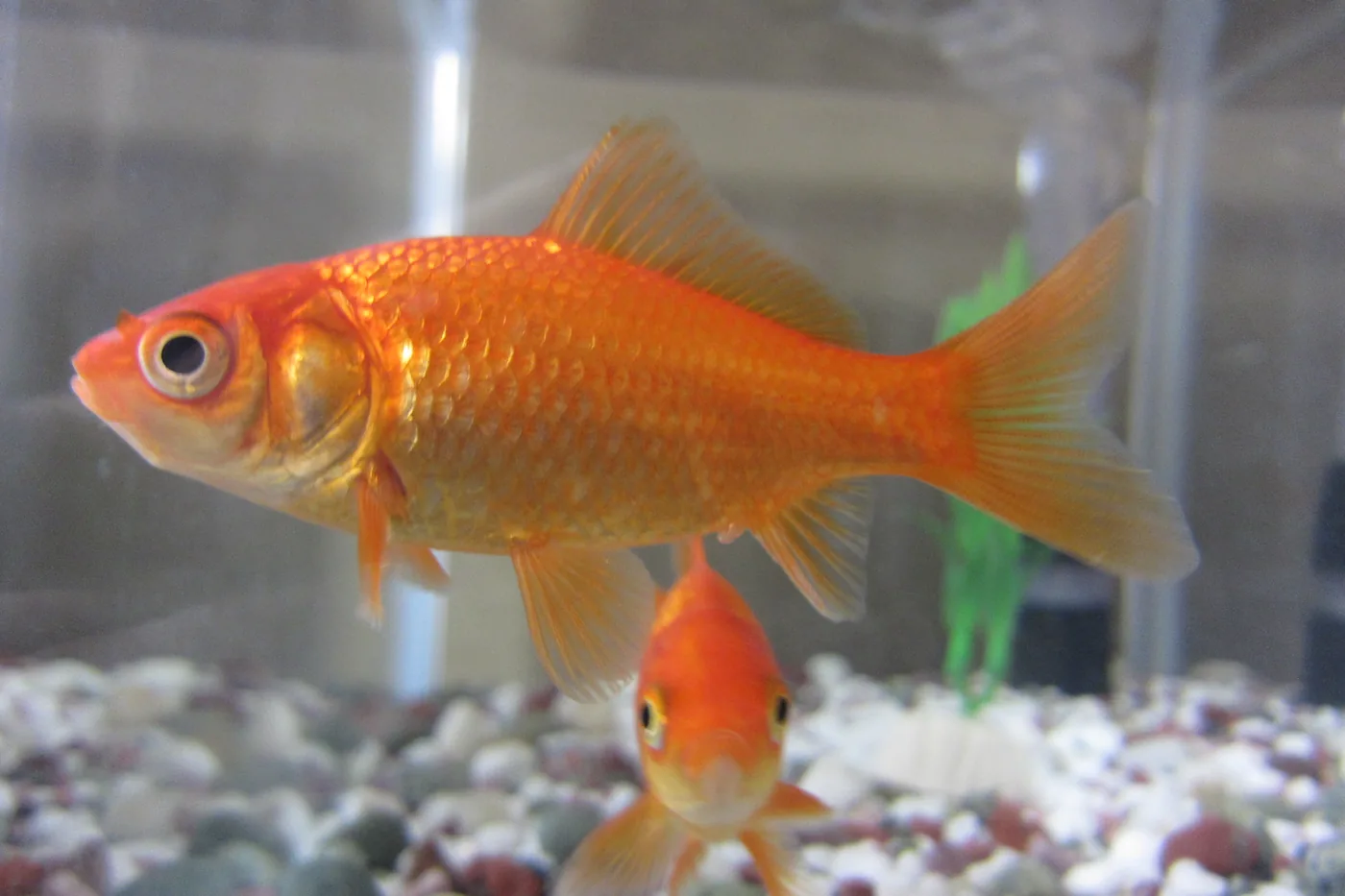
A short tail
-
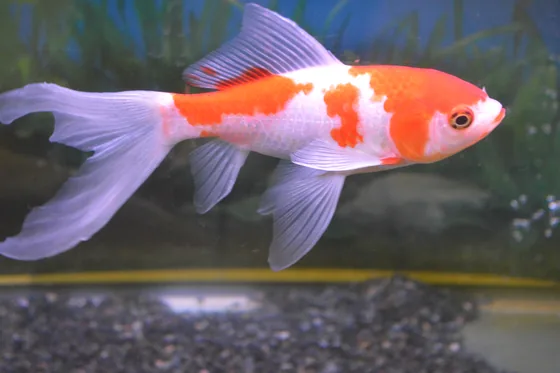
A long, deeply forked tail
-
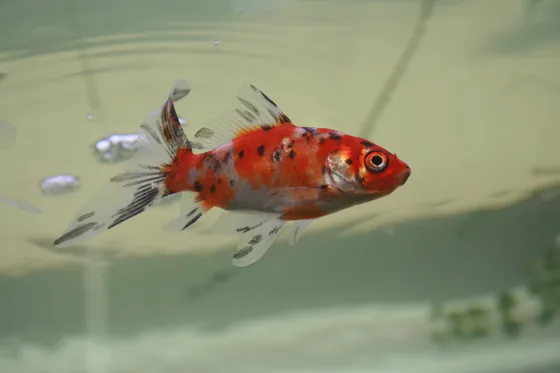
Calico, on see-through scales
Three single-tailed goldfish side by side: a common goldfish with its short tail ringed, a comet with its long, deeply forked tail ringed, and a shubunkin with its calico body ringed.
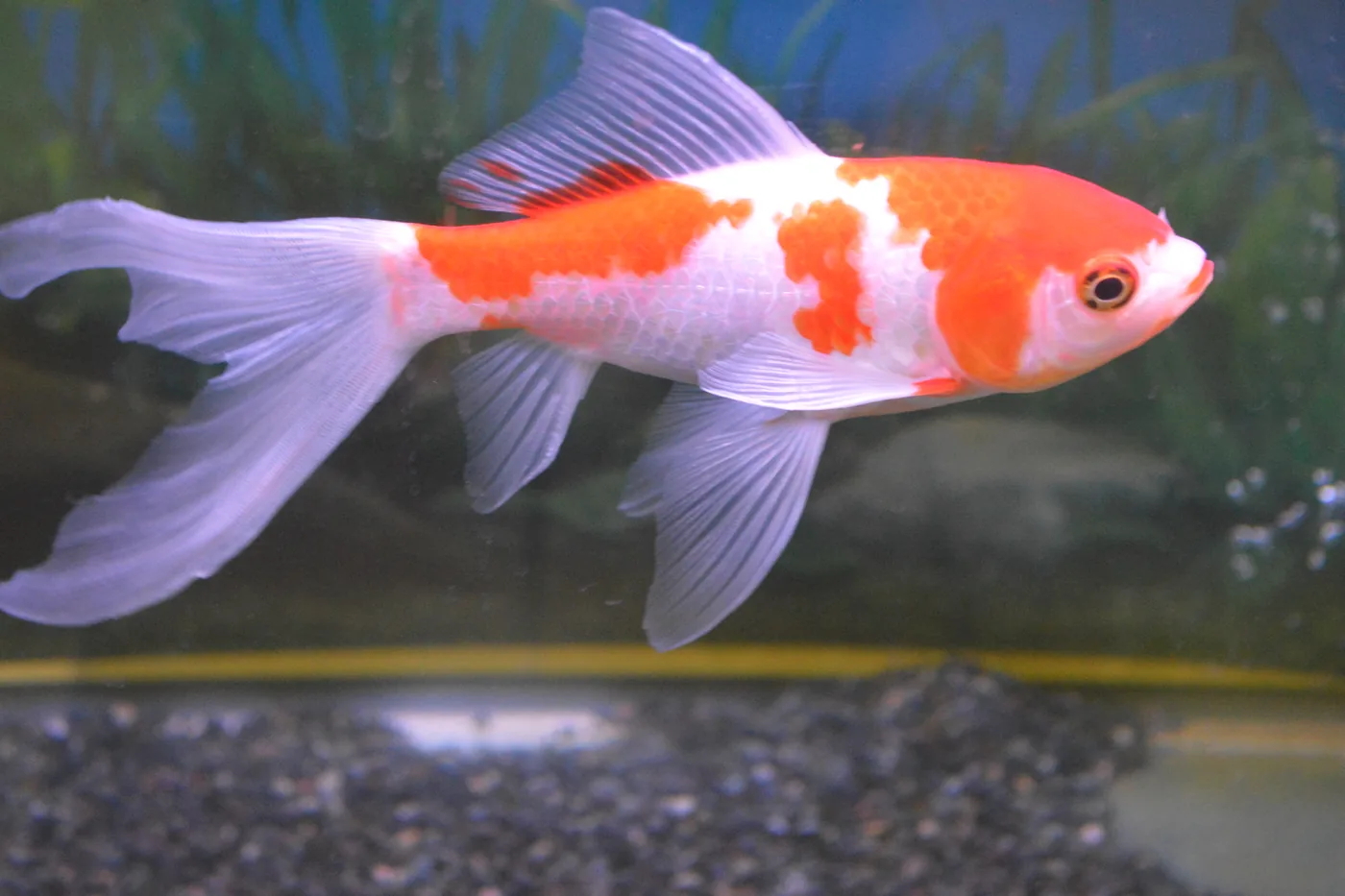
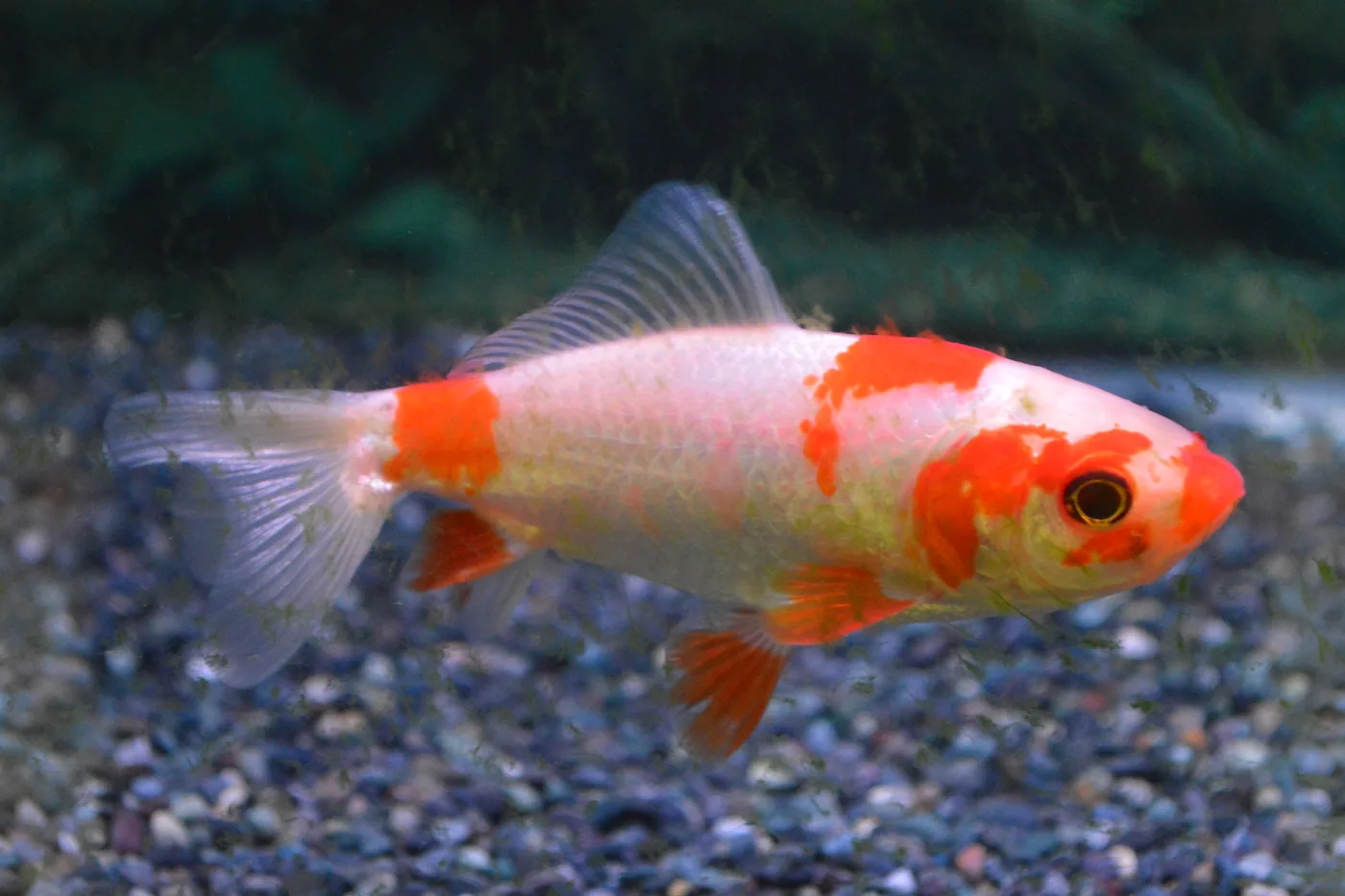
- Common Goldfish. A short tail and a metallic shine.
- Comet. Slimmer, with a long, deeply forked tail.
- Shubunkin. The same outline, wearing a calico pattern on semi-transparent scales.
Photographs: Common Goldfish, ぱたごん, CC BY-SA 3.0; Comet, Yatokin, CC BY-SA 4.0; Shubunkin, Michelle Jo, CC BY-SA 3.0. Rings added.
The three types
Here the “variety” changes the fish’s shape rather than its colour: all three are calico, and they differ in body and tail.
| Type | Tail | Body | Notes |
|---|---|---|---|
| London | Short, rounded | Stocky, like a common | Close to a common in build |
| Bristol | Large, broad rounded lobes | Moderate | The showpiece; the large tail tears easily |
| American | Long, deeply forked, pointed | Slim | Essentially a calico comet |
The Bristol tail is the one worth knowing about. Carried well it reads as a broad heart or a capital B seen from behind, and it is the thing the type exists for. It is also large, thin and easy to tear on sharp decor or in a cramped tank — torn fins covers the consequence and aquarium decorations the prevention.
“Japanese shubunkin” is usually a name for the American type, used inconsistently. And most shop fish are unlabelled, so judge by the tail.
The colour, and why blue is the prize
The defining feature, and it works differently from every other goldfish colour.
Nacreous scales are the mechanism. Goldfish scales come in three states: metallic, fully reflective; matte, with no reflectivity; and nacreous, part one and part the other. A shubunkin is nacreous, which is what produces the mother-of-pearl finish and lets pigment deeper in the skin show through.
The blue is not a blue pigment. On the usual account it is a few dark cells deep in the skin, seen through nacreous or matte scales with no red or yellow cells above them. It is hard to fix in a line because nacreous fish are heterozygotes: two calicos give roughly a quarter metallic, a half calico and a quarter matt young, so the pattern cannot be bred true. It also varies with the fish’s condition and the light it is kept under, and a good blue commands a price.
So the calico pattern keeps moving. Blue, red, orange, black and white shift and redistribute through the first years and continue changing slowly afterwards. Black in particular comes and goes, for the reasons the black moor page sets out.
What you can influence, and what you cannot:
- Diet reaches the reds and oranges. Carotenoids in food deepen them, and goldfish nutrition explains why a fish cannot make those pigments itself.
- Nothing adds blue or black. Those are not dietary pigments.
- Light and background matter a little, because fish adjust pigmentation to their surroundings — aquarium lighting covers what a colour-enhancing lamp does and does not do.
- Genetics decide the rest, which is most of it.
How it develops
Slowly, and it is the source of most disappointment. Most goldfish hatch bronze and lose the dark pigment during the first year; a shubunkin’s pattern then redistributes for years, and no published source gives a timetable.
A juvenile shubunkin is a gamble, and a good seller will say so. The parents tell you far more than the fish does, which is the argument breeding goldfish makes about every trait that arrives late.
The awkward stage is real, and it is when most shubunkins are sold on. A pattern that redistributes does not do it tidily: a fish can look better at six months than at a year, muddy through its second summer, and then come good at three. Judging the fish in the middle of that is judging it at its worst.
Blue is the slowest and the most valued, and it is the one trait that cannot be rushed or fed into a fish — a line either carries it or it does not, and you may not know for a couple of years. The right way to buy a particular look is to buy an adult that already has it. The right way to buy a juvenile is to accept you are buying the breed rather than the pattern, and to be pleasantly surprised.
Choosing one
Accept first that you are buying a gamble on colour, because a juvenile is plainer than the adult it becomes and the pattern keeps moving for a year or more.
- Look for blue already showing rather than hoping it arrives. Blue is the prized colour and the least predictable, and a fish with none at a year old may not develop much.
- Prefer a pattern spread over the whole fish to one concentrated at the head or tail, which tends to look unbalanced as the fish grows.
- Check the tail type, because it tells you which of the three you are buying and the Bristol’s large tail is the easiest to damage.
- Then ignore the colour entirely and check the fish. A straight spine seen from above, fins held open, no flicking against decor, and a fish that is cruising rather than hanging — flashing and rubbing covers what that behaviour means.
- Read the whole shop, as choosing and bringing home a goldfish sets out, then quarantine for at least four weeks.
A plain juvenile from a good line beats a bright one from a bad one. The colour will change either way; the health and the body shape will not.
Where you will find one. Widely, but with a catch: the three types differ considerably and shops rarely label which they are selling. London shubunkins, with short rounded fins, are what most general shops stock; Bristols, with the large rounded tail, are genuinely harder to find and usually mean a specialist or a breeder. Buy on the fish in front of you rather than the label. Calico patterning also settles with age, so a juvenile’s markings tell you very little about the adult — if a particular pattern is the point, buy an older fish.
Personality and behaviour
Shubunkins behave like the commons and comets they descend from: active, curious, hungry and constantly on the move. They shoal loosely, forage through the substrate all day and learn feeding routines quickly. They are peaceful, but their speed makes them poor company for slow fancies, so keep them with single-tails. In spring, spawning chases are vigorous, and Bristol-type tails may come out of them frayed.
Aquarium requirements
Whatever the delicate colouring suggests, a shubunkin is a 25 to 30 cm single-tailed goldfish with the waste output to match. Use 150 to 200 litres (40 to 53 US gallons) for the first fish and 75 to 100 litres for each additional one, favour length over height, and expect a group of adults to need 280 litres (75 US gallons) or more; the tank size guide explains the reasoning. Ponds suit them exceptionally well, since the pattern reads best from above, and the pond guide covers depth and overwintering.
Filter for five to ten turnovers an hour, change 25 to 50 percent of the water weekly according to nitrate, and keep the temperature between 10 and 24 °C (50 and 75 °F) without sudden swings. Dark sand flatters the colours, and the substrate guide explains why sand or large smooth stones are safer than gravel a goldfish can swallow. Give Bristol-type fish smooth decor and open water, since the big tail tears easily.
Feeding
Feed as you would a common goldfish: a quality pellet as the base, floating or sinking, with blanched peas, zucchini and leafy greens, gel food and frozen daphnia or brine shrimp across the week. Small portions one to three times daily, cleared within a minute or two, keep the water clean and the fish trim. Foods rich in natural carotenoids, such as spirulina, krill or colour-enhancing pellets, deepen the reds; they cannot create blue, so be sceptical of any product that promises it. In a pond, taper feeding as the water cools and stop below about 8 to 10 °C.
Common health considerations
Shubunkins are as hardy as any goldfish, and the pale nacreous skin has one practical advantage: red streaks in the fins and blotches on the body, the early signs of ammonia or nitrite trouble, show up clearly. Treat any such sign as a prompt to test the water; the water parameter checker interprets the readings, and the red streaks guide explains what they mean.
Ich is common in new arrivals, though its white spots are harder to see against a speckled pattern, so watch for flashing against objects and clamped fins as well. The large tail of the Bristol type tears on rough decor and in spawning chases; tears heal in clean water. Quarantine pond fish and new stock for at least four weeks to catch external parasites.
What goes wrong, in order
A hardy single-tail, so the list is short and mostly mechanical.
| What you see | Usually | Where to look |
|---|---|---|
| A torn tail, especially a Bristol | Sharp decor, or too little room | Torn fins |
| Colour going plainer | Age, light, or a dark background | Ordinary, not illness |
| Sudden pallor with lethargy | Not colour — test the water | Pale or faded colour |
| Red patches that were not there | Harder to see on calico; check properly | Red streaks |
| Outgrowing the tank | It is a 25 to 30 cm fish | Goldfish tank size |
| A slow fancy going thin beside it | It eats like a comet | Chasing and bullying |
Calico makes one thing genuinely harder, which is spotting redness. A fish already patterned in red and black hides the early signs the site relies on, so a shubunkin is worth inspecting deliberately under good light rather than noticed in passing — the same argument the black moor page makes for the opposite colour.
Is a shubunkin right for you?
It suits you if you have a pond, or a long tank of 150 litres or more, and you like the idea of a fish whose appearance you cannot fully predict. Seen from above in a pond, a good calico is a lovely thing.
It does not suit you if you want a specific colour delivered on purchase, if the tank holds fancies, or if you were expecting something smaller than a common goldfish — it is the same fish in different paint, with the same adult size and the same waste output.
And it has almost nothing to answer for. It swims well, sees normally and digests like any single-tail. The only selected cost is the Bristol tail, which is larger than a fish strictly needs and correspondingly easier to damage — modest by the standards goldfish welfare examines.
History and origin
The shubunkin was first bred in Japan in 1892 by Akiyama Yoshigoro, who is credited with producing it by crossing a calico telescope with single-tailed goldfish, keeping the calico colouring and nacreous scales while losing the protruding eyes and double tail; it was named in 1900 and shown in 1902. The name is usually translated as “red brocade”, after the patterned cloth the fish was thought to resemble.
The breed reached Britain in the early twentieth century. The Bristol Aquarists’ Society set the Bristol standard, with its broad, rounded tail, in 1934, while the stocky London type is dated only to between the wars. In North America the slimmer comet-tailed form became the norm. The shubunkin remains a popular pond goldfish, valued for the qualities it started with: the hardiness of a common goldfish and a pattern no two fish share.
Before you bring one home
- Adult size and waste output are those of a common goldfish, whatever the delicate colouring suggests
- Bristol-type tails are large and tear on sharp decor or in cramped tanks
- Colour and pattern shift with age, light and diet; juveniles are often plainer than adults
- Well suited to ponds, where the calico pattern is easy to see from above
Suitable companions
Single-tailed goldfish are fast and boisterous. Keep them with fish that can keep up.
Best kept apart from: Fantail, Oranda, Ranchu, Lionhead, Ryukin, Telescope, Black Moor, Pearlscale, Bubble Eye, Celestial Eye, Pompom, Veiltail, Tosakin, Lionchu, Jikin. Speed and appetite differences leave the slower fish underfed.
Thinking about other species? Try the compatibility checker.
Similar breeds
The breeds most like the shubunkin — the comet and common goldfish — are all pictured above among its companions.
Frequently asked questions
What is the difference between a shubunkin and a comet?
Body and fins can be identical, especially in the American type, so look at the scales and colour. A comet has metallic scales in solid orange, red, yellow, white or red-and-white. A shubunkin has semi-transparent nacreous scales carrying a calico pattern of blue, red, black and white with fine black speckling. A calico fish with a comet's tail is a shubunkin.
Why are blue shubunkins more expensive?
Blue is the colour breeders select for, and fish with a wide, even spread of it are the minority in any spawn. On the usual account the blue is not a pigment but a few dark cells deep in the skin, seen through nacreous or matte scales with no red or yellow cells above them, so it depends on a combination of scale type and pigment placement that cannot be guaranteed. Scarcity sets the price; the care is identical.
Do shubunkins lose their colour as they age?
The pattern often changes. Black speckling often increases with age, other patches can fade, spread or vanish over the first couple of years, and reds may deepen or wash out with light and diet. This is normal in nacreous fish and not a sign of illness on its own. Sudden paleness alongside clamped fins, hiding or loss of appetite is different and calls for a water test.
What are the three shubunkin types?
London, Bristol and American, and the difference is the tail. A London shubunkin has a short, rounded single tail and a stocky body close to a common goldfish. A Bristol has a large, distinctive tail with broad rounded lobes carried like a capital B or a heart, and it is the showpiece of the three. An American — sometimes called a Japanese shubunkin — has a long, deeply forked pointed tail and a slim body, essentially a calico comet. All three want the same care; the Bristol's tail is simply easier to damage.
What should I look for when buying a shubunkin?
Accept first that you are buying a gamble on colour, because juveniles are plainer than adults and the pattern keeps moving for a year or more. Beyond that: a straight spine from above, fins held open, a fish that cruises rather than hangs, and no flicking against decor. If colour matters to you, look for blue ground already showing rather than hoping it arrives, and for a pattern spread over the whole fish rather than concentrated at one end.
What are nacreous scales?
A middle state between the two other scale types. A metallic goldfish has fully reflective scales, a matte one has none, and a nacreous one is a mixture of the two, which is what gives a shubunkin its mother-of-pearl finish and lets the underlying pigment show through as blue. The blue is not a blue pigment at all — it is dark pigment seen through the tissue above it, which is why it is difficult to breed for and why it deepens or fades with the fish's condition.
Can shubunkins live in a pond all year?
In temperate climates, yes. Shubunkins are as cold-tolerant as common goldfish and their calico pattern shows well from above, which is one reason they are so popular in ponds. The pond needs enough depth not to freeze solid, generally 60 to 90 cm or more depending on winter severity, an ice-free patch of surface in winter, and no feeding once the water falls below about 8 to 10 °C.