Symptom
Red streaks in a goldfish's fins or body
Fine red lines through the fins or across the body usually mean the fish is being burned by its own water. Sometimes it is a bacterial infection, and occasionally it is nothing at all.
How soon to act
- Watch closely
- Act within a day or two This symptom
- Act today
Ammonia and nitrite damage progresses hour by hour, so test the water today. If the streaks come with lethargy, bloating or open sores, treat it as urgent.
What you may observe
- Thin red lines following the rays of the tail or fins, sometimes with a pink flush at the fin base
- Red patches or streaks on the belly or flanks, especially near the vent or behind the pectoral fins
- Whether the fish is lively and eating, or lethargic, clamped and hiding
- Fast breathing, dark red or pale gills, or hanging near the surface
- Any recent change, such as a missed water change, a new fish, extra feeding or a filter rinsed in tap water
- Bloating, raised scales or open sores alongside the streaks
- Whether one fish is marked or all of them, which is the fastest way to separate water from infection
- A white or clear margin along the edge of a damaged fin, which is new growth rather than fungus
- Whether the redness is worse in the evening than the morning, since ammonia toxicity rises with pH and pH rises through a planted day
Common possible causes
In rough order of how often they turn out to be the answer. None of these is a diagnosis.
-
Ammonia or nitrite poisoning
CommonFish produce ammonia constantly, and nitrite appears as the filter bacteria convert it, so either can rise fast in an uncycled, overstocked or overfed tank. Ammonia burns skin and gills, and nitrite stops the blood carrying oxygen properly. Red streaks in the fins, red gills and fast breathing are the classic result, and often every fish in the tank is affected.
-
Bacterial septicaemia
PossibleA systemic bacterial infection that leaks blood into the small vessels of the fins and skin, producing haemorrhagic streaks and blotches. It usually follows a period of poor water or another stressor, and the fish is visibly ill, lethargic, off its food and sometimes bloated or ulcerated. It needs a vet and often antibiotics, not a shop remedy.
-
Physical injury or handling stress
PossibleA knock against decor, rough netting, a chase during spawning, or a fish that was recently bagged and transported can all bruise the fins and leave short red streaks or blotches. These are usually confined to one area, the fish behaves normally, and they fade over a week or two in clean water.
-
Normal blood vessels
PossibleThe fins of a goldfish are living tissue with their own blood supply. In a pale, white or thin-finned fish, especially a long-finned comet or veiltail, the vessels can show as faint, evenly spaced pink lines that never change. If they have always been there and the fish is well, they are anatomy, not illness.
-
Chlorine or chloramine exposure
Less commonTap water added without a conditioner, at a water change or a top-up, irritates the gills and skin within hours. The fish flushes red, breathes fast and may dart or gasp. It looks very like an ammonia burn, and the timing, right after fresh water went in, is the clue.
Water checks to do first
Poor water mimics or worsens almost every goldfish illness. Test before you treat.
- Ammonia, which must read zero; even a trace is enough to irritate gills and fins over time
- Nitrite, which must also read zero; it is the usual culprit in a tank that is a few weeks old
- Nitrate, as a measure of how far behind the water changes have fallen; aim for under 40 mg/L, ideally under 20
- pH, because ammonia becomes far more toxic as pH rises, and a sudden pH swing is a stressor in itself
- Whether the conditioner you use neutralizes chloramine as well as chlorine, and whether it went in at the last water change
- Whether you are using an ammonia-binding conditioner, because a standard test kit still reads bound ammonia and the number can look alarming when the fish is no longer in danger
- Whether the tap water itself contains ammonia or chloramine, which some supplies do, especially seasonally
Red streaks are the goldfish equivalent of a warning light. They show as fine red lines along the rays of the tail and fins, sometimes as a flush at a fin base or a bloody patch on the belly, and in most home aquariums they mean the water is burning the fish. Ammonia and nitrite, the waste products that build up in a tank that is new, overstocked or behind on maintenance, damage the thin tissue of the fins and gills, and the tiny vessels inside show it. Less often the cause is a bacterial infection in the bloodstream, an injury, or simply the visible anatomy of a pale fish.
First: showing through, or coming out?
Settle this before anything else, because the two look similar in a tank and are not the same problem at all.
Blood showing through is what this page is about. The fins and the thin skin of a goldfish are close to translucent, and the vessels running inside them are normally invisible. When the tissue is inflamed or the vessels are leaking into it, those vessels become visible as fine red lines along the rays, or as a flush at a fin base. Nothing is leaving the fish. The blood is inside, where it belongs, and you are seeing it through tissue that has stopped hiding it. Wipe a clean finger along the outside of the glass and nothing changes; look again in an hour and the pattern is the same.
A fin, ray by ray
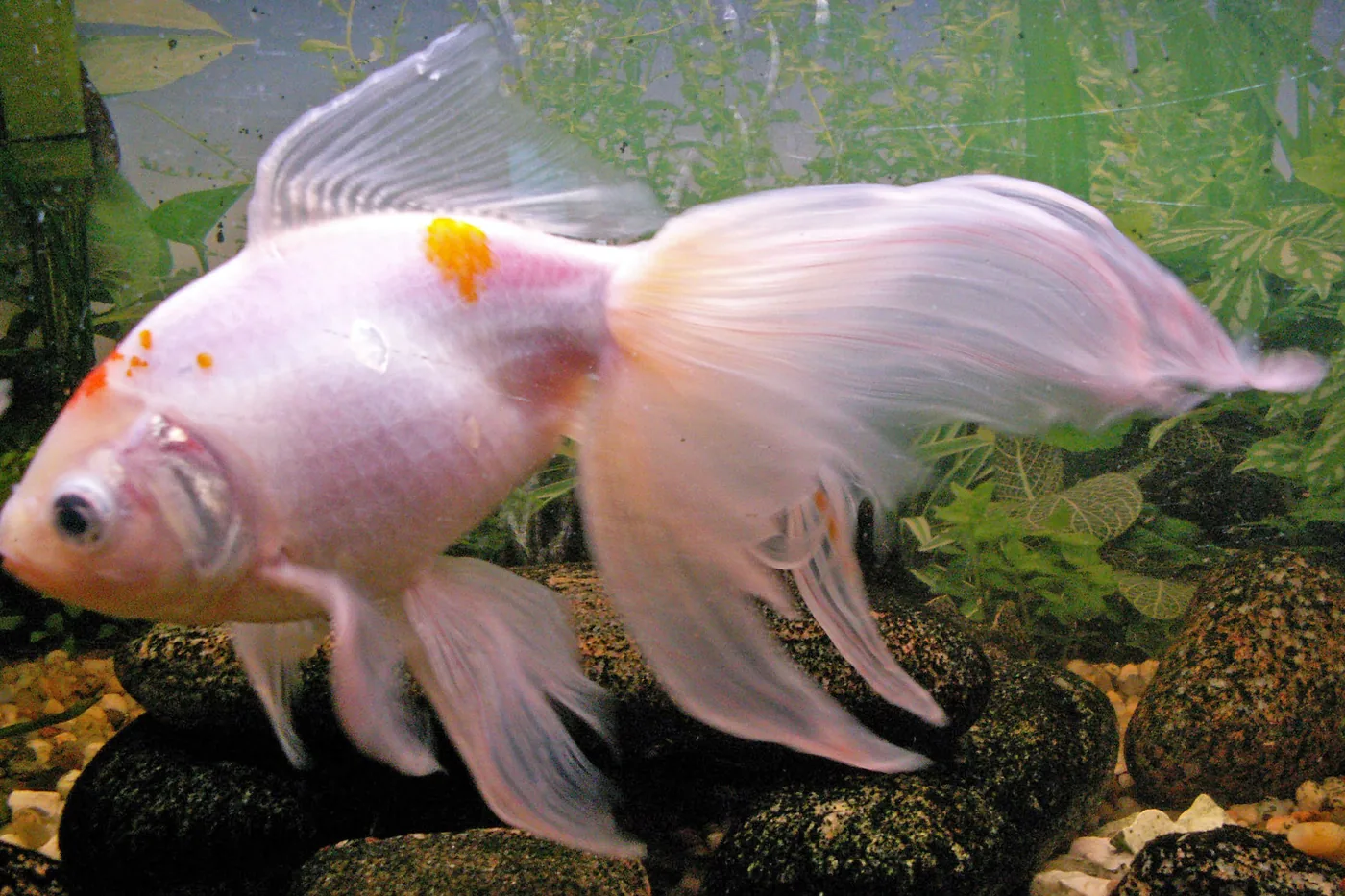
Photograph: Bechstein, CC BY-SA 3.0 · Wikimedia Commons. Numbers and lines added.
- The base. Where the fin leaves the body. Rot that reaches it, or redness spreading from it onto the flank, is no longer a fin problem, and is the time for a vet.
- The rays. Fine bony rays, each with a blood vessel along it. Red streaks follow them when ammonia or nitrite burns the fish, or when a bacterial infection reaches the blood; faint, even pink lines that never change are normal.
- The web. The thin skin between the rays. In clean water a torn edge starts to close within days and the web grows out with the rays; regrowing the full length takes months, and longer in cool water.
- The edge. Where fin rot starts: frayed, ragged or melted, with a white, milky or red rim, and advancing. A split with clean edges is a tear, and heals.
- Long fins. The longer the fin, the more it catches on decor and the longer it takes to regrow: months, for a long fancy tail.
Blood coming out is an injury, and belongs on a different page. It appears at a torn edge rather than along the rays, it is often a single site rather than a pattern, it may smear or trail briefly in the water, and it stops. Injured goldfish first aid covers wounds, and torn fins covers the damaged edge afterwards.
The one that catches people out is blood at the base of a fin, around the vent, or seeming to seep from under a scale. That reads as a wound and is rarely one: it is the internal picture, usually septicaemia or advanced ammonia damage, and it is more serious than a tear rather than less.
Telling the causes apart
Water poisoning tends to affect the whole tank. The streaks run through several fins, the gills may look dark red or unusually pale, and the fish breathes fast or hangs near the surface. There is nearly always a story behind it: a tank set up in the last few weeks, a filter rinsed under the tap, a new fish, a holiday feeding block, a missed water change. If two or three fish show streaks on the same day, the water is the suspect until proven otherwise.
Septicaemia looks like a sick fish, not just a marked one. The redness spreads beyond the fin rays into blotches on the flanks or belly, and it comes with lethargy, refusing food, and sometimes bloating, bulging eyes or open sores. Usually one fish is far worse than the rest.
An injury is local: one fin, one side, one bruise-like patch on a fish that is otherwise eating and swimming normally. It fades over a week or two, though a damaged fin can become a site for fin rot or fungus if the water is poor.
Normal blood vessels are constant: faint, evenly spaced pink lines along the fin rays that never change from week to week, on a fish that is well. Compare an older photo; if they were always there, they are anatomy.
What to do first
Test for ammonia and nitrite before anything else, and note the pH while you are at it. Everything that follows depends on that one result: a reading above zero makes this a water emergency with a clear sequence, and a reading of zero on a well-maintained tank moves the question somewhere else entirely.
If either reads above zero, work through the next section today. Our water change guide covers the practical side of the changes it asks for, and cycling a goldfish aquarium explains why a new tank goes through this phase at all.
Aquarium salt reduces how much nitrite a fish absorbs through its gills and is a traditional support during a nitrite spike; the right amount depends on the water volume and the fish, so follow a reputable protocol rather than guessing.
The first twenty-four hours
If ammonia or nitrite is reading above zero, this is the sequence. It is worth having in one place, because most people find this page at the point where the fish already looks wrong.
- Change water, generously. If ammonia reads 2 mg/L or more, change at least half of it; below that, thirty to fifty percent. Use conditioned, temperature-matched water. This is the only thing that removes ammonia and nitrite immediately, and it is the whole treatment. Do it now rather than after reading the rest. The exception is a tank that has gone months without proper changes and has a pH below about 6: a big change lifts the pH in one step and makes the ammonia far more toxic, so change only a little each day there.
- Stop feeding. Every meal becomes more ammonia within hours, and a healthy goldfish loses nothing by missing several days. This is the second most effective action available and it costs nothing.
- Add aeration. An air stone, or the filter outlet raised to break the surface harder. A fish with irritated gills extracts oxygen poorly and needs more of it in the water — aeration and oxygen covers the options.
- Leave the filter alone. Do not clean it, do not replace media, do not rinse anything under the tap. The bacteria in there are the only thing that will end this properly, and a tap rinse is often what started it.
- Retest in twelve hours, and change water again if either reading is above zero. Daily changes until both are zero, then a few more days for confidence.
- Find the cause while you wait. A new tank, a cleaned filter, a dead fish behind the decor, a holiday feeder, a jump in stocking, a heater that failed. The readings tell you there is a problem; only the history tells you why.
What not to do in the same period: no medication, no antibacterials, no filter cleaning, no large temperature change, and no complete water change, which removes the fish’s entire chemical environment at once and shocks an already strained animal.
Conditioners that “detoxify” ammonia
Worth explaining properly, because the test kit will appear to contradict the bottle and that is where people panic.
What they do. Products of this kind convert free ammonia into a bound form that gills cannot absorb. The fish is genuinely safer while it holds.
Why your test still reads high. A standard liquid test measures total ammonia and counts the bound form along with the free form. So a tank that has just been dosed can read 2 mg/L while the fish is in far less danger than that number implies. The reading is not wrong; it is measuring something different from what you want to know.
Why it is not a solution. The binding is temporary — it reverts over a day or two — and the filter still has to process the ammonia either way. Treating a bottle as a substitute for water changes is a common way a manageable spike becomes a prolonged one.
So: use it, and keep changing water. It buys hours, which is genuinely valuable at eleven at night with a flushed fish and no clean water prepared. It does not buy days. The source water page also covers the case where the ammonia is coming out of the tap in the first place, which happens more often than people expect.
The gills are the part you cannot see
An important thing on this page after the water change, and the reason a fish that looks better may not be better.
Fins are visible and gills are not, but the gills are where the real injury happens. Ammonia inflames and scars the delicate gill filaments, and nitrite disables the blood’s ability to carry oxygen. Both leave a fish extracting oxygen poorly for weeks after the water has been corrected — long after the red in the fins has faded.
So a fish that is still breathing fast, hanging at the surface, sitting on the bottom or off its food in water that now tests clean is not a fish with a new problem. It is a fish that is recovering, and what it needs is the least eventful few weeks you can arrange:
- Immaculate water, changed regularly, tested weekly.
- Extra aeration, kept up even after the fish looks brighter.
- Light feeding, because digestion demands oxygen too.
- Nothing else. No new fish, no rearranging, no medication courses, no treatments “to help it along”.
Fast or laboured breathing covers the breathing side, gasping at the surface the emergency version of it, and if it persists past a few weeks of good water, gill damage severe enough to need assessment is a real possibility — finding an aquatic vet is the page for that.
What recovery looks like
Useful to know in advance, because two stages of healing are routinely mistaken for the problem getting worse.
The red fades from the outside in, over several days to a fortnight in clean water. Streaks that persist or spread after two weeks of genuinely clean water are pointing at something other than the water.
Damaged fin tissue may go first. A badly burned fin can lose its thin outer edge before it starts regrowing — split rays, ragged margins, sometimes a visible loss of length. This looks like deterioration and is often the tissue that was already dead falling away.
Then the new edge appears, and this is the one that causes alarm: a soft, clear or whitish margin along the fin edge. That is new growth, not fungus. Fungus is fluffy, sits in tufts and starts at a wound; new growth is smooth, even and slowly extends the fin. Treating it as fungus is a common and avoidable mistake.
Full fin regrowth takes weeks to months, longer in a fancy with long fins, and the regrown tissue sometimes comes back a slightly different colour or without the original pattern. That is cosmetic. Torn fins covers the regrowth process in more detail.
When it is something else
If the water tests clean, has been changed regularly, and the fish is clearly unwell, a bacterial infection becomes the more likely explanation. Septicaemia is serious and generally needs antibiotics, which in most countries means a veterinary prescription. Move the fish to a cycled hospital tank if you have one, keep the water immaculate, and get advice quickly. A fish that is gasping at the surface despite clean, well-aerated water may have gill damage that also needs assessment.
Red streaks in a pond
Seasonal, and it catches pond keepers out every year.
The classic case is spring. The fish come through winter with their immune systems slowed, the water warms and they start producing waste again, and the pond’s filter — which has been running cold and largely idle — takes weeks to catch up. Ammonia rises in that gap. The pond through the year page covers the spring restart, which is the underlying problem rather than the fish.
Two differences from a tank. Volume works in your favour, so a pond spike is usually milder and slower than a tank one; it also means a water change is a bigger undertaking, so restarting the filter properly and feeding sparingly matter more than they do indoors. And the streaks are harder to see through pond water from above, so a fish that shows them at all has usually been affected for a while.
Preventing it
Almost every case of red streaks traces back to a tank that cannot process the waste its fish produce. A cycled filter, stocking that suits the tank size, filtration with enough media for the load, and a regular water change routine guided by nitrate readings remove most of the risk.
The conditioner is worth getting right, because this is the one case where the tap is the culprit. Many supplies are treated with chloramine rather than chlorine, and a product that only neutralizes chlorine breaks the bond and leaves the ammonia behind — delivered straight into the tank, at the moment the keeper believes they are doing the fish a favour. Streaking that appears a day after a water change in a tank that otherwise tests clean is very often this. Check the label for chloramine specifically, and if you are unsure what your supplier uses, the water company will say.
The two windows where the risk is highest are the first two months of a new tank, when the filter is still finding its capacity, and the week after any change to the system: a new filter, a deep clean of the old media, a fish added, a heater failing. Neither is a reason to test more anxiously the rest of the year; both are reasons to test daily for a week when something has changed.
Test on a schedule rather than on suspicion. A liquid kit used weekly, and again whenever a fish looks off, will tell you about a problem days before the fins do — and more usefully, a run of weekly readings tells you which way the tank is drifting, which a single reading taken in alarm never can. The water parameter checker will interpret a set.
When to see a vet
- The streaks are spreading onto the body, or come with bloating, raised scales or open sores
- The fish is lethargic or has stopped eating while the water tests clean
- Red gills, gasping or rapid breathing persist after a large water change
- More than one fish is affected and there is no water quality explanation
What not to do
- Do not reach for antibiotics or "anti-bacterial" remedies before testing the water; if ammonia is the cause, medication will not help and can harm the filter bacteria you need
- Do not do a 100% water change or scrub the filter media; a large temperature-matched partial change is safer and keeps the biological filter alive
- Do not add salt at a guessed concentration; it can help during a nitrite spike, but the amount depends on the volume and the fish
- Do not stop water changes because the fish "seems stressed by them"; clean water is the treatment
- Do not keep feeding normally while ammonia or nitrite is present; feed lightly until both are back to zero
- Do not assume the fish is safe because it looks brighter; gill damage is invisible and outlasts the visible redness by weeks
- Do not rely on an ammonia-binding conditioner instead of water changes; it buys hours, not a solution
- Do not mistake the pale margin on a healing fin for fungus and start treating it
Frequently asked questions
Are red streaks in the tail always ammonia?
No, but ammonia and nitrite are common causes, particularly in a tank that is new, small or heavily stocked. Test both before assuming anything else. If they read zero, the water is changed regularly and the fish is otherwise well, think about injury or simply visible blood vessels. If they read zero and the fish is ill, a bacterial infection is more likely.
How long do red streaks take to fade?
If the cause was a water quality problem and it has been corrected, the redness usually fades over several days to two weeks as the damaged tissue heals. Fins that were burned badly may take longer and can lose some tissue at the edges first. Streaks that persist or spread in clean water point to an infection or an ongoing source of stress.
I used a conditioner that detoxifies ammonia, but the test still reads high. Which is right?
Both, in a sense, and this catches a lot of people mid-emergency. Products of that kind convert ammonia into a bound form that the fish's gills cannot absorb, but the standard liquid test measures total ammonia and counts the bound form too, so the number stays high while the danger has dropped. The bound form is also temporary — it reverts within a day or two, and the filter has to process it either way. So treat the conditioner as something that buys you hours in which to do water changes, not as a fix, and keep changing water until the reading falls on its own.
The fins look better but the fish is still breathing fast. Why?
Because the fins are what you can see and the gills are what matters. Ammonia and nitrite damage gill tissue, and inflamed or scarred gills take up oxygen poorly for weeks after the water has been corrected — long after the redness in the fins has faded. A fish that is still breathing hard, hanging near the surface or off its food in water that now tests clean is recovering rather than cured. Keep the water immaculate, add aeration, feed lightly, and give it time.
There is a clear or white edge on the damaged fin. Is that fungus?
Usually it is new growth. A fin regrowing from damage puts out a soft, transparent or whitish margin at the edge that looks worryingly like something growing on the fish. Fungus is fluffy, sits on the surface in tufts and usually starts at a wound or a torn ray rather than running evenly along the whole edge. If the margin is smooth, even and slowly extending the fin, it is healing, and treating it would do more harm than good.
Is septicaemia contagious to other goldfish?
Sometimes. Many of the bacteria involved live in every aquarium and only cause disease when a fish is weakened, so it is often the underlying stress that spreads. Some, though, are true pathogens that arrive on a carrier fish and can pass to tankmates; the atypical Aeromonas salmonicida behind goldfish ulcer disease is one. Either way a very sick fish sheds a lot of bacteria, and isolating it in a cycled hospital tank protects both it and its tankmates while a vet assesses it.