Symptom
Torn fins and fin rot in goldfish
A split or ragged fin is usually mechanical damage that will regrow in clean water. Fins that fray from the edges with white or red margins are fin rot, a bacterial problem that most often follows poor water.
How soon to act
- Watch closely This symptom
- Act within a day or two
- Act today
A clean split on an otherwise healthy fish needs only good water and time. If the edges are white, red or milky, or the fin is shrinking day by day, treat it as fin rot and act within a day or two.
What you may observe
- A clean split or notch, or edges that look frayed, ragged or melted away
- White, milky or red margins along the damaged edge
- Whether the damage is on one fin or several, and whether it is getting smaller or larger over days
- Cotton-like tufts growing on the damaged tissue
- Tankmates nipping, chasing or crowding the fish, especially at feeding time
- Sharp decor, a rough net, or a filter intake strong enough to hold a fin against it
- A soft, clear or whitish margin along the fin edge, which is new growth rather than fungus
- Whether the damage is symmetrical on both sides, which points at the water, or one-sided, which points at an object or a fish
- Whether new damage keeps appearing, which means the cause is still in the tank
Common possible causes
In rough order of how often they turn out to be the answer. None of these is a diagnosis.
-
Physical damage
CommonLong, soft fins catch on sharp rock, resin ornaments, plastic plants and filter intakes, and a panicked fish can tear a fin on the way past. The result is a clean split or a missing notch with healthy-looking edges, no discolouration, and a fish that is otherwise well. In clean water it heals over within a few weeks, though a split between intact rays may seal rather than refill.
-
Fin rot
CommonA bacterial infection of the fin tissue that starts at the edges and works inward, leaving the margin ragged, frayed or as if melted, often with a white, milky or red rim. It most often follows poor water, though injury, handling, chilling, low oxygen or parasites can start it in clean water too; the bacteria are usually in the tank already and take hold on a fish weakened by ammonia, nitrite, high nitrate or stress.
-
Fin nipping by tankmates
PossibleGoldfish rarely nip one another, but spawning chases can shred a female's fins, and unsuitable tankmates such as barbs, some tetras and many cichlids will target long flowing fins. The damage is repeated, appears on the trailing edges, and the fish may hide. Look at who else is in the tank and how they behave at feeding time.
-
Fungus on damaged tissue
PossibleWater moulds settle on tissue that is already dead or damaged, growing as white or grey cotton-like tufts on a torn fin edge or a rot lesion. Fungus is rarely the first problem; it is a sign that the fin was damaged, the water was poor enough to let the mould in, and the wound needs attention.
-
Ammonia burn
PossibleHigh ammonia, particularly in an uncycled tank, chemically burns the thin fin tissue. The edges turn ragged and may look bloodshot, and the damage appears on every fish at once rather than one. It looks very like fin rot and often turns into it, which is one more reason the first step is always a water test.
Water checks to do first
Poor water mimics or worsens almost every goldfish illness. Test before you treat.
- Ammonia and nitrite, which must both read zero; fin rot most often follows poor water, though a clean test does not rule it out
- Nitrate, which tells you how long the tank has gone without enough water changes; keep it under 40 mg/L and ideally under 20
- pH, since a fall well below 7 in a neglected tank stresses fish and slows healing
- Temperature, because healing and regrowth are slow in cold water and fancies should sit at a stable 18–24 °C (64–75 °F)
- How long since the last substrate siphon, since decaying waste on the bottom feeds the bacteria that cause rot
- Whether the filter outflow is strong enough to pin a long-finned fish against something
Goldfish fins are large, soft and constantly in motion, and they get damaged. A split tail after a night of spawning chases, a notch torn on a piece of slate, a fin held against a filter intake: these are ordinary events, and in clean water they heal without any help from you. The damage that matters is the kind that spreads. Fin rot starts at the edge and works inward, and it is usually the water, not bad luck, that lets it in. Reading the fin edge tells you which you are looking at.
Telling the causes apart
A tear is clean. The split or notch has sharp edges in the fin’s usual colour, appeared suddenly, is often on one fin only, and stays the same or shrinks as the fin regrows. The fish swims, eats and behaves as it always has, and a look around the tank often finds the culprit: a jagged ornament, a stiff plastic plant, an unguarded intake, a net with a rough seam.
Fin rot, which keepers call tail rot when it reaches the tail, is ragged. The edge looks frayed, moth-eaten or melted, has a rim of white, milky or reddish tissue, affects a length of margin rather than one spot, and advances; check it against a photo taken two days earlier. Fin rot follows poor water so often that a tank with a case of it usually shows ammonia, nitrite or high nitrate, or a history of missed water changes, although injury, handling, chilling, low oxygen or parasites can start it in clean water too.
A fin, ray by ray
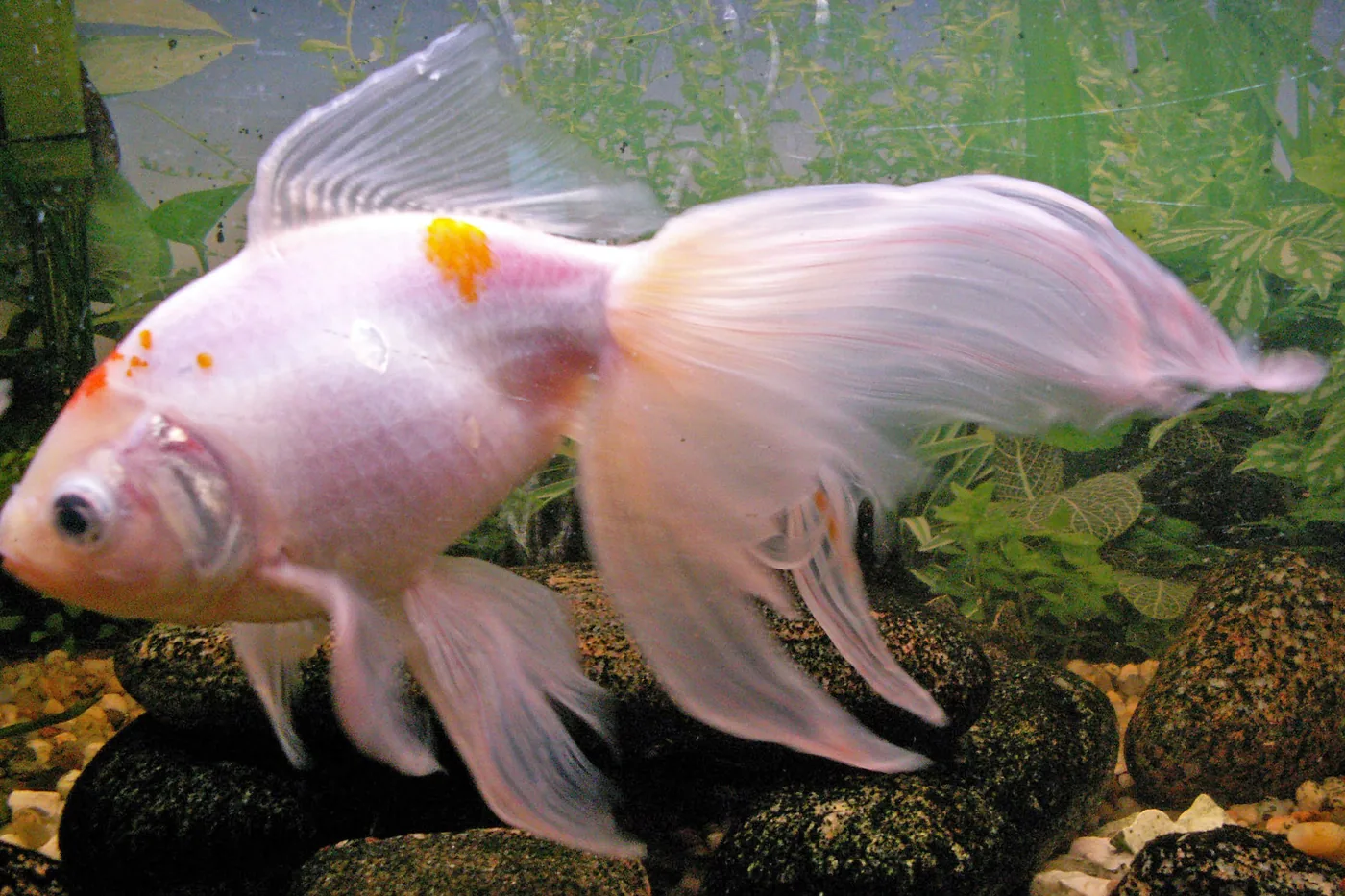
Photograph: Bechstein, CC BY-SA 3.0 · Wikimedia Commons. Numbers and lines added.
- The base. Where the fin leaves the body. Rot that reaches it, or redness spreading from it onto the flank, is no longer a fin problem, and is the time for a vet.
- The rays. Fine bony rays, each with a blood vessel along it. Red streaks follow them when ammonia or nitrite burns the fish, or when a bacterial infection reaches the blood; faint, even pink lines that never change are normal.
- The web. The thin skin between the rays. In clean water a torn edge starts to close within days and the web grows out with the rays; regrowing the full length takes months, and longer in cool water.
- The edge. Where fin rot starts: frayed, ragged or melted, with a white, milky or red rim, and advancing. A split with clean edges is a tear, and heals.
- Long fins. The longer the fin, the more it catches on decor and the longer it takes to regrow: months, for a long fancy tail.
Nipping is repetitive and comes from a tankmate. Goldfish do not usually nip each other outside spawning, but many community fish will; fresh notches keep appearing on the trailing edges and the victim starts hiding. Chasing and bullying covers telling a genuine tankmate problem from the three things more often mistaken for one. The compatibility checker will tell you whether a tankmate is known for it.
Fungus grows on damage rather than causing it. White or grey cotton-like tufts on a torn edge or a rot lesion mean a wound that has sat in water poor enough for water moulds to colonize it, and they look nothing like the neat salt grains of ich.
What to do first
Test the water. If ammonia or nitrite reads above zero, or nitrate is well above 40 mg/L, do a 30–50% water change (at least half if ammonia reads 2 mg/L or more, unless the pH is below about 6, when smaller daily changes are safer) with conditioned, temperature-matched water and repeat it daily until the readings are right. That is the treatment for a burn and for mild fin rot, and the condition for healing a tear; the guide to testing goldfish water explains what the numbers mean.
Then remove the cause: take out or sand down anything sharp, fit a sponge guard over the filter intake, rehome a nipping tankmate, and if a spawning male is shredding a female, give her a few days in a separate tank. Our page on aquarium decorations covers what is safe for long-finned fish.
Finding what is doing it
Worth a proper hunt rather than a glance, because a cause still in the tank undoes every bit of healing.
The stocking test. Take a pair of nylon tights or a thin stocking and run it slowly over every surface the fish can reach: decor, rocks, the filter intake and its slots, heater clips, suction cups, silicone seams, the underside and inside of every ornament. Anything that snags the nylon will snag a fin. This finds edges your fingers miss entirely, because skin is enormously less delicate than a fin membrane, and it is a very useful thing on this page for a fish that keeps getting damaged.
The usual offenders, in rough order of how often they turn out to be the answer:
- Filter intakes. A long fin drawn against a bare strainer tears, and a pre-filter sponge fixes it permanently — the filtration guide covers fitting one.
- Resin and plastic ornaments, particularly the moulding seam and anything with a hole a fish can investigate.
- Stiff plastic plants, whose leaf edges are sharper than they look.
- Rock and slate with a fresh break in it.
- The net you use. A stiff, coarse or worn net does real damage; a soft fine mesh, or better a container rather than a net, does not. The handling guide covers moving a fish without tearing it.
And the causes that are not objects. A spawning chase shreds a female’s fins in a night — is my goldfish breeding describes what that looks like so it is not read as aggression. A startled fish in a tank with nowhere to go will hit something; a lid, a settled routine and somewhere to retreat all reduce it.
What regrowth looks like
Knowing the timescale prevents both premature panic and premature relief. Fins recover better than most of what a goldfish has; what heals and what does not puts that alongside the parts that do not come back.
| Roughly | What you see |
|---|---|
| Days 1–3 | Damaged tissue may fray further or fall away. This looks like deterioration and is usually the dead edge going. |
| Week 1 | A soft, clear or whitish margin appears along the edge. This is new growth, not fungus. |
| Weeks 1–3 | The web between the rays closes. The fin stops looking ragged even though it is still short. |
| Weeks 6–12 | Real length returns. Bony rays regenerate along with the web. |
| Months | A long fancy tail rebuilds its full shape. Some fish never quite recover the original outline. |
These are rough figures, not a measured goldfish timetable, and warm water shortens them.
Three things worth knowing:
- The new edge is not fungus. This is a common mistake on this page. New growth is smooth, even and slowly extending the fin. Fungus is fluffy, sits in tufts on the surface, and usually starts at one point rather than running along the whole margin. Treating healthy regrowth sets it back.
- Colour often changes. Regrown tissue comes back clear or white and may stay paler than the original, and a patterned fish may not get its pattern back in that section. Cosmetic.
- Cold water stalls it. Regeneration is metabolically expensive and slows sharply as the water cools. A pond fish damaged in autumn may show no visible progress until spring, which is not a failure of healing.
Photograph it. Against the same background, once a week. Fin regrowth is slow enough that memory is useless and a photograph is conclusive.
The fins that come back slowly, or short
A real limit, because “fins always regrow” is repeated more confidently than it deserves.
- Damage right down to the body. A fin lost at its base has more to rebuild than one lost at its tip, so it regrows more slowly, and the result may not match the original outline.
- Repeated damage to the same place. A fin that is torn, heals partway and is torn again never gets the chance to finish rebuilding, which is the strongest argument for finding the cause rather than waiting. There is no good evidence that repeated damage stops regrowth for good, so once the cause is gone the fin can recover.
- Rot that reached the rays. Once the bony rays themselves have been eaten back, the fin may regrow shorter or mis-shapen.
None of that makes the fish unwell. A goldfish with a permanently short or uneven tail swims, eats and lives a normal life, and the welfare page is a better guide to what matters to the animal than the outline of its fins is.
Long-finned fancies
Worth its own note, because the breeds with the most dramatic fins are the ones that lose them.
Veiltails, long-finned orandas and similar varieties carry fin surface that is large, thin and impossible for the fish to keep out of the way. They snag more, they tear more easily, they heal more slowly because there is more to rebuild, and their reduced swimming ability makes it harder for them to avoid a strong outflow or a quick tank mate.
The answer is to build the tank around the fish rather than treat the fin:
- Smooth everything, using the stocking test above.
- Guard the intake, without exception.
- Soften the flow, spreading the filter outflow so nothing pins a fish against the glass.
- Choose tank mates carefully. Fast single-tails outcompete and jostle fancies — how many goldfish covers why the two types are kept separately.
- Keep nitrate low, because a long-finned fish has more fin margin exposed to whatever is in the water, and rot has more edge to start on.
Trimming, and why not to
Still recommended in places, so it is worth saying why this site does not.
The idea is that cutting away ragged tissue gives rot nothing to work on and lets the fin regrow cleanly. In practice: a fin is living tissue with a nerve and blood supply, cutting it hurts, the cut edge is a fresh wound in water full of the same bacteria, and the fish has to be caught and held out of water to do it. It treats a symptom that resolves on its own in clean water.
The exception is veterinary — a vet may debride badly necrotic tissue under proper conditions, with pain relief, as part of treating something serious. That is a different act from taking scissors to a fish over the kitchen sink.
When it is something else
If the water has been clean for several days and the fin is still shrinking, the infection has outrun the fish’s own defenses and needs treating. Commercial fin rot treatments work on many cases; use one according to its label, for your real water volume, with activated carbon removed from the filter. Rot that has reached the fin base or the body, or has become an open sore on the skin, or a fish that is also lethargic and off its food, is a whole-body problem and belongs with a vet, who may prescribe antibiotics. Fins with red streaks as well as ragged edges deserve the same caution.
Preventing it
Fins stay whole in tanks with smooth decor, guarded intakes, gentle handling and tankmates that leave them alone. They stay free of rot in tanks where ammonia and nitrite never appear and nitrate is kept down by regular water changes and filtration that matches the stocking. A goldfish in good water can lose half a tail to an accident and grow it back; in poor water it can lose the whole tail to a tiny nick.
When to see a vet
- The fin is receding toward the body day by day despite clean water
- The rot has reached the fin base or the body, or there are open sores on the skin
- The fish is lethargic, clamped or refusing food, which suggests the infection has gone beyond the fins
- Several fish have fin rot and a week of daily water changes has not slowed it
What not to do
- Do not trim damaged fins; it is an old practice that hurts the fish and rarely helps, and fins regrow on their own in clean water
- Do not start antibiotics on the assumption of fin rot before testing the water; a clean split needs nothing, and a burn needs water changes
- Do not dose salt or medication at a guessed rate; if you use a fin rot treatment, follow the label for your true tank volume and remove carbon from the filter
- Do not leave the fish with the tankmate that is shredding its fins while you "see how it goes"
- Do not scrub the decor and the filter media in one go; the fish needs the filter bacteria more than ever
- Do not treat the pale edge of a regrowing fin as fungus; new growth is smooth and even, fungus is fluffy and sits in tufts
- Do not judge progress daily; fin regrowth is measured in weeks, and a photograph beats memory
- Do not keep a long-finned fancy in a tank you have not checked for snags, because the fins it was bred for cannot avoid them
Frequently asked questions
Do goldfish fins grow back?
Yes, and remarkably well. Where the bony rays have been broken or cut, they regrow from the stump and the web regrows with them, over weeks to months, though the new section may be a slightly different colour or shape at first. Damage to the web alone, a split between rays that are intact, tends to seal over and round off rather than refill. Regrowth depends on clean, stable water, a good diet and the absence of whatever caused the damage, and it is slower in cool water and nearer the body.
How do I tell fin rot from a torn fin?
Look at the edge. A tear or split has clean, sharp margins in the fin's normal colour, does not change from day to day except to heal, and is often a single notch. Fin rot has a frayed, ragged or melted edge with a white, milky or reddish rim, affects a length of margin rather than one spot, and gets worse over days if nothing changes. Fungus adds cotton-like tufts on top of either.
How do I find what is tearing the fins?
Run a pair of nylon tights or a thin stocking slowly over every surface in the tank — decor, rocks, the filter intake, the heater clips, silicone seams, the underside of ornaments. Anything that snags the nylon will snag a fin, and the test finds edges your fingers miss completely because skin is far less delicate than a fin membrane. Do it with the decor out of the tank where you can, sand or remove whatever catches, and fit a sponge over the filter intake while you are there.
How long does a fin take to grow back?
No goldfish study gives a timetable, so these are rough figures: the web between the rays closes over one to three weeks, rebuilding real length takes something like six to twelve weeks, and a long fancy tail can take several months to look like itself again. Warm water speeds all of it and cold water slows it considerably, which is why a pond fish damaged in autumn may show no progress at all until spring. Regrown tissue often comes back a different colour — commonly clear or white at first, sometimes permanently paler than the original — and that is cosmetic rather than a problem.
Does salt help fin rot?
It can support a fish in mild cases, by easing the osmotic work its body has to do while it heals, and it is a traditional part of many protocols. It is not an antibacterial treatment at the concentrations used for goldfish, and it will not stop rot that is advancing. The thing that stops mild fin rot is clean water, reliably, and the thing that stops advancing rot is a specific treatment or a vet. Salt is a support, not the answer, and it should not be dosed by guesswork.
Can fin rot kill a goldfish?
Left in the water that caused it, yes. The infection can eat back to the fin base and into the body, and at that stage it is a systemic bacterial disease rather than a fin problem. Caught early, fin rot is one of the easiest goldfish problems to reverse, because clean water alone stops many mild cases. Persistent or fast-moving rot needs a proper treatment and, ideally, a vet.