Symptom
White spots on a goldfish
Salt-grain spots scattered across the body and fins are the classic sign of ich, but not every white mark is a parasite. Here is how to tell them apart and what to do first.
How soon to act
- Watch closely
- Act within a day or two This symptom
- Act today
Ich multiplies within days. Confirm it and start treatment the same day; it is very treatable when caught early.
What you may observe
- Small white dots, like grains of salt, on the body, fins or gill covers
- Spots that appear over a day or two and increase in number
- Fish rubbing or flicking against decor, gravel or the glass
- Clamped fins, faster breathing or hiding
- White marks that are mostly on the gill covers and front fins of an otherwise lively fish
- Spots that are raised and sit on top of the skin rather than under it, which points away from ich
- A fish that looks clear in the morning and spotted by evening, because the parasite emerges in waves
- More than one fish in the tank showing the same thing within a few days
Common possible causes
In rough order of how often they turn out to be the answer. None of these is a diagnosis.
-
Ich (white spot disease)
CommonA parasite, Ichthyophthirius multifiliis, that burrows into the skin and gills. The visible spots are the mature stage; a much larger population lives in the tank. It often follows a new fish, new plants or a temperature drop that stressed the fish.
-
Breeding tubercles
CommonMature male goldfish develop tiny white pimples on the gill covers and along the front rays of the pectoral fins, especially in spring. They look neat and symmetrical, do not spread across the body, and the fish behaves normally. This is healthy and needs no treatment.
-
New wen growth
PossibleOn orandas, lionheads and ranchus, white pimples confined to the head hood are often new growth of the wen itself rather than disease, by keepers' experience; spots that multiply or reach the body are treated as ich.
-
Fungus or bacterial patches
PossibleCotton-like tufts or larger, irregular white patches are more likely fungal or bacterial than ich. They often start on a wound or a torn fin and are strongly linked to poor water quality.
-
Epistylis
PossibleA stalked protozoan that forms small white tufts, often on the fins or a wound, and is routinely mistaken for both ich and fungus. Under close light it looks fuzzier and more irregular than ich and sits on top of the skin rather than under it. It is associated with organically loaded water and responds to water quality and different treatments than ich does.
-
Lymphocystis or other growths
Less commonWaxy, cauliflower-like nodules that grow slowly over weeks rather than days are usually viral or benign growths. They rarely spread quickly and need a vet's assessment rather than a shop treatment.
-
Salt or mineral deposits on the glass
Less commonWorth ruling out before treating anything. Spots on the outside of the glass, or on the inside where evaporation has left a tide line, line up with the fish only from certain angles. Move your head and see whether the spots move with the fish.
Water checks to do first
Poor water mimics or worsens almost every goldfish illness. Test before you treat.
- Ammonia and nitrite, which should both read zero; any reading suppresses the immune system and makes ich much harder to fight
- Temperature, and whether it has dropped or swung recently, since a chill is a classic trigger
- Nitrate, ideally under 40 mg/L, to see how well the tank is being maintained overall
- Whether anything new entered the tank in the last two weeks: fish, plants, snails, decor
- Dissolved oxygen indirectly, by watching whether fish sit at the surface in the early morning, because any treatment will reduce it further
- Whether activated carbon is in the filter, since it strips most medications out of the water within hours
White spots are one of the most searched goldfish symptoms, and one of the most misread. The classic case is ich — often spelt ick, and properly Ichthyophthirius multifiliis — a parasite that shows up as a dusting of salt-like grains across the body and fins. But some common “white spots” are perfectly healthy: the breeding tubercles of a male in spring, or new growth on the hood of an oranda. The difference is usually obvious once you know where to look and how the fish is behaving.
Telling the causes apart
Ich spots are scattered and untidy. They appear on the body, the fins and often the gill covers, and their number grows over a day or two. The fish usually shows other signs of irritation: rubbing on decor, clamped fins, faster breathing. Everything about it says “something is wrong”.
Breeding tubercles are the opposite. They are small, evenly spaced and usually confined to the gill plates and the leading edge of the pectoral fins. The fish is bright, active and often chasing tankmates. Nothing spreads. If you see this on an otherwise lively fish in spring, you have a mature male, not a patient.
Where the difference shows
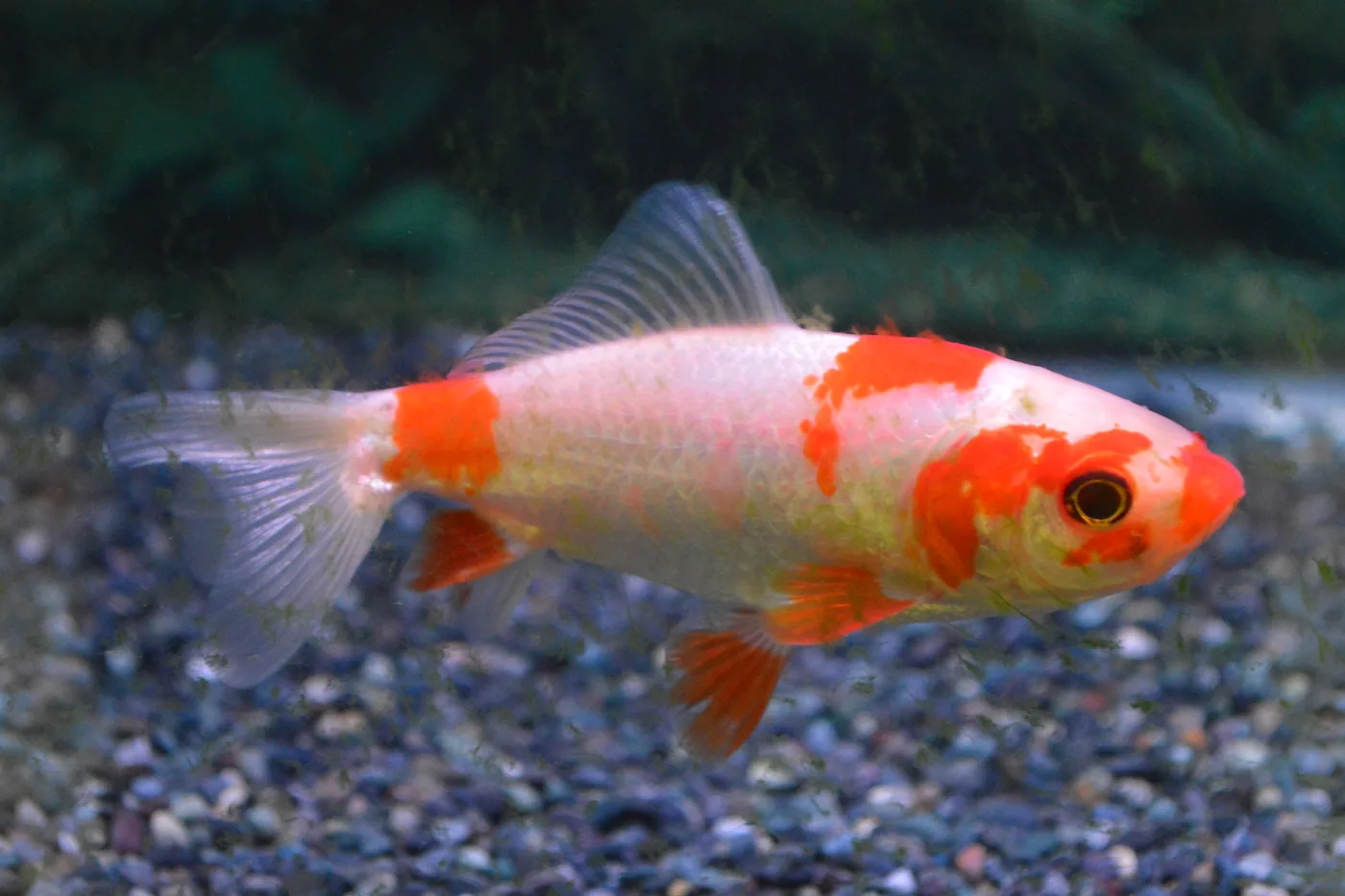
Photograph: Yatokin, CC BY-SA 4.0 · Wikimedia Commons. Numbers and lines added.
- Gill covers. Small, hard, white tubercles: the clearest external sign of a male in breeding condition, when it is there.
- Pectoral fins. The same tubercles, in a row along the leading ray. Together with the gill covers, a neat pattern on a well fish usually means a male, not white spot.
- Vent. Just in front of the anal fin. In condition, a male’s is small, narrow and slightly concave, a female’s rounder and slightly protruding.
- Belly. Not a reliable sign. A full outline can be eggs in condition; out of season it can be a well-fed fish, but fluid and illness swell the belly too, so a swollen fish with raised scales or lethargy needs a vet.
New growth on a wen is the same kind of false alarm, and is confined to the head hood on an oranda, ranchu or lionhead — wen care covers what the tissue is doing as it develops.
Cotton-like tufts, larger irregular patches, or a single slow-growing lump are not ich either, and treating them with an ich product will not help.
A quick test before any of that: do the spots move with the fish? Mineral deposits and marks on the glass line up with a fish convincingly from one angle and separate the moment you move your head. It sounds too obvious to mention and it saves a certain number of people a bottle of medication. So does looking twice at spots that are clear and glinting rather than white: those are bubbles, usually after a water change.
What to do first
Test the water. Ammonia and nitrite readings above zero suppress the immune response and make any treatment much less likely to work. If either is present, a partial water change is the first action, before any medication.
Check the temperature and think about the last two weeks. A drop of a few degrees, a new fish added without quarantine, or plants from a shop tank are the usual routes in. Knowing the trigger helps you prevent a repeat.
Then look closely, ideally with a torch against the glass, and decide which of the patterns above you are seeing. If it is ich, treat the whole tank, not just the fish, because most of the parasite’s population is in the water and the substrate rather than on the animal.
Treatment principles
There are two effective approaches: commercial ich treatments, and aquarium salt at a controlled concentration. Warmth is not a treatment on its own, but it shortens the parasite’s cycle, so the salt or the medicine has fewer days to cover, and it has to come with strong aeration. Each has conditions attached. Salt can harm plants and some tankmates. Heat lowers oxygen and needs aeration. Medications have specific dosages that depend on your tank volume, so know your real water volume before you start; the aquarium volume calculator will give it to you.
We do not publish dosages here, because the right amount depends on the product, the volume and the fish. Follow the label of whatever you use exactly, remove activated carbon from the filter during treatment, and keep going for several days past the last visible spot. Using medications safely covers the rest of it — real volume, aeration, what a course does to the filter.
What treatment looks like, day by day
Knowing the shape of it in advance matters, because the course looks like it is failing at exactly the point where most people give up.
| Roughly | What you see | What is happening |
|---|---|---|
| Days 1–3 | Spots the same or increasing | Nothing reaches the parasite under the skin. More of the existing population is maturing into visible spots. This is normal. |
| Days 3–7 | New spots slowing, fish less irritated | The free-swimming generations are being killed as they emerge. |
| Days 7–14 | Spots gone | The last embedded parasites have dropped off and their young have been killed. |
| Several days past that | Nothing | Keep treating. Any survivor restarts the whole thing. |
A common mistake is stopping when the spots disappear. At that moment the fish is clear and the tank is not: encysted parasites on the substrate are still releasing free-swimming young. Continue for several days beyond the last visible spot, and longer in cool water, where every stage of the cycle runs slower.
If new spots are still appearing after a week of correct treatment, that is a genuine signal — check the dose against your real water volume, check that carbon is out of the filter, and consider that you may not be looking at ich.
Temperature, and the advice that is not for goldfish
Worth separating carefully, because this is where goldfish keepers get given tropical-fish instructions.
Why warmth is suggested at all. The parasite is only vulnerable during its brief free-swimming stage. Warmer water speeds the whole cycle, so those vulnerable windows come around faster and the course finishes sooner. At cool goldfish temperatures the same cycle can take two or three times as long, which is why goldfish ich treatment is a longer job than the label suggests.
Why the usual figure is not needed here. The commonly repeated instruction to hold a tank at 30 C comes from tropical fishkeeping. Goldfish are temperate fish; the temperature guide sets out where they should actually sit. Warm water holds less dissolved oxygen at precisely the moment a fish with parasite-damaged gills needs more of it, and a tank held at 30 C needs heavy aeration to stay safe. Heat can turn a treatable infestation into a fish that suffocates.
If you raise it at all: add aeration first, raise by about a degree a day, stop in the low-to-mid twenties Celsius rather than higher, and watch for surface gasping — aeration and oxygen covers how to add more, and gasping at the surface is the sign to stop. Many experienced goldfish keepers skip the heat entirely, accept a longer course, and lose nothing.
Ich in a pond
A different problem with a different answer, and it comes up every spring.
Pond outbreaks typically follow the spring warm-up, when the water rises through the range the parasite likes while the fish are still run down from winter and their immune systems are slow to restart. The cause is often a new fish added the previous season, or the pond’s own resident population taking advantage of stressed hosts.
Treating a pond is harder than treating a tank for the obvious reason: volume. Dosing accurately requires knowing the real volume, which most pond owners have only estimated, and the cost of getting it wrong is proportionally larger. Ultraviolet clarifiers help against the free-swimming stage as water passes through them, but they do not sterilise a pond. In most cases the practical approach is to support the fish — aeration, feeding appropriately for the temperature, and no further additions — and to treat only if the outbreak is progressing. The pond through the year page covers the spring restart, which is the underlying issue.
After the outbreak
The fish being clear is not the same as the tank being clear.
Keep treating past the last spot, as above. Then do a large water change, replace the carbon you removed, and return the filter to its normal routine — but do not clean the filter media during or immediately after a course, because many treatments have already knocked the bacterial colony back and cycling it again is a job you do not need. Test ammonia and nitrite for a week or two afterwards: a treatment that damaged the filter shows up as a small ammonia reading in an established tank.
Equipment that has dried completely is very unlikely to carry live parasites. Nets, siphons and buckets left to dry out are the cheap answer; if in doubt, disinfect them or keep a separate set for the fish that were ill.
A fallow tank clears itself. If the fish can be housed elsewhere — a hospital tank — a tank left fishless runs the parasite out of hosts within a couple of weeks, faster when warm. This is rarely necessary for a single outbreak and is worth knowing about for a recurring one.
Expect the fish to look rough for a while. Damaged slime coat and small skin wounds take time to heal, and a fish that has been through a course of treatment and a parasite load is tired. Clean, stable water and modest feeding do more for that recovery than anything in a bottle. If wounds are opening rather than closing, ulcers and sores is the page for the next stage.
Preventing the next outbreak
Quarantine new fish for at least four weeks, 30 days being the usual veterinary minimum, before they join the main tank. It is tedious and it is an effective step against ich, because the parasite often arrives with a new animal. Keep the temperature stable, keep ammonia and nitrite at zero, and give your fish the water volume and filtration they need. A well-kept goldfish with a strong immune system can shrug off exposure that would overwhelm a stressed one.
Three things worth adding, because fish are not the only route in:
- Plants and equipment can carry it too. Shop plants are usually held in tanks containing fish, so they arrive with whatever those fish had. Quarantining plants is the step nobody takes and it closes a real gap.
- A temperature drop is the usual trigger for an outbreak that was already latent — a winter window left open, a large water change with cold water, a heater that failed. A steady temperature is part of the prevention.
- Do not skip quarantine because the shop looked clean. Ich is invisible for most of its cycle, and a fish that shows nothing on the day of purchase can be carrying it. That is the entire argument for the month.
When to see a vet
- The fish is breathing rapidly at the surface, which can mean the gills are heavily affected
- Spots are spreading despite a week of correct treatment
- The fish has stopped eating, or several fish are affected at once
- You are unsure whether you are looking at ich, fungus or something else
What not to do
- Do not raise the temperature sharply; a slow rise of a degree or so a day is the most that is sensible, and only with plenty of aeration
- Do not combine several medications or add extra doses "to be safe"; overdosing kills fish faster than ich does
- Do not treat with chemicals while carbon is in the filter, since carbon removes most treatments from the water
- Do not net and move a stressed fish repeatedly; treat the whole tank, because the parasite is in the water, not just on the fish
- Do not stop treating when the spots disappear; the free-swimming stage is still in the tank and this is a common reason ich comes back
- Do not follow tropical-fish advice to heat the tank to 30 C; it is unnecessary for goldfish and risky without heavy aeration, especially for fancies
- Do not assume a second outbreak means the treatment failed; it usually means it was stopped too early
Frequently asked questions
Can a goldfish recover from ich without treatment?
Occasionally, if the infestation is light and the water is excellent, a healthy fish can clear a few spots on its own. It is a gamble. The parasite multiplies fast, and a mild case can become a heavy one within days. Treating early is safer.
Should I add salt for white spot?
Aquarium salt is a traditional and often effective treatment for ich, but the concentration and duration matter, and salt can harm live plants and some tankmates. Follow a reputable, specific protocol or ask a vet rather than guessing.
The spots got worse after I started treating. Should I change treatment?
Usually not, and this is a common reason a course is abandoned just as it starts working. Nothing reaches the parasite while it is embedded under the skin, so the spots you can see are unaffected by the treatment, and more of the existing population is maturing into visible spots at the same time. A tank that looks worse on day two or three of a correct course is behaving normally. What matters is whether new spots are still appearing after five to seven days.
Should I raise the temperature to treat ich?
Carefully, if at all, and never to the figures you will see quoted. Warmth speeds the parasite's life cycle, which brings the vulnerable free-swimming stage around faster and shortens the course. But the widely repeated advice to hold a tank at 30 C comes from tropical fishkeeping: goldfish are temperate fish, the extra heat is unnecessary, and warm water holds less oxygen at exactly the moment a fish with damaged gills needs more. If you raise it at all, raise it by about a degree a day, stop in the low-to-mid twenties Celsius, and add aeration before you add heat.
Can ich survive in a tank with no fish?
Not indefinitely. In warm water the free-swimming stage has to find a host within roughly a day or two or it dies, and the encysted stage on the substrate releases its young on a similar timescale; in cool water everything takes longer. A tank left completely fishless will clear itself, faster when warm and slower when cool. This is why a fallow period is a genuine option for a heavily infested tank if you have somewhere else to put the fish, and why equipment that has been dried completely is very unlikely to carry live parasites.
How long does ich treatment take?
Because only the free-swimming stage is vulnerable, treatment has to continue through the parasite's life cycle, which takes longer in cooler water. Expect one to two weeks at goldfish temperatures, and keep treating for several days after the last spot disappears.