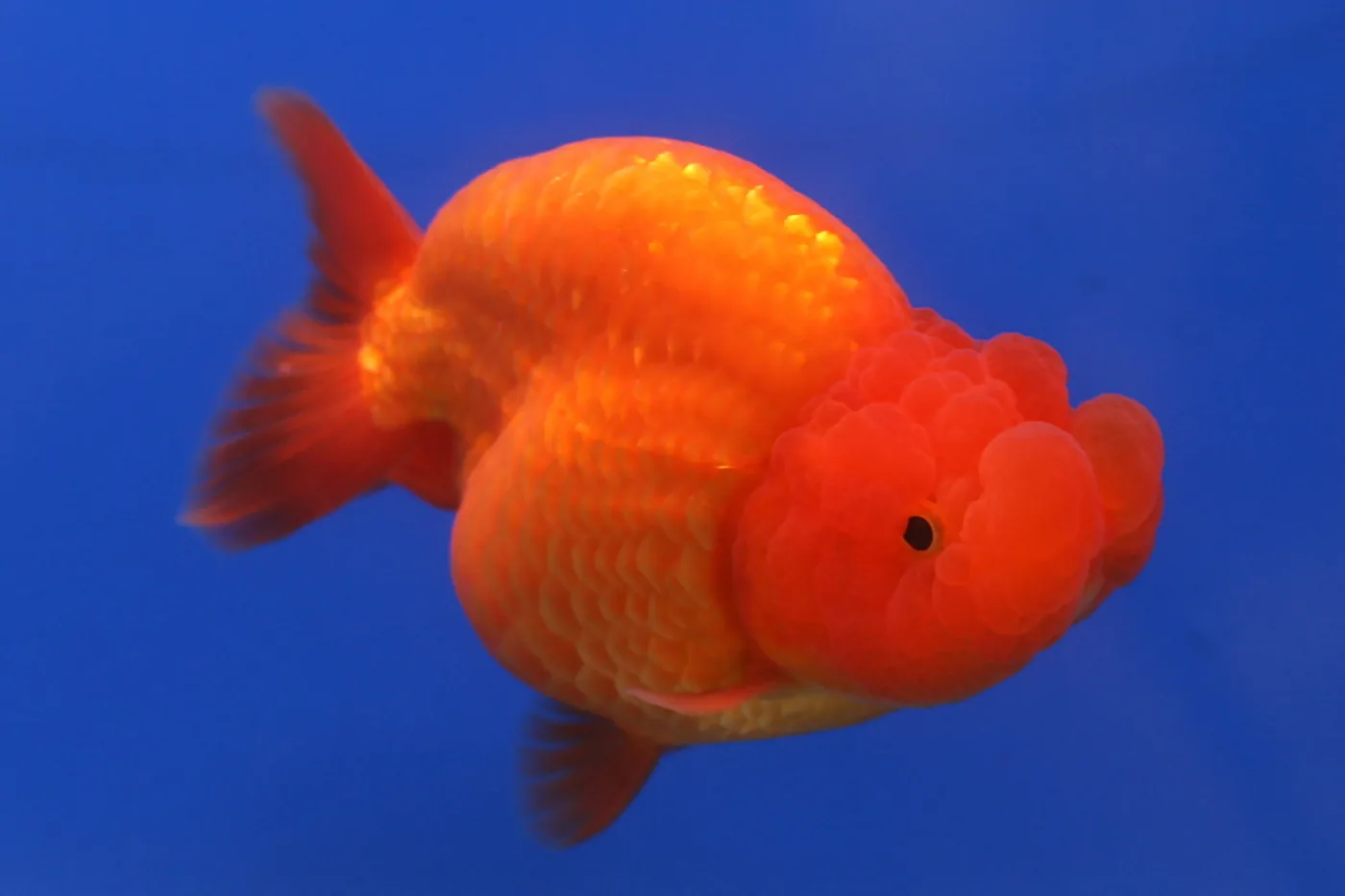
No. 07Name first recorded in 1748
Ranchu
Japan's king of goldfish, bred to be admired from above.
Also known as Japanese lionhead · Buffalo-head goldfish (trade name) · King of goldfish
- Specimen
- Fancy goldfish, Japan
- Adult size
- 15–20 cm
- Lifespan
- 7–10 years
- Water
- 18–24 °C
- Care
- Demanding
- Swimming
- Weak
- First fish needs
- 100 litres
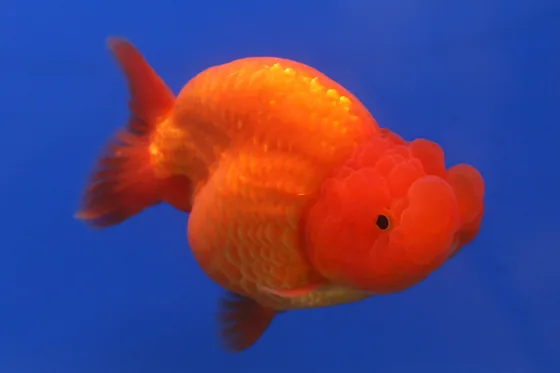
Photograph: Lerdsuwa, CC BY-SA 4.0 · Wikimedia Commons
About these figures Size, lifespan and water are the ranges keepers' guides give for a fish in good care, not measurements of this breed, and swimming and care are this site's own ratings of the published advice. Lifespan is where the sources differ most: how long goldfish live sets them side by side. First fish needs is a middle figure for one fish, from advice that runs from 50 litres to about 300; tank size sets that out.
The specimen
Quick facts
- Classification
- Fancy goldfish
- Body type
- Short, deep, dorsal-less body with a smoothly arched back that drops sharply to a tucked, spread double tail
- Tail and dorsal
- Double tail, no dorsal fin
- Swimming ability
- Weak
- Keeper experience
- Intermediate
- Temperament
- Calm, slow and gentle; easily outcompeted for food and unsettled by strong current
- Adult size
- 15–20 cm (6–8 in)
- Temperature
- 18–24 °C (64–75 °F)
- Minimum aquarium
- 100 L (26 US gal) for one fish
- Origin
- Japan, from dorsal-less Chinese stock, Name first recorded in 1748; modern line from the Meiji period
How to recognise one
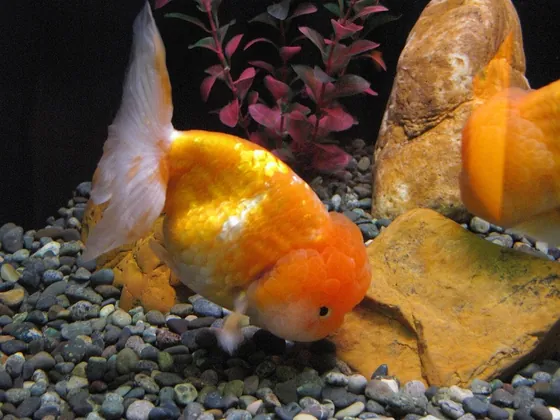
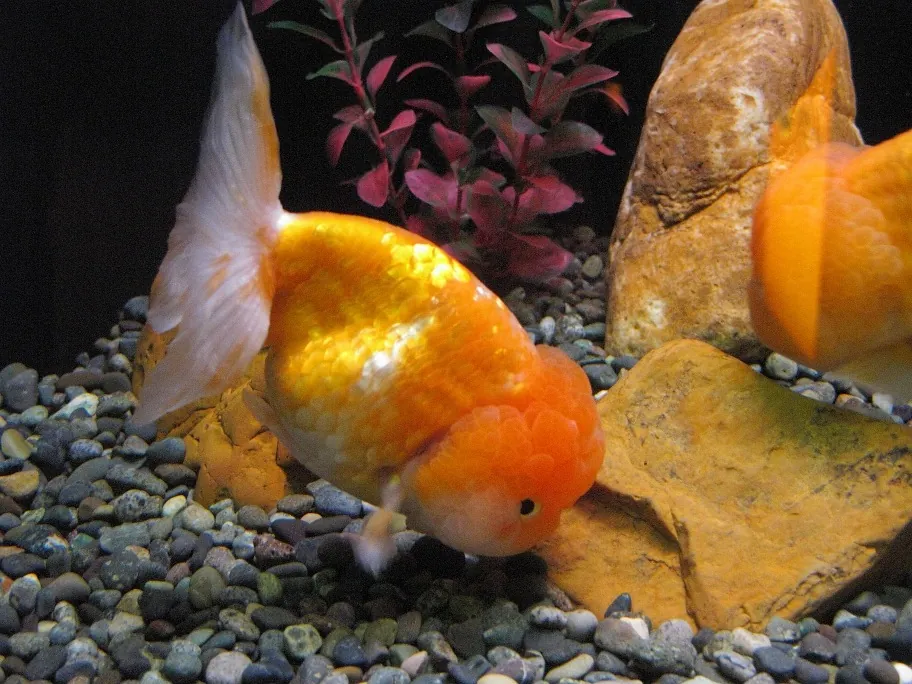
- No dorsal fin, with the back forming one smooth, unbroken arch from head to tail
- A back that drops at the tail base to a short double tail set at about 45 degrees to the peduncle
- Tail spread wide so that it reads as a fan when viewed from above
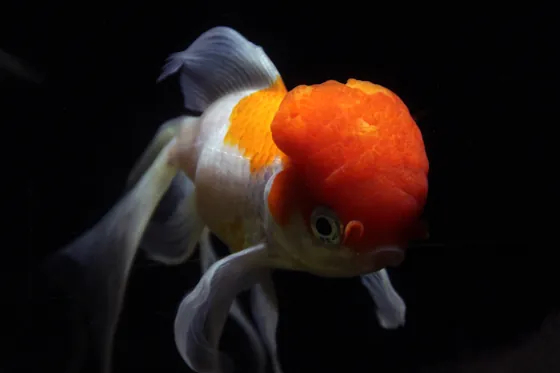
- A wen covering the head and cheeks, typically neater and more compact than a lionhead's
- Short, deep body, with a broad square head and a thick back of near-even width seen from above
Identification
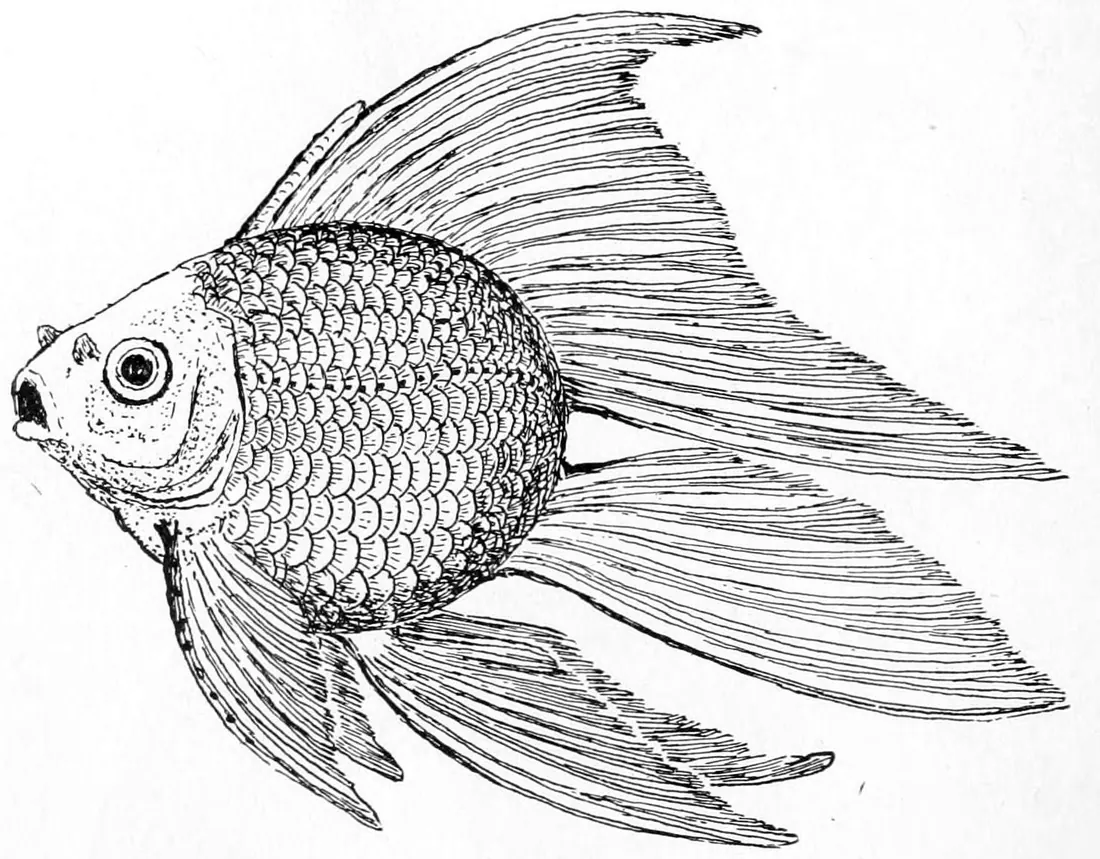
A ranchu is recognised first by what is missing. There is no dorsal fin, and the back runs from the top of the head in one smooth, unbroken arch that drops steeply at the tail. That final drop is part of the ranchu’s look, though what the standard asks for is a short double tail set at about 45 degrees to the peduncle and spread wide, so that from above it reads as a fan. The body is short and deep, and from above the outline should be broad and roughly rectangular, with a square head and a thick back of near-even width.
The head carries a wen, the raspberry-textured growth also seen on orandas, but on a ranchu it tends to be neater and more compact, covering the head and cheeks without swallowing the eyes. Wen care covers what the tissue is and why water quality is nearly the whole of looking after it. Separating a ranchu from a lionhead is a matter of profile: the lionhead’s back is flatter and longer, its tail set shallower, its wen larger and looser. Colours include red, orange, red-and-white, white, black and calico, with nacreous red-and-white fish sold as sakura.
Oranda, lionhead or ranchu?
Three hooded goldfish side by side: an oranda with a dorsal fin ringed on its back, a lionhead with its fairly straight, finless back ringed, and a ranchu with its arched, finless back ringed.
- Oranda. The one of the three with a dorsal fin. Its hood can spread down the cheeks and over the gill covers.
- Lionhead. No dorsal fin, and a back that runs fairly straight or gently curved, with only a mild tuck at the tail. Shops often sell it as a ranchu.
- Ranchu. No dorsal fin, and one smooth arch from head to a tail tucked in at about 45 degrees.
Photographs: Oranda, Vassil, CC0; Lionhead, Lawrencekhoo, CC BY-SA 4.0; Ranchu, Lerdsuwa, CC BY-SA 4.0. Rings added.
The varieties, and the two traditions
The names on a shop tank describe colour; the thing that actually differs is which country’s standard the fish was bred to.
- Japanese ranchu. Bred and judged from above, in shallow tubs. Japan has two show lines judged to different standards: the Association line prizes body, tail and swimming, the Uno line wen and colour. Broad square head, thick back of near-even width, flat tail spread, compact wen.
- Chinese and Thai lines. Common in Western shops. Often selected with the side view in mind, which the side-view standard describes as shorter, deeper bodies and heavier wens. Not worse fish; different fish.
- Sakura. Nacreous red-and-white, so the scales are part translucent and the pattern has a softer edge.
- Calico and black. Black ranchus commonly lighten toward bronze with age, which is ordinary rather than a fault — pale or faded colour covers why.
- Edonishiki. A calico ranchu line.
- Osaka ranchu. A round-bodied form without a head wen, recorded in the Edo period, lost in the Second World War and rebuilt from other stocks, among them ranchu crossed with hanafusa, Izumo nankin and tosakin. Rare.
What this means practically: a “ranchu” bought in a general aquatic shop and a ranchu bought from a specialist are often quite different animals, and the price gap reflects the lineage rather than the fish’s health. Either will live happily in the same tank.
How it develops
A ranchu is judged on things that arrive at different times, which is why breeders grade the same spawn repeatedly. The wen shows from about four months and keeps filling for a year or more, while the back and tail set are judged early, because breeders say they do not improve with age. No published source gives a finer timetable.
The back and the tail set are the parts that cannot be improved later. A fish whose back runs flat into the tail may not develop the drop, whatever it is fed — which is the whole argument for buying from someone who grades, made in breeding goldfish.
And buy the tank for the adult. How big do goldfish get covers the gap between a shop fish and a grown one.
Choosing one
Look down at it before you look through the glass. That is not an affectation; it is the view the breed exists for.
- From above: a broad, square head, a thick back of near-even width, and a tail spread flat like a fan rather than folded.
- From the side: one smooth arch, with a definite downward tuck at the tail base.
- Watch it swim. It should hold level and move deliberately. A juvenile that lists, rolls or sinks may not grow out of it.
- Check the breathing. A raised gill rate in a shop tank is worth noticing — fast or laboured breathing covers what it can mean.
- The wen matters least at this stage, because it arrives last. Judge the back and the tuck.
- Read the whole shop, as choosing and bringing home a goldfish sets out, then quarantine it for at least four weeks. A ranchu going in with other fancies is exactly the case where that matters most.
Where you will find one. There are effectively two markets, and knowing which one you are in prevents most disappointment. Pet-shop ranchu are ordinary fancy goldfish sold young, perfectly good for a home aquarium, and priced accordingly. Japanese show ranchu are a graded, competitive market with prices to match, where back curvature, tail set and head are judged against a standard most keepers will never need. Neither is a better fish to live with. Buy from the first market unless you intend to show, and do not pay show prices in a shop that is not selling show fish.
Personality and behaviour
Ranchus are slow, calm and deliberate, spending much of the day near the bottom picking over sand or bare glass for food. They are not timid and quickly learn to meet the keeper at the glass, but everything they do takes time. That makes tankmate choice decisive: with other slow fancies such as lionheads, telescopes and bubble eyes, a ranchu eats and settles normally; with fantails or ryukins it is often last to the food, and with any single-tail it simply loses — chasing and bullying covers that quiet mechanism, which starves a fish without anything that looks like conflict.
Aquarium requirements
Around 100 litres (26 US gallons) for the first ranchu and 40 to 50 litres for each additional one is a reasonable working range; the tank size calculator turns your group into figures. Depth matters less than footprint: ranchus are traditionally raised in shallow tubs, and a wide, low tank suits a fish that struggles to hold position in deep or moving water. Many keepers run ranchu tanks bare-bottomed for easier cleaning, and substrate for goldfish covers the alternative if you would rather not. A wide, shallow tub is a legitimate home rather than a compromise — the tank buying guide makes that case, and for this breed it is stronger than usual.
Flow separates a good ranchu tank from a bad one. Filter for five to ten turnovers an hour but deliver it gently, through a sponge filter, a spray bar aimed at the glass or a baffled outflow, as the filtration guide explains. Keep the temperature between 18 and 24 °C (64 and 75 °F) and steady, change 25 to 50 percent of the water weekly according to nitrate, and test regularly; the water testing guide covers the routine. Decor should be minimal and smooth — aquarium decorations covers the test for anything you are unsure about, and a fish with no dorsal fin has no business near a narrow gap.
Feeding
Feed a quality sinking pellet designed for fancy goldfish as the base, soaked briefly, in two or three small meals a day. Ranchus gulp air readily at the surface, and floating food is often blamed for their buoyancy trouble, as is dry food that swells in the gut. Gel food suits them well because it is soft, moist and easy to portion; the gel food guide explains how to use it. Add shelled peas or blanched greens once or twice a week, and frozen daphnia as an occasional treat. Breeders feed heavily to build body and wen in young fish, but in a home aquarium a modest, consistent routine and clean water do more than rich food.
Common health considerations
Three problems account for most ranchu trouble. Wen infections appear as reddened, cottony or eroded patches on the hood and usually follow a lapse in water quality; the fix begins with a test and a large water change. Buoyancy problems, floating or tipping after meals, often trace to diet and gulped air, though vets find many causes; the floating guide walks through the possibilities. A ranchu that sits on the bottom with clamped fins is usually reacting to ammonia, nitrite, a temperature swing or exhaustion from current; the sitting on the bottom guide explains how to narrow it down.
Ranchus also feel the stress of transport and new tanks more than hardier breeds, so quarantine new fish, introduce them to a mature, cycled aquarium and expect a week or two of quiet before they settle. A fish that catches itself on decor during that unsettled fortnight is common enough to plan against — first aid for an injured goldfish covers the response.
What goes wrong, in order
Predictable problems, which is the useful thing about a demanding breed.
| What you see | Usually | Where to look |
|---|---|---|
| Floating or tipping after meals | Often diet, though other causes exist | Floating upside down |
| Resting low, fins clamped | Water, temperature, or exhaustion from flow | Sitting on the bottom |
| Redness or fuzz in the wen folds | Water quality, then bacteria | Wen care |
| Losing condition with no visible cause | Outcompeted at feeding | Chasing and bullying |
| Working hard to hold position | Current, more often than illness | Goldfish filtration |
| Gill rate up, everything else normal | Warm water, or the water itself | Fast or laboured breathing |
Five of those six are the tank, which is the short version of ranchu keeping. The breed does not need anything exotic; it needs the ordinary things done properly, and it complains sooner than a hardier fish when they are not.
Is a ranchu right for you?
It suits you if you have kept fancy goldfish for a year or two, you enjoy looking at a fish from above and would consider a tub or a shallow tank, you test water and change it on schedule without being reminded, and you find a demanding animal interesting.
It does not suit you if it would share a tank with single-tails or with quicker fancies, if the tank is deep and the flow is strong, or if you want a first goldfish — goldfish for beginners is straight about where to start, and it is not here.
And it is worth knowing what you are taking on. A dorsal-less, round-bodied fish with a hood is a long way from a wild carp, and the argument in goldfish welfare about how far selection should go is one a ranchu keeper should have read. A well-bred, well-kept ranchu is a thriving animal; an extreme one in poor water is not.
History and origin
The ranchu was developed in Japan from dorsal-less Chinese stock. English-language accounts call it a descendant of the Chinese lionhead, while Japanese sources trace it to the wen-less, dorsal-less maruko brought from China, with the wen selected in Japan; the name ranchu is first recorded in 1748. From the Meiji period Tokyo breeders laid the foundation of the modern ranchu, the steep tail drop, the compact wen and the broad, arched back, all defined for viewing from above, and Japan now has two show lines judged to different standards. A round-bodied form without a head wen, recorded in the Edo period, was lost in the Second World War and rebuilt from other stocks, and it is rare.
In Japan it is called the king of goldfish, and it has one of the most developed show cultures among goldfish: fish are judged in shallow tubs against a written standard, and top fish change hands for large sums. Ranchus bred in China and Thailand, sometimes selected for side view rather than top view, are common in Western shops.
Before you bring one home
- Without a dorsal fin it swims weakly and tires in current, so filter outflow must be gentle
- The wen's folds trap debris and it is prone to infection in poor water; one that bleeds, ulcerates or changes quickly needs a vet
- Reacts quickly to poor water and temperature swings; test regularly and change water on schedule
- Prone to buoyancy problems, so feed sinking food in small, frequent amounts
- Easily outcompeted by faster fancies such as fantails and ryukins at feeding time
Suitable companions
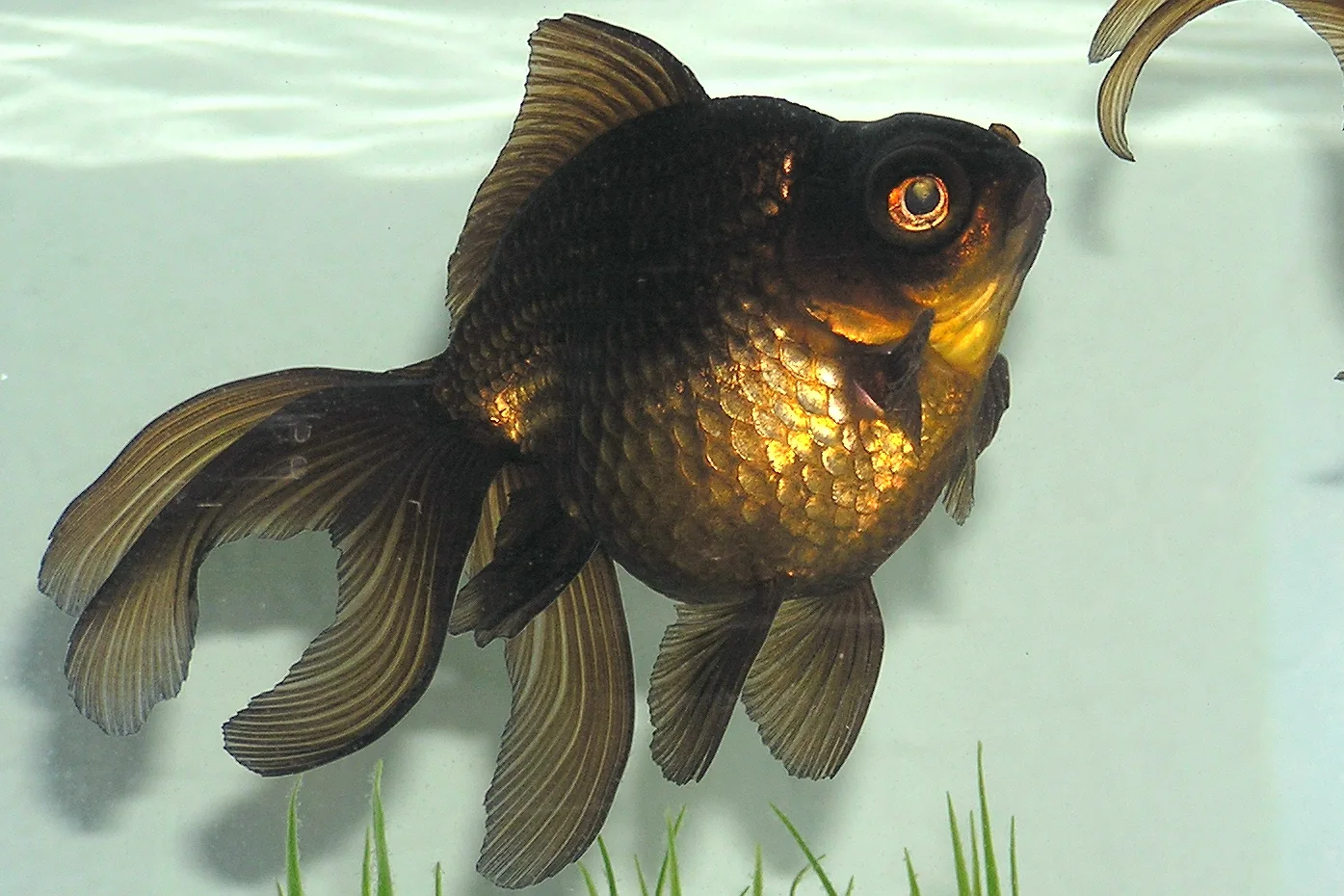
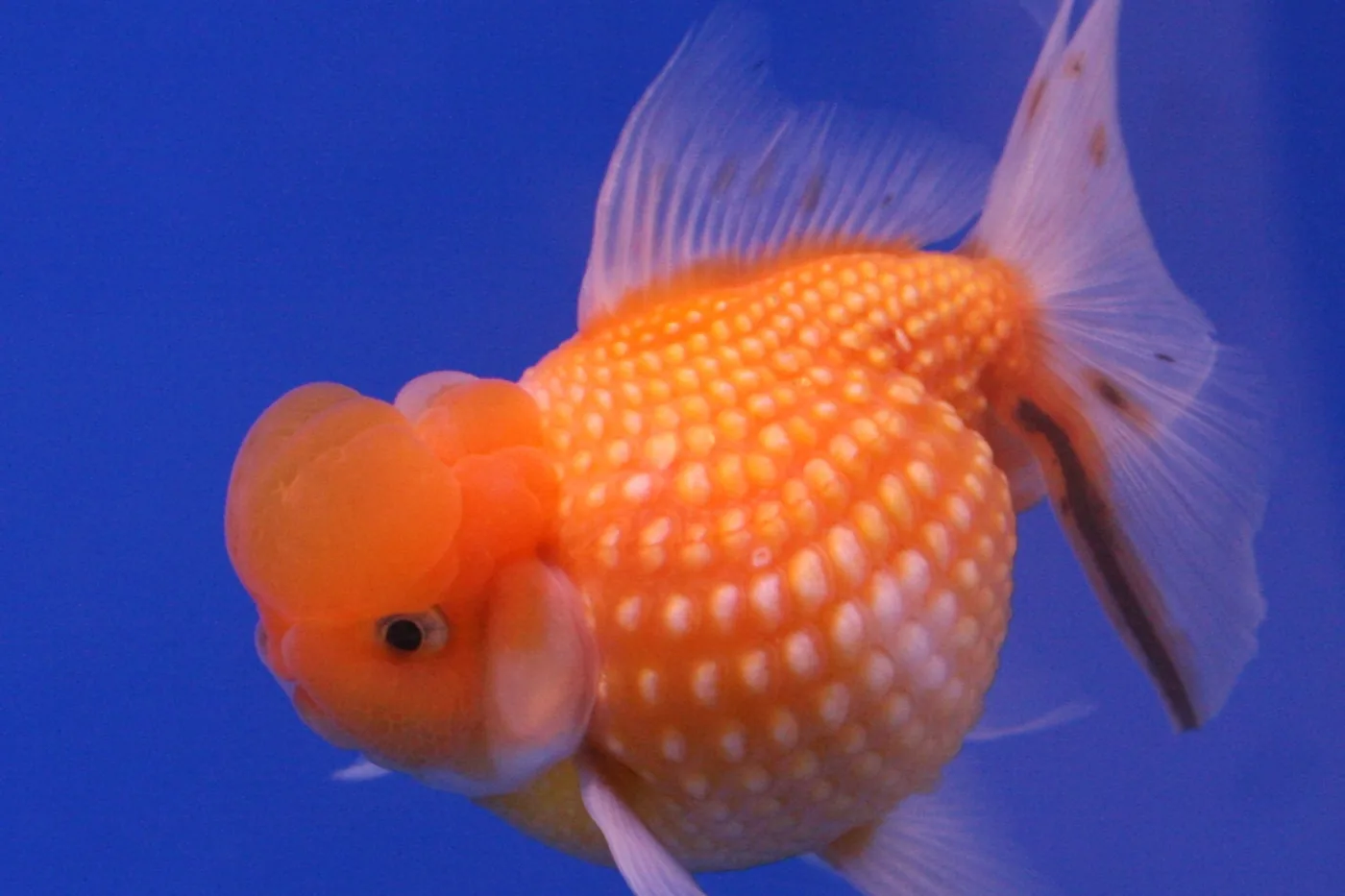
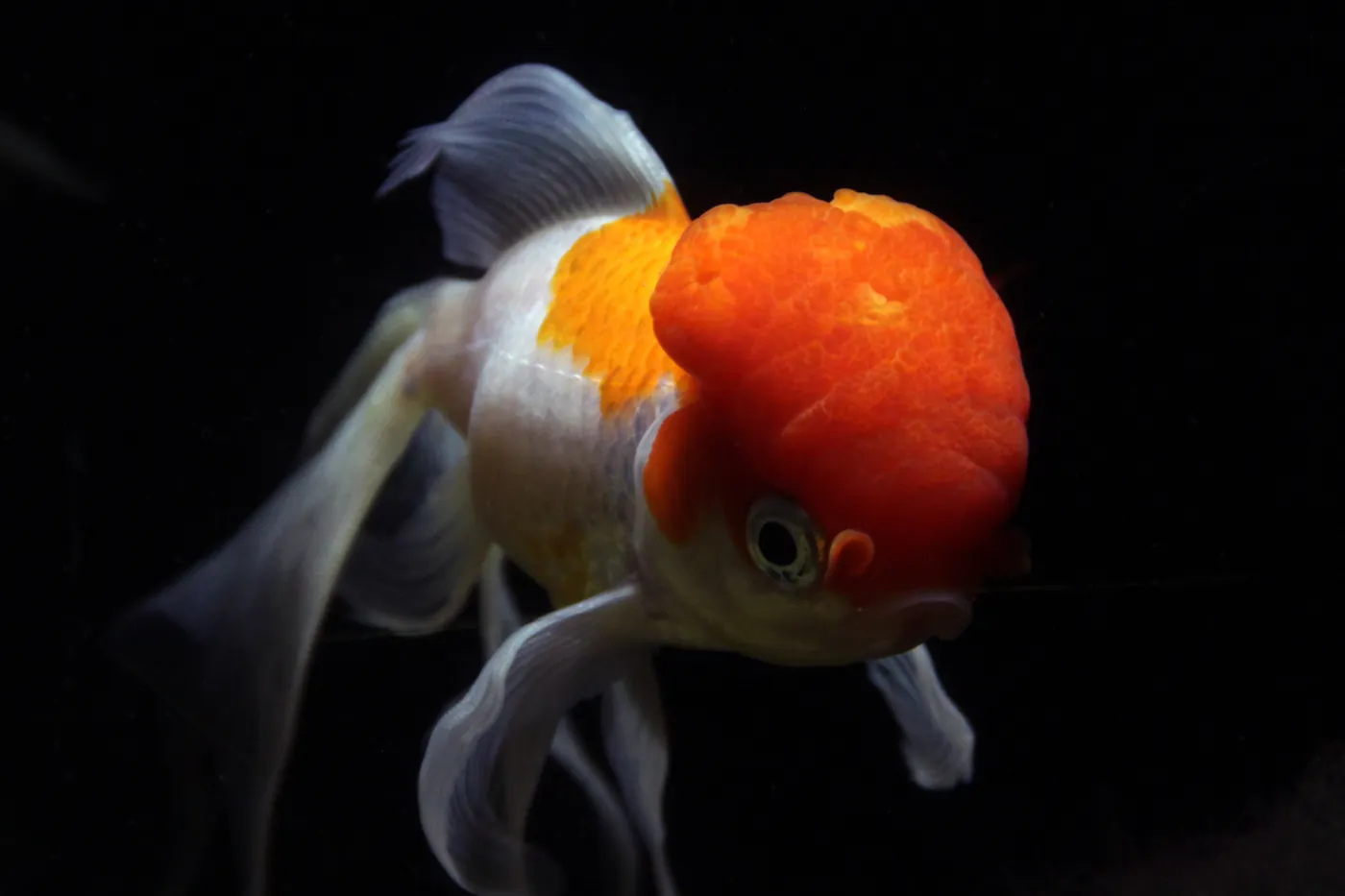
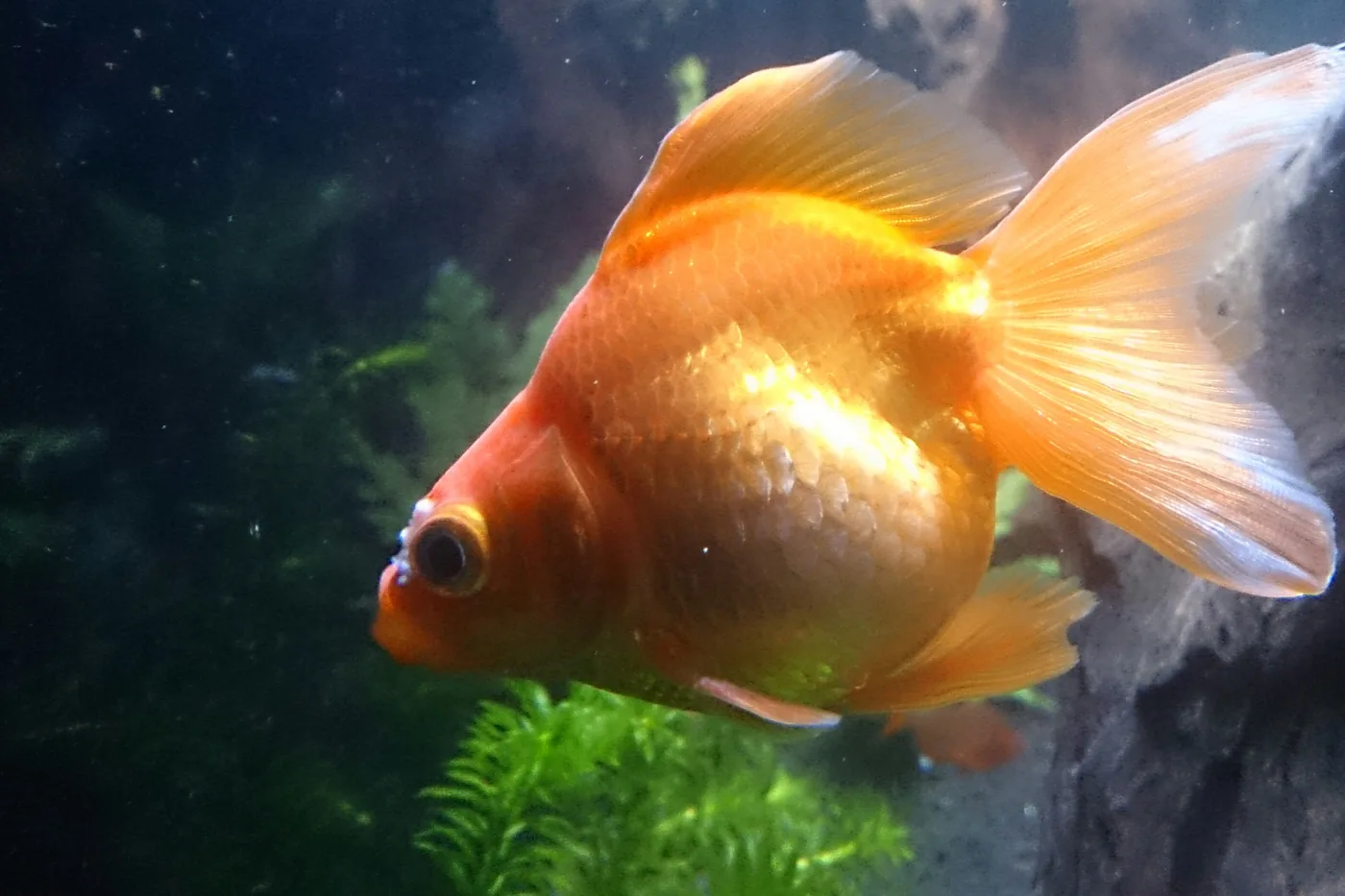
Round-bodied goldfish should live with fish of similar speed. These breeds share the same pace, water and food.
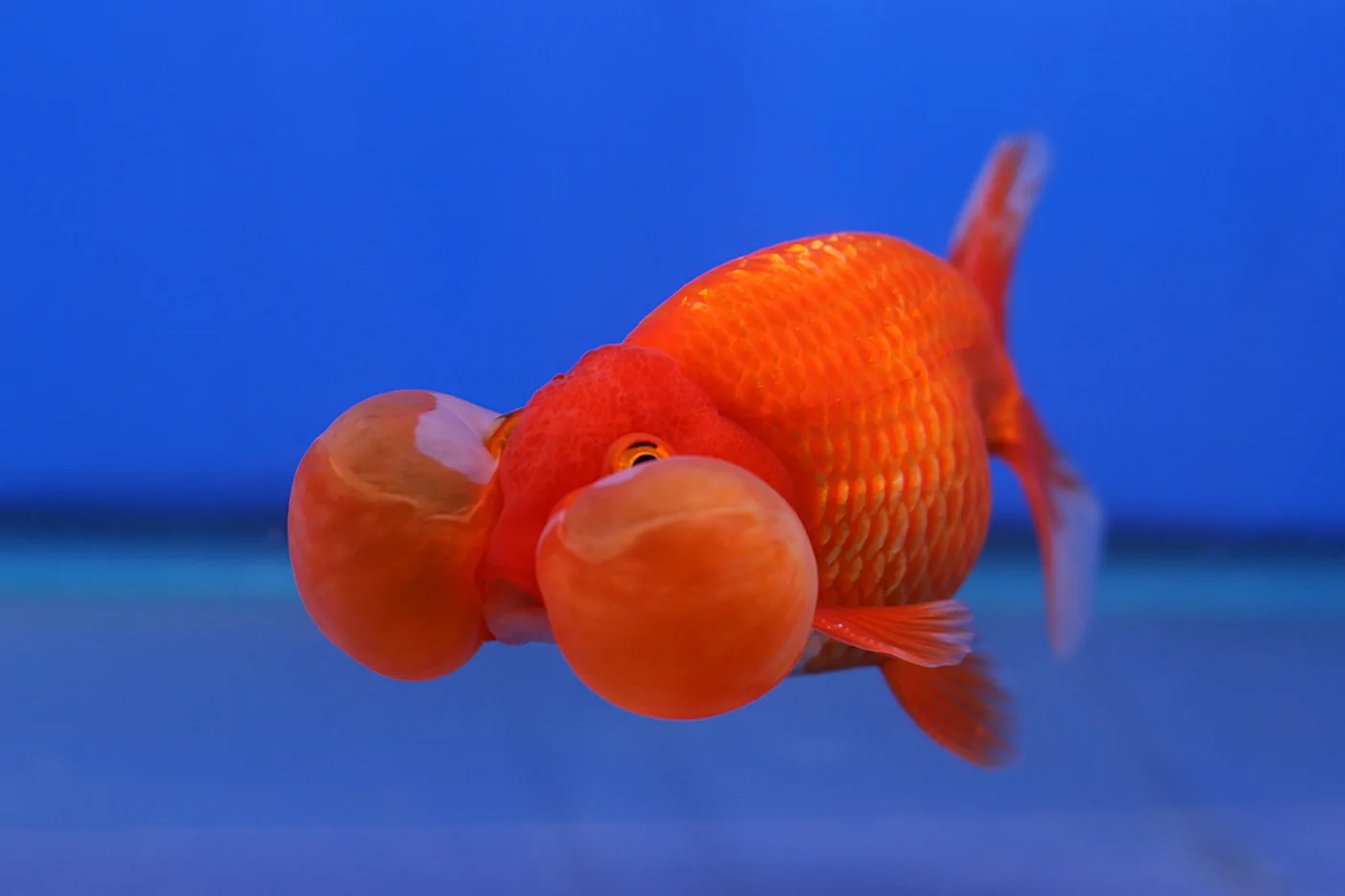
Bubble Eye
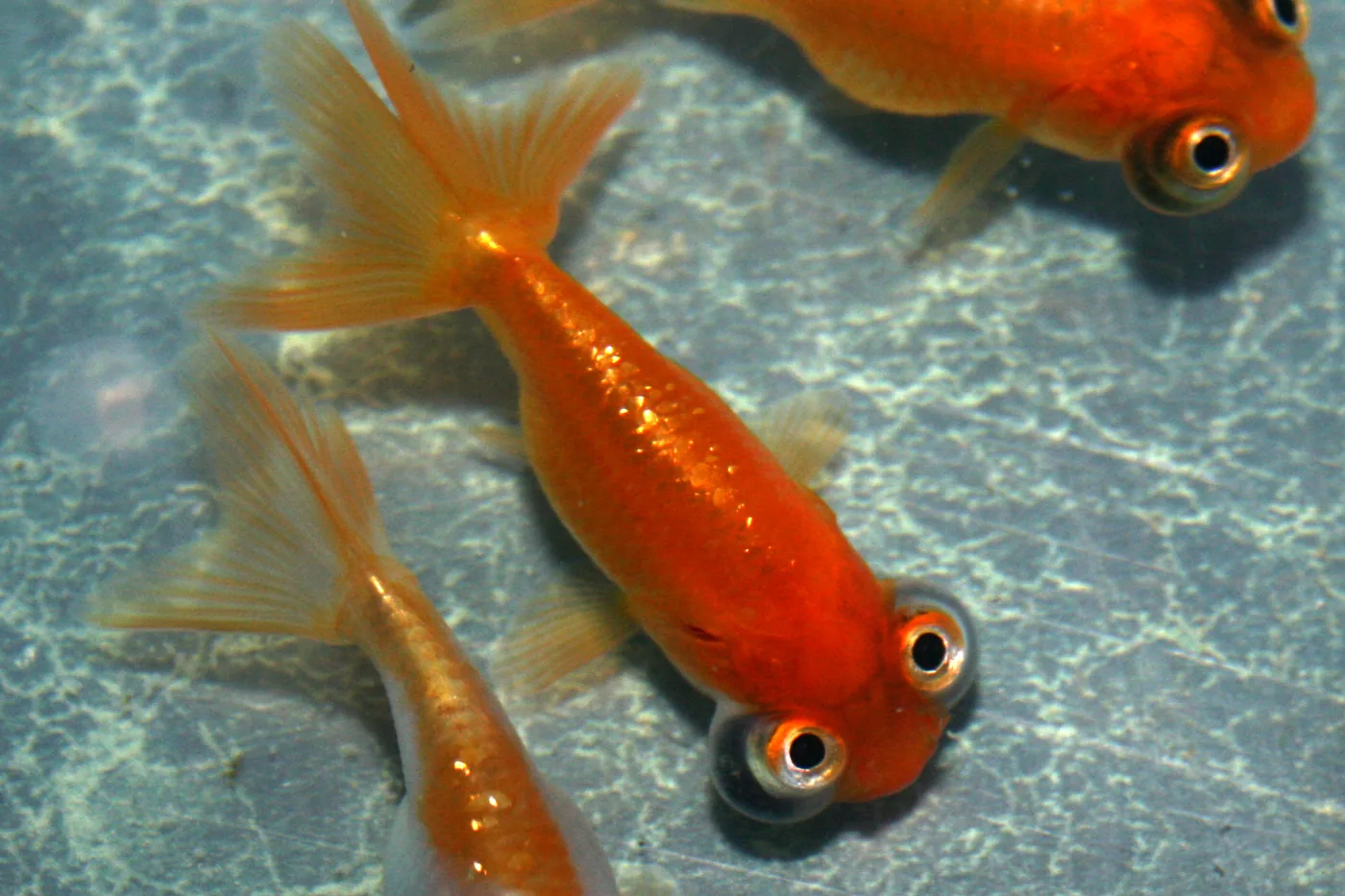
Celestial Eye
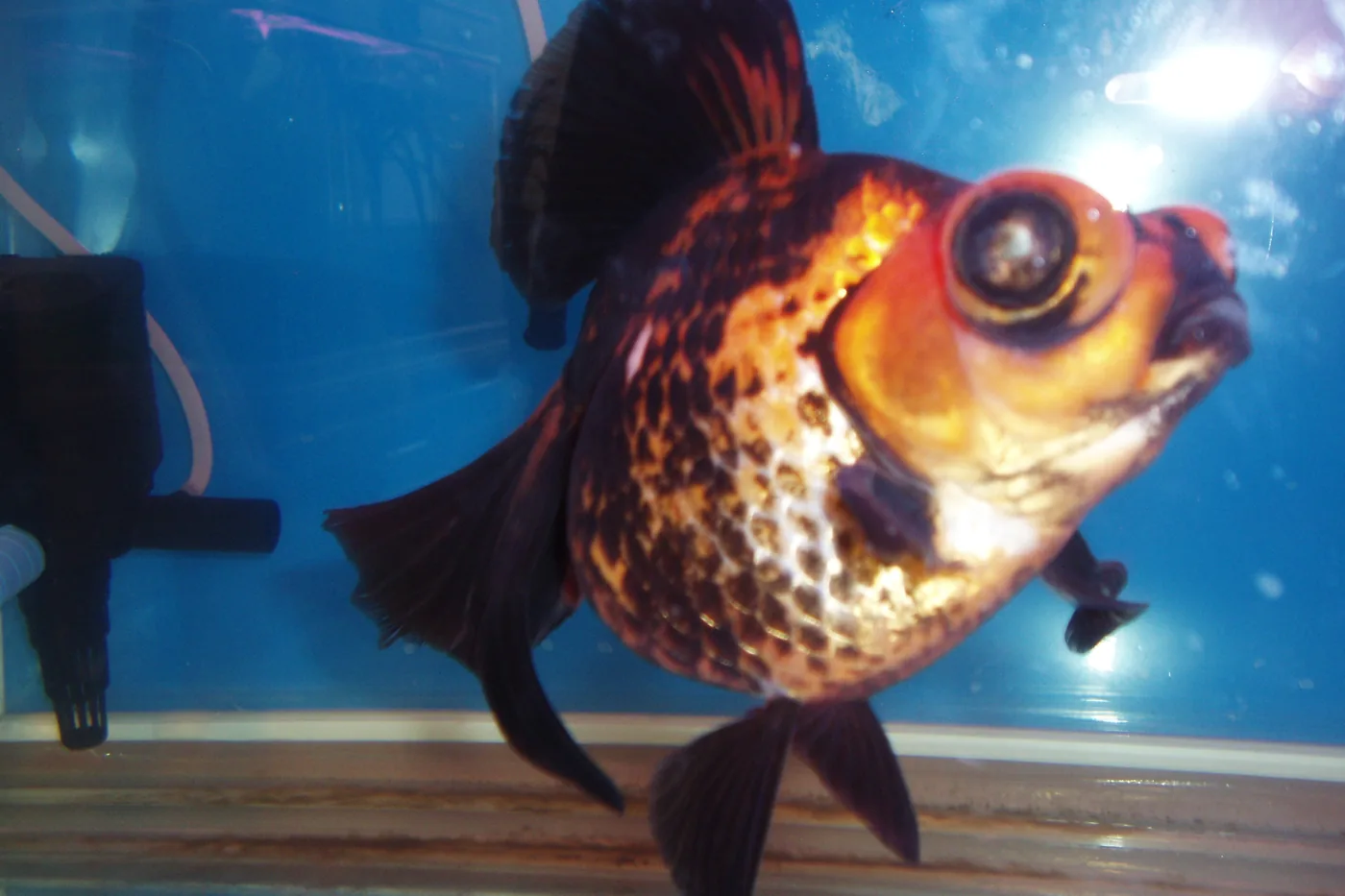
Telescope
Black Moor
Pearlscale
Oranda
Fantail
Pompom
Veiltail
Tosakin
Lionchu
Best kept apart from: Common Goldfish, Comet, Shubunkin, Ryukin, Jikin, Wakin. Speed and appetite differences leave the slower fish underfed.
Thinking about other species? Try the compatibility checker.
Similar breeds
Of the breeds most like the ranchu, the lionhead, oranda, bubble eye, celestial eye, pompom, tosakin and lionchu are pictured above among its companions. The others:
Frequently asked questions
What is the difference between a ranchu and a lionhead?
Both lack a dorsal fin and carry a wen, so look at the profile. A ranchu's back curves in one smooth arch and drops steeply into a tucked tail set at a sharp angle, giving a short, deep outline. A lionhead's back is flatter and longer, its tail sits at a shallower angle, and its wen is usually larger and looser. Japanese ranchu are judged from above; Western shows judge both breeds mainly from the side.
Are ranchus hard to keep?
They are more demanding than a fantail or oranda, not because they need anything exotic but because they tolerate less. Weak swimming, a wen that harbours bacteria and a body prone to buoyancy trouble mean that poor water, strong current or careless feeding show up quickly. A keeper who has already run a fancy goldfish tank for a year or two, and who tests water and changes it on schedule, will manage a ranchu well.
Why are Japanese ranchus judged from above?
Because that is how the Japanese tradition bred them to be seen. Breeders raised ranchus in shallow outdoor tubs and viewed them looking down, so the Japanese standard describes the outline from above, with a broad, square head, a thick back of near-even width and a tail spread flat at the end, while British standards show both side and top views. Side-view qualities matter less in the Japanese tradition, which is why a champion ranchu can look unremarkable through aquarium glass.
What should I look for when buying a ranchu?
Look down at it first, because that is the view the breed was made for. From above you want a broad, square head, a thick back of near-even width, and a tail spread flat like a fan. From the side you want one smooth arch with a sharp downward tuck at the tail base. Then watch it swim: it should hold level and move deliberately rather than struggling, and a juvenile that already lists or sinks may not grow out of it. Wen symmetry matters less at a young age than the back and the tuck, because the hood arrives last.
Can a ranchu live in a pond?
In a shallow, well-filtered summer tub or pond in a mild climate, yes, and that is close to how they were traditionally raised. Overwintering one outdoors is a different matter: many keepers bring ranchus indoors, since a dorsal-less, round-bodied fish is a weak swimmer that cannot escape a predator and the wen is thought to be prone to infection in cold water, although some keepers in mild climates overwinter young hooded dorsal-less fish outdoors. Summer outdoors and winter indoors is a routine many ranchu keepers follow, with the temperature changed gradually at both ends.
Why does my ranchu keep resting on the bottom?
Often nothing is wrong. A ranchu has no dorsal fin to keep it upright and swims in short deliberate bursts, so resting low is normal behaviour for the breed in a way it would not be for a comet. What is not normal is sitting with the fins clamped, breathing hard, or refusing food. If the fish rouses, swims and eats when you approach, it was resting; if it does not, test the water first, because ammonia and a temperature swing both produce exactly that picture.
Do ranchus need a bigger tank than other fancies?
Not more litres, but a better shape. The working figures are the same as for any fancy, around 100 litres for the first fish and 40 to 50 for each additional one. What a ranchu needs is that volume spread wide and shallow rather than tall, because depth is work for a fish with no keel, and it needs the flow across that footprint to be gentle. A long, low tank of 100 litres suits a ranchu better than a deep one of 150.
Is the lumpy growth on my ranchu's head normal?
Almost certainly. The wen is a fleshy, raspberry-textured hood that begins to show in the first few months, develops over a year or more and is the breed's defining feature, not a tumour or an infection. Small white pimples confined to the wen are often new growth, by keepers' experience, though spots that multiply or reach the body are treated as ich. Reddened, fluffy or eroded patches are different and point to a bacterial problem, and the response begins with a water test and a large water change.