No. 16On record from the late 1890s
Pompom
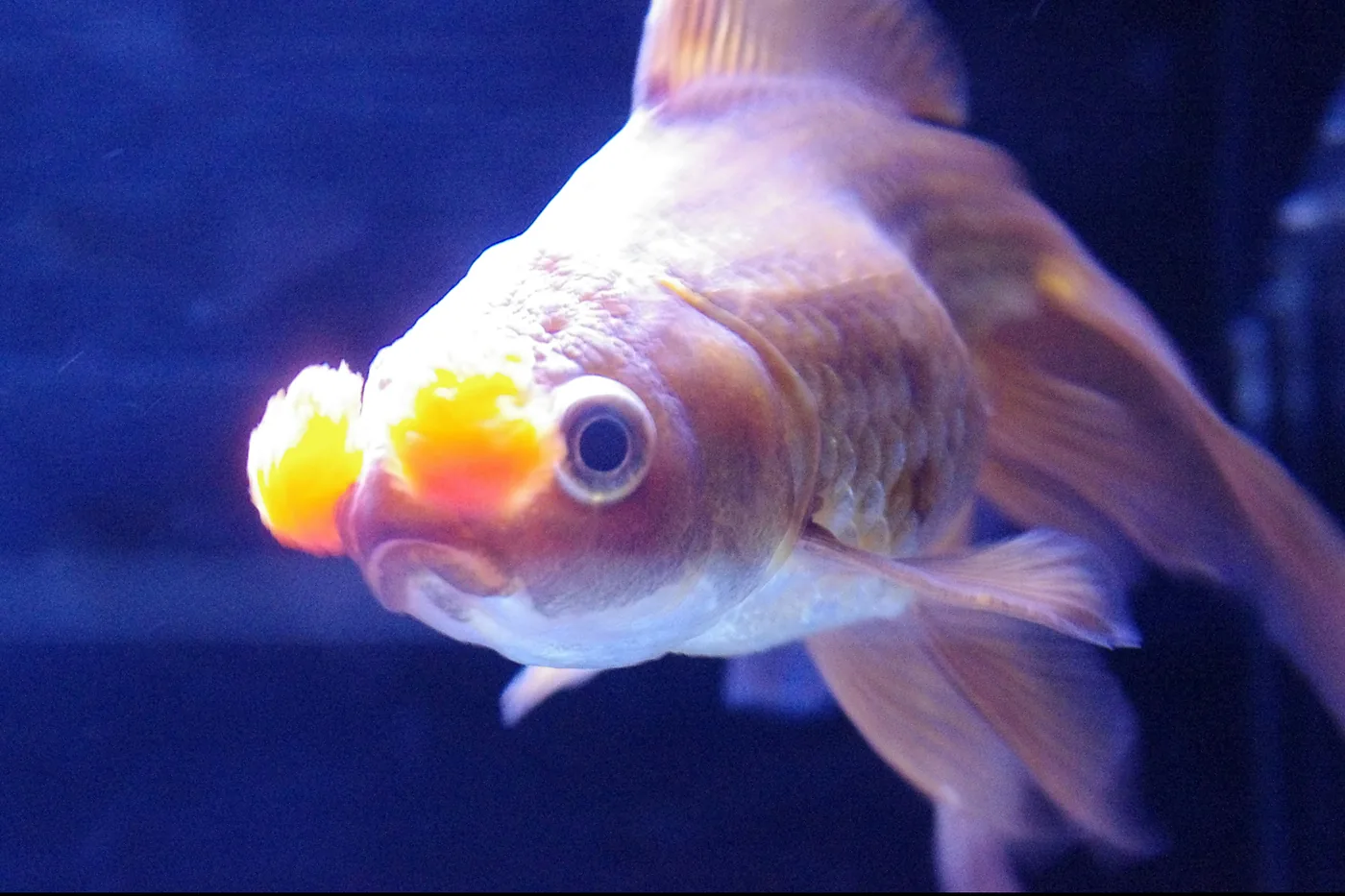
A goldfish wearing two bouquets on its face, grown from the nostrils rather than the hood.
Also known as Pom Pom · Pompon · Velvet ball (China) · Hanafusa (Japan, the dorsal-finned form)
- Specimen
- Fancy goldfish, China
- Adult size
- 10–15 cm
- Lifespan
- 10–15 years
- Water
- 18–24 °C
- Care
- Demanding
- Swimming
- Weak
- First fish needs
- 100 litres
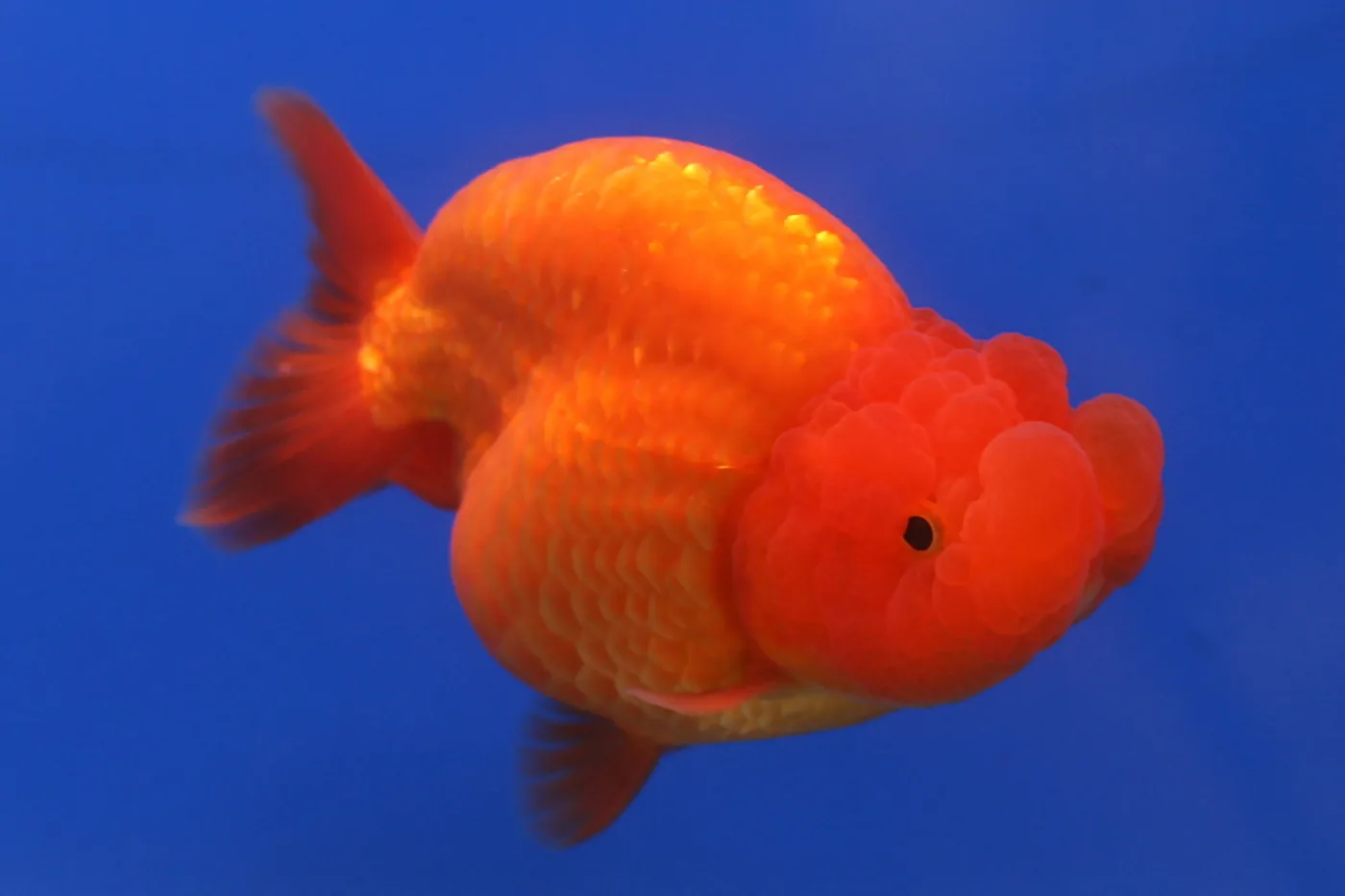
Photograph: Tomoko Saeki — Unsplash License · Unsplash
About this pictureThis fish carries a dorsal fin, the form also sold as a pompom oranda; the classic pompom has none. The bouquets are the same in both, two soft tufts grown from the nostrils in front of the eyes, and here, as often, a brighter colour than the body.
About these figures Size, lifespan and water are the ranges keepers' guides give for a fish in good care, not measurements of this breed, and swimming and care are this site's own ratings of the published advice. Lifespan is where the sources differ most: how long goldfish live sets them side by side. First fish needs is a middle figure for one fish, from advice that runs from 50 litres to about 300; tank size sets that out.
The specimen
Quick facts
- Classification
- Fancy goldfish
- Body type
- Egg-shaped body, most often dorsal-less, carrying two soft fleshy bouquets that protrude from the nostrils at the front of the face
- Tail and dorsal
- Double tail, no dorsal fin
- Swimming ability
- Weak
- Keeper experience
- Experienced
- Temperament
- Placid and slow, and slower still to food because the bouquets sit directly in front of the mouth
- Adult size
- 10–15 cm (4–6 in)
- Temperature
- 18–24 °C (64–75 °F)
- Minimum aquarium
- 100 L (26 US gal) for one fish
- Origin
- China, with a dorsal-finned form also bred in Japan, On record from the late 1890s
How to recognise one
- Two soft fleshy bouquets protruding from the nostrils, at the front of the face rather than on top of the head
- The bouquets are enlarged nasal septa, not wen tissue, and the distinction changes the care
- Most often dorsal-less with an egg-shaped body, though a dorsal-finned form exists and is also sold as a pompom
- The bouquets begin to show at around four to five months and go on developing for many months
- A short double tail, and a head otherwise free of the hood that orandas, ranchu and lionheads carry
- Orange, red-and-white, calico, black, blue and chocolate all occur, and the bouquets are often of a contrasting colour
Among the goldfish bred for a growth on the head, the pompom is the odd one out: its growth is not on the head, and it is not a wen.
Two soft bouquets hang from the nostrils at the front of the face, and almost everything specific about keeping one follows from where they sit and what they are made of.
Identification
Look at the front of the face, not the top of the head. A pompom’s bouquets protrude from the nostrils and hang forward, over or beside the mouth. An oranda’s, ranchu’s or lionhead’s wen sits on top of the skull and spreads back over the cheeks and gill covers. They are in different places and they are different tissue.
The standard pompom has no dorsal fin, on a smooth egg-shaped back like a lionhead’s. A dorsal-finned form, the Japanese hanafusa, exists, usually on an oranda- or ryukin-shaped body, and is sold under the same name — which makes this one of the few breeds where the dorsal fin does not settle the question. The identification guide uses the dorsal as a primary split, and the pompom is one of its stated exceptions.
Juveniles barely show it. The bouquets begin to show at around four to five months and go on developing for many months, so a young pompom can look like a plain dorsal-less goldfish.
What the bouquets actually are
They are enlarged nasal septa — the flaps of tissue between and around the nostrils, which on an ordinary goldfish are small folds that direct water over the olfactory rosette.
Two things follow, and together they are the reason this page exists apart from the hooded breeds.
The wen-care routine does not apply. Wen care is largely about folds: inspecting them, keeping them clean, watching for tissue creeping over the eyes. A pompom has none of that. There are no folds to foul and no growth over the eyes. That page says explicitly that pompoms are not wenned, and this is where the rest of that thought goes.
They are exposed, soft and at the front. A wen is a thick pad on top of a skull. A bouquet is loose tissue hanging off the leading edge of the animal, in exactly the place that meets ornaments, nets and other fish first.
How it develops
The bouquets arrive late and their final shape is not predictable. They begin to show at around four to five months and go on developing for many months, and no published source gives a finer timetable, so there is no table of ages here. A young pompom looks like a plain dorsal-less goldfish, and buying one is largely an act of faith in the line it came from.
Symmetry cannot be assessed on a juvenile, which matters because symmetry is the whole of how this breed is judged and the thing damage takes away permanently. A matched pair at two years tells you about the line; a matched pair at four months tells you nothing yet.
What can be judged young is the body. Dorsal fin or no dorsal fin is fixed from the start, as is the tail count, and those are the features the identification guide says to trust in a young fish. If you want the dorsal-less form rather than the dorsal-finned one, that is a decision you can make at the shop with confidence; the bouquets are not.
And the growth is not something to hurry. As with the wen on an oranda, the ceiling is genetic and pushing rich food at a young fish produces a deeper body rather than better bouquets — overfeeding covers what it does produce.
Why they get damaged, and why that is permanent
The bouquets are the breed’s whole point, and they are judged as a matching pair. That makes the asymmetry the problem rather than the injury.
Tankmates nip them. This is the specific risk, and it is not aggression — a soft pale bouquet waving in front of a fish’s face looks like food to another goldfish. Faster or more assertive company will investigate it, and one investigation is enough. Chasing and bullying covers telling ordinary goldfish curiosity from something that needs intervention; here the curiosity is the problem.
Decor and nets catch them. Everything the decorations guide says about telescope eyes applies here for the same reason: a soft protruding structure at the front of a slow fish meets things the fish did not see coming. Net with a container where possible, as handling and netting sets out.
And it heals unevenly. Minor damage recovers in clean water, but a torn bouquet frequently comes back smaller or misshapen, and what heals and what does not explains the general version: soft tissue regrows, the original outline often does not.
Aquarium requirements
100 litres minimum for one, and more for each additional fish. Pompoms sit at the smaller end of the fancy range and the figure is still the one every other weak-swimming fancy carries, because the limiting factor is water volume and calm rather than the length of the animal — the tank size guide makes that argument in general and it holds particularly here.
Gentle flow. Most pompoms are dorsal-less, and a fish without a dorsal fin has lost the keel that keeps it upright against a current. Spread a canister’s outflow, or choose a filter whose output is inherently soft — the filtration guide covers the options.
Nothing sharp, and nothing with holes. Smooth rounded decor, silk or live plants rather than plastic, and guarded intakes.
18–24 °C, the standard fancy range, held steady. The temperature guide covers why.
Clean water as the routine, because soft exposed tissue in poor water is where fungus starts. The water parameter checker will read a set of results if the numbers are not yet meaningful.
Personality and behaviour
Slow, calm and unbothered — a placid fish that moves deliberately and competes for nothing.
The behavioural point specific to this breed is that a well-developed pair of bouquets sits directly in front of the mouth, and a fish wearing large ones is visibly clumsier at food than one with modest ones. It is not distress and it does not need fixing; it does mean feeding has to be arranged rather than assumed.
Feeding
Sinking food, at a consistent spot, with slow company. That is nearly the whole of it.
Sinking versus floating covers why sinking food is the default for dorsal-less fancies, and the reasoning is stronger here: a pompom hunting at the surface is working around both its buoyancy and its face.
Soak dry food, keep portions small, and watch the fish actually eat. Weight loss in a pompom is a feeding-arrangement problem long before it is a disease, and loss of appetite covers separating the two.
Common health considerations
Damaged or fouled bouquets, a common problem, and covered above.
Fungus on damaged tissue. Opportunistic and specific to soft tissue in water that is not clean enough.
Buoyancy trouble, the standard dorsal-less, deep-bodied risk: floating upside down has the full treatment and the prevention is the usual sinking, soaked, small-portion routine.
Being outfed. Not a disease, and a common reason a pompom declines in a mixed tank.
Mistaken alarm about the bouquets themselves. They are a breed feature, and lumps, growths and tumours lists them alongside the wen as a common false alarm on a goldfish. Symmetrical, slow-developing and on a fish that is otherwise well means nothing needs doing.
What goes wrong, in order
| What you see | What it usually is | Where to go |
|---|---|---|
| One bouquet smaller than the other | Damage, usually a nip or a snag | What heals |
| White fuzz on a bouquet | Fungus on damaged tissue | Fungus |
| A fish that cannot find its food | Bouquets plus slow swimming | Sinking food |
| Thinning fish in a mixed tank | Outcompeted at feeding | Tankmates |
| Floating after meals | Deep body, dorsal-less | Floating upside down |
| Growths appearing at a few months old | The breed arriving, not a problem | Lumps and growths |
Choosing one
- Look for a matching pair. Size, shape and colour should correspond. A single well-developed bouquet with a stub opposite is old damage, and it will not even up.
- Check they are clean-edged, not ragged, greyish or fuzzy.
- Decide which form you want. Dorsal-less is the classic; dorsal-finned is common and perfectly legitimate. They are not quite the same fish to keep — the dorsal-less form is the weaker swimmer.
- Watch it feed in the shop if you possibly can.
The general checks in choosing and bringing home a goldfish all apply on top.
Is a pompom right for you?
Yes, if you already keep slow fancies successfully, your tank is calm and smooth, and you find the fish charming enough to arrange its feeding around.
No, if this is a first goldfish, if there is anything quick or inquisitive in the tank, or if you want a fish that looks after itself. A fantail is the better alternative for anyone drawn to the unhurried fancy shape without the exposed feature.
History and origin
The pompom is a Chinese form, on record from the late 1890s and known there as the velvet ball, which is the dorsal-less form that is the standard western pompom. A dorsal-finned form is also bred in Japan, where it is called hanafusa, and it is sold in the West as a pompom or a pompom oranda.
The bouquets are a feature that sits on several bodies: the dorsal-less egg shape, the dorsal-finned oranda or ryukin shape, and others besides. That is how goldfish traits behave — they recombine, which is why so many modern fancies are stacks of traits, and the domestication page covers how that worked.
Before you bring one home
- The bouquets are soft, exposed and positioned at the front of the fish, which makes them the first thing to be damaged or nipped
- They are not wen tissue, so the wen-care routine does not apply and the folds that need cleaning on a hooded fish do not exist here
- A heavily developed pair sits directly in front of the mouth and can get in the way of feeding
- Nipping tankmates are a specific risk because the bouquets look like food to another fish
- Most are dorsal-less and therefore weak swimmers that need calm water and gentle flow
- Damage often heals asymmetrical, which is permanent on a feature judged by its symmetry
Suitable companions
Round-bodied goldfish should live with fish of similar speed. These breeds share the same pace, water and food.
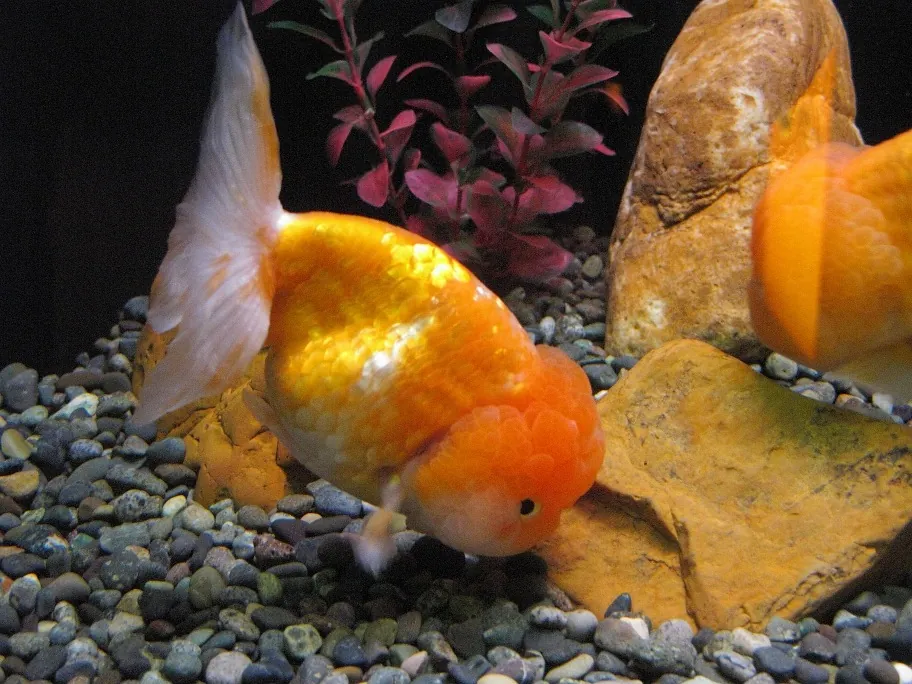
Lionhead
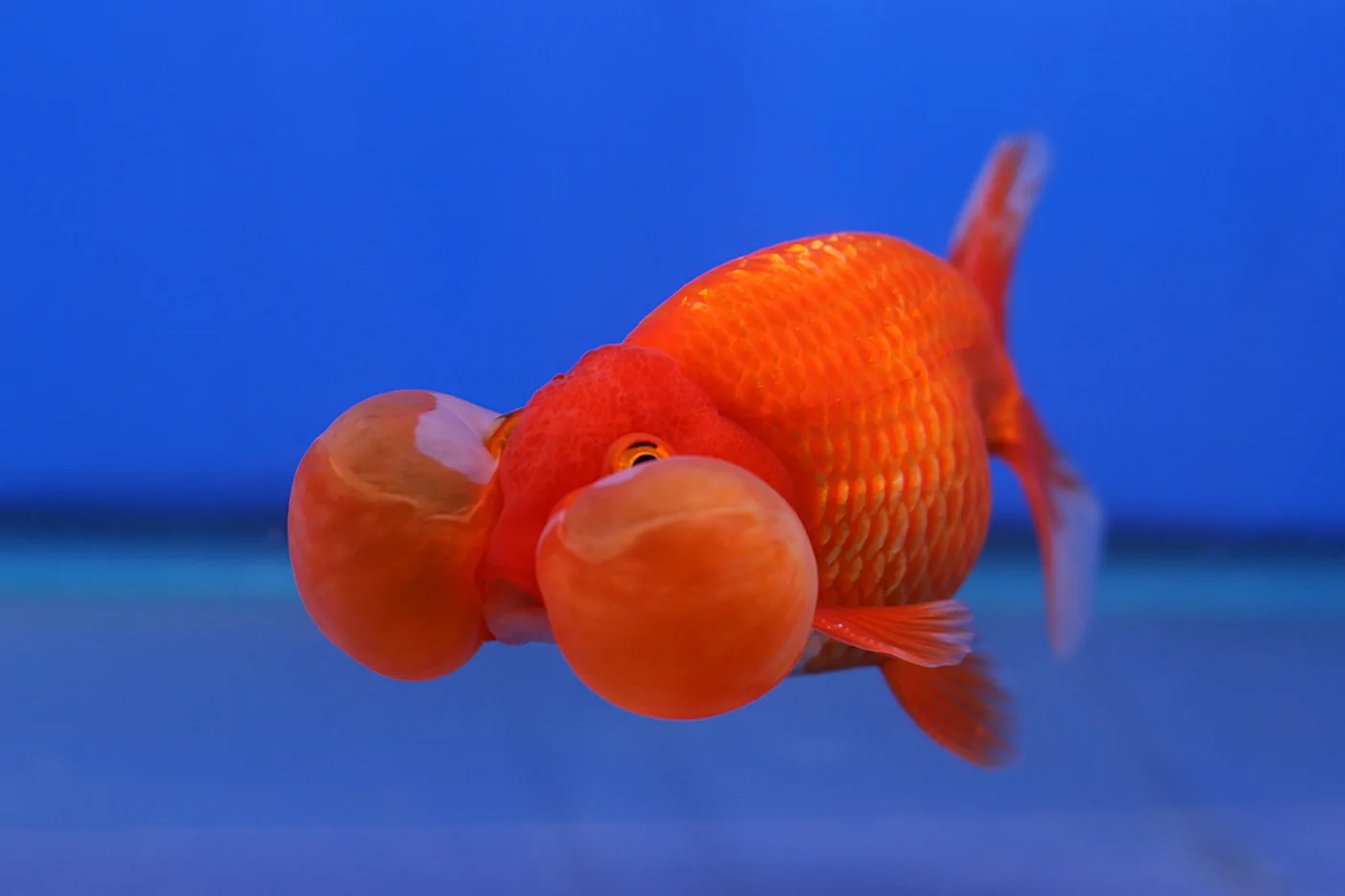
Bubble Eye
Celestial Eye
Pearlscale
Veiltail
Black Moor
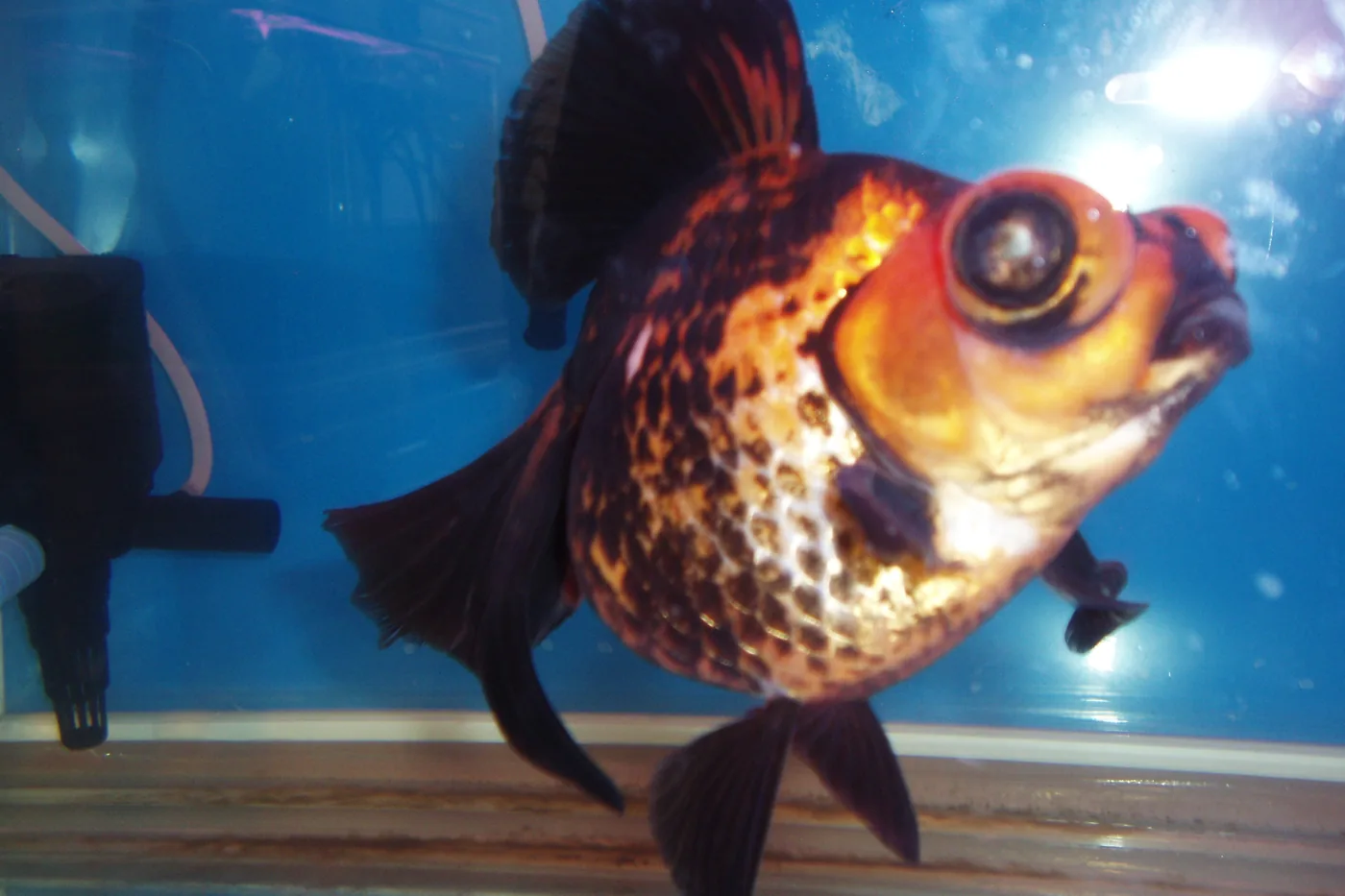
Telescope
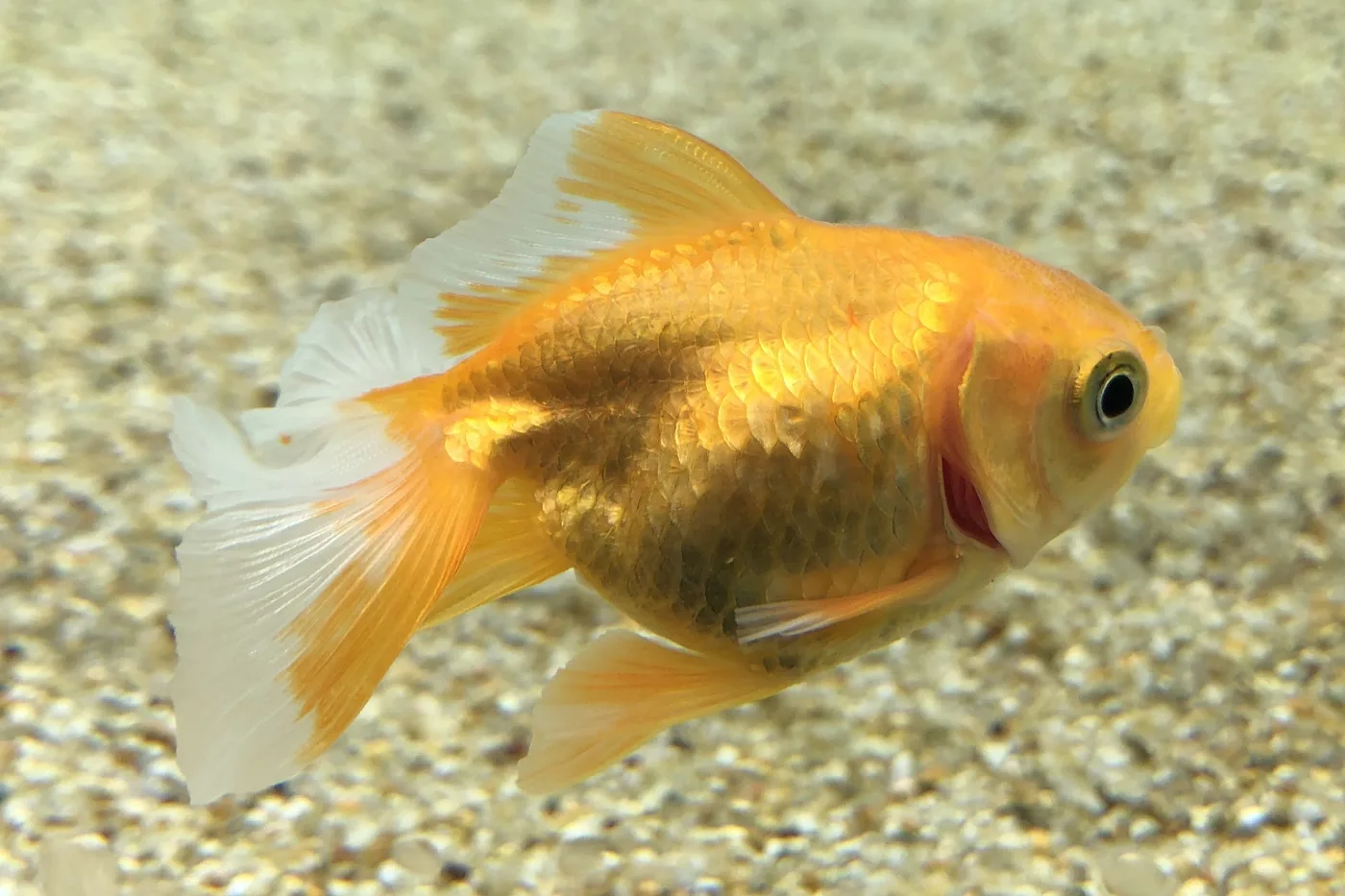
Tosakin
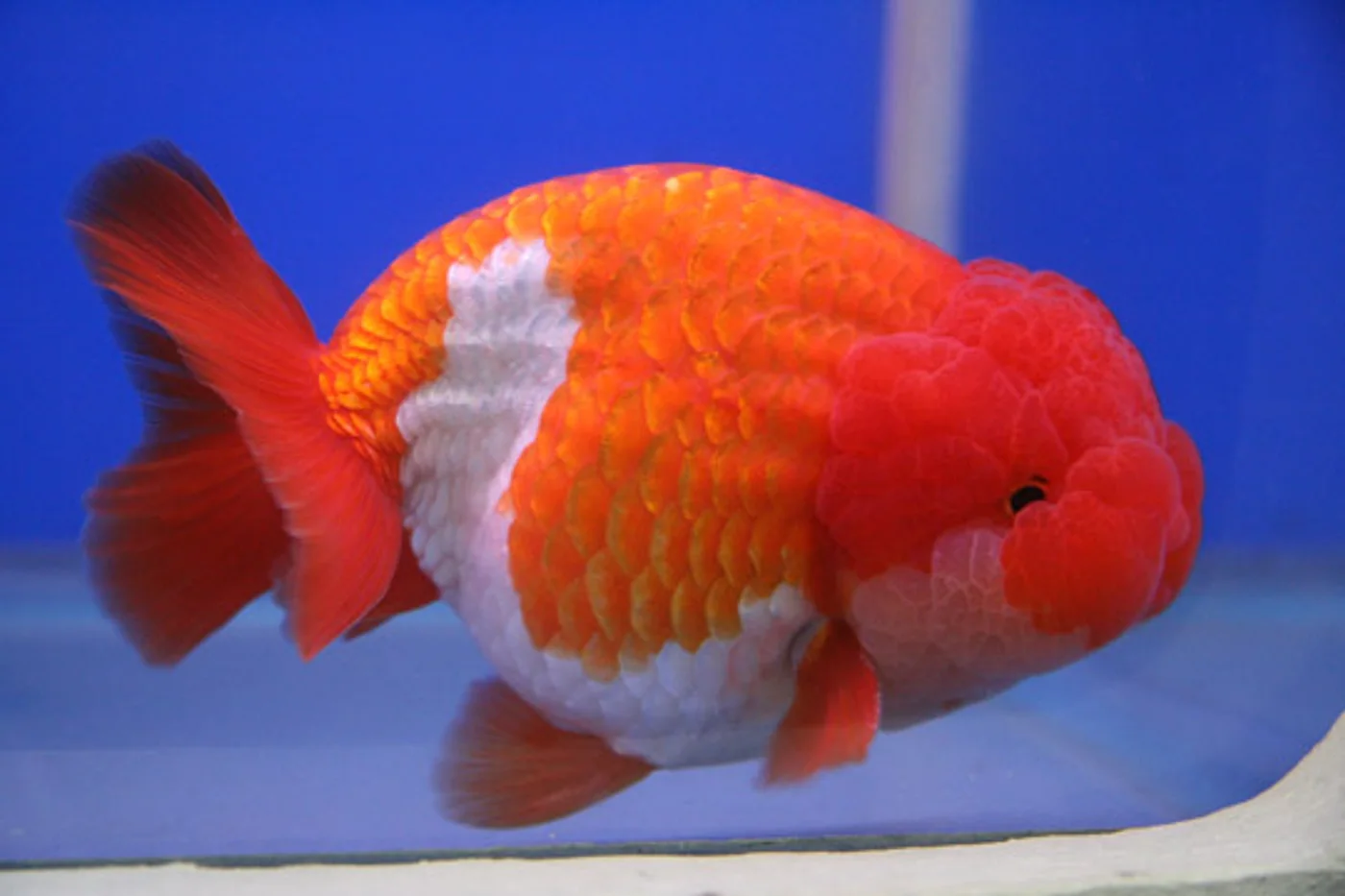
Lionchu
Best kept apart from: Common Goldfish, Comet, Shubunkin, Ryukin, Jikin, Tamasaba, Wakin. Speed and appetite differences leave the slower fish underfed.
Thinking about other species? Try the compatibility checker.
Similar breeds
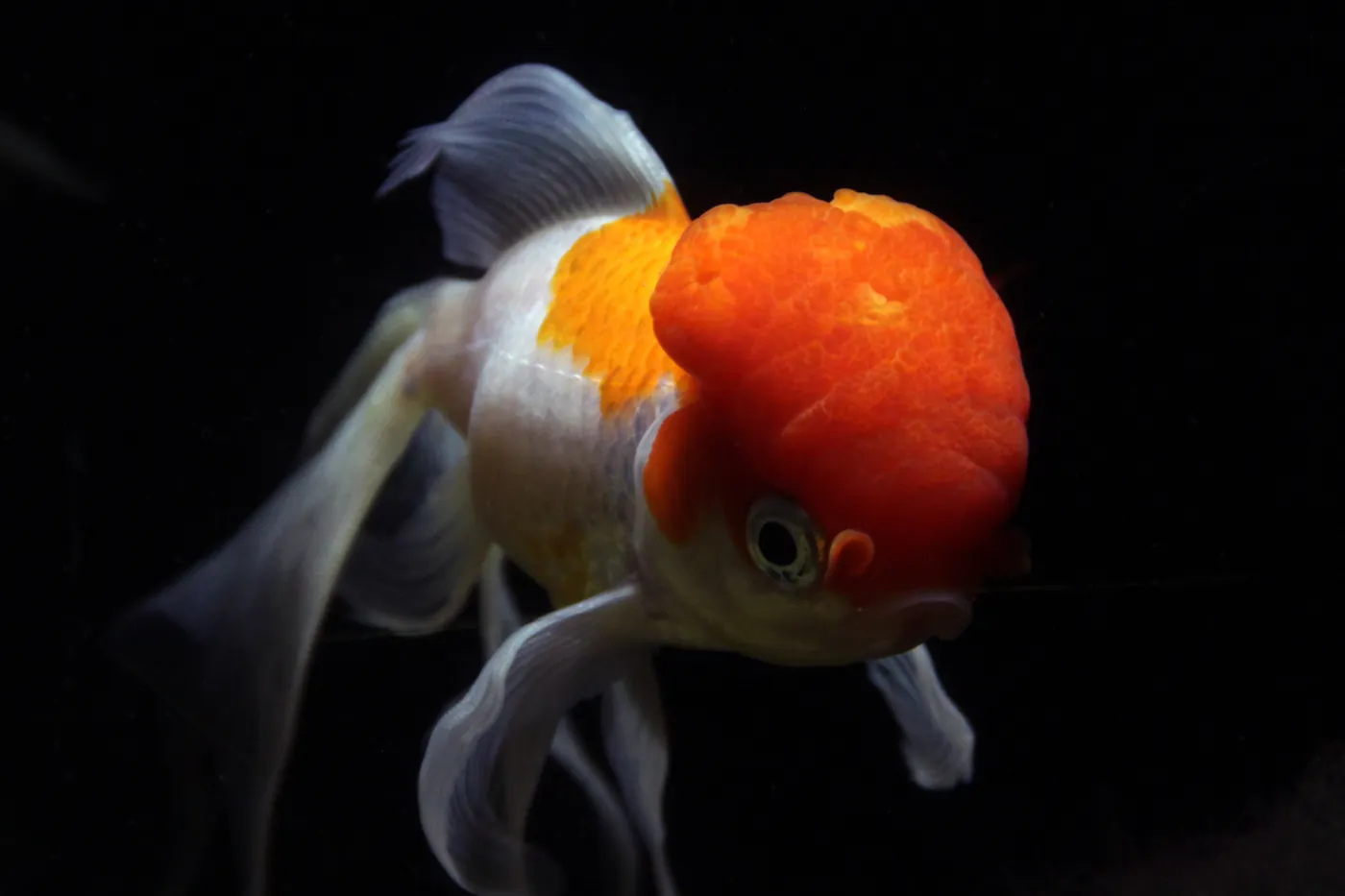
Of the breeds most like the pompom, the lionhead and ranchu are pictured above among its companions. The others:
Frequently asked questions
Is a pompom's bouquet the same as a wen?
No, and this is the distinction that matters. A wen is thickened skin growing over the top of the head and cheeks. A pompom's bouquets are greatly enlarged nasal septa - the tissue between the nostrils - so they sit at the front of the face and are a different structure entirely. The practical consequence is that the wen-care routine does not apply: there are no folds to inspect, nothing to keep clean in the same way, and none of the risk of tissue creeping over the eyes.
Do pompoms have a dorsal fin?
The standard western pompom has none: it is the dorsal-less form the Chinese call the velvet ball, on an egg-shaped body. The Japanese hanafusa is the dorsal-finned form, usually on an oranda- or ryukin-type body, and it is sold in the West as a pompom or a pompom oranda. This is one of the few breeds where the dorsal fin does not tell you what you are looking at, so judge by the bouquets.
Will a damaged pompom grow back?
Partly, and rarely to the same shape. The tissue can recover from minor damage in clean water, but a torn or bitten bouquet frequently heals smaller or lopsided, and on a feature whose whole point is a matching pair that is effectively permanent. Prevention is the entire approach: no nipping tankmates, nothing sharp, and gentle flow.
Can a pompom feed normally?
Usually yes, but a heavily developed pair hangs directly in front of the mouth and a fish with large bouquets can be slower and clumsier at food than one with modest ones. Feed sinking food at a consistent spot, keep the company slow, and confirm the fish is actually eating rather than assuming it.
Why do people confuse pompoms with lionheads?
Because most pompoms share the lionhead's dorsal-less egg-shaped body, and both carry conspicuous growths on the head end. Look at where the growth sits: a lionhead's wen covers the top of the head and the cheeks, while a pompom's bouquets hang from the nostrils at the front.
Is a pompom a good beginner goldfish?
No. It is a weak swimmer with an exposed, easily damaged feature at the front of its face, it is outcompeted at feeding, and it needs calm water and careful tankmate choice. A fantail gives a beginner the same unhurried fancy shape with none of these. Come to a pompom once you have kept fancies for a while.
How big do pompoms get?
Roughly 10 to 15 cm, which puts them at the smaller end of the fancy range alongside the pearlscale and the eye breeds. That does not make the tank smaller in proportion, because the limiting factor is water volume and the calm conditions the fish needs rather than the length of the animal.