No. 05Early Edo period, from wakin stock
Jikin
A wakin whose tail opens into an X, with a white ground the breeder makes by hand.
Also known as Peacock tail goldfish · Peacock-tailed goldfish · Jikin goldfish
- Specimen
- Single-tailed goldfish, Japan
- Adult size
- 12–20 cm
- Lifespan
- 5–10 years
- Water
- 15–24 °C
- Care
- Demanding
- Swimming
- Moderate
- First fish needs
- 150 litres
Photograph: Yatokin, CC BY-SA 4.0 · Wikimedia Commons
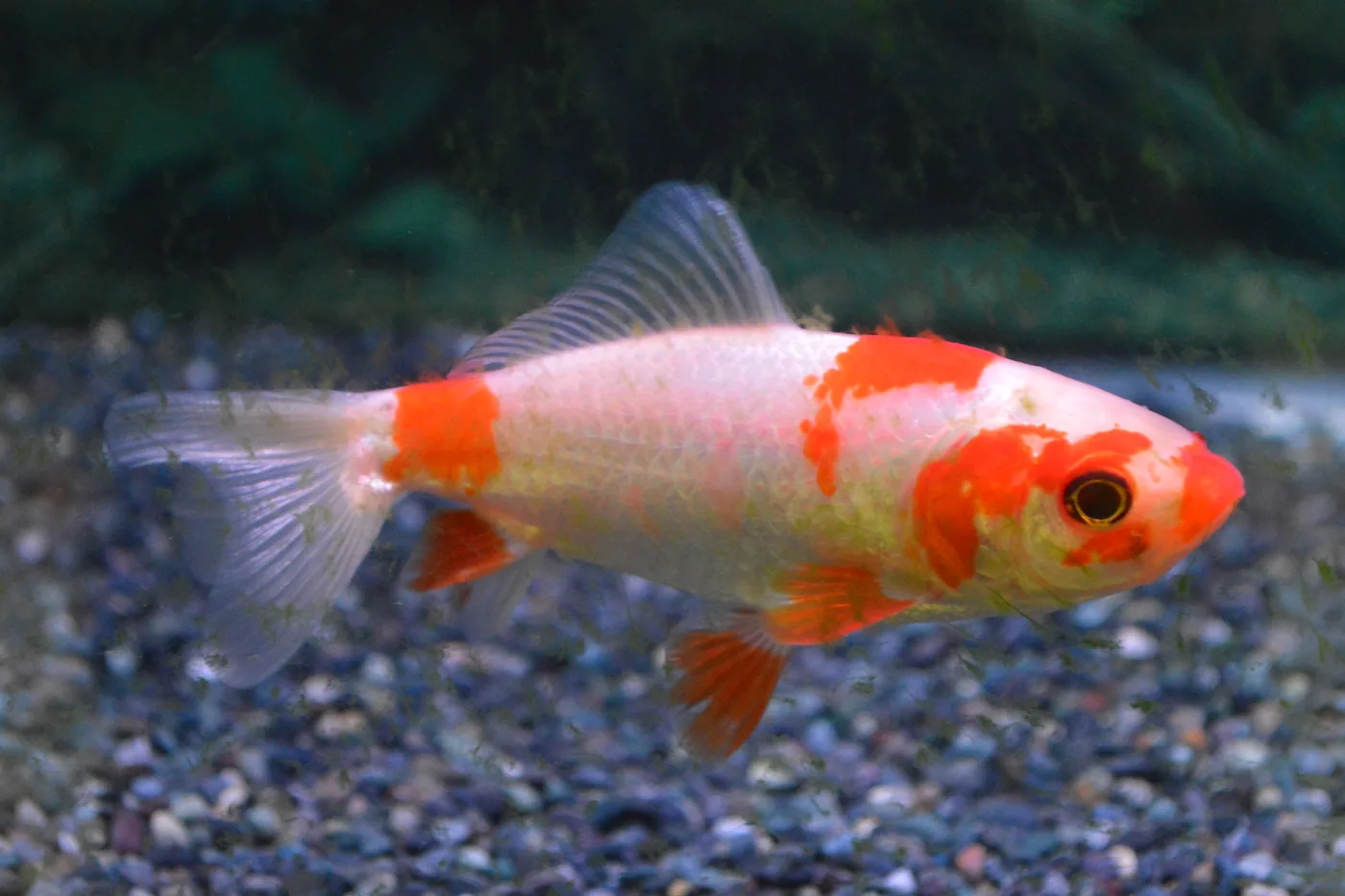
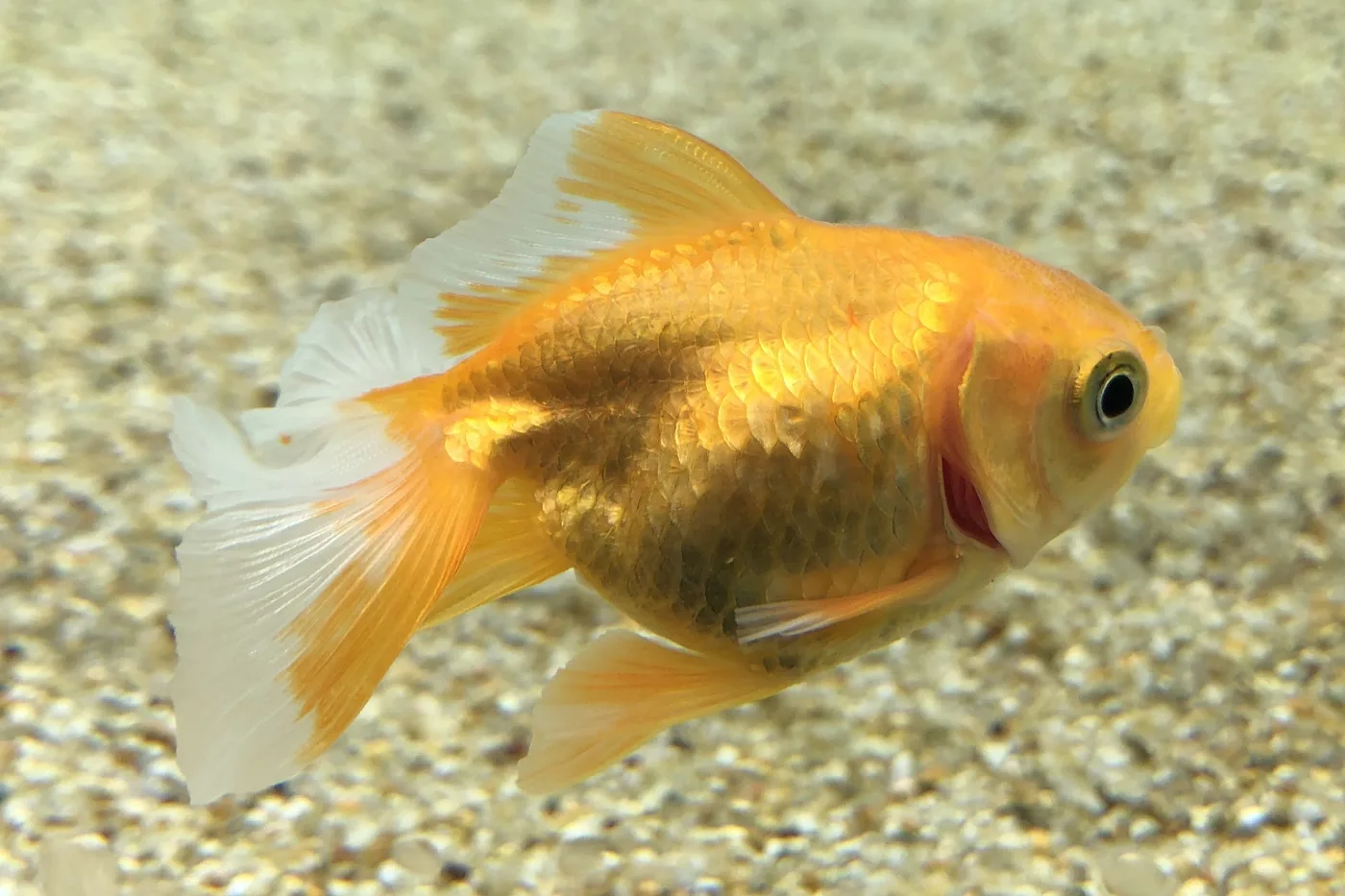
About this pictureSide-on, as here, a jikin passes for a wakin with a full tail: the flat X that names it opens only from above or behind. The red keeps to the gill covers and the fins, which is the pattern the breed is kept for.
About these figures Size, lifespan and water are the ranges keepers' guides give for a fish in good care, not measurements of this breed, and swimming and care are this site's own ratings of the published advice. Lifespan is where the sources differ most: how long goldfish live sets them side by side. First fish needs is a middle figure for one fish, from advice that runs from 50 litres to about 300; tank size sets that out.
The specimen
Quick facts
- Classification
- Single-tailed goldfish
- Body type
- Wakin-type body, stocky in the Mikawa line and longer and leaf-shaped in the Owari line, carrying a wide, flattened double caudal that spreads into an X when the fish is viewed from behind
- Tail and dorsal
- Double tail, dorsal fin present
- Swimming ability
- Moderate
- Keeper experience
- Experienced
- Temperament
- Slow and deliberate for a wakin type, weak in constitution, and not suited to mixed company
- Adult size
- 12–20 cm (5–8 in)
- Temperature
- 15–24 °C (59–75 °F)
- Minimum aquarium
- 150 L (40 US gal) for one fish
- Origin
- Japan, developed from wakin stock in the Aichi region, Early Edo period
How to recognise one
- A caudal fin that spreads flat and wide into an X shape, visible only from directly behind or above
- A wakin-type body with a full dorsal fin on a smooth back, stocky in the Mikawa line and longer in the Owari line, so from the side it reads as an ordinary goldfish with a full tail
- The prized colouring is a white body with red only on the mouth, the gill covers and the fins, which English-language sources call the twelve points of red
- A white ground that the breeder makes by hand, so a clean pattern is rare
- Compared in Japan to the golden shachihoko on the roof of Nagoya Castle, which gives it the name shachi tail
- Rare outside Japan, and a natural monument of Aichi Prefecture since 1958
Most goldfish are bred to be looked at from the side, which is how a fish in a glass tank presents itself.
The jikin is not. Its defining feature is invisible in profile, and the breed only makes sense once you have stood behind it. It is also, in every Japanese account of it, a difficult fish: weak in constitution, short-lived for a wakin type, and not made for mixed company.
Identification
From behind, the tail opens into an X. The upper and lower lobes spread flat and away from each other rather than hanging, so the outline is four points at wide angles. That is the peacock tail, and it is the entire breed. In Japan it is also called the shachi tail, after the golden shachihoko, the mythical fish that stands on the roof of Nagoya Castle.
From the side, it is a wakin. A wakin-type body, a full dorsal fin on a smooth back, and a tail that reads as generously doubled and nothing more. The two breeds are genuinely difficult to separate in profile, and the identification guide is explicit that some features simply cannot be judged from the angle you happen to have. The body varies by line: Japanese sources describe a stocky form from the Mikawa part of Aichi and a longer, leaf-shaped form from Owari.
The colouring, when it is there. A white body with red only on the mouth, the gill covers and the fins. English-language sources call this the twelve points of red. In Japan it is called rokurin, “six scales”, and described as red on the tip of the mouth and in six places on the fins. A fish that has it completely is a specialist’s achievement, and the next section says why.
The white is made by hand
A young jikin is red, like a young wakin, and the white ground that defines the breed is not simply bred in. Japanese sources describe the breeder removing the red by hand: the scales are stripped with a fingernail or a spatula, over several sessions so as not to overload the fish, and the skin is treated with an acid such as acetic acid. What is left is a white body with the red kept on the mouth, the gill covers and the fins.
Three things follow for a keeper.
A clean pattern is a breeder’s work. It takes years of practice to do without harming the fish, which is a large part of why a good jikin is rare and why the breed is kept by specialists.
Ask who finished the colour. A jikin sold as a young fish is a red fish with a promise, and one sold with a clean white ground has been worked on. Neither is dishonest, but they are different purchases, and the price should say which.
It is a technique to describe, not to try. It is set out here because it explains the fish. Stripping scales from a fish at home is a good way to injure it, and what heals and what does not is blunt about how rarely damaged skin returns to its original state.
A breed you have to walk around
Worth dwelling on, because it puts the jikin in a small group and explains how it is kept.
Goldfish keeping has two traditions. Most of the breeds on this site are side-view fish: the glass is vertical, the fish presents its flank, and everything that was bred into it — a ryukin’s hump, a veiltail’s finnage, a telescope’s eyes — reads from there.
A few are top-view fish, bred to be looked down on in a shallow tub. The ranchu is the famous one, and the showing guide explains why that tradition produced a standard nobody can judge through aquarium glass. The jikin sits in that tradition: a guide by a member of the Japanese preservation society describes it as judged from above and in profile, and says the tail opens when the fish stops and not when it turns.
How it develops
The jikin is judged early and re-judged often. The guide by the preservation society’s member describes breeders selecting on tail shape from about ten days after hatching and again at one and two months, long before the fish has any colour to judge. The red begins to turn from about three months, later than in the ranchu, and in some fish not until the second year; that is when the white is made. The tail goes on developing for years: the notch in it deepens and the tail lifts as the fish grows, and it is described as nearly finished at about three years.
No table of ages is given here, because the figures come from one source and differ from line to line.
So a juvenile jikin is a promise twice over. Both the tail angle and the finished colour arrive late, and what arrives depends on the line and on the breeder’s hands. Buying one means buying the line and the breeder, which is the argument breeding goldfish makes about goldfish generally and which applies here with unusual force.
Aquarium requirements
Nothing specific to keeping the jikin has been published in English, and the Japanese sources say that it is difficult without saying how. The sensible basis is a wakin’s, with a wider margin, because the fish is weaker.
150 litres minimum for a first fish, following the single-tail row of the tank size guide rather than the fancy one. It is reported at roughly 12 to 20 cm.
Cool to moderate, and steady, in the range of about 15 to 24 °C. A weak fish has no margin for swings, and a heater, if it is needed, is there to hold the number still.
Its own kind, or alone. Japanese sources advise against keeping it with other goldfish, and the compatibility lists below say the same. The compatibility checker will settle anything else you are considering.
A container you can look down into. A wide, shallow tank or a tub gives the view the breed was made for. Calm water and gentle flow suit a fish that is not a strong swimmer.
Personality and behaviour
Slow and deliberate for a wakin type. The guide by the preservation society’s member describes a fish that advances a little, pauses and steps back half a pace, which keepers prize, and not the quick patrolling of a common goldfish or a comet.
That decides the company more than anything else. A jikin among faster fish is not aggressive, and it is simply the last to the food, which is the mechanism the chasing and bullying page identifies as the one that actually harms slow fish. A fancy is not the answer either, because the jikin is the weaker fish, and Japanese sources advise its own kind.
Feeding
A wakin type’s regime. Nothing about the jikin’s feeding has been published beyond that, so the usual rules apply: sinking food, small portions, and a little vegetable matter. Feed as how often to feed goldfish sets out. Because the fish is slow to the food, feed where it is, and watch that it eats.
The one addition worth making is carotenoid-rich food if you care about the red holding — goldfish nutrition covers what actually affects colour, and the answer is less than people hope.
The one thing the tail does change
Smooth surroundings matter. A wide, flat caudal presents a lot of edge to the world, and it is carried by a fish that cannot get out of its own way quickly. Sharp rock, stiff planting, unguarded intakes and resin ornaments all cost fin tissue — aquarium decorations sets out the fingertip test, and torn fins covers what happens when it is skipped.
Damage matters more than usual for a second reason: the tail’s symmetry is what makes the X read at all, and the page on what heals is blunt about regrown fin rarely returning to the same outline.
Common health considerations
A weak constitution. Japanese sources describe the jikin as the weak and short-lived one among the wakin types, and one breeder’s page puts its usual life at five or six years. For a keeper that means steady water, a quiet tank, and attention to the first sign that something is off, because a weak fish has little in reserve. Signs of a healthy goldfish lists what to watch.
Fin damage, covered above, and the other thing the breed adds.
Colour that does not arrive, or does not stay. The pattern depends on red being removed from everywhere except the mouth, the gill covers and the fins, and colour in goldfish is neither stable nor fully heritable — goldfish genetics explains why, and pale or faded colour covers the cases where losing it is a husbandry problem rather than a genetic one.
What goes wrong, in order
| What you see | What it usually is | Where to go |
|---|---|---|
| A tear or notch in the tail | Sharp decor, and the flat tail meets more of it | Torn fins |
| The X no longer reads evenly | Old damage healed asymmetrical | What heals |
| Red outside the points | The colour not yet finished, or the fish colouring as it chooses | Genetics |
| Red fading away | Diet, or age, or simply the fish | Pale colour |
| Thinning while tankmates thrive | Outcompeted at every meal | Tankmates |
| A fish that is just not thriving | The weak constitution the breed is known for | Finding an aquatic vet |
Choosing one
- Look from behind, or do not judge. In profile you cannot tell a jikin from a wakin, and a seller showing you side views only may not know which they have.
- Ask who finished the colour, and when. A clean white ground is hand work. Decide whether you want a finished fish or a young one with a promise.
- Check the tail for old damage, because its symmetry is the feature and damage to it is permanent.
- Expect to be told it is difficult, and listen. A seller who calls it an easy beginner’s fish does not know the breed.
- Buy from someone who knows what they have. This is not a general-retail fish, and one sold from a mixed tank of other goldfish is more likely to be a wakin. Finding a goldfish no shop stocks covers the routes.
Is a jikin right for you?
Yes, if you have kept goldfish for a while, you can offer a fish of its own a container you can look down into, and the idea of a delicate fish that has to be viewed from a particular angle appeals rather than irritates.
No, if it would be your first goldfish, the tank sits against a wall, or it would share with others. You will have paid for a feature you will not see, and a wakin gives you a hardy fish of the same outline for far less trouble.
History and origin
The jikin was developed in Japan from wakin stock, in Aichi Prefecture, from a mutation of the wakin in the early Edo period. A samurai named Amano Suo is traditionally credited with fixing it, by selecting fish whose tail fins stood up. It has stayed regional in a way few goldfish breeds have: Japanese sources describe a stocky form from the Mikawa part of Aichi and a longer one from Owari, around Nagoya, and in 1958 it was designated a natural monument of the prefecture.
The difficulty of the breed is part of its history and not a flaw in the account. Two things have to come right in the same fish: a tail that opens to the correct angle, and a body that is white where the breeder has taken the red away. The first is a matter of selection over years, the second of patient hand work, and the fish itself is weak. A breed defined by that combination will always be rare, and the jikin is the clearest example of it on this site. The domestication page sets out why goldfish traits behave this way in general.
Before you bring one home
- The defining feature cannot be seen from the side, so the fish is judged and appreciated from behind or above
- Japanese sources describe the jikin as weak in constitution, very difficult to keep and short-lived for a wakin type
- They advise against keeping it with other goldfish
- The red-on-white pattern is finished by hand, by stripping the red from the young fish, so it is a breeder's work as much as the fish's
- The wide flat tail catches on sharp decor, and its symmetry is what makes the X read
- Rare in the trade, which makes mislabelling and disappointment more likely than with common breeds
Suitable companions
Single-tailed goldfish are fast and boisterous. Keep them with fish that can keep up.
Best kept apart from: Common Goldfish, Comet, Shubunkin, Wakin, Fantail, Ryukin, Oranda, Telescope, Black Moor, Pearlscale, Veiltail, Pompom, Tamasaba, Ranchu, Lionhead, Lionchu, Bubble Eye, Celestial Eye, Tosakin. Speed and appetite differences leave the slower fish underfed.
Thinking about other species? Try the compatibility checker.
Similar breeds
Frequently asked questions
What is a peacock tail goldfish?
The jikin, and the name describes the tail seen from behind. Instead of hanging as two lobes the caudal fin spreads flat and wide, the upper and lower halves opening away from each other so the outline reads as an X. From the side it looks like an ordinary full tail, which is why the fish is traditionally looked at from behind or above. In Japan it is also called the shachi tail, after the golden shachihoko on the roof of Nagoya Castle.
Is a jikin a fancy goldfish?
No. It is a wakin type: the body is a wakin's, with a full dorsal fin and a single-tail outline, and the twin tail is the only thing it has borrowed from the fancies. What it does not share with the wakin is the wakin's hardiness. Japanese sources call the jikin the weak and short-lived one among the wakin types, so it is kept like a careful single-tail and not like a common goldfish.
What are the twelve points of red?
The prized jikin pattern: a white body with red only on the mouth, the gill covers and the fins. English-language sources count twelve red points, and in Japan the pattern is called rokurin, 'six scales', and described as red on the tip of the mouth and in six places on the fins. It is not simply bred in. The white ground is made by hand, by stripping the red scales and treating the skin, so a clean pattern is a breeder's work as much as the fish's.
Is a jikin hard to keep?
Yes, by every Japanese account. The constitution is described as weak, the fish as very difficult to keep and short-lived for a wakin type, and beginners are advised to gain experience with other varieties first. One Japanese breeder's page puts its usual life at five or six years. Nothing specific about its water or diet has been published in English, so the sensible course is a wakin's care with a wider margin, still water and no strain.
Why are jikin so hard to find?
They are regional even within Japan, a prefectural natural monument of Aichi, they are difficult to keep, and a good one needs years of hand finishing by an experienced breeder. Outside Japan they appear occasionally through specialist keepers rather than through general retail.
Can a jikin live with other goldfish?
Japanese sources say it is not suited to mixed keeping, and the safe answer is its own kind or a tank of its own. It is slower than a wakin, not faster, so a fast single-tail will take its food, and a fancy is not a better match, because the jikin is the weaker fish.
How do I tell a jikin from a wakin?
Look at it from behind. In profile the two are close, both being wakin-type goldfish with a double tail, and the difference is the angle the tail lobes sit at. A wakin's hang; a jikin's spread flat and wide into an X. If you can only see the fish from the side, you cannot reliably tell.