01 Care guide
What a healthy goldfish looks like
The health section describes more than two dozen things that go wrong. This is the one about what right looks like, because you cannot recognise a change in a fish you have never looked at closely while it was well.
Every page in our health section is about something being wrong. That is a useful library when you already suspect a problem, and a poor one when the real question is the more common one: is this normal?
This page is the other half. It describes what a well goldfish looks like, which is the reference you need before any of the symptom pages mean much, and it lists the things that look alarming and are not.
The two-minute check
Do this properly once a week, in good light, with the fish unhurried.
Trim and posture. A healthy goldfish sits level in the water and holds its position without visible effort. It should neither drift upward when it stops swimming nor sink. Fancies are less stable than single-tails by design, so judge a round-bodied fish against its own usual behaviour rather than against a comet.
Fins. Held open and moving. The dorsal should stand up, on the breeds that have one — a ranchu or lionhead has none, and that is the breed, not a problem. Fins pressed tight against the body are a useful early warning a goldfish gives; the clamped fins page covers what it means.
Breathing. Watch the gill covers for fifteen seconds and multiply by four. (What the gills are doing explains why it is worth counting.) Both covers should move together, smoothly and without visible effort, and the mouth should not hang open. The number itself varies with temperature and with the individual, and there is no standard range, which is why the useful version is your fish’s number rather than a figure from a table.
Colour and sheen. Bright, with a reflective quality to the scales. A dull, greyish or milky film over the flanks is not a colour, it is excess slime, and it means irritation.
Eyes. Clear and matched to each other, allowing for the breed: a telescope, a moor and a celestial all have eyes that would be alarming on a fantail. What matters is that both look the same and neither is cloudy or protruding more than it did.
Body, from above. This is a view many people never use, and it shows a good deal. Look down the length of the fish: it should be symmetrical, with no swelling on one side, no lumps, and scales lying flat against the body.
Appetite and faeces. A well goldfish is enthusiastic about food to the point of rudeness. Faeces should be short, dark and roughly the colour of what it has been eating. Long, pale, trailing strings suggest the gut is not working properly.
Behaviour. Curious, foraging through the substrate, using the whole tank, and coming to the front when someone approaches.
The two-minute check
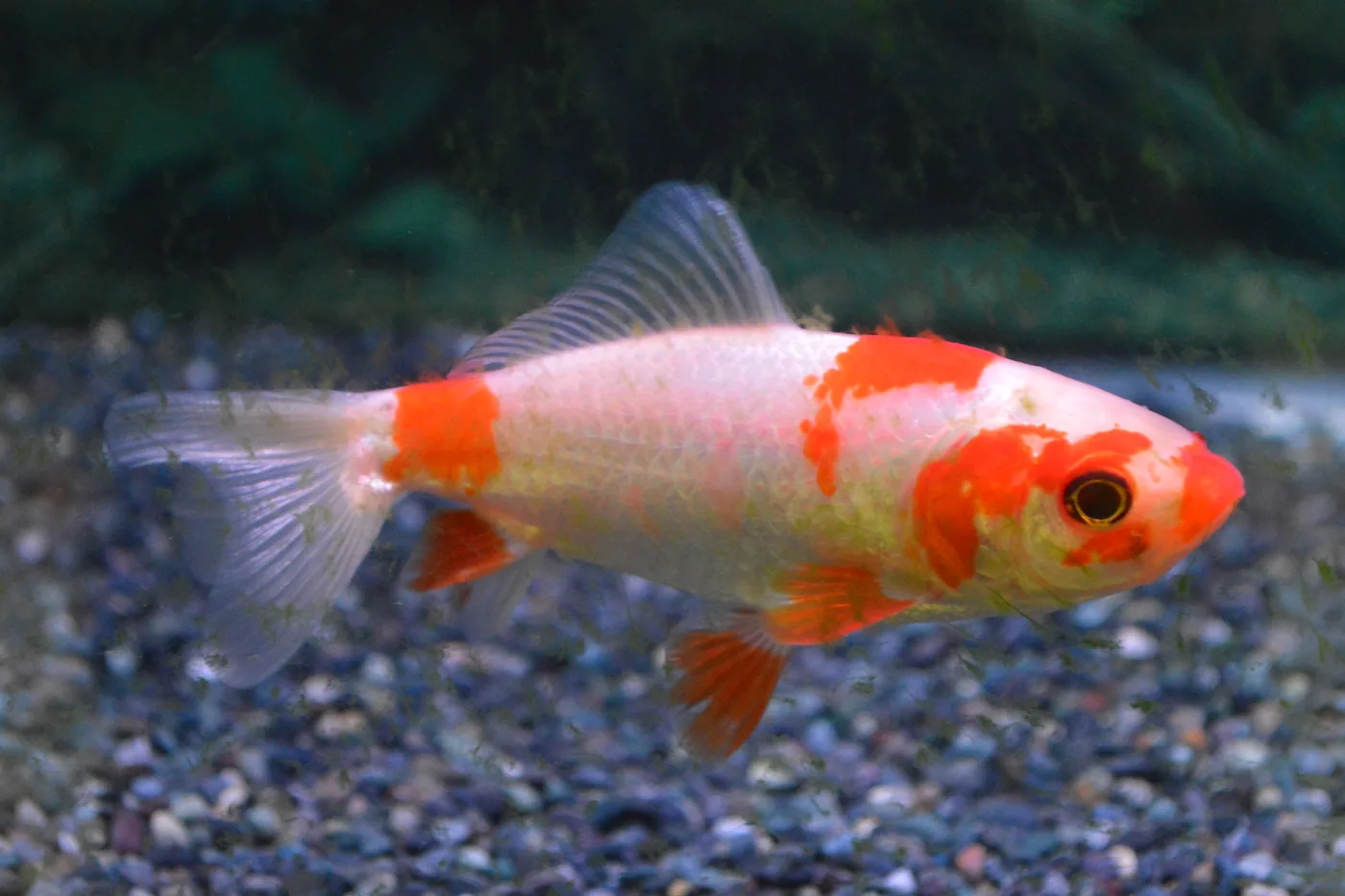
Photograph: Yatokin, CC BY-SA 4.0 · Wikimedia Commons. Numbers and lines added.
- Dorsal fin. Standing up, on the breeds that have one. Fins pressed to the body are one of the earliest warnings a goldfish gives.
- Gill cover. Both moving together, smoothly. Count them for fifteen seconds while the fish is well and at rest, and note the water temperature beside the number.
- Scales and sheen. Bright and lying flat. A dull, grey or milky film is not a colour, it is slime.
- Eye. Clear, and matched to the other one, allowing for the breed.
- Belly. Even, neither swollen nor hollow. The view from directly above shows the body best, and a side view like this one cannot.
- Vent. Clean and not red or swollen; a ripe female’s may sit slightly proud. Faeces short, dark and the colour of the food. Long, pale strings usually mean too much food, and persistent white ones with weight loss are a case for a vet.
- Tail. Spread, with clean edges and no red streaks running along the rays.
Counting the gill rate
The one number on that list, and worth doing once properly so it means something later — fast or laboured breathing is the page that uses it, and it is far more useful having been taken on a good day.
Count the gill-cover movements for fifteen seconds and multiply by four. There is no standard range for goldfish: the figure varies with temperature, body size, breed and how recently the fish noticed you, which is exactly why the absolute number is the least useful part of it.
Count it on your own fish, while it is well. From across the room rather than at the glass — a fish that has just seen you approach is not a resting fish — on an ordinary evening, and write the number down with the temperature beside it. From then on, “breathing fast” stops being a judgement and becomes a comparison, which is the difference between a worry and a finding.
Two things to note alongside the rate. Both covers should move together; one held shut or moving differently points at that gill rather than at the water. And the movement should be smooth rather than wide — flaring indicates a fish working considerably harder than a raised count alone suggests. Gasping at the surface covers what those mean when they appear.
Things that look wrong and are not
This list matters more than it looks, because a great deal of unnecessary medicating starts here. The behaviour lookup takes the same idea further, organised by what the fish is doing.
White pimples on a male’s gill covers and front fin rays. Breeding tubercles, not white spot. They sit in a neat pattern on exactly those two places, on a fish that is otherwise lively. Spawning explains the rest of the picture.
A fuller, softer belly on a female in spring. Eggs. The distinguishing question is always what the scales are doing: lying flat is a full fish, standing out from the body is a problem.
Resting on the bottom at night, with faded colour. Sleep. Goldfish have no eyelids and do not look asleep, but fish do show behavioural sleep: they settle, slow down and become less responsive, and many goldfish go pale while doing it. They should be alert within seconds of being disturbed.
A black moor turning bronze or orange. A normal, usually permanent change driven by genetics and age. It is not a disease.
Black patches appearing on an orange fish. Often healing. Skin darkens where it has been injured, and many keepers link black patches to ammonia burns, so a patch that follows a water quality problem is more likely a mark than a new illness — which is also a reason to check what the water was doing in the weeks before.
Gulping at the surface during feeding. Eating. It looks like gasping and is distinguished by context: gasping continues when there is no food, is accompanied by fast gill movement, and usually affects every fish at once.
A single yawn or gill flare. Goldfish stretch their gill covers and mouths occasionally, much as you might. One is nothing. Repeated, forceful flaring is worth attention.
A growing wen on an oranda or ranchu. The hood develops over the first two or three years and keeps thickening. Watch that it does not grow over the eyes; otherwise it is the breed doing what it was bred to do.
One flash against the gravel, now and then. Ordinary. It is repeated, frantic scratching that means something.
What a normal day looks like
The baseline in its other form. A goldfish’s day has a shape, and knowing the shape makes a departure from it obvious.
Early morning, before the lights. Low in the water or settled on the bottom, colour often faded, moving little. This is rest, and it is a picture often mistaken for illness — sitting on the bottom covers the distinction, which is whether the fish gets up.
Lights on. Rousing within a minute, colour returning, and then almost immediately at the front of the tank looking for you, because a goldfish associates light and movement with food.
Through the morning. Foraging. This is what goldfish mostly do: working over the substrate, picking at plants and decor, taking mouthfuls and spitting them out. A fish that is not foraging is worth a second look.
Feeding. Competing, taking food cleanly, and returning to foraging afterwards rather than hanging at the surface waiting for more.
Afternoon. Quieter. Cruising, some resting, occasional investigation. Fancies rest more than single-tails and are not being lazy about it.
Evening, lights off. Settling to the same place it settled last night. Goldfish are creatures of habit about where they rest, and a fish that has changed its spot has usually changed it for a reason.
Across the year, expect more activity and appetite as the water warms, spawning behaviour in spring, and a slower fish in a cool room in winter — the temperature guide covers what to expect at each band.
Normal for the breed
Several breeds carry features that would be alarming on a fantail. Knowing which is which prevents a good deal of unnecessary treatment.
| Breed | Normal, though it may not look it |
|---|---|
| Ranchu, lionhead | No dorsal fin at all. The back should be a smooth curve, not a gap where a fin ought to be. |
| Oranda, lionhead, ranchu | A wen that thickens over two or three years and keeps developing. Watch only that it does not grow over the eyes. |
| Telescope, black moor | Eyes standing clear of the head on stalks. Both should match each other and neither should be cloudy. |
| Celestial eye | Eyes rotated permanently upward, which is the breed and not a disease. In the strain studied the retina degenerates in the first months, so treat the fish’s vision as unreliable. |
| Bubble eye | Large fluid-filled sacs beneath the eyes. Fragile: a punctured sac can refill, and a torn one risks infection. |
| Pearlscale | Domed, raised-looking scales across the body. Compare against the fish’s own past appearance rather than against another breed, because this is exactly what raised scales look like in dropsy. |
| Black moor | Colour that fades toward bronze or orange with age, usually permanently. |
| Ryukin | A pronounced shoulder hump and a very deep body. Not a swelling. |
| Shubunkin, calico | Patches of black, blue and red that shift over months. |
The general rule: judge a fish against itself and against others of its own breed, and if you keep an unusual variety, read its breed page once while the fish is well so you know which of its oddities are the point.
Watching the group, not just the fish
In a tank with several goldfish, a quick diagnostic costs nothing and is easy to overlook.
Compare them against each other. One fish breathing faster than its tank mates, one hanging back at feeding, one sitting lower, one duller, one with a fuller belly — a difference between fish in the same water is far easier to see than a change in one fish over time, and it immediately separates a problem with an individual from a problem with the tank.
Which is the useful fork:
- Everyone affected points at the water, the temperature or something added.
- One affected points at that fish: a parasite that has taken hold in the weakest animal, an injury, or the one being bullied.
Social behaviour that is normal: a little jostling at feeding, brief squabbles over a good spot, and vigorous chasing in spring, which is spawning rather than aggression and is alarming the first time you see it.
Social behaviour that is not: persistent one-way chasing outside the breeding season, one fish consistently driven off food, or damage that keeps appearing on the same individual. Clamped fins covers how to confirm it, and the usual cause is space rather than temperament — how many goldfish has the figures.
Growth is a health sign
Easy to overlook because it happens slowly, and one of the strongest signals available in a fish under about two years old.
A young goldfish in good conditions grows visibly. Not week to week, but obviously over a few months, and the growth page has the year-by-year figures. A juvenile that has barely changed in twelve months is probably being held back by its environment — and that can be true even when the test kit reads clean, because growth integrates everything about the conditions over a long period in a way a single reading cannot.
How to track it without fuss. Photograph the fish beside something fixed — a mark on the glass, a particular ornament — every few months, from the same angle. Comparing two photographs six months apart takes ten seconds and answers a question that guesswork cannot.
And the other direction. An adult that is losing condition, seen from above as a narrowing behind the gill covers, is a finding even while it is still eating well; loss of appetite covers what weight loss with a good appetite usually means.
You have spotted a change. Now what?
The judgement this page implies and should answer, because noticing something and knowing what it is worth are different skills.
Test the water first, always. Whatever the change, this costs ten minutes, rules out a common cause of much of what is in the health section, and turns a vague worry into either an answer or a genuinely narrowed question. Few things you can do have that ratio.
Then weigh what you saw:
- One sign, mild, and the fish is otherwise itself. Watch it tomorrow. Photograph it today so tomorrow’s look is a comparison. Most single mild signs are gone by the second day.
- One sign that has persisted for several days. Worth working through the relevant health page properly, with the water tested.
- Two or more signs together. This is the combination that matters. A fish that is clamped and off its food, or breathing fast and sitting on the bottom, is telling you considerably more than either would alone, and it moves the timescale from days to today.
- Anything sudden, in a fish that was fine yesterday. Treat the speed itself as information. Sudden changes usually have environmental causes — something added, something failed, something died unnoticed.
And the thing not to do is treat. Almost every medication is a stressor, several damage the filter, and a treatment started before the water was tested is as likely to add a problem as remove one. Using medications safely covers the case where treating is genuinely the answer.
And a healthy tank
Some of what you are checking is not the fish at all.
Ammonia and nitrite at zero, every time you test. Nitrate under 40 mg/L and ideally under 20. A temperature that is steady rather than any particular number: 18 to 24 °C for fancies and 10 to 24 °C for single-tails are the usual keepers’ conventions, not limits, and what harms a goldfish is a large, fast swing. Water that is clear rather than cloudy, glass you can see through, a filter with an unchanged flow, and no smell beyond a faint earthy one. The water testing guide explains what each reading is telling you.
The short version
Look at your fish while nothing is wrong. Learn how it sits, how fast it breathes, how it holds its fins and how full it looks from above, and photograph it. Then most of the worried questions answer themselves, and the ones that do not will bring you to the health section with something far more useful than a description from the internet: a change you can actually name.
Frequently asked questions
How can I tell whether my goldfish is happy?
Happiness is not something a fish can report, but contentment has recognisable behaviour: a goldfish that is well spends its day foraging, moves around the whole tank rather than one corner, comes to the front when you approach, holds its fins open, and eats with enthusiasm. A fish that hangs in one place, keeps its fins pressed to its body, hides, or ignores food is telling you something. None of these is a diagnosis on its own; all of them are worth noticing.
My goldfish sits on the bottom at night. Is that normal?
Almost certainly. Goldfish rest, and a resting fish often settles near the substrate or against a plant with its colour slightly faded and its movements slow. It should become alert within a few seconds of the lights coming on or of you approaching. What is not normal is a fish sitting on the bottom during the day, unresponsive, with fins clamped, or repeatedly sinking after trying to swim up. The distinction is whether it can and does get up.
What is a normal breathing rate for a goldfish?
There is no standard range for pet goldfish. The rate varies with temperature, body size, breed and how recently the fish noticed you, so the absolute number is the least useful part. Count it on your own fish, on an ordinary evening, from across the room rather than at the glass, and write it down — from then on "breathing fast" stops being a judgement and becomes a comparison.
Is it normal for my goldfish to chase each other?
In spring, yes, and vigorously. A male pursuing a female around the tank, nudging at her flanks and following her relentlessly for days, is spawning behaviour rather than aggression, and it looks alarming the first time. Outside the breeding season, persistent one-way chasing that keeps one fish away from food or leaves it with damaged fins is a different matter, and usually means the tank is short of space or the two fish are badly matched.
How do I know the conditions are right, not just adequate?
Growth is a good answer, in a fish under about two years old. A young goldfish in good water with sensible feeding grows visibly over months, and one that has barely changed in a year is probably being held back by its environment, even if the test kit reads clean. After that the markers are steadiness rather than change: a fish that eats well, holds its fins open, sits level, breathes calmly and behaves the same way this month as last is in conditions that are working.
How often should I actually look at my fish?
Twice a day for a few seconds at feeding time, and once a week for two minutes properly. The feeding look catches the obvious: is everyone there, is everyone eating, is anyone hanging back. The weekly look is the one that catches slow changes — a fin held slightly tighter, a belly a little fuller, breathing a little faster — which is exactly the category of change that a memory is bad at and a photograph is good at.