01 Care guide
Goldfish anatomy and biology
Almost every piece of goldfish care makes more sense once you know how the animal is built. This is the reference the rest of the site assumes — what the gills actually do, why there is no stomach, why a fancy floats, and what a thousand years of breeding altered.
Most goldfish advice is a list of instructions: this much water, this often, this temperature. The instructions are sound, but they are much easier to remember — and much easier to adapt when your situation does not match the example — once you know what the animal they describe is actually like.
This page is that background. It is the reference the rest of the site assumes: what the gills are doing, why a goldfish is permanently at risk of absorbing its own aquarium, why a fancy floats and a comet does not, and what a thousand years of selective breeding rearranged. None of it is required to keep a goldfish well. All of it makes the rest make sense.
Goldfish anatomy
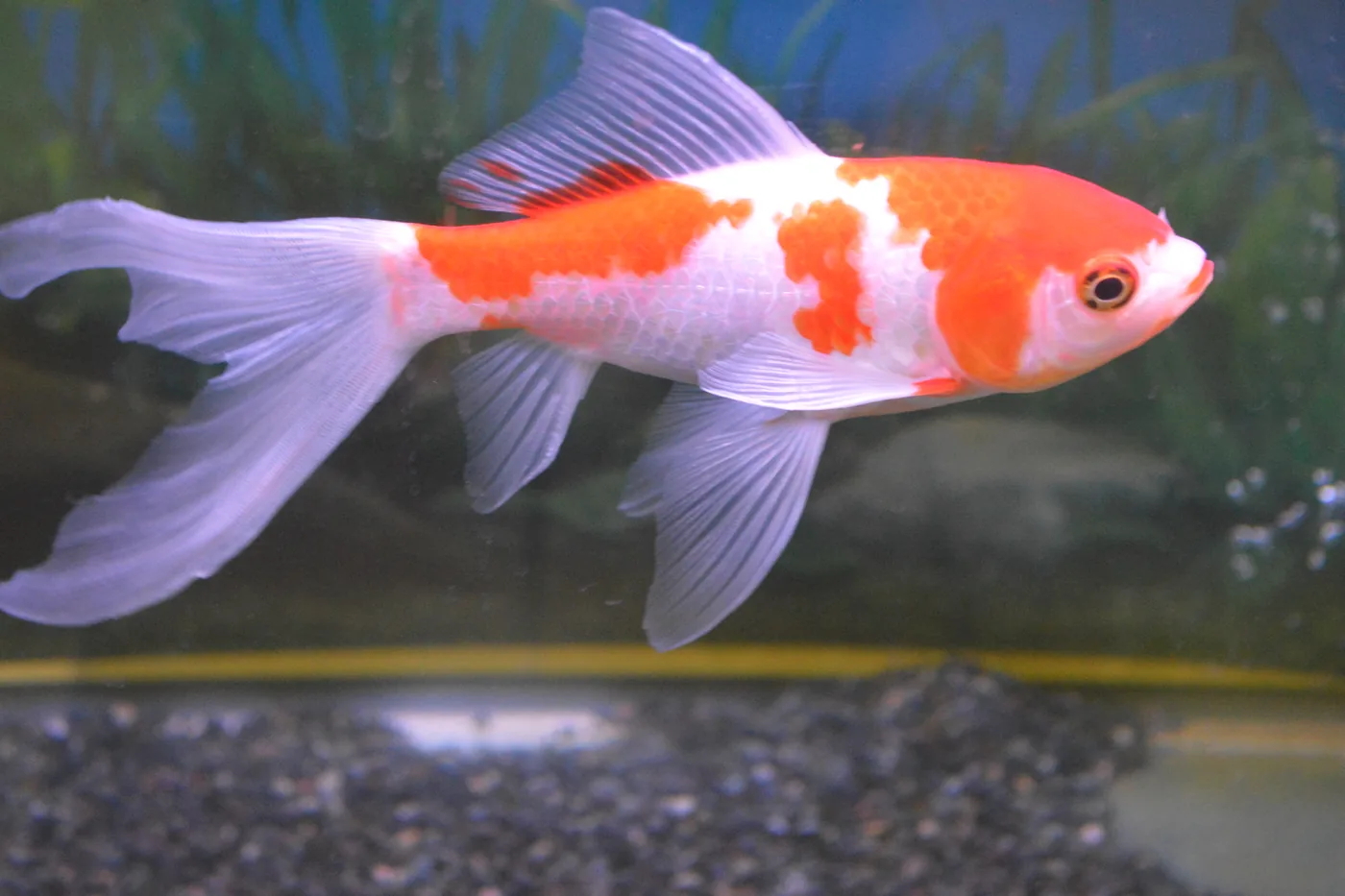
Photograph: Yatokin, CC BY-SA 4.0 · Wikimedia Commons. Numbers and lines added.
- Dorsal fin. Stability. Absent by design in ranchu, lionhead, bubble eye and celestial eye.
- Caudal fin (tail). Single in commons, comets and shubunkins; paired in most fancies and in the wakin and jikin, and single again in the tamasaba.
- Anal fin. Also paired in double-tailed breeds.
- Pelvic fins. Braking and fine position control.
- Pectoral fins. Steering, hovering and reversing; males grow breeding tubercles here in spring.
- Gill cover (operculum). Protects the gills; fast movement here is an early warning sign.
- Lateral line. Senses pressure and movement; part of why goldfish notice you before they see you.
- Eye. Goldfish see colour well, including some ultraviolet.
- Mouth. No teeth at the front; food is crushed by pharyngeal teeth in the throat.
The animal underneath
A goldfish is Carassius auratus, a member of the carp family, domesticated in China more than a thousand years ago from a dull olive-brown wild fish. Everything about the original animal is a design for a specific life: shallow, slow, often poorly oxygenated fresh water, a diet of whatever small edible matter can be sifted out of soft sediment, and a seasonal climate with a genuine winter.
That inheritance explains a great deal that surprises new keepers. Goldfish tolerate cold well because they evolved in water that froze at the surface. They are messy because sifting sediment all day is their idea of a meal. They grow large — 15 to 20 cm for most fancies, 25 to 35 cm for single-tails — because the wild animal is a substantial fish, and nothing about domestication changed that. They can live for many years because carp are long-lived.
The single-tailed goldfish — the common, the comet and the shubunkin — retain that body almost unaltered: a long, muscular, streamlined fish with a single tail, built to swim fast for a long time. The fancies are the same animal rebuilt, and the last section of this page covers what that rebuilding cost.
The gills
If you learn one piece of goldfish anatomy, learn this one, because it is where most goldfish problems either begin or show themselves.
Behind each gill cover — the operculum, the hard plate that opens and closes as the fish breathes — sit four gill arches. Each arch carries a double row of filaments, and each filament carries hundreds of tiny plates called lamellae stacked like the pages of a book. The point of all that folding is surface area: a structure small enough to tuck behind the gill cover presents a very large surface to the water, and it is only a few cells thick, because oxygen has to cross it. The surface is not fixed: in water below 15 °C a mass of cells covers the lamellae.
Water taken in at the mouth is pumped over those lamellae and out under the gill covers, while blood flows through them in the opposite direction. That opposition matters. Because the blood always meets water slightly richer in oxygen than itself, the gradient never reverses along the whole length of the exchange, and the fish can extract a remarkable share of the oxygen present. Fish gills in general work this way, goldfish included.
The gills are not only lungs. They are also:
- The main route for ammonia excretion. A goldfish does not primarily urinate its nitrogen waste; it diffuses ammonia straight out across the gills into the water. This is why a goldfish poisons its own tank so efficiently, and why filtration is really about processing what the gills put out.
- A salt pump. Specialised cells in the gill actively pull chloride and other ions out of the water to replace what is constantly lost to the surroundings.
- Part of the acid-base system, exchanging ions to keep blood pH steady.
Now consider what that thin, enormous, permanently exposed, multi-purpose organ is vulnerable to. Ammonia burns it. Nitrite is taken up by the same transporter that collects chloride, which is the mechanism behind nitrite poisoning. Chlorine and chloramine in untreated tap water damage the gills and can kill, which is why tap water is always dechlorinated first. Parasites settle there too. A pH swing disrupts the ion exchange.
And a damaged gill is almost invisible from outside. The fish cannot show you the inside of its gill chamber, and it will keep eating and swimming while a substantial fraction of its respiratory surface is gone. Faster or wider gill movement, one cover working differently from the other, or a fish hanging near the filter outflow are often the only signs. The gasping and flashing pages both trace back to this tissue.
Skin, slime and scales
A fish’s skin does a job yours does not have to: it separates two chemically different fluids that are constantly trying to equalise.
The outermost layer is the slime coat, a continuously secreted mucus that is far more than lubrication. It is a physical barrier against bacteria, fungi and parasites, and it carries antibodies, enzymes and antimicrobial compounds. Roles in slowing water uptake and in reducing drag are often suggested, but neither is well established. It is also fragile. A dry hand, a rough net, a chase or a scrape removes it in patches, and a patch without slime is an opening. This is a main reason handling a goldfish is discouraged and why minor injuries can become ulcers.
Beneath it, scales are bony plates growing from the skin itself, overlapping backwards like roof tiles and covered by a thin layer of living epidermis — which is why a scale is not a dead fingernail but part of the animal, and why losing one bleeds. Scales grow at the edges throughout life, laying down concentric rings that record periods of fast and slow growth. In a wild fish those rings mark summers and winters and can be counted like tree rings; in a heated indoor tank with steady feeding, there are no seasons to count.
Colour lives in the skin, in pigment cells of several kinds. Melanophores hold black pigment, xanthophores yellow, erythrophores red, and iridophores contain stacked guanine crystals that produce the metallic sheen of a “metallic” goldfish — and whose absence produces the pearly, matt look of a shubunkin or a calico.
The famous colour change of a young goldfish is usually put down to a loss of melanophores, so that a fish that hatches olive-brown and turns orange over its first year or two stops masking its orange with black rather than gaining orange pigment. The process is genetic and influenced by light and temperature, it runs at its own pace, and it can happen late in life too: a black moor often loses its black with age and finishes bronze or orange. This is normal, and it is one of the entries on the list of things that look wrong and are not.
Living in water that wants to get in
A freshwater fish has a problem that a marine fish does not. Its body fluids are considerably saltier than the water around it, so by simple osmosis water moves continuously into the fish, across every surface thin enough to allow it — gills above all, but also mouth, skin and the linings of the gut.
Left alone, the animal would swell. It does not, because it deals with the influx in two ways at once: the kidneys produce large volumes of very dilute urine, dumping water while retaining salts, and the gills actively reclaim ions from the surrounding water to replace what leaks out and what the kidneys inevitably lose.
This is quiet, continuous, energetically expensive work, and it runs in the background of everything else a goldfish does. It explains several things that otherwise look unrelated:
- Why a wound is worse for a fish. An open sore is a hole in the barrier, so the fish is not only exposed to infection but leaking osmotically at exactly the moment it needs its energy for healing.
- Why a sick fish often looks bloated. When osmoregulation fails, fluid accumulates — the mechanism behind the raised-scale appearance described on the swollen abdomen page.
- Why salt has a real but narrow role. Raising the salinity slightly narrows the gradient and reduces the work, which is a genuine support for a fish under strain and useless as a routine practice.
- Why sudden chemistry changes are stressful in a way that a steady value at either end of a range is not. The system is built to hold a set point, and moving the set point costs.
The swim bladder, and why it is connected to the gut
The swim bladder is a gas-filled sac in the body cavity that lets a fish hold a chosen depth without swimming. Adjust the gas, adjust the buoyancy.
In many fish the bladder is sealed and gas is added or removed through the blood, slowly. Goldfish belong to the other group. Their swim bladder retains an open duct to the oesophagus, which means a goldfish can gulp air at the surface and pass it into the bladder, and can burp gas out the same way. It is a fast, direct system, and a suspected source of trouble.
A goldfish feeding at the surface can take in air with its food. In a long-bodied single-tail this seldom matters. In a round-bodied fancy, whose body cavity is compressed into a sphere and whose gut is folded to fit, swallowed air is one suspected contributor to the buoyancy disorders that are common in these breeds, and one argument for sinking rather than floating food.
Buoyancy trouble in a fancy has more than one possible cause. Keepers suspect air swallowed at the surface, a gut full of food pressing on the bladder, or constipation from a diet with too little fibre; infection and a deformed bladder or body also occur, and no study gives the proportions. Keepers report that sinking or soaked food and a short fast help some fish, though there is no controlled evidence, and a fish that does not improve is worth an aquatic vet’s opinion.
The bladder has a second, quite separate job, which is the subject of the next section but one.
A digestive tract with no stomach
A goldfish has no stomach. Not a small one — none at all. Food passes from the mouth, through the throat where the pharyngeal teeth grind it, down the oesophagus, and directly into an intestine that handles digestion and absorption along its length. There is no acid-secreting chamber, no reservoir, and nowhere to hold a large meal while it is worked on.
This is normal for carp and it is one of the most practically important facts in goldfish feeding. An animal with no stomach is built to eat small amounts almost continuously, extracting what it can from a steady trickle of material. Give it a large meal and the tract simply fills; food is pushed through faster than it can be digested, absorption falls, and the water pays for what comes out the other end.
Much of the feeding frequency and overfeeding advice follows from this: small meals, several times a day, each gone within a minute or two. The advice is not caution for its own sake — it is a description of the plumbing.
Two further consequences are worth knowing. First, goldfish benefit from fibre, which is why blanched peas and other vegetables are a genuine part of the diet rather than a treat. Second, in a fancy the whole tract is folded into a compressed body cavity, pressed against the swim bladder, which may be why digestive problems and buoyancy problems in round-bodied fish are often linked.
The senses
Goldfish are considerably better equipped than their reputation suggests.
Vision. Goldfish see in colour, with four types of cone cell — including one sensitive into the ultraviolet, which is more than human eyes manage. Their eyes sit on the sides of the head, giving a very wide field of view, with a narrow region of overlap in front and a blind spot directly behind. They tell shapes, colours and patterns apart; telling individual people apart has not been shown.
The lateral line. A row of pores running along each flank, visible on most goldfish as a faint dotted line, opening into a canal lined with hair cells. It detects water movement and pressure changes, giving the fish a sense with no human equivalent: an awareness of currents and of other animals moving nearby. Whether it also lets a goldfish sense obstacles and find its way in the dark is not well established. A blind or telescope-eyed fish often manages well in a stable tank, whatever the explanation.
Smell. Two pairs of nostrils on the snout lead to chambers of sensory tissue. Water flows in one and out the other as the fish swims. Smell, taste and sight all help a goldfish find food, and a fish that cannot see well can often still find a sinking pellet in a planted corner.
Taste. Taste buds are not confined to the mouth; cyprinids carry them on the lips and across the body surface, so a goldfish tests things by mouthing them. This is why a goldfish picks up gravel and spits it out — it is not confusion, it is the standard procedure for finding out what something is.
Hearing. This is the surprising one. Goldfish belong to the Ostariophysi, a group whose members possess a Weberian apparatus: a chain of small bones derived from vertebrae, connecting the swim bladder to the inner ear. Sound in water vibrates the gas-filled bladder, the bones transmit those vibrations to the ear, and the bladder effectively works as an eardrum. The result is a hearing range and sensitivity well beyond a fish without the arrangement — and a second job for the swim bladder. It is a reason to keep a tank away from a speaker or a slammed door.
Heart, blood and why nitrite kills
A goldfish heart has one atrium and one ventricle, and drives a single circuit: blood goes from the heart to the gills to be oxygenated, then onward to the body, then back to the heart. There is no separate pulmonary loop as in a mammal, which means blood arrives at the body having already lost pressure passing through the gills. It is an efficient enough arrangement for an animal whose oxygen supply is dissolved in the medium it lives in.
Oxygen is carried, as in you, by haemoglobin in red blood cells. This is the detail that makes nitrite so dangerous: nitrite absorbed at the gills converts haemoglobin into methaemoglobin, which cannot carry oxygen. A fish in nitrite-contaminated water suffocates in water that has plenty of oxygen in it, and its gills and blood take on a characteristic brown cast. The suffocation is chemical, not environmental, which is why aeration alone does not fix it.
An animal with no thermostat
A goldfish is an ectotherm: its body temperature is the water’s temperature, and its metabolic rate rises and falls with it. As a rough rule, chemical and biological processes roughly double in rate for every 10 °C increase, and much of a fish’s physiology follows that curve, though not all of it: in goldfish given time to acclimate, net ammonia excretion changes little between 7 and 25 °C.
So temperature is not a comfort setting. It is one of the main controls on the whole animal. At 12 °C a goldfish eats little, digests slowly, grows slowly, heals slowly and mounts a sluggish immune response. At 24 °C it eats more, grows faster, produces more waste because it eats more, and both it and any pathogen present are running fast. This is why:
- Feeding changes with temperature. Digestion slows progressively as the water cools and goldfish eat less of their own accord; many keepers stop feeding pond fish at about 8–10 °C as a precaution.
- Cold water is not dangerous but a cold snap is. A goldfish at a steadily low temperature is fine. A goldfish dropped several degrees in an hour has its immune response suppressed while the parasites around it are largely unaffected, which is a common trigger for an ich outbreak.
- Fancies and single-tails are given different ranges. 18–24 °C and 10–24 °C respectively are keepers’ conventions, as the temperature guide sets out, not limits: goldfish tolerate roughly 0–41 °C once acclimated, and what harms them is a large, fast swing.
- Healing is temperature-dependent. A wound closes slowly in cold water.
What selective breeding changed
Every fancy goldfish is the wild carp body altered, and each alteration has an anatomical consequence. Knowing which is which turns a list of breed quirks into something predictable.
| Alteration | What it changes | The consequence |
|---|---|---|
| Shortened, deepened body | Gut folded, swim bladder displaced | Buoyancy disorders are common in round-bodied breeds |
| Doubled caudal and anal fins | More drag, less thrust | Slow swimmers that lose every race to food |
| Dorsal fin removed | No keel | Ranchu and lionhead often roll more and steer less precisely |
| Enlarged, protruding eyes | Delicate tissue outside the body line | Telescopes and moors injure their eyes on decor |
| Upturned eyes | Permanent upward gaze | In the strain studied the retina degenerates in the first months, so vision is unreliable |
| Fluid-filled sacs under the eyes | Thin-walled, unsupported, no muscle | Bubble eyes are easily ruptured |
| Hypertrophied head tissue (wen) | Thickened skin that keeps growing | Can obstruct vision and nostrils; folds harbour infection |
| Domed, thickened scales | Rigid body wall | Pearlscales are poor swimmers |
None of these is a disease. They are the intended results of centuries of selection — the domesticated goldfish covers where that selection came from and why so much of it was aimed at a view from above — and the fish carrying them are not suffering by default. But they are all departures from a body that worked, and every one of them converts into a care requirement: smooth decor, sinking food, gentle flow, matched tankmates, a wider margin on water quality. The fancies are the more demanding fish for reasons that are entirely structural. The names breeders gave these features, from the wen to the narial bouquet, are collected in the glossary.
Growth and age
Goldfish grow throughout life, quickly at first and then progressively more slowly, and growth rate depends far more on the environment than on the calendar: volume, water quality, temperature and diet together account for most of the variation between two fish of the same age. A goldfish in a small tank does not stop growing because it has sensibly matched its container — the persistent “they grow to the size of the tank” belief has the causality backwards. What is well supported is that fish held in small volumes with accumulating waste grow more slowly, and that a body which grew unevenly does not work as well as one that did not. The popular mechanism, in which the skeleton stops while the organs carry on until the fish is crushed from the inside, is repeated far more confidently than the evidence supports. Either way it is a welfare problem rather than a convenient size limit, and the how big do goldfish get page sets out what is and is not established.
Lifespan follows the same logic. Care guides such as the RSPCA’s give 10 to 15 years for goldfish and fancies; the Bristol Aquarists’ Society says the more developed varieties, such as the short-bodied twintails, live 7 to 10 years or so, and single-tails are given 15 to 20, some longer. The record is Tish, a goldfish won at a fair in 1956 and kept by the same family, who died in 1999 aged 43 (Guinness); FishBase gives a maximum of about 41. Many pet goldfish die well short of these figures, usually for environmental reasons, though infection and the fish’s origin play a part — the subject of how long goldfish live and, when it has already happened, why a goldfish dies.
An ageing goldfish slows down, often fades in colour, and becomes less interested in food over its final months. There is no treatment for that, and a fish that reaches it has had the life the animal is capable of.
Frequently asked questions
Do goldfish have teeth?
Yes, but not where you would look for them. A goldfish has no teeth in its jaws at all — the mouth is a soft, protrusible tube for picking things up. The teeth are pharyngeal, set in the throat, where they grind food against a hard pad at the base of the skull. You can sometimes hear a large goldfish crunching a snail or a pea. This arrangement is why a goldfish can crush surprisingly hard food while being physically incapable of biting another fish, and why fin damage in a goldfish tank is often mechanical, spawning-related or bacterial rather than a bite.
Why does my goldfish have no stomach?
It is a carp, and carp are built to eat small amounts more or less continuously rather than to take large meals and digest them slowly. Food passes from the oesophagus into an intestine that does the whole job of digestion and absorption, with no acid-secreting chamber in between and nowhere to hold a backlog. That fact is behind much of the usual goldfish feeding advice: small meals several times a day suit the anatomy, a large one does not, and food that is still arriving when the previous meal has not cleared is how a goldfish ends up with a gut full of undigested pellets.
Can goldfish really hear?
Better than most fish, and better than people expect. Goldfish belong to a group whose swim bladder is linked to the inner ear by a chain of small bones — the Weberian apparatus — which works as an amplifier in the same way the bones of your middle ear do. The swim bladder vibrates with sound in the water, the bones carry that vibration to the ear, and the result is a hearing range far wider than a fish without the arrangement. Goldfish can be trained to associate a sound with food, and it is a reason to think about where the tank sits in a noisy room.
Why do fancy goldfish have so many more problems than commons?
Because every feature that makes a fancy a fancy is a deviation from a body that worked. Compressing a long streamlined body into a sphere folds the gut and displaces the swim bladder, which fits the buoyancy disorders that are common in round-bodied breeds. Removing the dorsal fin removes a keel. Enlarging the eyes puts delicate tissue where the fish cannot see it. A wen is thickened skin that can grow over the eyes and nostrils. None of these is a defect in the sense of something having gone wrong; they are the intended results of selection, and the care they need is the price.
How can you tell how old a goldfish is?
Not precisely, and not from the outside with any confidence. Scales lay down growth rings in the way a tree does, faster in warm well-fed periods and slower in cold ones, and a specialist can estimate age from a scale under magnification — but the rings are laid down by season, and an indoor goldfish in a room at a steady temperature with steady feeding does not have seasons. Size is a poor guide because growth depends far more on volume, water quality and diet than on age. In practice you know a goldfish's age only if you know when it arrived, and even then the shop rarely knows how old it was then.
What is the slime coat and can I damage it?
The slime coat is a layer of mucus the skin secretes continuously. It is a physical barrier against bacteria and parasites, and it carries antibodies and enzymes that attack them. Roles in slowing the constant osmotic flow of water into the fish and in reducing drag are often suggested, but neither is well established. It is also easily removed. A dry hand, a rough net, a chase around the tank or a scrape on decor all strip patches of it, which is why handling a goldfish is worth avoiding and why an injury that would be trivial on your skin can become an ulcer on a fish.