01 Care guide
A goldfish glossary
Goldfish keeping has a vocabulary of its own, from biology, from water chemistry and from centuries of breeders naming what they selected. This is where the words are explained, each with the page that covers it in full, and with the few that are most often misread marked as such.
Keeping goldfish comes with a vocabulary: some of it from biology, some from water chemistry, and some from centuries of breeders naming what they had selected. The pages on this site use it without stopping to explain every word, because stopping on every page would bury the point of each one. This is where the words are explained once.
Each entry says what the term means, what it is often taken to mean instead where that matters, and which page covers it in full. The sections follow the order in which a new keeper tends to meet the words: the fish, then its water, then the equipment, then the things that go wrong.
The body
Anal fin. The fin on the underside, just behind the vent. Single in the single-tailed breeds and paired in most fancies.
Barbels. Whisker-like feelers at the corners of the mouth. Goldfish have none and koi have two pairs, which is the quickest way to tell the two apart, as koi or goldfish explains.
Caudal fin. The tail. Single in the common goldfish, the comet and the shubunkin; split into two lobes in most fancies.
Dorsal fin. The fin along the top of the back. The ranchu, lionhead, celestial eye, bubble eye and most pompoms have none, by design rather than by accident.
Gill cover, or operculum. The bony flap over the gills. Its movement is the breathing rate, and counting it while the fish is well gives a keeper the most useful single number there is; fast or laboured breathing is the page that uses it.
Gill rakers. Comb-like projections on the gill arches. With the muscular palatal organ on the roof of the mouth, they help a goldfish sort food from sand and grit, and spit out what it cannot eat.
Head kidney. The front part of the kidney, behind the gills. It makes the stress hormones, and it is one of the main organs of the immune system; stress in goldfish covers why that pairing matters.
Lateral line. A row of pores along each flank that senses pressure and movement in the water, and lets a goldfish find its way in the dark. What a goldfish can see, hear and smell covers it with the other senses.
Nares. The nostrils: a pit on each side of the snout, used for smell alone and not joined to the mouth.
Pectoral fins. The paired fins just behind the gill covers, used for steering, hovering and reversing. A male in breeding condition carries a row of tubercles along their leading rays.
Pelvic fins. The paired fins on the belly, in front of the vent, used for braking and for fine adjustments of position.
Pharyngeal teeth. Teeth in the throat rather than the jaws, which have none. A goldfish takes food in without chewing and grinds it behind the gills, an arrangement the anatomy page sets out.
Slime coat. The layer of mucus over the skin. It is the fish’s first defence against bacteria and parasites, and it is what rough handling, poor water and many medications strip away.
Swim bladder. The gas-filled organ that keeps a fish neutrally buoyant, with two chambers in a goldfish. In a round-bodied fancy the gut presses against it, which is why floating upside down is so often a question of food.
Vent. The opening just in front of the anal fin, through which faeces, eggs and milt pass. Vent problems covers what is and is not normal there.
Weberian apparatus. A chain of small bones joining the swim bladder to the inner ear, which turns the bladder into an amplifier. It is the reason goldfish hear far better than most fish.
Goldfish anatomy
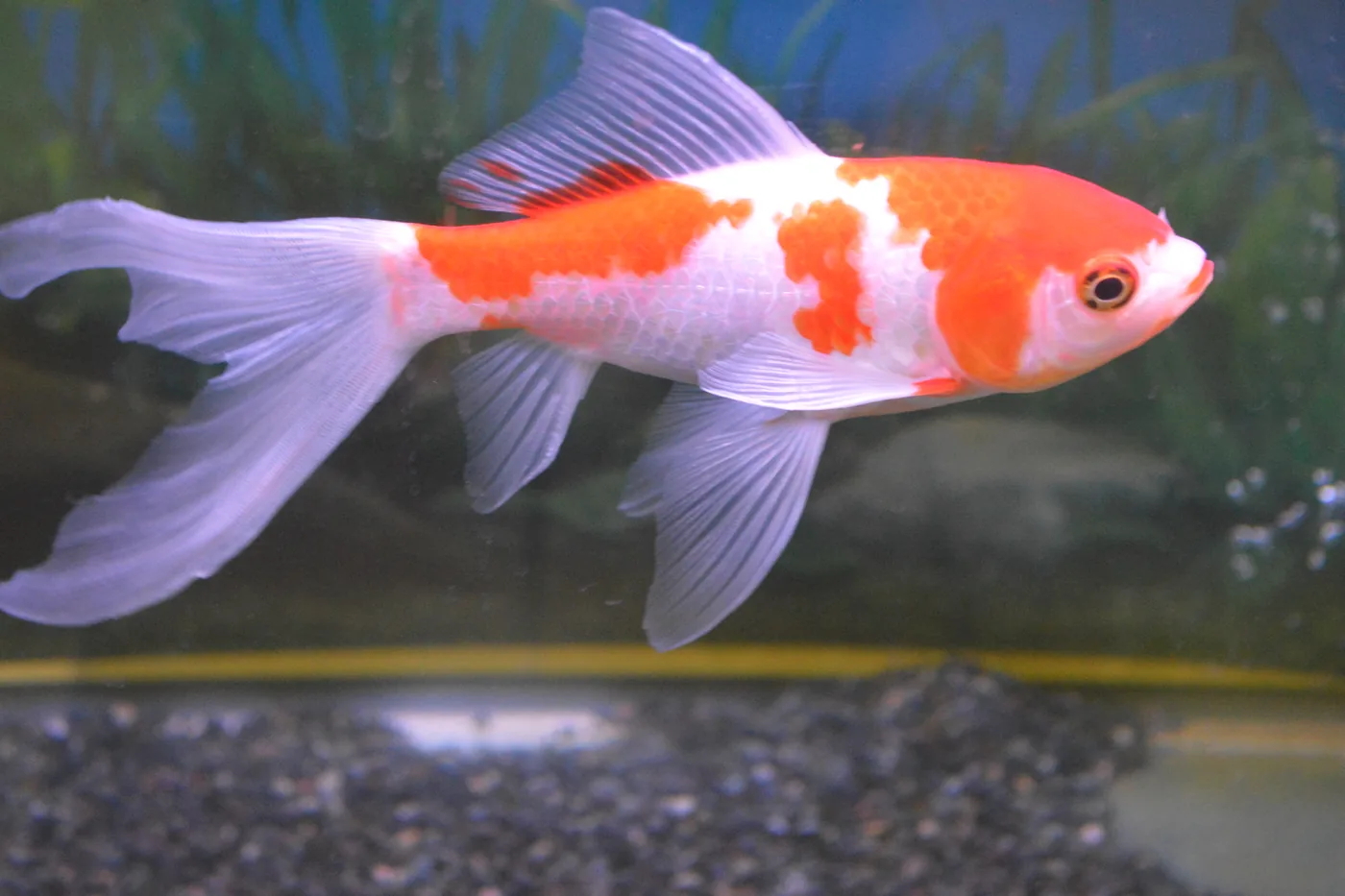
Photograph: Yatokin, CC BY-SA 4.0 · Wikimedia Commons. Numbers and lines added.
- Dorsal fin. Stability. Absent by design in ranchu, lionhead, bubble eye and celestial eye.
- Caudal fin (tail). Single in commons, comets and shubunkins; paired in most fancies and in the wakin and jikin, and single again in the tamasaba.
- Anal fin. Also paired in double-tailed breeds.
- Pelvic fins. Braking and fine position control.
- Pectoral fins. Steering, hovering and reversing; males grow breeding tubercles here in spring.
- Gill cover (operculum). Protects the gills; fast movement here is an early warning sign.
- Lateral line. Senses pressure and movement; part of why goldfish notice you before they see you.
- Eye. Goldfish see colour well, including some ultraviolet.
- Mouth. No teeth at the front; food is crushed by pharyngeal teeth in the throat.
Shape, scale and colour
Bronze. The olive-brown of the wild fish the goldfish descends from. Many young goldfish are bronze and colour up somewhere between three months and two years; some never do, and a bronze goldfish is not a sick one.
Calico. A nacreous fish patterned in red, orange, black, blue and white: the colouring of the shubunkin and of the calico fancies.
Dorsal-less. Bred without a dorsal fin, like the ranchu, lionhead, lionchu, celestial eye and bubble eye. The pompom is usually dorsal-less too, though a form with a dorsal fin is sold under the same name.
Double tail. A caudal fin split into two lobes, usually with the anal fin doubled too. It marks most fancies, and also the wakin and jikin, which carry it on a long body.
Fancy. Any breed shaped away from the wild form: shorter, rounder, usually double-tailed, and sometimes with changed eyes or a hood. Fancies are slower and less hardy than the single-tails, which is the reason the two are not kept together. What kind of goldfish do I have? sorts them by two questions.
Hood. Another name for the wen.
Metallic, matt and nacreous. The three scale types, set by how much reflective tissue the scales carry. Metallic scales have a full reflective layer, the familiar shiny orange. Nacreous fish have it on some scales and not others, so the colours beneath show through in patches. Matt fish have essentially none and look flat, often pinkish. Goldfish genetics explains how each is inherited.
Narial bouquets. The fleshy pompoms that grow from the nostrils of the pompom, from the nose rather than the hood.
Single-tail. The common goldfish, the comet and the shubunkin: the long-bodied fish closest to the wild form, fast, hardy and large, and at home in a pond. How big goldfish get gives their adult sizes.
Telescope, celestial and bubble eyes. The three eye types bred into fancies: eyes pushed out to the sides, eyes turned to look straight up, and upturned eyes with a fluid-filled sac beneath each. The telescope page sets the three side by side.
Wen. The raspberry-textured growth on the head of the oranda, lionhead and ranchu. It is a thick, soft growth of the skin, not ordinarily a tumour, and it goes on developing for two years or more. Wen care covers keeping it healthy.
Water and its chemistry
Ammonia. The waste goldfish excrete, mostly through their gills, and the most toxic thing in most tanks. It should read zero. Testing goldfish water covers what each reading means.
Chloramine. Chlorine bonded to ammonia, which many water supplies now use because it lasts longer in the pipes. It does not gas off from standing water the way chlorine does, so a conditioner has to be one that says it treats chloramine.
Chlorine. The disinfectant in tap water, lethal to fish and to filter bacteria alike, and removed at once by a water conditioner. Tap water and source water covers both chlorine and chloramine.
Conditioner, or dechlorinator. A treatment that neutralises chlorine and chloramine in tap water. It goes into every drop of new water, not just the first fill.
Cycling. Growing the bacteria, in the filter and on every surface, that turn ammonia into nitrite and nitrite into nitrate. A new tank is not safe for fish until it is done, and it takes weeks: four to eight for a fishless cycle. Cycling a goldfish aquarium covers both methods.
Fish-in and fishless cycling. Cycling with the fish already in the tank, kept safe by frequent water changes, or cycling with an ammonia source and no fish at all. Fishless is the kinder route; fish-in is what happens when a fish arrives before its tank is ready.
GH. General hardness: the dissolved calcium and magnesium in the water. Goldfish are largely indifferent to it across the range of ordinary tap water.
KH. Carbonate hardness, or buffering: what stops the pH from moving. A tank with little KH can see its pH fall suddenly, which is why KH matters more to a goldfish keeper than GH. pH, KH and GH explains the three together.
New tank syndrome. Ammonia and nitrite poisoning in a tank that has not finished cycling, and a common way for a new goldfish to die.
Nitrate. The end of the chain: far less toxic than ammonia or nitrite, and kept down by water changes rather than by the filter. Ideally under 20 mg/L, and comfortably under 40.
Nitrite. The middle of the chain, toxic because it stops the blood carrying oxygen. Like ammonia, it should read zero.
Nitrogen cycle. The whole chain, from waste to ammonia to nitrite to nitrate, and the reason both cycling and water changes exist.
The nitrogen cycle
pH. How acid or alkaline the water is. Goldfish do well between about 7.0 and 8.0, and a sudden change harms them more than any steady value inside that range.
Filters, tanks and kit
Air stone. A porous block that breaks air from a pump into fine bubbles. It adds oxygen through the bubbles and, by keeping water moving up to the surface, at the surface too, as aeration and oxygen explains.
Bare bottom. A tank with nothing on the floor: the easiest kind to keep clean, and the standard for hospital and quarantine tanks.
Bioload. The waste a tank’s fish produce, which the filter and the water changes must deal with. It grows with the fish’s bulk rather than its length, which is why stocking is counted in litres rather than in fish; how many goldfish a tank can hold works through the numbers.
Biological, mechanical and chemical media. The three jobs inside a filter. Mechanical media catch debris, biological media give the bacteria somewhere to live, and chemical media such as carbon take up dissolved substances. Filter media covers what goes where, and in what order.
Biofilm. The thin living layer that forms on every wet surface, including the white film on new wood. It is mostly harmless, and part of what a mature tank is; snails, hitchhikers and biofilm covers the rest of what arrives uninvited.
Canister, hang-on-back and sponge filters. A sealed filter below the tank, a box hung on its rim, and a sponge driven by air: the three common types, each with its place. Goldfish filtration compares them.
Hospital tank. A small, bare, separate tank for treating one sick fish without medicating the whole display. Setting one up takes an afternoon and a sponge seeded in advance.
Mulm. The brown sediment of waste and decaying matter that settles in gravel and in filters, and is siphoned out at water changes.
Photoperiod. The hours a day the tank light is on: commonly six to eight, on a timer. Longer mostly grows algae. Aquarium lighting covers the rest.
Quarantine. Keeping a new fish apart for at least four weeks before it joins the others, to see whether it has brought anything with it. Quarantining a new goldfish covers the tank and the watching.
Spray bar. A pipe with a row of holes on a filter’s return, which spreads the outflow so fancies are not pushed around the tank.
Stocking. How many fish a tank can hold, and the arithmetic behind it, worked out from volume, filtration and the fish’s adult size.
Substrate. Whatever covers the floor of the tank. Sand or bare glass is safer than small gravel, which a goldfish can take into its mouth and fail to spit out again; substrate for goldfish explains why the middle size is the dangerous one.
Turnover. How many times an hour a filter moves the tank’s volume: its flow divided by the volume. Five to ten times an hour is a common goldfish target, and a filter’s rated flow is measured clean and empty, so real flow is lower.
Anatomy of a goldfish aquarium
- Filter rated well above the tank’s volume, outflow softened for fancies.
- Air stone or surface agitation so oxygen can enter and carbon dioxide leave.
- Sand or bare bottom. Small gravel can be swallowed and lodge in the throat.
- Smooth decor with no sharp edges or gaps a fish could wedge into.
- Hardy plants such as anubias and java fern, attached to rock or wood.
- Thermometer where you can read it daily; avoiding large, fast swings matters more than the exact number.
- Lid and light on a timer for six to eight hours a day.
Health
Acclimation. Bringing a new fish’s water to the tank’s temperature and chemistry before it goes in. Choosing and bringing home a goldfish gives the first hour step by step.
Aquarium salt. Plain sodium chloride with nothing added, used at measured strengths for particular problems. It is not a tonic, and table salt, which may be iodised and usually carries an anti-caking agent, is not a substitute; see aquarium salt.
Clamped fins. Fins folded tight against the body: a common sign that something is wrong, and no diagnosis of what. Clamped fins covers what to check.
Columnaris. A bacterial infection that shows as a greyish-white patch near the mouth, on the gills or as a pale saddle across the back. It spreads fast and is dangerous.
Dropsy. A swollen body with the scales lifted like a pine cone: a sign of fluid building up inside, usually from failing organs, rather than a disease of its own. Swollen abdomen covers what else a swelling can be.
Fin rot. Bacterial decay that starts at the fin edges and works inward, driven far more by poor water than by the bacteria themselves. Torn fins tells it from a tear.
Flashing. Darting and rubbing against decor or the floor: a sign of irritation, from the water or from skin parasites. Flashing and rubbing covers which.
Flukes. Tiny flatworm parasites of the gills and skin, invisible without a microscope. Goldfish diseases explained covers them with the other named diseases.
Ich, or white spot. A parasite that shows as white spots like grains of salt, and the classic follow-on from a chill or a move. White spots covers it, and what else looks like it.
Mycobacteriosis, or fish TB. A slow bacterial infection that wastes a fish over months while it goes on eating. Losing weight is where it is usually first suspected.
Popeye. An eye pushing out from its socket, on one side or both, from injury or from fluid behind it. Popeye and bulging eyes tells the breed eye from the problem.
Stress. The response a fish mounts to a threat: useful for minutes, and harmful when a cause keeps it going for days. Stress in goldfish covers the causes in the order to check them.
Stunting. A goldfish held small by a tank too small, too crowded or too poorly kept for it. It is not an adaptation, and not a harmless way of staying small; see how big goldfish get.
Swim bladder disorder. A fish that cannot hold its level. In fancies it is often mechanical, the gut pressing on the bladder, but infection, fluid in the bladder and kidney disease also cause it.
Tubercles, or breeding stars. Small, hard white spots on a male’s gill covers and along the leading rays of his pectoral fins, in spring: a sign of breeding condition, not of white spot. Sexing goldfish explains how to tell the two apart.
Food and breeding
Carotenoids. The red and orange pigments a goldfish cannot make for itself and takes from its food. A diet short of them fades the fish over months, as pale or faded colour explains.
Conditioning. Bringing fish into breeding condition, with a winter rest, spring warmth and rich food. Breeding goldfish covers the cycle.
Fasting. A planned day or more without food. It helps with some problems and is the wrong answer to others; see fasting and rest days.
Fry. Newly hatched goldfish, which need food far smaller than anything sold in a tub. Feeding fry and young goldfish covers the first weeks.
Gel food. Food set with gelatine or agar: soft, moist and sinking, and well suited to fancies. Gel food covers making and buying it.
Infusoria. A culture of microscopic organisms sometimes used for the tiniest fry. Goldfish fry can take rotifers or newly hatched brine shrimp from their first feed.
Sinking and floating food. Food that sinks lets a round-bodied fancy feed level; food that floats has it tipping at the surface and swallowing air. Sinking versus floating food sets out the difference.
Spawning. The chase and the egg-laying of breeding goldfish, which happens on its own in spring in many tanks and ponds. Is my goldfish breeding? covers what to expect.
Units, and the gallon that comes in two sizes
This site gives volumes in litres first, with US gallons in brackets, and temperatures in degrees Celsius with Fahrenheit alongside.
Litres and gallons. A US gallon is 3.785 litres and an imperial gallon, the one still used in the UK, is 4.546. The same tank therefore comes out at about a sixth fewer gallons when its size is quoted in imperial ones. A figure from an American source and one from a British source can describe the same tank with different numbers, and the aquarium volume calculator gives all three.
mg/L and ppm. Milligrams per litre and parts per million, which for the water tests a keeper uses are the same number under two names. Nitrate is the one trap: a kit that reports nitrate-nitrogen shows a figure about a quarter the size of the nitrate one, so multiply it by 4.4 before comparing it with 20 or 40 mg/L.
Degrees. Single-tailed goldfish do well from about 10 to 24 °C (50 to 75 °F) and fancies prefer 18 to 24 °C (64 to 75 °F). Goldfish handle a wide range of temperatures and a fast change badly, as the temperature guide explains.
Frequently asked questions
What does KH mean on a test kit?
Carbonate hardness, which is the water's buffering: its ability to absorb acid without the pH moving. A tank with plenty of KH holds its pH steady, and a tank with very little can see its pH fall suddenly as waste acidifies the water. It is a different measurement from GH, which is the dissolved calcium and magnesium, and from pH itself.
Are ppm and mg/L the same thing?
For the water tests a goldfish keeper uses, yes. Milligrams per litre and parts per million are equal in fresh water, so a nitrate reading of 20 mg/L is 20 ppm, and a test card printed in one unit can be read in the other without converting. The exception to watch is nitrate: a kit that reports nitrate-nitrogen gives a figure about a quarter the size of the nitrate one, so check which a card means.
What is the difference between a fancy and a single-tail goldfish?
Single-tails, meaning the common goldfish, the comet and the shubunkin, keep the long body and single tail of the wild fish: fast, hardy, large and at home in a pond. Fancies were bred away from that shape: shorter, rounder, usually double-tailed, sometimes with changed eyes or a hood, and slower and less hardy. The two are not kept together, because the single-tails take every meal.
What does nacreous mean in goldfish?
A scale type rather than a colour. Nacreous fish have reflective tissue on some scales and not others, so the pigment beneath shows through in patches, which gives the blues, blacks and speckled reds of calico fish such as the shubunkin. Metallic fish have a full reflective layer and matt fish have essentially none.
What is bioload?
The waste a tank's fish produce, which the filter and the water changes have to deal with. It grows with the fish's bulk rather than its length, because a fish twice as long is several times as heavy, which is why stocking is worked out in litres per fish rather than centimetres of fish.
What does it mean when a tank is cycled?
That the bacteria which turn ammonia into nitrite, and nitrite into nitrate, have grown large enough to keep both at zero for the fish in it. It takes four to eight weeks to grow them from nothing without fish, and it can be set back badly if the media are scrubbed or soaked in untreated tap water, or if the filter sits for weeks with nothing to feed on.
What is a wen on a goldfish?
The raspberry-textured growth on the head of an oranda, lionhead or ranchu. It is a thick, soft growth of the skin, not ordinarily a tumour. It starts in the first months and goes on developing for two years or more, and it needs clean water more than anything else, because its folds trap debris and are prone to infection.