01 Care guide
How to tell if a goldfish is male or female
Outside breeding condition you often cannot tell, and confident answers based on body shape are guesses. In condition it becomes straightforward — which is why the real question is whether your fish are in condition rather than what they look like.
The real headline first, because it saves a great deal of squinting: most of the time, you cannot tell.
Goldfish have no permanent external difference between the sexes. No modified fin, no colour difference, no shape that holds outside the breeding season. A confident answer given from a photograph of a fish’s outline is a guess dressed up, and it is wrong about half the time by construction.
What is true is that in breeding condition it becomes reasonably straightforward. So the real question is not what your fish looks like but whether it is in condition — and if it is not, there is no technique that will help.
The three signs that work
Breeding tubercles. Small, hard, white pimples on a male’s gill covers and along the leading rays of his pectoral fins. This is a reliable sign, and it is unambiguous when present: a neat, patterned scatter on exactly those two places, on a fish that is eating and behaving normally.
The confusion to avoid is with white spot, and the distinction is clear once known. Ich scatters untidily across the whole body and fins, increases over a day or two, and arrives with flashing and clamped fins. Tubercles sit in a specific pattern on the gill covers and front fins and change nothing else about the fish.
The vent. The opening just in front of the anal fin. In a fish in condition, a male’s is small, narrow and slightly concave; a female’s is rounder, fuller and slightly protruding. This works, and it needs a calm fish, a good look, and a fish that is actually in condition — out of season the two converge. A vent that is red, raw or has something protruding from it is a health question rather than a sexing one, and the vent page sorts those.
Behaviour. The easiest sign to use, because you do not have to catch anything. In spring, a male drives a female: nose to her flank and vent, persistently, for hours, often with several males joining in. In a spawning chase the chaser is usually male and the chased fish usually a female, but males also chase each other, so confirm with tubercles or the vent. The breeding page covers the behaviour in full, including why it is not aggression and why it is still hard on her.
A fourth sign is sometimes cited and is weak: pectoral fins, said to be longer, thicker and more pointed in males. There is something in it and there is far too much overlap to use it on its own.
Where the difference shows
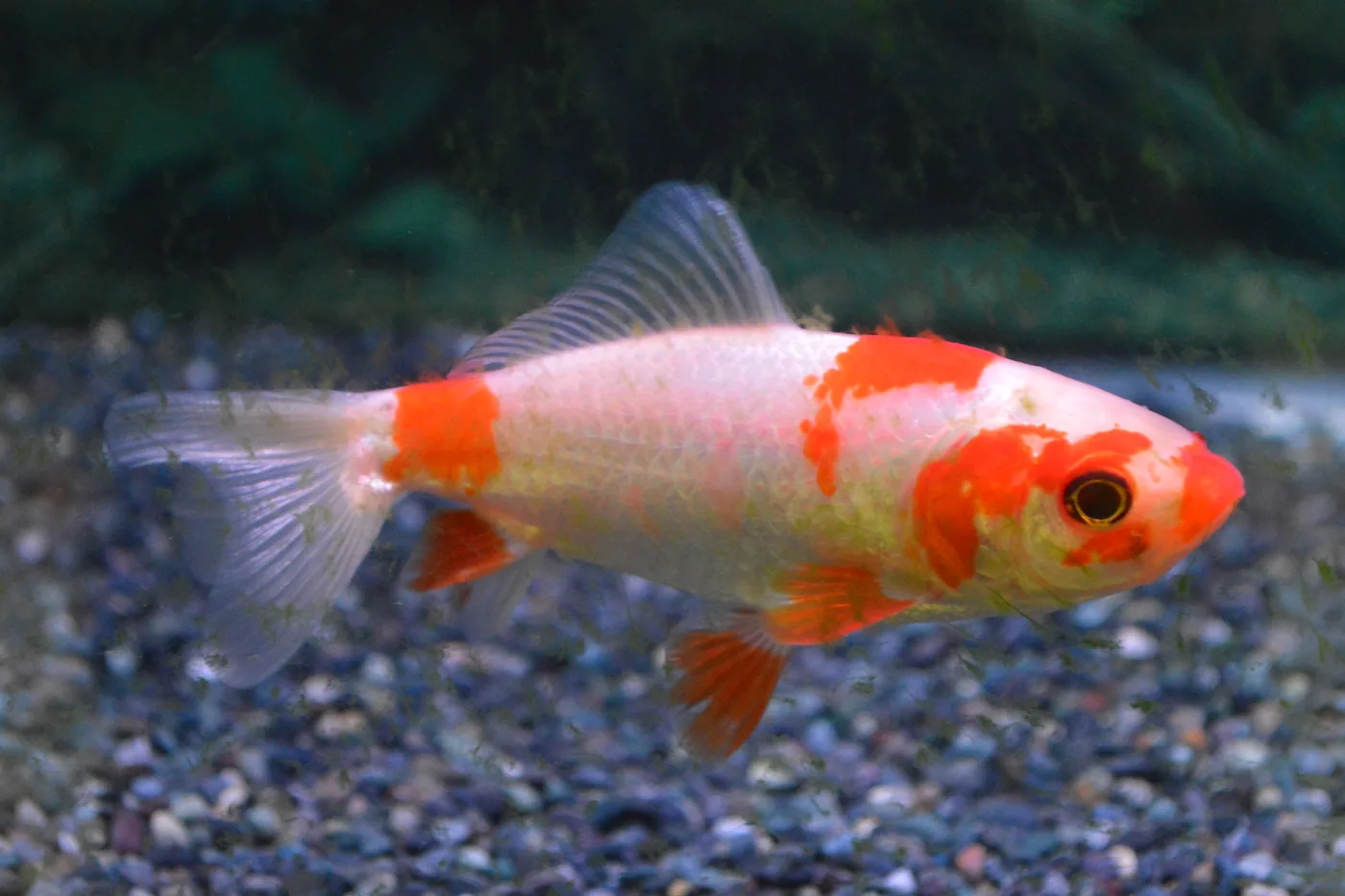
Photograph: Yatokin, CC BY-SA 4.0 · Wikimedia Commons. Numbers and lines added.
- Gill covers. Small, hard, white tubercles: the clearest external sign of a male in breeding condition, when it is there.
- Pectoral fins. The same tubercles, in a row along the leading ray. Together with the gill covers, a neat pattern on a well fish usually means a male, not white spot.
- Vent. Just in front of the anal fin. In condition, a male’s is small, narrow and slightly concave, a female’s rounder and slightly protruding.
- Belly. Not a reliable sign. A full outline can be eggs in condition; out of season it can be a well-fed fish, but fluid and illness swell the belly too, so a swollen fish with raised scales or lethargy needs a vet.
The signs that do not work
| Method | Verdict |
|---|---|
| Body shape, outside condition | Does not work |
| Size | Females marginally larger on average; useless in practice |
| Colour | No relationship at all |
| Fin length or shape, on its own | Too much overlap |
| Vent shape in a juvenile or an out-of-condition fish | Unreliable; the two converge |
| Counting or measuring anything | No |
| Behaviour outside the breeding season | Nothing to see |
The one place getting this wrong hurts a fish
Worth separating out, because it is the only genuinely dangerous error on this page.
“She is fat, so she is female, so she is full of eggs” is a chain of reasoning that ends with a fish in organ failure being left alone for a fortnight.
A female carrying eggs is fuller, softer and often uneven from above, her scales lie flat, and she eats, swims and behaves entirely normally. A fish with fluid accumulating internally is hard, symmetrically swollen, with scales standing out from the body so that it looks like a pinecone viewed from above, and it is usually lethargic and off its food. The swollen abdomen page sets out the distinction properly, and the question that separates them is what are the scales doing.
So: the swelling does not tell you the sex, and the assumed sex must never be the reason a swollen fish is not looked at.
Sexing a group, in spring, without catching anything
The method that actually works for most keepers, and it needs no equipment.
Over a week or two in spring — or after the tank has warmed following a cool spell, which the seasonal page explains is the same cue:
- Watch for ten minutes a day. Who is chasing, and who is being chased? Males usually drive, and the driven fish is usually a female.
- Look at the cheeks and front fins of any fish doing the chasing, in good light. Tubercles will usually be visible.
- Look at the group from above. A gravid female is fuller and often uneven, against her own usual outline rather than against the other fish.
- Note which fish is which. Not “the orange one” — most of them are orange. Use a specific marking, a fin shape, a scar.
- Write it down.
By the end of that fortnight you will typically have most of a group sorted, with no netting, no handling and no stress — which is more than an examination would give you and considerably kinder.
Ponds are easier
Counterintuitive, since you can see the fish far less well.
Two things make up for it. The seasonal cue is real. A pond cools through winter and warms through spring exactly as the fish’s physiology expects, so pond goldfish come into condition reliably and obviously, while indoor fish held at one temperature year-round sometimes never do. And the behaviour is unmistakable: a spring spawning chase in a pond involves the whole group, at the surface, in the shallows, for hours, and it is impossible to miss.
What you lose is the close look — you will rarely get a view of a vent in a pond, and tubercles need the fish near the surface in good light. In practice that matters less, because the behaviour has already told you most of it. The pond guide covers the spring routine.
Do goldfish change sex?
Not in any way that should concern a keeper, and the question usually arises from a mis-sexing rather than a change.
Some fish species do change sex as a normal part of their biology. Goldfish are not among them, and a fish that appears to have switched between one year and the next was almost certainly identified wrongly the first time — which, given that the first identification was probably made from body shape out of season, is not surprising.
The more useful way to hold it: your fish has a sex, and your knowledge of it is seasonal. Nothing about the fish changed between May and November. What changed is that the evidence went away.
The signs, summarised
| Sign | Points to | Reliability | When visible |
|---|---|---|---|
| Tubercles on gill covers and front fin rays | Male | High | In condition only, mostly spring |
| Doing the chasing | Usually male | Moderate | Spawning behaviour only; males also chase each other |
| Being chased | Usually a female | Moderate | Spawning behaviour only |
| Vent narrow and concave | Male | Good | In condition; converges out of season |
| Vent round and protruding | Female | Good | In condition; converges out of season |
| Fuller, uneven body from above | Female, gravid | Moderate | Carrying eggs only |
| Longer, thicker pectoral fins | Male | Weak | Too much overlap to use alone |
| Size, shape, colour out of season | — | None | Never |
What a shop can tell you
Very little, and it is worth knowing what to expect before you ask.
Shop goldfish are usually juveniles and usually out of condition, so nobody in that building can sex them either. A straight answer is “we cannot tell”, and that is the answer a good shop gives. A confident one — particularly one delivered from a glance at the tank — is a guess, and it tells you something about the shop that is worth noticing before you buy anything else there.
If you genuinely need a known sex, the route is a breeder rather than a shop, in spring, when the fish are mature, in condition and can be sexed reliably. Breeders keep track of their own stock and will not be guessing. That is also when you can see the fish at their best, which the choosing guide argues is worth more than anything else about the purchase.
And for a pet tank, do not need a known sex. Buy the healthiest fish in the shop, from a system that looks well run, and let the spring tell you what you have.
Age, and the season
Juveniles cannot be sexed by anyone. Goldfish reach sexual maturity somewhere around one to two years, depending on size, temperature and how well they were grown — the growth page covers why the first two years vary so much.
That is why goldfish are often sold without a stated sex. It is honesty, not carelessness, and a shop that confidently sexes juveniles is telling you something about the shop. The choosing guide covers what is actually worth assessing in a young fish.
And the signs are seasonal. Tubercles appear as a mature male comes into condition and fade afterwards; a female fills with eggs and then does not. In a stable indoor tank held at one temperature year-round, some fish never come into obvious condition at all, and those fish are effectively unsexable without a vet.
How to look, if you are going to
Rarely worth catching a fish for. If you are:
Look in water, not in air. A container of tank water, viewed from above and from the side, is enough and is far kinder than holding a fish up — the handling guide covers why the chase and the lift do more damage than the thing you were trying to do.
Use the container method rather than a net, for the same reason.
Look from both angles. The vent needs a view from below or from the side; tubercles need light across the gill covers.
Have someone else hold the light. Two people makes this thirty seconds instead of three minutes.
And stop if it becomes a chase. No sexing question is worth a stressed fish.
When it actually matters
For most people, it does not.
It does matter if:
- You are deliberately breeding and want a sensible ratio — two or three males to a female is common practice and helps fertilisation, though one male can spawn a female, and a single female with a crowd of males takes a beating.
- You are showing, where the standards distinguish.
- You want to understand a chase, though the behaviour answers that faster than an examination.
It does not matter if:
- You keep goldfish as pets. There is no ratio requirement, neither sex is more aggressive, and mixed groups live together perfectly well.
- You are trying to prevent spawning by keeping one sex, which is not a workable plan for anyone who cannot reliably sex them. What actually damps it down is removing the cue: steady temperature, small rather than large water changes in spring, normal rather than generous feeding.
Bringing them into condition on purpose
If you genuinely need to know, the route is to make the signs appear — which traditionally means giving the fish the cue that spring has arrived: a cooler period followed by a steady rise of a few degrees, lengthening light, and richer feeding. Breeding goldfish on purpose sets out how that is actually done, the breeding page the mechanism, and the temperature guide the ranges.
The obvious caveat: this works, and what it produces is a spawn. Possibly thousands of eggs, a chased and exhausted female, and the decision about where hundreds of goldfish would live. Do not trigger a spawn to satisfy curiosity about sex — the fry page sets out what follows, and the breeding page makes the argument about numbers.
The answer that always works
An aquatic vet with an ultrasound can visualise the gonads directly, without anything invasive. It is done routinely for valuable koi and for breeding stock, and it is the only method that works on a fish that is out of condition.
For a pet goldfish it is an expensive answer to a question that rarely needs one. It is worth knowing that it exists, and the aquatic vet page covers finding someone who could do it.
The short version
Look for tubercles on the gill covers and front fins in spring, watch who chases whom, and otherwise let it go. A goldfish that cannot be sexed is not a problem to solve — it is a goldfish, doing what goldfish do, which is to look exactly like every other goldfish for most of the year.
Frequently asked questions
How do you tell a male goldfish from a female?
In breeding condition, by three things: small white tubercles on a male's gill covers and along the leading rays of his pectoral fins, a vent that is narrow and slightly concave in males and rounder and slightly protruding in females, and behaviour — in a spawning chase the chaser is usually male and the chased fish usually a female, though males also chase each other. Outside condition, usually you cannot, and that is the answer rather than a failure of technique. Goldfish have no permanent external difference between the sexes.
Can you sex a goldfish by its body shape?
No, and it is the most confidently repeated wrong answer in the hobby. Females carrying eggs are fuller and often uneven from above, which is real — but that is a fish in condition, and the same fish out of season looks like any male. Outside the breeding period, body shape reflects breed, line, age, diet and how the fish was grown far more than it reflects sex. Anyone sexing a goldfish from a photograph of its outline is guessing.
At what age can goldfish be sexed?
Not as juveniles, at all. Goldfish reach sexual maturity somewhere around one to two years depending on size, temperature and how well they were grown, and the signs only appear once a mature fish comes into breeding condition. A young fish in a shop tank cannot be sexed by anyone, which is why goldfish are often sold without a stated sex — that is honesty rather than carelessness.
Do the white spots on my goldfish's face mean it is male?
If they are on the gill covers and along the front edge of the pectoral fins, in a neat pattern, on a fish that is otherwise entirely well, then yes — those are breeding tubercles and that fish is a male in condition. The important distinction is from white spot disease, which scatters untidily over the whole body and fins, multiplies over a day or two, and comes with rubbing and clamped fins. Treating tubercles achieves nothing and puts a healthy fish through a course of chemicals.
Does it matter whether my goldfish are male or female?
For a pet tank, very rarely. Goldfish need no particular sex ratio, neither sex is more aggressive, and mixed groups live together without difficulty. It matters if you are deliberately breeding and want a sensible ratio, if you are showing, or if you are trying to understand a chase — and even then the behaviour tells you more quickly than an examination would. The usual right answer is to stop wondering and enjoy the fish.
Can I stop my goldfish breeding by keeping one sex?
Only if you could reliably sex them, which for most keepers most of the time you cannot — so it is not a workable plan. What does damp spawning down is removing the cue: hold the temperature steady rather than letting it climb, keep water changes small rather than large and sudden in spring, and feed normally rather than generously. The breeding page covers the levers, and the fair position is that goldfish kept well in a group will sometimes spawn and the eggs will usually be eaten within hours.
Can a vet tell?
Yes. Ultrasound will show the gonads, and an aquatic vet can sex a fish that way without it being invasive — it is done routinely for valuable koi and breeding stock. For a pet goldfish it is an expensive answer to a question that rarely needs one, but it exists, and it is the only method that works on a fish that is out of condition.
Are female goldfish bigger?
Marginally, on average, and not usefully. Mature females tend to be a little deeper-bodied and heavier, particularly when carrying eggs. The difference is small next to the variation produced by breed, line, and the conditions of the fish's first two years — a well-grown male will comfortably outsize an underfed female. Size is not a sexing method.