04 Aquarium
Keeping goldfish in an outdoor pond
A pond is where a common goldfish or comet finally gets the space its body was built for. It is also a different kind of keeping, with seasons, predators and a rhythm of its own.
The goldfish is, before anything else, a pond fish. It was domesticated in Chinese ponds around a thousand years ago, and the single-tailed varieties still carry the build for it: a streamlined body, a strong tail and a tolerance for cold. In an aquarium a common goldfish is a large, active animal in a modest space; in a pond it grows into what it was meant to be, often startlingly fast.
Why single-tails belong in ponds
Common goldfish, comets and shubunkins reach 25 to 35 cm (10 to 14 inches) as adults, and larger still with pond space and a summer diet of insects and algae. Indoors that means 150 to 200 litres for the first fish and a great deal more for a group. Outdoors, a pond of a few thousand litres gives a shoal room to swim at full speed, natural food, sunlight and true seasons.
They also show well from above, and the calico shubunkin, a Japanese breed from around 1900, shows especially well.
Size and depth
Surface area sets how much oxygen enters and how much heat the pond exchanges with the air, so a wide pond is better than a narrow, deep one of the same volume. Depth sets stability. The deepest point has to be deeper than the ice the local winter makes, so that an unfrozen layer of slightly warmer water is left at the bottom where the fish overwinter: about 60 cm (2 feet) is commonly advised for mild winters, and 80 to 90 cm (around 3 feet) or more where hard frosts persist. Deeper water also buffers summer heat. Something in the region of 1,000 litres (about 260 US gallons) is a sensible minimum for a small group; ponds of several thousand litres are far easier to keep stable, and there is no realistic upper limit. Building a goldfish pond covers the construction itself — siting, liners, levelling, plumbing and the decisions that cannot be revisited once it is dug.
A goldfish pond in cross-section
Comet and wakin: Yatokin, CC BY-SA 4.0
- Deep enough not to freeze solid: 60–90 cm or more where winters freeze, deeper in harder climates. Keep a hole in the ice for gas exchange.
- A planted shelf for marginal plants that shade the water and take up nitrate.
- Pump and filter sized for the pond’s volume, with the intake protected.
- Waterfall or return that keeps the surface moving for oxygen and gas exchange.
- Netting or cover against herons, cats and raccoons, and to keep autumn leaves out.
- Floating plants for shade and cover in summer.
Steep sides with a narrow planting shelf, rather than a gentle beach, are safer against wading predators, and an edge raised slightly above the surrounding ground keeps fertilizer-laden garden runoff out.
Tubs, half-barrels and patio ponds
The version most people can actually fit, and it is worth being clear about what it is and is not.
A container pond is a summer arrangement, not a small pond. Everything that makes a pond forgiving comes from volume and surface area, and a half-barrel has little of either: it heats through a sunny afternoon and cools overnight, holds little oxygen when warm, and in a hard winter it can freeze most of the way through. A goldfish that would overwinter comfortably under ice in a proper pond will not survive that.
If you want one, the rules are the same and tighter:
- The largest container you can manage. A few hundred litres behaves far better than eighty.
- Shade part of it. Lily pads, a floating plant, or simply a position that gets morning sun and afternoon shade.
- Aerate it in warm weather, which matters more here than in any pond.
- Stock it very lightly — one or two small fish, not a group, and see how many goldfish for why the arithmetic is unforgiving in small volumes.
- Filter it. A small pond filter or even an air-driven sponge is a real improvement over nothing.
- And plan the winter before you start. Bring the fish indoors before the first hard frost, to a tank that is already cycled and waiting.
Done that way it is a genuinely pleasant thing and the fish do well through a season. Done as a permanent home in a cold climate it is a bowl outdoors. The tub and patio pond guide covers the whole season, from the first fish out to the last one in.
Filtration and clear water
Goldfish produce as much waste outdoors as in, and the filtration principles are the same: a pump moves water through mechanical media that trap solids and biological media that host bacteria. Pressurized, gravity-fed and planted bog filters all work; whichever you choose, size it for goldfish rather than for the lightly stocked ornamental pond the packaging assumes. Pond filter ratings are quoted for sparsely stocked ornamental water features, so the sensible approach is to buy for roughly double the volume you actually have.
The turnover figure is not the tank figure, and that is not a contradiction. Indoors the target is five to ten times the tank volume every hour. Outdoors the common target is the whole volume once every one to two hours, which is somewhere between a twentieth and a fifth of the indoor rate. The difference is stocking density and biology, not disagreement. A pond holds a fraction of the fish per litre that a tank does, its surface area per litre is far greater so it gasses off and takes up oxygen more easily, and its walls, liner, plants and sediment host nitrifying bacteria across an area no canister can match. The filter is doing a smaller share of the work.
Where the pump matters more than the filter. Solids that settle and rot are the usual cause of a pond that tests clean but smells, so the intake position does more for water quality than an extra stage of media. Take water from near the bottom, where the waste is, not from the surface where it looks cleanest. A skimmer is worth having in autumn, when the real threat is leaves: a few weeks of leaf fall left in the water will consume oxygen as it decomposes and drive the pH down, and a net over the pond for six weeks costs nothing and prevents all of it.
Run it through the winter, or plan how you will not. A filter that stops in cold weather can lose much of its bacterial colony and may have to cycle again in spring, exactly when the fish start eating. If you shut it down, treat the restart as a new cycle and feed accordingly. Keeping it running is simpler, but pond suppliers advise moving the outlet so it does not churn the whole depth, leaving fish overwintering at the bottom a layer that stays still and slightly warmer than the surface.
Green water, and whether it is a problem
The classic pond complaint, and the first question is whether it needs treating at all.
What it is. A bloom of single-celled algae suspended in the water, multiplying because there is light and there are nutrients. It is not the same thing as blanketweed, the stringy green mat that grows on surfaces, which a pond through the year covers.
What it does to the fish: essentially nothing. Green water is harmless to goldfish, takes up nitrate, gives fry somewhere to hide, and is part of what makes a pond a pond. A great many healthy, well-stocked ponds are green for part of every summer. The only genuine complaint is that you cannot see your fish, which is a real complaint and an aesthetic one.
There is one caveat worth knowing: a very heavy bloom consumes oxygen at night and can crash suddenly, taking the oxygen with it, which is one of the situations behind fish gasping at dawn.
The two ways to clear it.
- Take away the light and the nutrients. Shade perhaps a third to a half of the surface with lily pads, plant heavily so the plants outcompete the algae for nitrate, feed less, and check the stocking. This is slower, it fixes the cause, and it makes the pond better in several other ways at once.
- An ultraviolet clarifier fitted in line with the pump, which clumps the algae so the filter can remove it. Match its rating to the pump’s flow and replace the lamp roughly yearly as its output fades. This works quickly and reliably, and it treats the symptom continuously — switch it off and the bloom returns, because nothing about the pond has changed.
And a word on crystal-clear water as a goal. A pond polished by UV looks like a photograph and is not necessarily the healthier pond; a green one is usually a pond with more biological activity in it. Clear is a preference, not a health measure, and the measures that matter outdoors are the same ones that matter indoors: ammonia at zero, nitrate low, and fish that behave normally.
Plants and shade
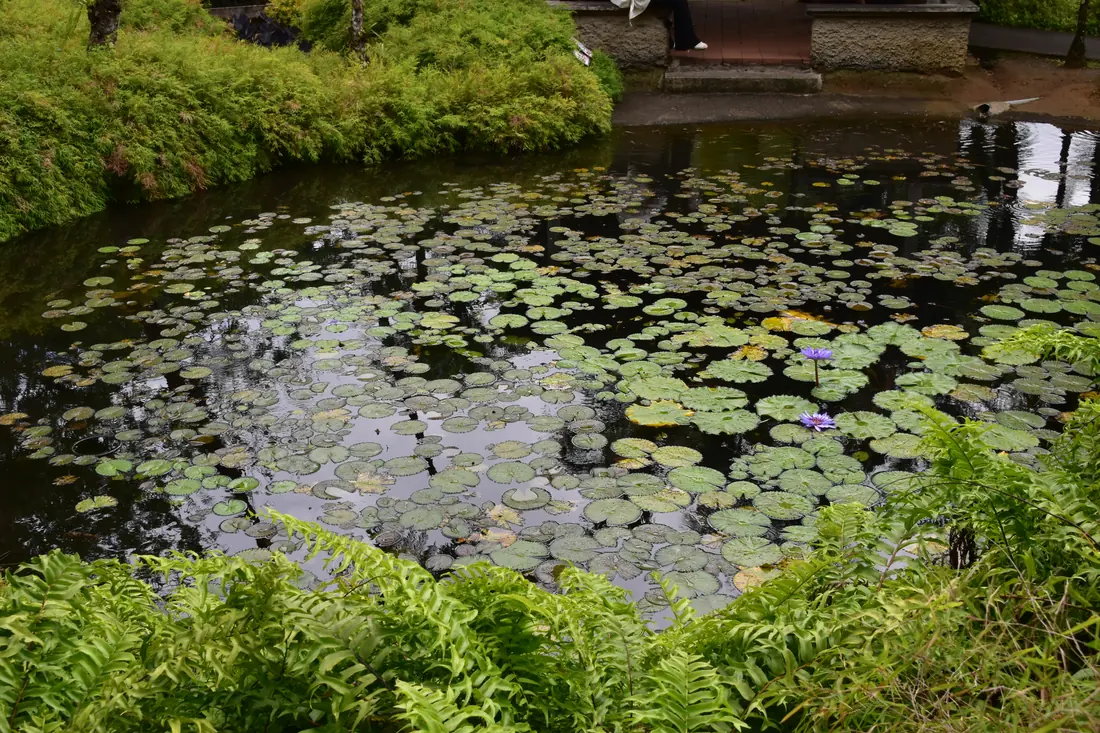
Water lilies and other floating-leaved plants do useful work: their pads shade the surface, cool the water and starve algae of light. Keepers’ advice is to cover something like a third to a half of the surface in summer. Submerged oxygenators such as hornwort add oxygen by day and give fry somewhere to hide, and marginal plants on the shelf take up nitrate. Goldfish will eat soft plants and root through planting baskets, so cap the baskets with gravel too large to swallow and expect some losses. Check that any plant you buy is not listed as invasive where you live; several classic pond oxygenators are.
Predators
A common way a pond loses its fish suddenly, and worth taking more seriously than the garden-centre solutions suggest.
Herons are a main threat in much of Europe and North America. A heron typically works at dawn, wades in from a shallow edge, and stands motionless until something comes within reach, though it can also take fish from deeper water. One bird can empty a small pond over a few mornings, and it will return daily once it has learned the pond is there. The defences are physical, and only one of them is dependable:
- Netting or mesh over the whole pond. This is the dependable defence: covering the water removes access altogether.
- Depth and steep sides, so there is less shallow water to stand in. This is designed in at construction — building a goldfish pond covers the profile. It reduces wading access but does not remove the risk.
- Somewhere to hide. A length of wide pipe on the bottom, a shelf with an overhang, or dense lily cover gives fish somewhere to be that is not in the open.
What is less reliable: perimeter fences and wires, which US Department of Agriculture guidance says have had only limited success; plastic heron decoys, which keepers report herons soon ignore; and motion-activated sprinklers, which keepers report work for a while until the bird learns the pattern.
Cats take small fish from shallow edges and are deterred by the same steep sides and netting. Raccoons, where they occur, wade, are dextrous and are persistent, and netting needs to be genuinely secured rather than laid over. Kingfishers take small fish and fry and are difficult to exclude; a pond that loses fry to one is usually still fine.
And the quiet one: a pond that has lost fish to a predator has also been stressed by it, so fish may hide for days afterwards and eat poorly. That is not illness.
Topping up, and what goes into the pond
An ordinary job that is easy to get wrong at pond volumes.
Evaporation removes water and leaves the dissolved solids behind, so a pond that is only ever topped up slowly concentrates. Rain offsets some of this; in a dry summer it does not.
Tap water needs the same conditioner it would indoors, and the volume makes this awkward — a hose running for twenty minutes delivers a great deal of untreated water. Two practical approaches: add conditioner for the volume you are adding as the hose runs, or top up in smaller amounts so the dilution into a large pond is substantial. The source water page covers chloramine, which does not evaporate and needs a conditioner that specifically neutralises it.
Garden runoff is the risk nobody plans for. Fertiliser, weedkiller, moss treatment from a roof, and detergent from a washed car all end up in the lowest point in a garden, which is frequently the pond. An edge raised slightly above the surrounding ground, and care about what is used nearby, prevents it.
And rain is not neutral. Heavy rain can drop pond temperature quickly, wash in debris, and in some areas is noticeably acidic. It is one of the situations after which it is worth testing.
A pond and small children
A safety question before it is a fishkeeping one, and it belongs on this page because the answer affects the design.
Open water in a garden is a drowning risk for a small child, and the depth at which that is true is far shallower than people assume. If children have access to the garden, the options are a rigid steel mesh grid set just below the water surface, strong enough to take a child’s weight and invisible from a distance once the pond settles; a fence with a self-closing gate around the pond; or not building the pond until later.
Netting against herons is not a safety barrier and should not be treated as one.
It is worth deciding this before digging rather than after, because retro-fitting a grid to a pond with an awkward profile is considerably harder than building for it.
The seasons, in one paragraph
A goldfish pond through the year is the operational calendar and covers each temperature band properly, along with the blanketweed nothing else here explains. The shape of it: spring, start feeding lightly once the water holds above about 10 °C, check equipment and expect vigorous spawning; summer, keep the surface moving because warm water holds less oxygen and still nights are the risk; autumn, net against leaves, thin dying plants and taper the feeding as the temperature falls; winter, stop feeding below 8 to 10 °C, keep one patch of surface ice-free for gas exchange, and never strike the ice — a pan of hot water melts a hole gently, while the shock waves from a blow can harm fish resting below. Feeding through the seasons has the bands on the food side.
Stocking
Goldfish in ponds breed, so a pond that starts lightly stocked will not stay that way. Keepers’ rules of thumb run from roughly 100 litres per adult single-tail in a well-filtered pond to 300 litres or more where filtration is modest, and none is a measured limit; clear water, zero ammonia and low nitrate are the real measure. The how many goldfish guide explains the reasoning behind the ranges, and the stocking checker will do the arithmetic.
Surface area is the second number, and outdoors it is often the binding one. Oxygen enters at the surface, so a deep, narrow pond and a shallow, broad one of the same volume do not hold the same number of fish. A rough check among pond keepers is about 25 to 30 cm of adult fish per square metre of surface, which for a 3 by 2 metre pond is about 1.5 to 1.8 metres of fish: five or six full-grown commons of 30 cm, not the twenty juveniles that would look right in it on the day you fill it. This is a keepers’ rule of thumb, not a measured limit. Stock for the fish you will have in three years.
Then plan for the fry, because the figures above assume you have. A settled pond of mixed-sex adults will spawn every spring, and unlike a tank, a planted pond hides enough fry that a good number survive without any help from you. The arithmetic is unforgiving: a pond stocked correctly for six adults is overstocked by its third summer if nothing is done. The realistic options are to accept a predator or two, to net and rehome each year, or to keep a single-sex group, and the last is harder than it sounds, since sexing goldfish is only reliable in spring on mature fish. Deciding which of the three you are doing before you stock is the difference between a pond that stays clear and one that is a green, gasping problem by the fourth year.
Check that they are goldfish. Mixed “pond fish” tanks often hold young koi, which look like commons until you see the barbels at the corners of the mouth, and which grow to 60 cm or more. All of the figures above are for goldfish; a pond with koi in it is a koi pond, and koi or goldfish? covers telling them apart and keeping the two together.
They will breed
Not a possibility to plan around so much as a certainty to plan for, and it is the thing that most changes a pond over years.
Goldfish spawn in spring, once the water warms and the fish are mature, and a pond provides everything the trigger needs: rising temperature, longer days, and plants to scatter eggs among. The chasing is vigorous enough to alarm anyone seeing it for the first time — is my goldfish breeding describes what it looks like so it is not mistaken for aggression or illness.
In most ponds, almost everything gets eaten. The adults eat the eggs, and they eat the fry, and so does everything else living in the water. A pond with a normal population of adults and no dense cover usually stays roughly stable year to year, which is the outcome most keepers want and none should feel bad about. It is what happens in any body of water.
Where it does not stay stable is a heavily planted pond with dense marginal growth and few adults — exactly the pond most people are aiming to build. Fry hide in the planting, survive in numbers, and are indistinguishable from a normal stocking level until the following summer, when suddenly there are forty fish where there were five.
So plan for it before it happens:
- Start well below the stocking figure, because the pond will fill itself.
- Know who would take surplus fish. Aquarium societies, other pond keepers and some shops will; arranging it in advance is far easier than in August.
- Never release them into a waterway that is not yours. Goldfish are an established invasive species on several continents, spread by stocking, bait, pond escapes and aquarium release.
- And if you want to raise a batch deliberately, understand that you are committing to somewhere to put dozens of fish — feeding fry and young goldfish covers the raising and the numbers.
Moving fish between tank and pond
Move fish out in late spring, once the pond stays reliably above about 15 °C (59 °F) and within a few degrees of the tank. Float them in a container of tank water for twenty minutes, mix in pond water gradually over the next half hour, and release them in the morning. A fish coming from a pond into a tank should be quarantined for at least four weeks, since ponds carry parasites that an aquarium does not.
The direction matters, and so does the season. Spring is the move; autumn is not. A fish put outside in September has weeks to settle before the water turns, which is not enough to build the reserves it will need, and it goes into winter underweight. If you have missed spring, keep the fish indoors and move it the following May. Nothing is lost by waiting, and the one thing that will not survive the error is the fish.
Match temperature first and chemistry second, but check both. Pond water and tap-filled tank water can differ more than people expect in pH, KH and GH, because a pond is a living body of water with plants, sediment and rain in it. A quick test of each before the move tells you whether to stretch the mixing from half an hour to two, and a difference of more than about 0.4 pH is, as a rough guide, worth taking slowly. The rule that matters is that everything moves in one direction at a time: do not correct temperature and chemistry simultaneously in a bucket.
The first days look alarming and usually are not. A goldfish released into a few thousand litres of unfamiliar water will go to the bottom, find cover, and stay out of sight, sometimes for two or three days. It will not come up for food. This is normal, and the common mistake is to feed anyway into water where nobody is eating, then to be dealing with the decomposing remains a week later. Offer nothing for the first two days, then a small amount once you can see fish at the surface. Count them at feeding time from then on, because a pond is the one place where a missing fish can go unnoticed for a fortnight.
Winter for fancies
Keepers regard fantails, orandas, ryukins and the other round-bodied breeds as less cold-tolerant than single-tails, and report buoyancy trouble in cold water. In climates with mild winters some keepers overwinter hardier fancies such as fantails in a deep pond, but where the surface freezes, fancies belong indoors from the time the water drops toward 10 to 12 °C until spring. The water temperature guide covers what each type of goldfish tolerates.
Move them before you need to, not when it gets cold. The 10 to 12 °C above is the point by which keepers want a fancy indoors, not the point to start thinking about it, and treating a deadline as a schedule is the mistake. A fish lifted out at 10 °C is already slow and already digesting very little, so the move is a bigger insult than it would have been a month earlier. Aim to bring fancies in while the pond is still around 14 to 15 °C: they are alert, they are still feeding, and the indoor tank can be matched to the pond within a couple of degrees rather than fifteen. Match the temperature, not the calendar, with a sealed bag of pond water floated in the tank for twenty minutes and then mixed over half an hour, the same as any other move.
The indoor tank has to be ready before it is needed, which in practice means cycling it in late summer rather than in November. It needs to be the full size those fish require, not a holding bucket for four months; a winter in cramped water is how a healthy fancy arrives at spring with clamped fins or a buoyancy problem. Keep it cool rather than warm. Sixteen to eighteen degrees is kinder than a heated 24 °C, because it keeps the fish on something close to its seasonal rhythm and makes the move back out in May a small change rather than another shock.
Round-bodied fish that do overwinter outside need depth and stillness. The deepest part of the pond rather than the shallow end, and deeper than the ice will reach; no pump churning the deeper water; no feeding below about 8 to 10 °C, as everywhere else; and an opening kept in the ice so gases can escape, never made by hitting it, since the shock waves can harm the fish resting beneath. If you cannot give all four, the fish comes in.
Frequently asked questions
How many goldfish can I keep in a pond?
Fewer than you think, because they grow large and they breed. Keepers' rules of thumb run from roughly 100 litres per adult single-tail in a well-filtered pond to 300 litres or more where filtration is modest, and none is a measured limit. Clear water, zero ammonia and nitrate that stays low are the real test. Start light and rehome surplus fry.
Can fancy goldfish live in a pond?
Through a warm season, yes, and in mild climates some keepers overwinter the hardier fancies in deep ponds. Where the surface freezes, keepers report that round-bodied breeds struggle with cold and with buoyancy, and they are best brought indoors once the water drops toward 10 to 12 °C. Single-tails are the natural pond goldfish.
My pond is bright green. How do I fix it?
First, decide whether to. Green water is a suspension of single-celled algae; it is harmless to goldfish, it takes up nitrate, and it gives fry somewhere to hide. The only real complaint is that you cannot see your fish. If that matters, the durable fix is to take away the light and the nutrients — shade perhaps a third to a half of the surface with lily pads, plant heavily so the plants outcompete the algae, feed less, and check the stocking. An ultraviolet clarifier in line with the pump is the quick fix and works well, but it treats the symptom continuously rather than changing why the algae are thriving.
Can I keep goldfish in a half-barrel or a patio tub?
In summer, in a mild climate, with very few small fish and a lot of attention — and not through a freezing winter. The problem is not the volume alone but everything that follows from it: a small body of water heats and cools with the weather, holds little oxygen when warm, and can freeze solid or near enough. If you want a container pond, use the largest you can, shade part of it, aerate it in hot weather, stock it very lightly, and plan to bring the fish indoors before the first hard frost. Treat it as a summer arrangement rather than a pond.
Will my goldfish breed, and what do I do with the fry?
Almost certainly, once they are mature and the water warms in spring. In most ponds the great majority of eggs and fry are eaten, by the adults and by everything else living in the water, and the population stays roughly stable — which is the outcome most keepers want and should not feel bad about. Where there is heavy planting and few predators, enough survive to change your stocking within a couple of seasons. Plan for it: know who would take surplus fish, and never release them into a waterway that is not yours.
Do I need to run the pump all winter?
Not necessarily, and pond suppliers advise against a pump that lifts the slightly warmer bottom water to the surface. What matters is one ice-free patch for gas exchange, from a floating de-icer, an air stone set at shallow depth or a small pump near the surface. Leave the deep, slightly warmer layer where the fish rest undisturbed.