01 Care guide
Is my goldfish breeding?
Most people meet goldfish breeding by accident and mistake it for illness. The chase looks like bullying, the tubercles look like ich, and the female looks bloated. Here is how to read it and what it asks of you.
Most people do not set out to breed goldfish. They notice something that worries them — one fish harrying another around the tank for a whole morning, a scatter of white pimples that looks like the start of a disease, a female who has gone from streamlined to swollen in a fortnight — and go looking for what is wrong. Often nothing is. Goldfish spawn readily, they do it in ordinary aquariums as well as ponds, and nearly every sign of it is mistaken for something else the first time it appears.
This page is about recognising it, keeping the fish well through it, and making a clear decision about the eggs.
What it looks like, and what it gets mistaken for
White pimples on the head and front fins. Small, hard, white spots on a male’s gill covers and along the leading rays of his pectoral fins are breeding tubercles, sometimes called breeding stars. They are normal, seasonal and appear on an otherwise lively fish that is eating and behaving well. The white spots page covers the distinction in detail, and it is worth knowing before you panic: ich spots are scattered untidily over the body and fins, grow in number over a day or two, and come with flashing and clamped fins. Tubercles sit in a neat pattern on exactly those two places and change nothing else.
One fish chasing another, hard, for hours. This is a practical clue to sex, which how to tell if a goldfish is male or female covers, though males also chase each other. It is usually a male driving a female, typically pushing at her flank and vent, often with several males joining in. It runs for hours or days, often at its most intense in the early morning. It is not aggression and the fish are not fighting.
A swollen female. Eggs make a belly fuller, softer and often uneven from above, and the fish continues to eat, swim and behave normally. That is quite different from the hard, symmetrical swelling with scales standing out from the body that the swollen abdomen page describes as a reason to see a vet. The two get confused constantly, and the distinguishing question is what the scales are doing.
Eggs. Small, clear or amber spheres, about 1.5 mm across, sticky enough to hold onto plants, glass, filter sponges and decor. There will be a great many of them, they appear after a chase, and in a tank containing adult goldfish most of them will be gone by the evening.
Where the difference shows
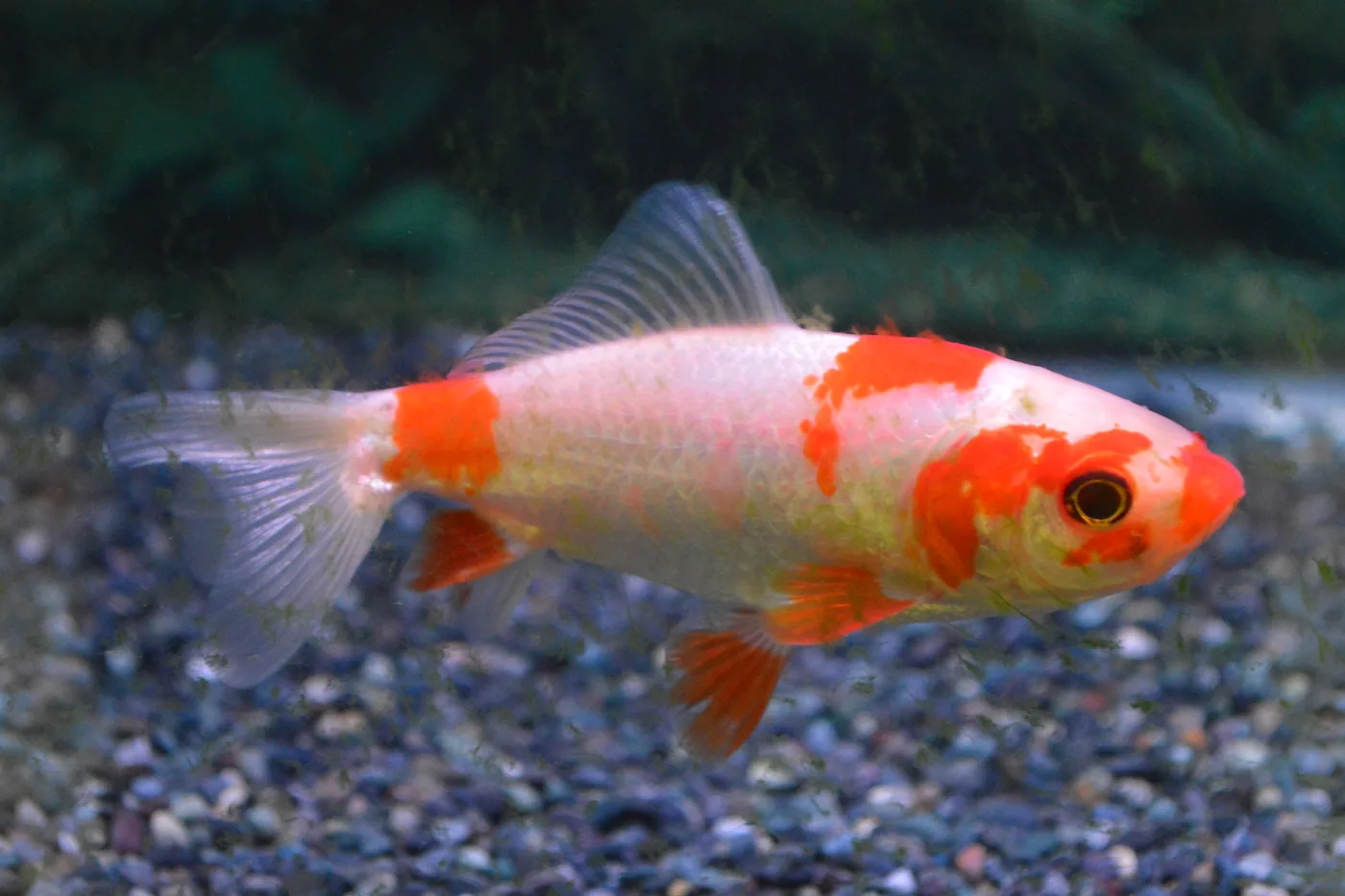
Photograph: Yatokin, CC BY-SA 4.0 · Wikimedia Commons. Numbers and lines added.
- Gill covers. Small, hard, white tubercles: the clearest external sign of a male in breeding condition, when it is there.
- Pectoral fins. The same tubercles, in a row along the leading ray. Together with the gill covers, a neat pattern on a well fish usually means a male, not white spot.
- Vent. Just in front of the anal fin. In condition, a male’s is small, narrow and slightly concave, a female’s rounder and slightly protruding.
- Belly. Not a reliable sign. A full outline can be eggs in condition; out of season it can be a well-fed fish, but fluid and illness swell the belly too, so a swollen fish with raised scales or lethargy needs a vet.
What sets it off
Goldfish read spring from the water. A cool winter followed by a warming spring is the natural cycle and the traditional preparation, but fish kept at 15 to 20 °C on long days can mature without one, and a temperature rise, planted media or a water change can each trigger ovulation, the release of ripe eggs. That is why pond fish spawn in spring and indoor fish often spawn after a large water change or when a room warms up.
That also means a keeper can trigger it accidentally, and can usually damp it down. If the chasing is wearing a female out, the useful levers are the ones that undo the signal: hold the temperature steady rather than letting it climb, keep water changes small for a week or two rather than large and sudden, and feed normally rather than generously. The temperature guide covers why large, fast swings are best avoided.
The shape of a spawn
Knowing the sequence makes the whole thing far less alarming, and tells you when each part should be over.
Days before. The chase builds. Males develop tubercles, the female fills out, and the pursuit becomes more persistent each morning. This phase can run for several days and is where most of the wear on the female happens.
The spawn itself. Spawning usually happens in bursts in the dark or early morning, with the male pushing the female against plants or decor and both releasing eggs and milt in a flurry. It runs for a few hours rather than all day, and there may be several bursts.
That evening. In a community tank, most of the eggs are gone — eaten by the adults, who are extremely diligent about it. This is normal and is what happens in a pond too.
Days one to seven. Surviving eggs develop; three to seven days to hatch at spring temperatures, longer when cool. Infertile eggs turn opaque white within a day and grow fungus.
Days three to ten. Newly hatched fry hang on the glass or plants, absorbing the yolk sac and barely moving. They do not need feeding yet and are easy to miss entirely.
After that they become free-swimming and need very small food several times a day, which is where feeding fry and young goldfish takes over.
And then again. A female in condition may spawn repeatedly at intervals of roughly a week or two while the conditions persist, so a single event is not necessarily the end of the season.
The male’s side of it
The page so far is about the female, which is right, and it leaves out something worth knowing.
A male in breeding condition is also spending himself. He typically stops eating, or nearly so, for the duration — sometimes several days — while expending a great deal of energy on the chase. He can injure himself against decor at speed, and the tubercles, while harmless, are a real physiological investment.
So a male that is thinner at the end of a spawning period, uninterested in food for a few days and then suddenly ravenous, is behaving normally. What is worth watching is whether he resumes eating within a few days of the chasing stopping. One that does not has moved from spawning behaviour into something worth investigating — loss of appetite covers the order to check things in.
Where there are several males to one female, both problems compound: she is pursued relentlessly by a relay of fish that take turns, and they exhaust themselves. That is the situation in which separating fish is most often the right call.
Look after the female, not the eggs
This is the part that matters for the animals in front of you. A spawning chase is normal, and it is also a common cause of torn fins in spring. Over a day or two a female can lose fin tissue and scales, take a wound that turns into a sore, and be kept away from food while she is spending energy she needs.
So watch her rather than the glass. Give the tank somewhere to rest — a clump of planting, a length of pipe, anything that breaks the line of a chase. Check her fins each evening for tears and her flanks for missing scales. Her vent will be fuller than usual and may show a small pale tube around spawning, which is normal; one that looks raw, or tissue that stays out afterwards, is covered on the vent page. If the harassment does not let up and she is visibly tiring, a few days apart is a reasonable intervention; in a tank with several males and one female, it is often the only one that works.
When she cannot release them
Rare, and worth recognising because it is the one version of this that is an emergency.
A female occasionally becomes egg-bound: the eggs mature, she does not spawn, and they are neither released nor reabsorbed. The picture is a fish that stays swollen after the breeding period has passed, becomes lethargic, goes off her food, and may sit on the bottom or strain visibly.
What to do: treat it as a veterinary problem, not a home one. Finding an aquatic vet covers locating one, and the condition is treatable when it is caught.
What not to do, under any circumstances, is squeeze her. “Stripping” a fish is a technique used by breeders on conditioned fish at exactly the right moment and it is easy to rupture internal organs. Applied by a keeper to a fish that is already in trouble, it is far more likely to kill her than to help.
The swollen abdomen page covers the wider question of what a distended belly means, including the distinction that matters most: scales lying flat is a full fish, scales standing out from the body is a different and more serious problem.
What a spawn does to the water
The part nobody expects, because it is a behavioural event with a chemical consequence.
A spawn puts thousands of eggs (commonly 2,000 to 4,000 from a mature female) plus a quantity of milt into the tank over a few hours. The adults eat a great deal of it; a good deal is never found, and settles into the substrate, the plants and the filter, where it decomposes. On top of that the fish have been disturbing the substrate for days.
So for three or four days afterwards:
- Test daily. A tank comfortably within its capacity can show an ammonia reading it has not produced in a year.
- Siphon what you can see, especially from the substrate and behind decor.
- Change water on the readings rather than on the schedule.
- Feed lightly, because the fish have barely been eating anyway and the filter has enough to do.
- Do not clean the filter in the same week, which is when it is most needed.
And check the fish afterwards. A female with torn fins or missing scales has broken skin in water carrying a higher-than-usual organic load, which is precisely the combination behind ulcers and fin rot. A week of clean water and a close look each evening is the whole of the aftercare.
Can you prevent it?
Worth answering plainly, because the question follows immediately from everything above.
Not reliably. The clean solution would be a single-sex group, and it is impractical: goldfish cannot be sexed with confidence outside breeding condition, which sexing goldfish is candid about. By the time you can tell, they are already in condition.
What genuinely helps is not giving the cue:
- Hold the temperature steady. A rise of a few degrees can trigger ovulation, so a stable tank gives that signal less often — goldfish water temperature covers how.
- Keep water changes small and regular, rather than large and sudden, because replacing a lot of water at once can itself trigger ovulation.
- Feed normally rather than richly. Conditioning is partly a feeding effect, and heavy feeding of rich foods brings fish into condition faster.
- Keep the photoperiod consistent, with the tank light on a timer rather than following the room.
What does not work is separating the fish permanently in a tank that cannot support two setups, or trying to interrupt a spawn in progress by netting fish out mid-chase, which adds a stress to an already strained animal.
The realistic position: a mixed group of mature goldfish in good condition will spawn, probably every spring, and the job is to manage it well rather than to stop it.
Spawning in a pond
Where goldfish actually breed, and the experience is different enough to be worth separating.
It happens every spring, reliably, once the water warms through the range the fish read as the season. A pond supplies the full cue — a genuine winter, a real temperature rise, lengthening days and a plankton bloom — in a way an aquarium only imitates. A pond through the year covers the restart that precedes it.
You will see less of it and lose less to it. The chase happens across a large volume with real cover, so the female has somewhere to go and comes through it in better condition than she would in a tank. The trade is that you cannot watch her closely, so a pond fish that has been badly worn is often noticed late — worth a proper look at each fish once the chasing stops, which the healthy baseline page describes.
And most of the eggs and fry are eaten, by the adults and by everything else living in the water, which keeps the population roughly stable. Where a pond is heavily planted with few adults, enough survive to change the stocking within a season or two — goldfish ponds covers what that means and why planning for it beats reacting to it, and how many goldfish has the figures.
Fry you do want to keep are easiest protected by moving the plants they are attached to, rather than by trying to net fry — plants for goldfish tanks covers which species survive both the goldfish and the season.
The arithmetic of a spawn
A goldfish spawn is not a handful of eggs. A mature female can release thousands (commonly 2,000 to 4,000), in batches roughly a week or two apart; most are eaten or infertile, but fry that survive their first weeks become fish that reach 15 to 35 cm and commonly live 7 to 10 years or more.
That is the decision, and it is worth making before the eggs are on the glass rather than after. Raising even a fraction of a spawn means a dedicated tank, a supply of very small food several times a day, growing space as they grow, and — the part rarely mentioned — a plan for where a hundred adult goldfish will live. Shops seldom take them. Rehoming a large batch is harder than it sounds. Putting goldfish into a wild pond, stream or lake is ecologically destructive and illegal in many places; goldfish have spread through stocking, bait and pond escapes as well as aquarium release, and a released fish adds to that.
Set against that, letting the adults eat the eggs is not a failure of care. It is what happens in any tank containing grown goldfish, it happens within hours, and it is the outcome most keepers should be content with.
If you do decide to raise them
Then do it deliberately. Move the eggs rather than the adults, since eggs stick to whatever they landed on and a spawning mop or a clump of plants can be lifted out whole into a separate tank of the same water. Expect fungus on the infertile ones, which turn opaque and white within a day and are best removed so the mould does not spread to the viable eggs beside them. Hatching takes a few days at spring temperatures and longer in cooler water, and the fry spend their first days attached to a surface, absorbing the yolk sac, before they begin to swim and need feeding.
From that point it becomes a different hobby with its own literature, its own equipment and its own hard decisions about which fish to keep. Breeding goldfish on purpose is the whole of it — conditioning, the spawning tank, the eggs and the year of selection afterwards — and feeding fry and young goldfish covers the first weeks in detail, including the decision about numbers that this page puts first.
Going into it on purpose is respectable. Drifting into it because the eggs were there is how most people end up with a problem they did not choose.
The short version
If one goldfish is chasing another and a third has white pimples on its cheeks, nothing is wrong. Keep the temperature steady, give the female cover and check her fins, and let the eggs take their chances. If you want to raise them, decide that first, and work backwards from where the adults will live.
Frequently asked questions
How do I tell a male goldfish from a female?
Outside breeding condition, reliably, you often cannot, and anyone who tells you otherwise is guessing from body shape. In condition it becomes much easier: a male develops small white tubercles on the gill covers and along the leading rays of the pectoral fins, and his vent is small and slightly concave. A female carrying eggs is fuller through the belly, often unevenly so when viewed from above, with a vent that is rounder and slightly protruding. Both signs fade outside the season, which is why goldfish are usually sold without a stated sex.
My goldfish is chasing another one relentlessly. Is it fighting?
Almost certainly not. Goldfish are not territorial and rarely fight; what looks like persecution is typically a male driving a female to release eggs, usually nose to her vent, for hours at a time and sometimes for days. It is normal behaviour and it is also hard on her — torn fins, lost scales, exhaustion and a fish that cannot get to food. Normal and harmless are not the same thing, so the answer is to let the behaviour run its course while making sure she has cover to rest in and is not being worn down.
How long does the whole thing take?
The chase builds over days and is often most intense in the early morning, and the spawning itself happens in bursts over a few hours, usually in the dark or early morning. Eggs are laid onto plants, glass and decor in batches through that time. In a community tank most are eaten within hours. Any that survive hatch in roughly three to seven days depending on temperature — faster when warm — and the fry then hang on a surface for another two or three days absorbing the yolk sac before they swim freely and need feeding. A female in condition can spawn again within a week or two if the conditions persist.
Should I test the water after a spawn?
Yes, for several days. A spawn puts a large quantity of eggs and milt into the tank; the fish eat much of it, and what remains decomposes, which is a genuine ammonia load on top of a filter sized for the fish. Test daily for three or four days afterwards, siphon what you can see from the substrate, and change water on the readings rather than the calendar. A tank that was comfortably within its capacity can show a reading it has not produced in a year.
Can I stop my goldfish breeding?
Not reliably, and the answer is that you manage it rather than prevent it. Keeping a single-sex group would work and is impractical, because goldfish cannot be sexed with confidence outside breeding condition. What you can do is avoid giving the cue: hold the temperature steady rather than letting it climb, keep water changes small rather than large and sudden, and feed normally rather than richly. That damps it down. It does not switch it off, and a mixed group of mature goldfish in good condition will spawn.
Is my goldfish pregnant?
Not in the way a mammal is. Goldfish lay eggs that are fertilised outside the body, so a female is never pregnant; what people see is a female carrying eggs. She fills out through the belly in spring or after the water warms, often more on one side than the other and most visibly from above, while her scales lie flat and she eats and behaves normally. She may release the eggs when a male chases her, or slowly reabsorb them. A belly that stays swollen well after the season, a female who stops eating, or scales that stand out from the body is something else, and the swollen abdomen page covers telling them apart.
Should I try to save the eggs?
Only if you have already answered the question that comes after it, which is where several hundred goldfish would live. A single spawn can run to thousands of eggs, a good number can hatch, and the survivors are fish that reach 15 to 35 cm and commonly live 7 to 10 years or more. Shops rarely take them, rehoming a large batch is harder than it sounds, and releasing goldfish into a wild waterway is both ecologically damaging and illegal in many places. Letting a spawn be eaten in the tank is an ordinary and entirely defensible outcome.