04 Aquarium
Plants for goldfish tanks: what survives
Goldfish treat most plants as salad. A handful of species are tough enough to be left alone, a few more are worth growing as food, and one houseplant does the best work of all.
Every goldfish keeper who has bought a bunch of cabomba knows how the story ends: shredded stems by morning, a tank full of floating fragments, and two fish looking innocent. Goldfish are omnivores with a strong taste for greens, they are strong, and they have all day. Planting a goldfish tank is possible, but it starts with accepting what they will do.
Why goldfish eat and uproot plants
In the wild, carp graze on aquatic vegetation, algae and the invertebrates living in it, and a goldfish’s gut is built for a steady intake of plant matter. Soft, fine-leaved plants are simply food. Then there is the digging: a goldfish sifting the substrate will lever out anything with shallow roots, and a plant floated free is a plant chewed. Finally, goldfish are large. A fish of 15 to 20 cm bumping through a stand of stem plants breaks them whether it means to or not.
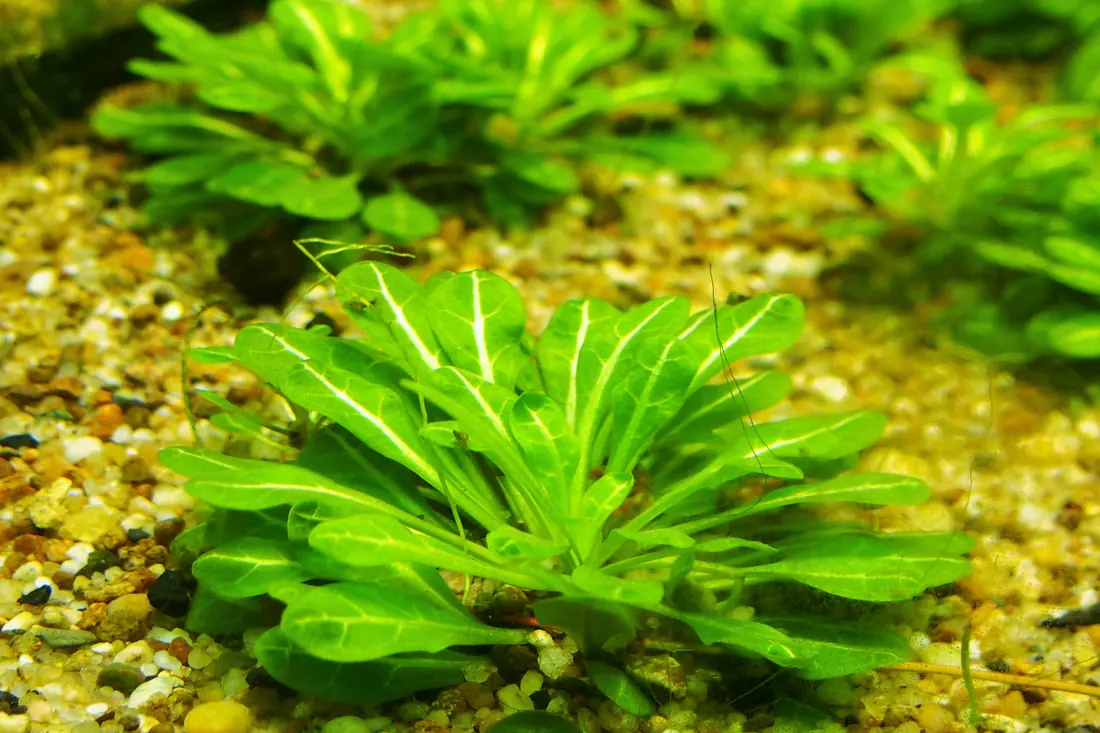
The survivors, then, share three qualities: tough leaves that goldfish tend to leave alone, a way of growing that does not depend on roots in the substrate, and enough strength to shrug off a clumsy fish.
Plants that usually survive
| Plant | How to grow it | Light | With goldfish |
|---|---|---|---|
| Anubias (barteri, nana, coffeefolia and others) | Rhizome tied or glued to wood or stone; never buried | Low | A reliable choice; leaves are thick and tough |
| Java fern (Microsorum) | Rhizome attached to wood or stone | Low | Tough; may be nibbled at first |
| Crinum (onion plant, C. thaianum, C. calamistratum) | Bulb two-thirds exposed in sand, weighted until rooted | Low to medium | Long, leathery leaves; usually ignored |
| Bolbitis (African water fern) | Rhizome attached, prefers gentle flow | Low | Slow but durable |
| Vallisneria | Rooted in sand, crown exposed | Medium | Hit and miss; some fish leave it, some shred it |
| Marimo moss ball | Rests on the floor | Low | Rolled around and sometimes torn, but survives |
Anubias is where most people start and where many stop, because it works. It comes in a dozen leaf sizes, from tiny petite varieties to plates the size of a hand, and it grows from a rhizome that must sit on top of the wood or stone, never under sand. Java fern is nearly as reliable and grows plantlets on its old leaves. Crinum is the plant for height: a well-established onion plant sends strap leaves up and across the surface, and adult goldfish leave it alone. Bolbitis is slower and looks wilder. Vallisneria is worth a try in a bigger tank; some goldfish never touch it, others reduce it to stubs in a week, and there is no way to know in advance. Marimo balls are algae rather than plants, and goldfish roll them around the tank like a toy; expect some wear.
Plants that become food
Elodea and its relatives sold as anacharis, duckweed, water lettuce, frogbit and hornwort will all be eaten, some within hours. That makes them useful rather than useless. A goldfish grazing on greens all day is eating a diet closer to its natural one, and it is less inclined to try the anubias. Grow them deliberately: keep a bucket, a spare tank or a sunny windowsill jar of elodea or duckweed and drop a portion into the tank every few days. Duckweed in particular multiplies fast enough to keep up with a modest tank, and floating plants shade the water and take up nitrate while they last. Vegetables for goldfish covers the rest of the green diet.
Quarantine, snails and pesticides
New plants can carry snails, snail eggs, hydra, planaria, pesticide residues and, if they were held in tanks with fish, parasite stages in the water or on their surfaces. Plants are often skipped when people quarantine, which makes them a common gap in an otherwise careful setup.
Two options:
- Time. Hold the plants in a bucket or spare tank of dechlorinated water, with a light, for two to four weeks, a keepers’ rule of thumb, changing the water every few days. Anything that needs a fish to complete its life cycle runs out of hosts. This is the gentle option and the one to use on anything delicate.
- A dip. Some keepers dip plants briefly in dilute bleach or potassium permanganate, then rinse and soak them in dechlorinated water. A cited strength and contact time are not available here, so none is given, and softer species may not survive it.
Tissue-culture plants, sold in sealed cups, arrive free of all of it and need no quarantine, which is most of what you are paying the premium for. Quarantining a new goldfish covers the same reasoning applied to fish, decor and second-hand equipment. As for hitchhiking snails: goldfish eat the small ones, and the survivors clean up leftover food. In a goldfish tank they are rarely a plague.
Attaching, potting and weighting
Anubias, java fern and bolbitis are attached rather than planted. Wrap the rhizome to a piece of driftwood or a stone with cotton thread or fishing line, or fix it with a dab of cyanoacrylate gel, the ordinary superglue gel sold in hardware shops, which is inert once cured and widely used in aquariums. Within a couple of months the roots grip the surface and the thread can go. A plant on a heavy stone cannot be uprooted, however hard a goldfish tries.
Plants that need roots in the substrate, crinum and vallisneria among them, go into small pots of sand topped with a layer of stones too large to swallow, or straight into the sand bed with a stone on either side until the roots take hold. Plant weights, the soft metal strips sold with bunched plants, hold stems down but do not stop a determined fish; wrap them in a strip of sponge so they cannot chafe the stems, and skip the lead ones.
The first month
Worth knowing in advance, because almost every new plant looks like a failure before it looks like a plant.
Melting is normal. Most aquarium plants are grown emersed at the nursery — out of water, with firmer leaves suited to air — and when they are submerged those leaves die back while the plant grows new ones adapted to being underwater. Anubias and java fern usually shrug this off; crinum and vallisneria can lose most of what they arrived with.
What to do about it: nothing to the plant, and something about the mess. Leave the rhizome, the bulb and the roots alone. Remove leaves that have gone soft or transparent, because they are decaying organic matter in the tank. Expect new growth within two to six weeks.
The fish will test it. A new object in the tank gets mouthed, and a plant that is going to be eaten is usually eaten in the first few days. A plant still intact after a fortnight will probably be left alone indefinitely.
What is genuinely wrong:
- A rhizome that has gone soft or black. Anubias and java fern rhizomes rot if buried in substrate. They belong on top of wood or stone.
- A bulb that is mushy at the base, which is the same problem.
- Everything uprooted every morning, which is a weighting problem rather than a plant problem.
Light
None of the survivors needs strong light, and strong light in a goldfish tank mainly grows algae. A modest LED for six to eight hours a day on a timer grows anubias, java fern and crinum slowly and steadily. Aquarium lighting covers the choices.
The timer matters more than the lamp. Plants respond to the length of the lit period, algae responds to the total, and the difference between a tank with a clean glass and one you scrape weekly is very often eight hours on a switch against twelve hours of whenever-someone-remembers. Consistency also matters to the fish, which settle into a day the same way they settle into a feeding time. If eight hours leaves the tank dark when you actually want to look at it, split it — four hours in the morning and four in the evening grows plants just as well and gives algae a break in between.
Daylight from a window is rarely the free lunch it looks like. It is unpredictable, it arrives strongest in the months algae is already thriving, and it heats one end of the tank in a way that matters more for goldfish than for most fish. If a tank gets direct sun for part of the day, the answer is usually to shade it and light it properly rather than to rely on what comes through the glass; green water in summer is very often a sunny windowsill rather than anything you did.
Remember what the light is for here. In a goldfish tank the plants are partly furniture and partly food, and a grazed plant needs to grow faster than it is eaten. That is an argument for adequate, steady light on tough species rather than for dim light on the theory that less is safer — an anubias kept too dark simply loses the race.
Feeding plants in a tank full of nitrogen
A goldfish tank is an unusual planted tank, and the usual fertiliser advice does not transfer.
Nitrogen is the thing you already have. Ammonia and nitrate are precisely what the fish produce and what the filter converts, so the nutrient most planted-tank advice is about adding is the one nutrient here in surplus. That is why plants help with nitrate at all.
What actually runs short is potassium, iron and trace elements. The symptoms are pale new growth, yellowing between the veins on older leaves, and growth that simply stops. A comprehensive liquid fertiliser dosed modestly fixes it.
Two adjustments for a goldfish tank:
- Use less than the bottle says. The dose assumes a tank whose nitrogen comes from a bottle too, and a goldfish tank is already at the top of the range for one of the three macronutrients.
- Root tabs for the rooted ones. Crinum and vallisneria feed from the substrate, and a tab pushed into the sand beside the roots works better than anything in the water column — substrate for goldfish covers why the bed itself is deliberately inert here.
And a caution: some fertilisers and some algae treatments contain copper, which is harmful to snails and shrimp. In a goldfish tank the snails are usually welcome — snails, hitchhikers and biofilm covers what they do.
When a plant is unhappy
A short diagnostic, because in this kind of tank the answer is rarely fertiliser.
- Holes in old anubias leaves. Normal ageing, plus occasional rasping by the fish. Trim leaves that are mostly gone; leave the rhizome.
- Pale, thin new growth. Not enough light, or not enough iron. Try light first, because it is free.
- Yellowing between the veins. Iron or trace deficiency.
- Leaves covered in algae. The plant is growing more slowly than the algae, which usually means too much light for how little the plant is doing — algae in a goldfish tank covers the balance, and the usual fix is a shorter photoperiod rather than more of anything.
- Stems bare at the bottom on vallisneria or anything rooted. Often the fish, working at the base.
- Everything failing at once after a treatment. Many medications and algaecides harm plants; check what went in.
The reliable order to check: light, then the fish, then nutrients. In a goldfish tank the first two explain most of it.
Free plants: propagating what works
The first anubias is the expensive one, and after that the tank can stock itself.
Anubias grows from a rhizome that extends steadily. Cut it with a clean blade so each piece keeps several leaves and some roots, and attach the new piece to its own stone. A single plant becomes several over a year or two.
Java fern does the work for you: plantlets form on the undersides and edges of older leaves, and drop off with roots already growing. Collect them and tie them down.
Crinum produces offsets from the bulb, which can be separated once they have their own roots.
Marimo balls can be pulled apart and rolled into smaller spheres, which then grow.
And elodea and duckweed propagate so readily that the difficulty is stopping them, which is exactly what makes them the renewable salad this page recommends growing separately.
Pothos and other emersed plants
A good nitrate sponge for a goldfish tank is not in the tank. Pothos, the trailing houseplant with heart-shaped leaves, will grow with its roots dangling in the water and its leaves in the room, fed by fish waste and rarely bitten by the fish. Cuttings root in a few weeks. Suspend them through a hole in the lid, from a suction-cup clip, or in a hang-on-back filter with the media removed, and rinse any soil from the roots first. Keepers also use peace lily and lucky bamboo this way, but there are no data on their safety for fish. A tank with a big pothos growing over it can show lower nitrate readings; the water parameter checker will show you whether yours does.
When plants make things worse
A counterweight, because two of these catch people out.
Oxygen at night. Plants photosynthesise in light and respire in the dark, so a heavily planted tank produces oxygen through the day and consumes it overnight, reaching its lowest level just before dawn. That coincides exactly with when a warm or crowded tank is already under most pressure, and it is one of the standard explanations for fish gasping at the surface in the early morning and looking fine by mid-day. The fix is an air pump running overnight — aeration and oxygen covers it.
A plant dying unnoticed. A bunch of elodea that has rotted behind the filter, or a crinum leaf that has gone to mush at the back, is decaying organic matter producing ammonia exactly like uneaten food, and it is far easier to miss than a dead fish. Take dead leaves out, and look behind things during the weekly water change.
A third, smaller one: heavy floating cover seals the surface and slows gas exchange. Duckweed left to form a solid raft over the whole tank is doing that, which is another reason to crop it and feed it rather than letting it take over.
None of this is an argument against planting. It is an argument for planting deliberately and taking the dead bits out.
Plants in a pond
The same principles outdoors with a much larger canvas, and one extra responsibility.
Lilies do useful work — their pads shade the surface, cool the water and starve algae of light, and keepers’ advice is to cover something like a third to a half of the surface in summer. Goldfish ponds covers this alongside the rest of the pond’s ecology.
Marginals on the shelf take up nitrate and soften the edge, and submerged oxygenators give fry somewhere to hide, although goldfish will graze them steadily.
And the responsibility: several classic pond plants are listed as invasive in various countries, and a pond is far more likely than a tank to leak into the wider world — by flood, by bird, or by someone tipping it out. Check before you buy what is legal and sensible where you live, and never dispose of pond plants into a waterway or a hedge.
Silk plants
If you would rather not run an experiment, good silk plants are a legitimate choice. They shade, they soften the tank, they give the fish something to swim through, and they cannot die. Choose silk over hard plastic, which can tear the fins of a fantail or an oranda, and rinse them monthly. A tank of silk plants with a real pothos over the top gets most of the benefit of live planting with none of the losses; the setup in the ideal goldfish aquarium uses live plants, but there is no shame in the alternative.
Frequently asked questions
Do live plants replace water changes?
No. Plants take up some nitrate and a little ammonia, and a big pothos can make a visible difference to readings, but goldfish produce far more waste than a home aquarium's plants can absorb. Treat plants as a modest help that slows the rise in nitrate between water changes, and let the test kit rather than the greenery set the schedule.
Is pothos safe with goldfish?
Pothos leaves and sap contain calcium oxalate and are irritant if eaten, so the leaves are kept above the water. Keepers widely grow it with its roots in the water, and goldfish rarely bite them, but there are no published safety data for goldfish. Rinse the roots free of soil before they go in, keep the leaves out of reach, and watch the fish.
My new plant is melting. Have I killed it?
Usually not. Most aquarium plants are grown out of water at the nursery, with firmer leaves suited to air, and when they are submerged those leaves die back while the plant grows new ones adapted to life underwater. It looks like failure and is a normal conversion. Leave the rhizome or the roots alone, remove leaves that have gone to mush so they do not foul the water, and wait — new growth appears within two to six weeks. What is not normal is a rhizome that has gone soft or black, which means it was buried or has rotted.
Do I need to add fertiliser?
Not nitrogen, which is the one nutrient a goldfish tank has in abundance — that is what the fish are producing. What plants in this kind of tank actually run short of is potassium, iron and trace elements, so if growth has stalled and the leaves are pale or yellowing between the veins, a modest dose of a comprehensive liquid fertiliser is the thing to try. Root tabs suit crinum and vallisneria, which feed from the substrate. Use less than the bottle suggests, because the bottle assumes a tank without goldfish in it.
Can plants make the tank worse?
Yes, in two specific ways worth knowing. Plants consume oxygen at night rather than producing it, so a heavily planted tank has its lowest oxygen level just before dawn — which is when a warm, crowded tank is already under most pressure. And a plant that dies unnoticed behind the decor is decaying organic matter in the tank, contributing ammonia exactly like uneaten food. Neither is an argument against planting. Both are arguments for aeration overnight and for taking dead leaves out.
Why does my anubias have holes in its leaves?
Old anubias leaves develop holes and yellow patches naturally, and goldfish occasionally rasp at the surface of a leaf without managing to eat it. Neither is a problem. Trim leaves that are mostly gone at the stem, leave the rhizome alone, and new leaves will follow. If every new leaf is being shredded, the fish are probably hungry; feed more greens.