04 Aquarium
Snails, hitchhikers and biofilm
Three things turn up in a new aquarium that nobody warns you about, and all three get mistaken for problems. Most hitchhiker population booms are not an infestation; they are often a nutrient reading you did not ask for.
Three things appear in a new aquarium that nobody mentions when you buy it: a brown dust across the glass, a white slime on any new wood, and snails you did not put there.
All three get treated as problems. Two are stages a tank passes through, one is a permanent and mostly useful resident, and the response to all of them is roughly the same — which is to understand what they are reporting.
The brown dust: diatoms
In many new tanks, somewhere between the second and eighth week, a rust-brown dusting appears on the glass, over the substrate and along the leaves. It wipes off with a finger, comes back in a day or two, and looks like a failure.
It is diatoms: single-celled organisms that build silica shells, thriving on the silicates present in most tap water and on an immature system that has nothing yet competing with them.
The important facts:
- It is normal in a new tank and very common.
- It passes on its own, usually within a few weeks, as the available silicates deplete and other organisms establish.
- Nothing needs buying. It is not what the products aimed at algae are for, and treating it achieves nothing that waiting would not.
- Wipe the glass if you want to see in, and leave the rest.
The one thing to distinguish it from is a brown film that persists for months in an established tank, which is a different problem and usually a lighting or nutrient one. And from cloudy water, which is bacterial and has its own page.
The white slime: biofilm on new wood
Any new piece of wood, and some new decor, grows a white or grey slimy coating within days of going in. It looks exactly like a fungus, which is what everyone assumes it is.
It is biofilm, colonising the sugars and other compounds the wood releases as it saturates. It is harmless, it is not attacking anything, snails and goldfish graze it enthusiastically, and it disappears by itself over a few weeks as the wood stops leaching.
Siphon it off if you dislike it. Do not medicate for it — a course of treatment aimed at a biofilm is all cost and no benefit, and it is one of the commoner reasons a new tank gets dosed for no reason.
The surface film
A distinct thing, and the one on this page that can matter for the fish.
An oily, iridescent or dull skin on the water surface, most visible at an angle. It comes from proteins and lipids — food oils, oils from hands, dissolved organics — accumulating where there is not enough surface movement to break them up.
Why it matters: gas exchange happens at the surface, and a film across it can slow the exchange down. Goldfish tolerate low oxygen better than many aquarium fish, but at room temperature that means hours, and a warm, crowded tank can still run short, so a film that cuts exchange is worth clearing — the aeration guide covers oxygen and aeration.
How to fix it:
- Increase surface agitation — angle the filter return upward, add an air stone, or lower the water level slightly so the outflow breaks the surface. This prevents it recurring.
- To clear what is there, lay a sheet of kitchen paper flat on the water and lift it straight off. The film comes with it. Twice is usually enough.
- Wash your hands before putting them in, and skim after feeding oily foods.
A surface skimmer attachment exists and works, and is rarely necessary once the agitation is right.
Snails
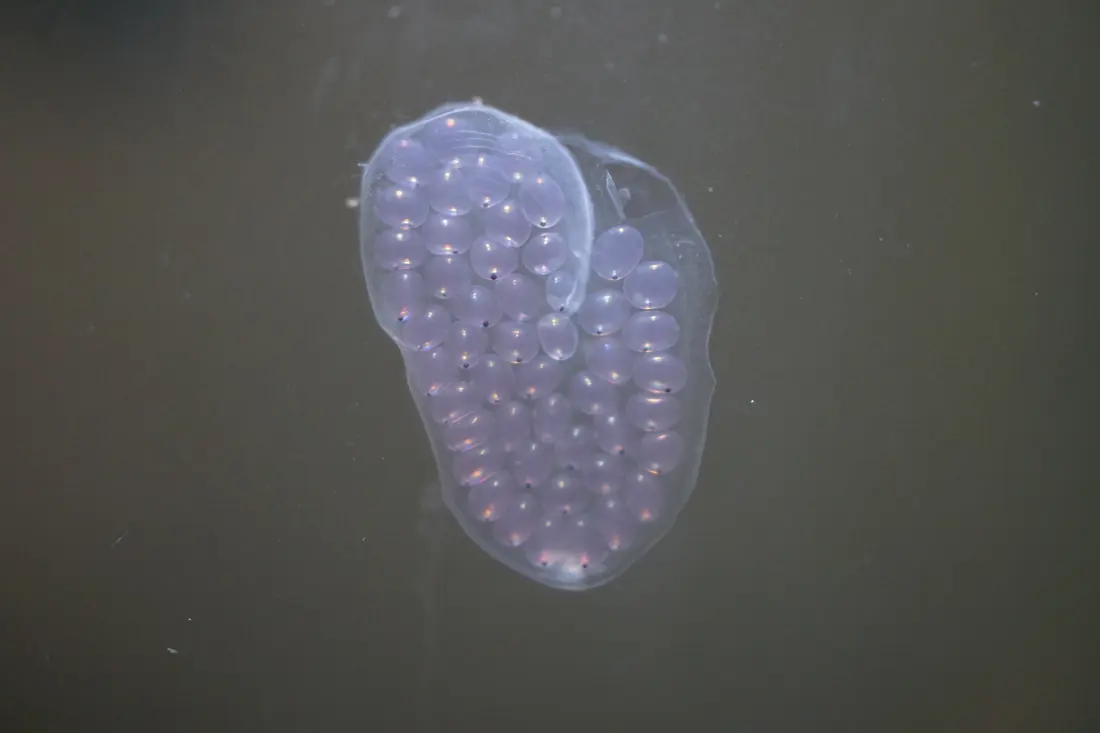
Nobody buys the common ones. They arrive as eggs in a clear jelly on the undersides of plant leaves, survive a rinse, and hatch a fortnight later — which is why a snail population seems to appear from nothing a month after the last time you added anything. Second-hand decor and water from another tank do the same job.
| Snail | Where from | Verdict |
|---|---|---|
| Bladder and pond snails | Plants | Harmless. Breed fast; population tracks food |
| Ramshorn | Plants | The same, with a nicer shell |
| Malaysian trumpet | Plants, substrate | Burrow and turn the substrate; nocturnal; very hard to remove |
| Nerite | Bought | Good algae eaters; the larvae need brackish or salt water, so numbers do not build up in fresh water |
| Assassin | Bought | Eat other snails, slowly |
| Apple and mystery snails | Bought | Large, may eat plants, and restricted or banned in some regions |
Do they harm a goldfish tank? In practice, no. They consume detritus, uneaten food and algae, they add a small amount to the bioload, and goldfish eat the smaller ones — which is good for the fish, supplying calcium and something to hunt.
Two genuine caveats. Soft water gives snails poor shells, so in a very soft supply they struggle and look pitted; the pH, KH and GH page covers the hardness question. And outdoors is different, for reasons below.
What appears when, in a new tank
Most of the anxiety here comes from not knowing that any of it is scheduled. It roughly is.
| When | What turns up | Do |
|---|---|---|
| Days 1–7 | Cloudy water, sometimes | Nothing — bacterial bloom, see cloudy water |
| Week 1–3 | White slime on new wood | Nothing. Siphon if you dislike it |
| Week 2–8 | Brown diatom dust everywhere | Wipe the glass. Wait |
| Week 3–6 | Snails appear from nowhere | Read the feeding, not the snails |
| Month 2 onwards | Green algae often begins as diatoms fade | Normal succession; algae page |
| Month 2–4 | Detritus worms, copepods, small life | Signs of a maturing system |
| Month 6+ | A stable film on everything, little drama | This is the goal |
A young aquarium is a succession, not a finished object. Organisms tend to arrive in a fairly predictable order as different resources become available and then get used up, and most of what looks like a problem in the first two months is a stage. The timings are keepers’ experience, not measurements, and vary from tank to tank.
The exception, and the one thing on that list worth acting on immediately, is a reading rather than a sight: ammonia or nitrite above zero, which the testing guide covers and which nothing on this page is a substitute for.
Adding snails on purpose
The other direction, and worth a straight answer because a goldfish tank is a poor home for most of what gets sold as a cleanup crew.
Shrimp: no. Goldfish eat them. Amano, cherry, any of them — a goldfish is a large opportunistic omnivore and shrimp are food. The tankmates page makes the general argument.
Small fish as algae eaters: also no, for the same reason and for the temperature reason.
Nerite snails: the one keepers most often suggest, with caveats. They are effective algae grazers, their larvae need brackish or salt water so the population does not build up in fresh water, and they are large enough that many goldfish leave them alone. Two costs: goldfish can knock them off surfaces and harass them, and nerites lay hard white egg capsules on hardscape that never hatch in fresh water and are very difficult to remove.
Assassin snails are used to reduce a pest-snail population without chemicals, and keepers find they work slowly.
And the general point: no invertebrate is going to clean a goldfish tank for you. Goldfish produce more waste than a cleanup crew can process, the siphon is the cleanup crew, and anything you add is there because you like it rather than because it will do the work.
When a hitchhiker is actually a problem
Pulling the exceptions together, because the reassuring tone of this page has limits.
Anchor worm and fish lice. Attached to a fish rather than living in the tank, visible as a thread from a red inflamed spot or a flat moving disc, and genuinely treatable. They arrive on new fish, plants or live food, which is the argument for quarantine. The anchor worm and fish lice page covers identification and treatment.
A snail die-off. Worth knowing about because it is usually self-inflicted. A copper treatment, a large water change with unconditioned water, or a sudden chemistry swing can kill a whole snail population at once, and a few hundred decomposing snails is a serious ammonia load arriving over a day or two. If snails have died en masse, siphon out the bodies, test daily and change water on the reading.
Hydra in a fry tank. Harmless to an adult goldfish and not harmless to newly hatched fry, which they can catch. The only situation on this page where a hitchhiker justifies intervention rather than a change in feeding.
Anything in a pond attached to a fish. Leeches and larger parasites are uncommon and worth acting on when they appear.
Everything else on this page is either a stage, a decomposer, or a reading.
The thing the snails are telling you
A useful idea on this page, and it applies to almost everything else here too.
A snail population is limited by food. It grows to match the surplus organic matter available and shrinks when that surplus goes away. Which has two consequences:
You cannot remove a population by removing snails. Cull them and the survivors breed back into the food that is still there. This is why manual removal feels endless and why people escalate to chemicals.
A snail explosion is a reading. It often means more food is going into that tank than the fish are eating — which is precisely the diagnosis the overfeeding page describes, arriving by a different route.
So the actual control measure is: feed less, siphon properly, and wait. The population often falls on its own over a few weeks.
For the ones you do want out today, a lettuce leaf or a slice of cucumber left in overnight collects a surprising number in one place.
The other hitchhikers
| What you see | What it is | Matters? |
|---|---|---|
| Thin white worms wriggling in the substrate | Detritus worms | No. Often follows surplus food |
| Flat, arrow-headed, gliding on the glass | Planaria | No, for goldfish. Often follows surplus food |
| Tiny stalked polyps with tentacles on the glass | Hydra | No, for adult goldfish. Often follows surplus food |
| Specks darting in the water column | Copepods, seed shrimp | No. A sign of a mature tank, and free food |
| Fine green or brown fuzz on surfaces | Algae | Its own page |
| A thread from a red inflamed spot on a fish | Anchor worm | Yes. See anchor worm and fish lice |
| A flat translucent disc moving on a fish | Fish louse | Yes. Same page |
| Large predatory larvae, in ponds | Dragonfly and damselfly nymphs | Outdoors only; will take fry |
| Leeches, in ponds | Leeches | Uncommon; usually harmless to healthy fish |
The pattern is worth stating once. The creatures in the upper half of that table are decomposers or animals that feed on them, so their numbers often follow the surplus organic matter in the tank. They are not infestations of the fish; they are often readings of the feeding. The two that genuinely matter are the two that are attached to a fish rather than living in the tank, and those arrive from outside on new fish, plants or live food.
Stopping them arriving
The realistic options, in order of effort.
Quarantine plants as you would fish — a bucket or spare tank for a couple of weeks, which lets eggs hatch where it does not matter.
Inspect and rinse, particularly the undersides of leaves, where the egg jelly sits. Useful, not reliable.
Dip or soak new plants. Some keepers use a dilute bleach dip or an alum soak to kill snails and eggs; protocols vary, both can damage the plants, and both need a thorough rinse, plus a dechlorinator soak after bleach. Worth it for a valuable display, excessive for most goldfish tanks — where, as the aquascaping page notes, the plants are a few tough species.
Buy tissue-culture plants, grown sterile in sealed pots. A reliable route, and it costs more.
Accept them. Entirely defensible. A modest snail population in a well-fed-but-not-overfed goldfish tank is a benefit rather than a cost.
Outdoors is different
A pond is a wildlife system and cannot be sterilised, which is mostly a good thing.
Snails are useful in a pond, grazing algae and processing debris.
But they close a life cycle. The fluke behind black spot needs both snails and fish-eating birds, which is why the encysted spots discussed on the black patches page turn up in pond fish. A closed aquarium cannot complete that life cycle without snails and birds, but fish bought from ponds can carry the cysts in with them. It is usually harmless in small numbers, hard to treat in any practical sense, and not a reason to remove the snails.
Predatory insect larvae — dragonfly and damselfly nymphs, diving beetle larvae — will take fry and very small fish. Nothing to be done, and nothing that threatens adults.
Do not try to clear it. A pond with snails, insect larvae and a general population of invertebrates is a functioning system, and the same organisms that look untidy are processing the debris and feeding the fish. The pond guide covers the maintenance that is actually worth doing.
Frequently asked questions
What is the brown dust all over my new tank?
Usually diatoms, and they are a normal sight in a young aquarium. A rust-brown dusting often appears on the glass, the substrate and the leaves somewhere between the second and eighth week, wipes off with a finger, and then usually goes away by itself as the tank matures and the available silicates are used up. It is not an algae problem to be treated, nothing needs buying, and the single best response is to keep doing your normal maintenance and wait.
There is white slime on my new driftwood. Is it a fungus?
It is biofilm, and it is harmless. New wood releases sugars and other compounds as it saturates, and a white or grey slimy growth colonises them within days. It looks alarming, it is not attacking the wood or the fish, snails and goldfish graze it, and it disappears on its own within a few weeks as the wood stops leaching. Siphon it off if you dislike the look; do not medicate for it.
Where did my snails come from?
Plants, usually — as eggs in a clear jelly on the undersides of leaves, which survive rinsing and hatch a fortnight later. They also arrive on second-hand decor, in water from another tank, and occasionally on a bag from a shop. Nobody buys pond snails or bladder snails; they arrive, and then a population appears from nowhere a month after the last time you added anything.
Do snails harm goldfish?
Not usually in an aquarium. They eat detritus, uneaten food and algae, they add a small amount to the bioload, and goldfish eat the smaller ones — which is good for the fish, providing calcium and something to hunt. The caveat is outdoors: snails are the intermediate host for the fluke that causes black spot, so a pond with snails and visiting birds can complete a life cycle that a closed aquarium cannot, although fish bought from ponds can carry cysts in with them.
How do I get rid of snails?
By feeding less, not by removing snails. A snail population is limited by food, so it grows to match what is available and rebuilds after any cull — which is why manual removal feels endless. Cut the feeding, siphon the substrate properly, and the population falls on its own. A lettuce leaf or slice of cucumber left in overnight makes a convenient trap for the ones you do want to take out, and it is worth reading the population as information first: a snail explosion usually means there is more food in that tank than the fish are eating.
Should I use a snail-killing product?
Rarely. Many of them are copper-based, and copper is a treatment your fish are also sitting in — hard to control, since it can bind to substrate and decor and leach back. A mass die-off of snails also releases a large quantity of decomposing material at once, which can produce an ammonia spike on top of everything else. Change the feeding instead; it is slower and it addresses what is actually driving the population.
What are the tiny white worms on my glass?
Usually detritus worms if they are thin and wriggling in the substrate, or planaria if they are flat, arrow-headed and gliding smoothly across the glass. Neither usually harms an adult goldfish. Both often turn up where organic matter is in surplus, so they may be telling you the same thing: there is more food going into that tank than is coming out of it. Keepers find they fade when the feeding and the siphoning are corrected.
Is there an oily film on the surface and does it matter?
It can. A protein and lipid film on the water surface can slow gas exchange at exactly the place where all of it happens. Goldfish tolerate low oxygen better than many aquarium fish, but at room temperature that means hours, and a warm, crowded tank can still run short, so it is worth fixing. Increase surface agitation, and to clear the existing film lay a sheet of kitchen paper flat on the water and lift it off; the film comes with it. Repeat once or twice and it is usually gone.