01 Care guide
Can goldfish live in a bowl?
A goldfish can survive in a bowl for a while. Living well in one is another matter. Here is what goes wrong, why, and the easiest way to fix it.
Almost everyone who searches this question already has a goldfish in a bowl. Maybe it arrived as a gift, maybe a child won it, maybe the shop said it was fine. So let’s skip the lecture. Bowls do not work well for goldfish, but the reasons are practical rather than moral, and the fix is simpler and cheaper than most people fear.
If the fish looks unwell right now
Before anything else, because a proportion of people reading this have a fish in trouble in front of them.
- Change half the water, with tap water that has been treated with conditioner and is at the same temperature as the bowl. Do it now. It is the only thing that removes ammonia immediately and it cannot do harm.
- Stop feeding. Every meal becomes more ammonia within hours, and a goldfish loses nothing by missing several days.
- Move the bowl out of sun and away from radiators, and take off any lid or cover.
- Get oxygen in. An air pump and air stone if you have one; failing that, pour a jug of the bowl’s own water back in from a height every hour or so, which aerates far better than it sounds like it should.
- Repeat the water change tomorrow, and daily after that.
If the fish is hanging at the surface gulping, gasping at the surface has the full emergency sequence. If it is sitting on the bottom and not moving, sitting on the bottom covers that. Both are common in bowls and both usually improve within a day of clean water.
What goes wrong in a bowl
The problem is not that the bowl is small, although it usually is. The problem is what happens to the water.
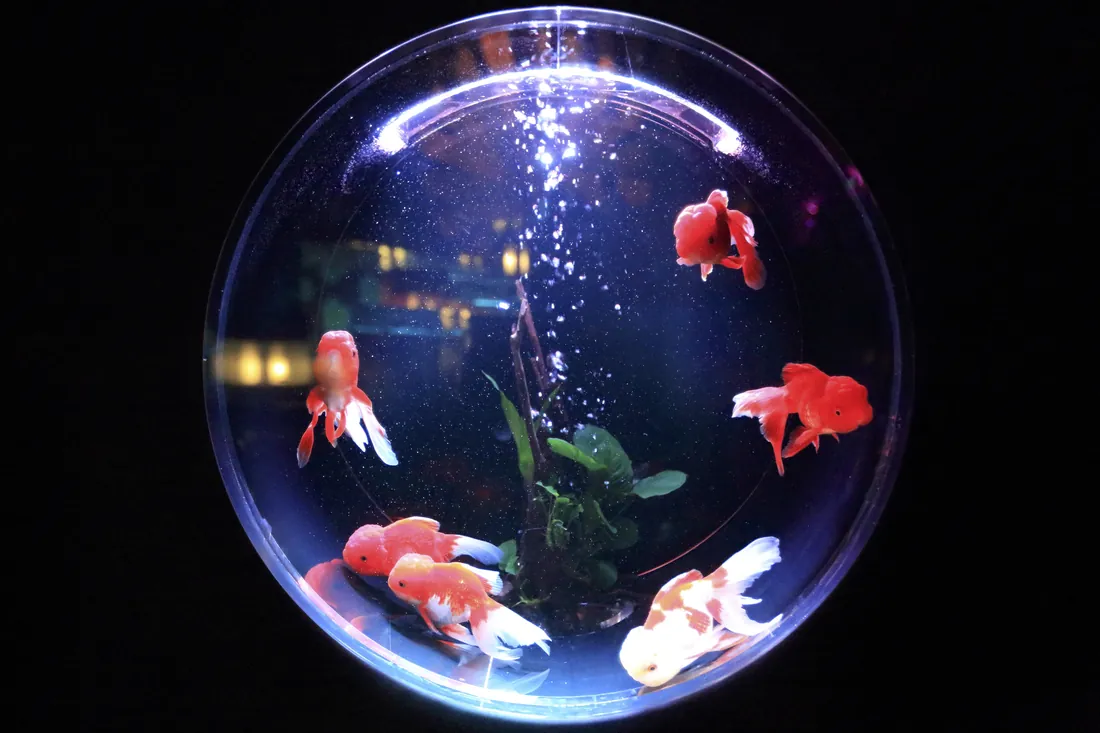
A goldfish produces ammonia continuously, through its gills and in its waste. In a filtered aquarium, colonies of bacteria in the filter convert ammonia into nitrite and then nitrate, which is far less harmful and is removed with water changes. In a bowl there is no filter, so there is nowhere for those bacteria to live in useful numbers. Ammonia simply accumulates in the water the fish is breathing.
Ammonia damages gill tissue, and clear water can still be toxic. The fish becomes lethargic, its gills redden, and it hangs at the surface or sits on the bottom. Each of these signs is easy to misread as “just being a goldfish”.
Two other things work against a bowl. Its narrow opening limits the surface where oxygen enters and carbon dioxide leaves, so oxygen runs low, especially in warm rooms. And its small volume means temperature and chemistry swing quickly with the room, which stresses fish adapted to the stability of ponds and lakes.
The numbers, roughly
Abstractions are easy to dismiss, so here is the shape of it in figures.
Volume. A typical goldfish bowl holds 4 to 8 litres. The starting figure for one fancy goldfish is 75 to 100 litres — see the tank size guide for where that comes from. So a bowl is not slightly short; it is roughly a tenth to a twentieth of the volume.
Surface area, which is what actually governs oxygen. A bowl’s opening is narrower than its belly, so the air-water interface is smaller than the widest part of the vessel — often under a fifth of what a rectangular tank of the same volume would give. Filling a bowl to the brim, which looks right, makes this worse rather than better: the water surface is then at the narrowest point.
Temperature. A few litres of water sitting in a room tracks that room almost exactly, swinging several degrees between afternoon and dawn. A hundred litres barely moves. Goldfish tolerate a wide range of temperatures and tolerate rapid changes considerably less well, which is covered on the temperature page.
And ammonia. Nothing in a bare bowl removes it. It accumulates from the moment the fish arrives until the next water change, which is why the daily change below is the whole of a bowl’s maintenance rather than part of it.
The same fish, in four volumes
The argument is usually made as a line between bowls and tanks. It is really a gradient, and seeing it as one makes the intermediate steps worth taking rather than dismissible.
| Volume | What that means day to day | A missed week |
|---|---|---|
| A 2 L bowl | Ammonia climbs within hours, no oxygen reserve, temperature follows the room. Daily large changes just to hold it | Fatal |
| 20 L, filtered | Ammonia over days, some buffering, room for a juvenile only. Changes twice a week | Serious |
| 75 L, filtered | Ammonia over a week, temperature lags, one adult fancy. Weekly changes | Recoverable |
| 150 L, filtered | Barely moves in any respect. Two fancies, or one single-tail. Weekly changes | Barely noticed |
The column that matters is the last one. What volume actually buys is not swimming room — it is the difference between a mistake being fatal and a mistake being absorbed. That is the same argument goldfish tank size makes for larger tanks, and it applies with much more force at the small end.
Which is why the intermediate steps count. Twenty filtered litres this week beats a hundred next year, and the fish does not get the benefit of a tank you have not bought.
Why the bowl exists at all
Worth knowing, because it explains why the advice you were given was confident and wrong, and because nobody reading this invented the idea.
The glass globe with a goldfish in it is a Victorian parlour ornament. It arrived in European and American homes in the nineteenth century, when goldfish were a fashionable curiosity and the vessel was designed as a piece of furniture: a sphere magnifies and displays the fish beautifully from every angle, and that was the entire design brief. The history of the domesticated goldfish covers how the animal reached that parlour.
Nobody knew about the nitrogen cycle. The bacterial process that makes a filtered aquarium possible was not understood in aquarium terms until the twentieth century, and did not reach hobbyists in any practical form until later still. Victorian goldfish in bowls died regularly and were simply replaced, which is also the origin of the fairground goldfish as a disposable prize.
So the image is older than the knowledge. It persists because it is attractive, because bowls are still sold, and because a goldfish is tough enough to survive in one for long enough that the connection between the container and the outcome is easy to miss. That is not a failure of the person holding the bowl. It is a century-old picture that was never true and has never been withdrawn.
If you are stuck with a bowl for now
Sometimes the new tank is a week away. In the meantime, the goal is to keep ammonia down.
Change about a third to a half of the water every day, using water that has been dechlorinated and is at the same temperature as the bowl. Feed lightly, once a day, only what disappears in under a minute, because uneaten food becomes ammonia too. Keep the bowl out of direct sun and away from radiators. If you can borrow or buy a small air pump and air stone, it will help with oxygen.
Get a liquid test kit if you possibly can, even before the tank. Without one the daily change is a guess: you cannot tell whether a third is enough or whether you should be changing half twice a day, and ammonia gives no warning you can see or smell. The testing guide covers reading it, and a kit is cheap next to the cost of finding out the hard way.
And watch the temperature rather than the thermometer’s absolute reading. A bowl on a windowsill can move several degrees between afternoon and dawn, and those swings do more harm than a steady temperature a little below ideal.
This is a holding pattern, not a solution. But it is far better than a bowl left to its own chemistry.
The cheapest real improvement: a storage tub
A very useful thing on this page for anyone who cannot buy an aquarium this week, and it is rarely suggested.
A plastic storage box — the kind sold for under-bed storage in any homeware or hardware shop — holds 30 to 80 litres, costs a small fraction of any aquarium, and is available the same afternoon. Food-grade plastic, no soap residue, no scented cleaning products ever.
What it gives you over a bowl:
- Several times the water, so ammonia concentrates far more slowly.
- A large, flat surface, which is where oxygen enters. This is the biggest single gain, and it is a consequence of the shape rather than the price.
- Room to swim, in a straight line, which a sphere never provides.
- A place to put a cheap sponge filter when you can get one — an air pump and a sponge is the least expensive filtration there is, and the filtration guide explains why it suits this job.
What it does not give you is a view. You are looking down into an opaque box, which is not why most people keep fish. But the fish is not the one looking, and a tub today beats an aquarium in three weeks’ time.
Two cautions: keep it covered enough that the fish cannot jump, with something that does not seal the air off, and remember it is still uncycled water — cycling has to happen wherever the fish lives, and until it does, daily testing and water changes are the routine.
The upgrade that changes everything
How big do goldfish get? sets out how to tell whether a fish has been held back, how much of it can be recovered, and what the evidence for the stunting mechanism actually supports. The single biggest improvement you can make is moving the fish to a filtered aquarium. It does not need to be enormous or expensive to be a transformation.
For one young fancy goldfish, a rectangular tank of around 60 litres (about 16 US gallons) with a sponge or hang-on-back filter is a workable starting point — and 75–100 litres is the figure to aim at, because that is what the adult fish needs. Buying the larger tank now is cheaper than buying both. For a common or comet goldfish, which can grow to 30 cm, think bigger from the start or plan for a pond eventually. Our tank size guide walks through the numbers, and the stocking checker will assess whatever you have in mind.
A second-hand tank is often the cheapest route. Glass aquariums are durable and widely available used; the filter and a bottle of dechlorinator are the parts worth buying new.
What it costs
The real barrier for most people reading this, and it is smaller than it looks.
The tank is the cheap part, second-hand. Glass aquariums last decades and are sold constantly, often for very little, because people leave the hobby with a tank in the garage. Check the silicone seams for lifting, fill it outside before it comes indoors, and accept a scratched one — the fish does not mind.
Buy the filter new. A used filter carries whatever was in its last tank, and a filter is the one part where a failure matters. A sponge filter and an air pump is the least expensive option that genuinely works; the filtration guide covers the types.
Buy the conditioner and test kit new too. They are inexpensive and they are the two things you will actually use every week. A liquid test kit costs more than the paper strips and is worth it.
Everything else can wait. Substrate, decor, lighting, a stand that matches the furniture — none of it changes whether the fish is healthy. What keeping goldfish costs sets out the whole picture, including the running costs, which are modest.
The comparison worth making: the tank is a one-off, and the alternative is years of a fish living in water you have to change every single day.
Moving the fish safely
When the new aquarium is ready, do not simply tip the fish in. Float the fish in a bag or container of its old water in the new tank for fifteen to twenty minutes so the temperatures match, then add a little tank water to the container every few minutes for another twenty minutes before gently releasing the fish. Discard the old water rather than pouring it in.
A brand-new filter has no bacteria in it yet, so the new tank will go through a cycling period. Read cycling a goldfish aquarium before the move, test the water daily for the first few weeks, and change water whenever ammonia or nitrite appear. It is a few weeks of attention in exchange for years of a much healthier fish.
The handling guide covers moving a fish without damaging it, which for a fancy means a container rather than a net.
What changes after the move
Worth setting out, partly because people want to know whether it was worth it and partly because the first week can be misleading.
Days 1 to 3. Often less activity rather than more. The fish has been moved, the surroundings are unfamiliar, and it may sit low or refuse a meal. That is settling, not a mistake — the clamped fins page describes the normal sequence.
Week 1. Activity increases noticeably. A fish that had been hanging in one place starts using the length of the tank, and most people find this the convincing moment.
Weeks 2 to 6. Colour deepens. A bowl-kept goldfish is very often pale, and the return of proper orange or the emergence of a pattern is gradual enough to be obvious only in photographs — pale or faded colour covers the mechanism.
Months 2 to 12. Growth. A fish whose growth was held back frequently resumes it once the water is right, sometimes quite quickly. The growth page sets out what to expect and how much is recoverable.
What does not reverse: skeletal deformity in a fish stunted for a long time, and gill damage severe enough to have scarred. Neither is a reason to delay, and both are arguments for moving sooner rather than for deciding it is too late.
Through all of that, remember the tank is cycling. Test daily, change water on the readings, and feed lightly. The improvement is real and it happens alongside a few weeks of attention rather than instead of them.
And what a bowl is good for
Having read all of that, you will have a bowl.
Not another fish. The bowl is no better for a betta, a white cloud mountain minnow or anything else sold alongside it; the problems on this page are problems of volume, surface area and filtration, and they do not care what species is in there. Small fish make the ammonia arithmetic slower, not different.
It is a good plant vase. A pothos cutting will live happily in one indefinitely, and keepers use peace lilies the same way, though there are no data on their safety for fish.
It is a useful container for water changes, for holding a fish for a few minutes while you work on the tank, or for soaking and rinsing filter media in tank water.
And it is a perfectly nice object, which was always the point of it.
Frequently asked questions
Is a 20-litre tank better than a bowl, or is it the same problem?
Much better, and still not enough, which is worth saying because the answer is a gradient rather than a line. Twenty litres with a filter holds roughly three to five times the water of a typical bowl, so ammonia climbs roughly three to five times more slowly and the temperature follows the room far less closely. That is a genuine improvement for a fish that is currently suffering. It is also still below the 75 to 100 litres an adult fancy needs, so treat it as a step rather than a destination — and take the step, because a fish in twenty filtered litres this week is better off than one waiting for a hundred next year.
My goldfish has lived in a bowl for two years. Is it fine?
Survival and thriving are different things. Goldfish are remarkably tough, and many endure years of poor conditions with stunted growth and a weakened immune system. If the fish is still alive, it is a great candidate for an upgrade, and the change in activity and colour after a move to a filtered tank often surprises people.
What about a really big bowl?
Size helps, but the shape still works against you. A bowl's narrow opening limits gas exchange, and without a filter ammonia still builds up at any size, though a larger volume dilutes it, so it climbs more slowly. A large bowl with a small filter is better than a bare bowl, but a simple rectangular tank of the same volume is better still and usually cheaper.
I cannot afford a tank this week. What is the best thing I can do today?
Buy a plastic storage tub. A food-grade box from a hardware or homeware shop holds several times what a bowl does, costs a fraction of any aquarium, and is available the same afternoon. It is the wrong shape for looking at a fish and the right shape for keeping one: more water, far more surface area for oxygen, and room to swim. Add a cheap air pump and sponge filter when you can. It is not a permanent home, but it is a genuine improvement rather than a holding pattern, and it buys you weeks rather than days.
My goldfish seems perfectly happy. Am I being told off for nothing?
No, and the appearance is accurate rather than misleading — goldfish are undemonstrative about chronic problems, which is precisely the difficulty. A fish in slowly deteriorating water does not act distressed; it becomes a little less active, a little less bright, grows more slowly, and looks like a normal goldfish to anyone who has not seen the same fish in good water. The comparison people find convincing is their own fish four weeks after an upgrade, which is usually startling. Until then, a test kit is the only way to know what the water is actually doing.
Is the damage permanent?
Often not, especially in a young fish. Growth that has been held back by poor water frequently resumes once the water is right, colour returns over weeks, and activity comes back within days. What does not fully reverse is skeletal deformity in a fish that has been stunted for a long time, and gill damage severe enough to have scarred. The practical answer is that moving the fish is worth doing at any age and is worth doing sooner, and that most of the visible change happens in the first month.
Can I keep a goldfish in a bowl temporarily?
For a few days, yes, with a daily partial water change using dechlorinated water at the same temperature. Treat it as a hospital stay, not a home.