01 Care guide
The domesticated goldfish
Every breed page here describes an animal that does not exist in nature. Goldfish are a domesticated carp, selected for a thousand years by people looking down into bowls, and almost everything odd about them follows from that.
Every breed page on this site describes an animal that does not exist in nature.
There is no wild ranchu, no wild telescope eye, no wild fish with two tails and no dorsal fin. There is a drab olive-brown carp in the rivers and ponds of East Asia, and everything else on the breeds page is a thousand years of people looking down into bowls.
The animal it started as
Goldfish are Carassius auratus, descended from one East Asian member of Carassius, a small genus of Eurasian carps. The wild form is unremarkable: olive to bronze, streamlined, a bottom-grubbing fish of slow water, historically of interest as something to eat.
Genetic studies trace goldfish to wild Chinese Carassius auratus of the lower Yangtze, and the gibel carp is a separate polyploid lineage, though naming within the group is still disputed. For a keeper the argument matters less than the fact underneath it. The ancestor was a plain freshwater carp, it still exists, and it looks nothing like the fish in a shop.
It is also not a koi. Koi are domesticated common carp, Cyprinus carpio: a different species, much larger, with barbels at the mouth that goldfish do not have. The two were domesticated separately and koi far more recently.
A mutation that should have been fatal
Wild carp populations occasionally throw up xanthic individuals — fish in which the dark pigment fails and the underlying yellow-orange shows through. It happens at low frequency, it is not rare in any deep sense, and in a wild pond a conspicuous fish is easy for predators to find.
A bright orange fish in murky water is visible to every heron, kingfisher and predatory fish for a considerable distance. The mutation appears, and the usual expectation is that it is eaten. That is the likely end of the story, and it is why wild carp are mostly brown.
So the interesting historical question is not where the colour came from. It is what stopped it being removed.
The temple ponds
A likely answer is a specific and rather unlikely piece of religious practice.
From around the fourth century, red and gold carp are recorded in China as curiosities. Over the following centuries — through the Tang period in particular — Buddhist observance produced release ponds: bodies of water attached to temples where animals were freed as an act of merit and where killing was prohibited.
An orange fish in an ordinary pond is food. An orange fish in a pond where nothing may be killed, netted or eaten is a fish that survives to breed, alongside others like it, generation after generation.
The move indoors
The decisive change was gradual. Deliberate breeding gathered pace under the Song dynasty, from around the tenth century, and by the Ming period goldfish were routinely kept and bred in vessels — ceramic bowls, tubs, basins.
That is the moment they become domesticated rather than merely collected, and it changed the selection pressure completely. In a pond, a fish still has to find food, avoid predators and survive a winter. In a bowl, none of that applies. What decides whether a fish breeds is whether its owner finds it interesting.
Under those conditions, traits that are useless or actively costly in a river are free to spread. Every strange thing about a fancy goldfish dates from after this point.
Why they were designed to be seen from above
This is the part that explains more than anything else about how fancy goldfish look, and it is invisible to anyone who has only seen them in a glass tank.
For most of their history, goldfish were kept in opaque vessels and ponds and viewed mostly from the top. A side view was rare. The aesthetic that centuries of breeders were working toward is a plan view: the outline of the body seen from overhead, the symmetry of a doubled tail spread flat below you, the shape of a wen framing the head, the curve of a ranchu’s back.
Which is why several breeds look faintly wrong through glass. They are not badly designed; they are designed for a different viewing angle. The tosakin, developed in Japan, is a clear case — a fish whose tail, a flat fan with its edges curled forward, is hard to read from the side and spectacular from above.
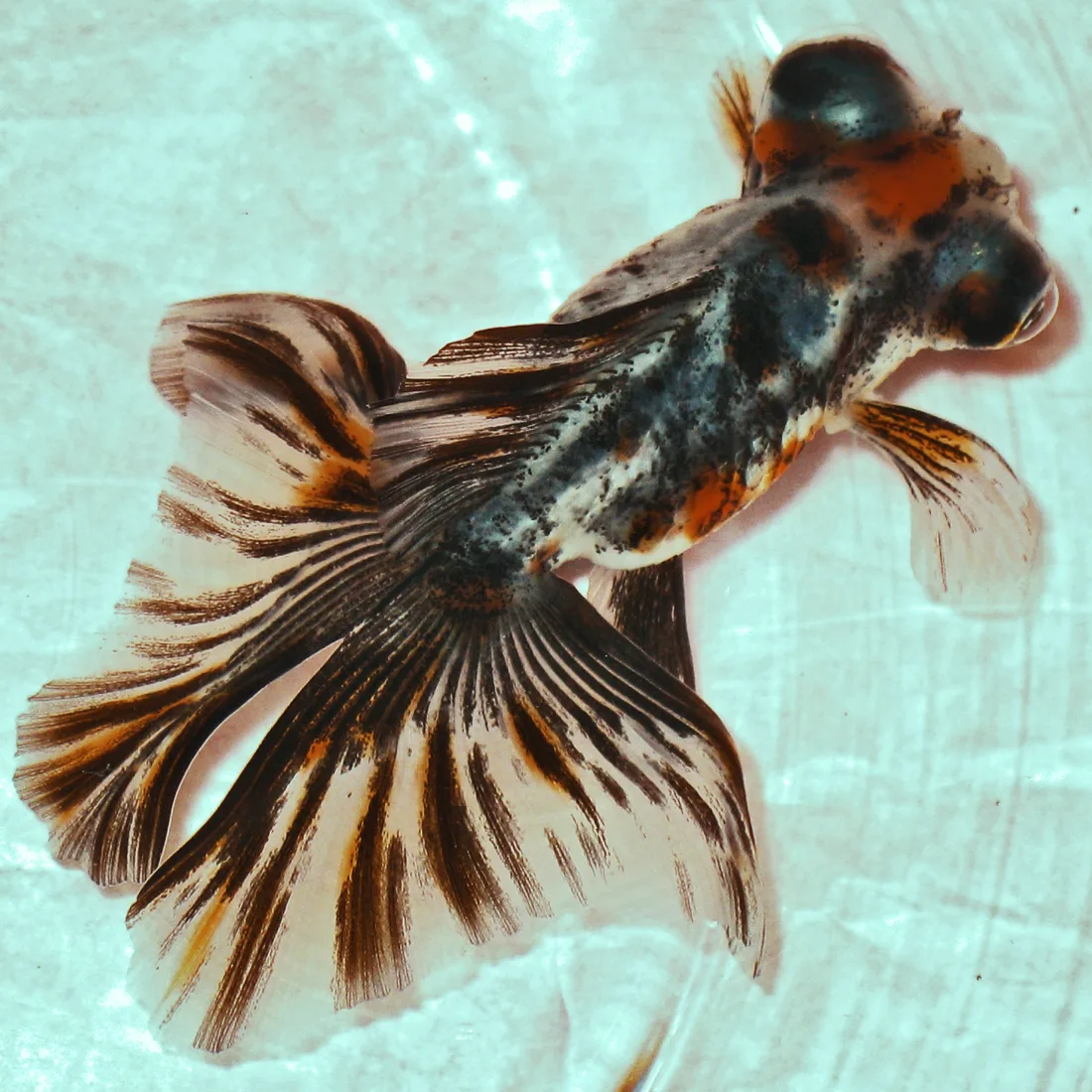
The glass-sided aquarium is a nineteenth-century idea applied to a much older animal, and a certain amount of the mismatch people notice in fancy goldfish is exactly that.
The traits appear
Through the Ming period and afterwards, the recognisable fancy forms arrive: doubled tails and anal fins, the loss of the dorsal fin, protruding telescope eyes, the head wen, the egg-shaped body, and later the bubble eye, the celestial and the pearlscale.
Each began as an oddity in a spawn that a breeder noticed and fixed. What each one actually is anatomically — and what it costs the fish that carries it — is set out in the table on the anatomy page, which is the right place for it and which this page will not repeat.
The through-line is worth stating once, though. Every fancy trait is a departure from a body that worked. A shortened body folds the gut against the swim bladder, which is why buoyancy problems concentrate in round-bodied breeds. A missing dorsal fin removes a keel. Telescope and celestial eyes trade vision for appearance. None of it is disease, all of it is intended, and all of it converts into a care requirement.
The breeds as combinations
Once the individual traits existed, the breeds are what you get by combining them. Reading them this way makes a long list of names considerably easier to hold.
The first fork is the largest: single tail or double tail. Everything after it applies to the double-tailed line.
| Breed | Body | Tail | Dorsal | Eyes | Head | Scales |
|---|---|---|---|---|---|---|
| Common | Wild | Single | Yes | Normal | Plain | Normal |
| Comet | Wild | Single, long | Yes | Normal | Plain | Normal |
| Shubunkin | Wild | Single | Yes | Normal | Plain | Nacreous |
| Fantail | Egg | Double | Yes | Normal | Plain | Normal |
| Ryukin | Egg, humped | Double | Yes | Normal | Plain | Normal |
| Oranda | Egg | Double | Yes | Normal | Wen | Normal |
| Telescope / moor | Egg | Double | Yes | Protruding | Plain | Normal |
| Pearlscale | Egg, round | Double | Yes | Normal | Plain | Domed |
| Ranchu | Egg, curved | Double | None | Normal | Wen | Normal |
| Lionhead | Egg | Double | None | Normal | Wen | Normal |
| Celestial | Egg | Double | None | Upturned | Plain | Normal |
| Bubble eye | Egg | Double | None | Sacs | Plain | Normal |
A fantail is the simplest fancy: the egg body and the doubled tail, and nothing else. Every other double-tailed breed is that plus one or two further traits, and the more of them a fish carries, the further it is from a body that swims well — which is the practical reason the tankmate question turns on how many alterations each fish is carrying rather than on temperament.
The single-tails barely changed
Worth separating out, because it explains a great deal.
A common goldfish, a comet and a shubunkin are, structurally, the wild carp. Same body plan, same single tail, same dorsal fin, same proportions. What was selected in them is colour and, in the comet, fin length — and neither changes how the animal works.
Which is why they are the hardiest goldfish there are: they grow the largest, swim the fastest, tolerate cold and pond life without difficulty, suffer buoyancy problems far less often, and generally live longest. They are also the ones that need the most space, for exactly the same reason — the tank size guide asks for roughly twice as much for a single-tail as for a fancy because the animal is twice the fish.
The fancy breeds are the interesting ones and the single-tails are the robust ones, and that is not a coincidence. It is the same fact stated twice.
Two body plans, to one scale
Comet: Yatokin, CC BY-SA 4.0
Single-tailed: can reach 25–35 cm The common, the comet and the shubunkin, measured with the tail, in a big tank or pond; a few pass 40, and many stay smaller. This comet is drawn at 30 cm.
Fancy: 15–20 cm Round-bodied and, with a few exceptions, double-tailed, measured the same way. Orandas pass 25 cm; bubble eyes and celestials stay under 15. This black moor is drawn at 18 cm, to the same scale.
What nobody chose
Selection produces what is aimed at and a great deal that is not, and two side effects are worth knowing about.
Narrow lines. Fixing a trait means breeding from a small number of related fish, repeatedly. Some fancy lines descend from few founders, and breeders report the reduced vigour that can follow — smaller spawns, weaker fry, a higher proportion of deformities — although the one cost measured so far is that an allele of the twin-tail gene lowers embryo survival. It is one reason a well-bred fancy from a serious breeder is a noticeably different animal from a mass-produced one of the same breed.
Volume over quality. Most goldfish sold are produced in enormous numbers at minimal cost, and the selection applied to them is for survivability in a production system rather than for the standard of the breed. A cheap fancy goldfish is frequently a poor example of its breed with a compressed body and none of the features that make the breed worth having — and, more importantly, it has usually spent its first months crowded. The choosing guide covers what to look for and why the shop’s whole system matters more than the individual fish.
Standards, and why they are so precise
Goldfish have been a show animal for centuries, with written standards describing exactly what a good example of each breed looks like — the angle of a ranchu’s back, the proportion of a ryukin’s hump, the shape of a wen, the carriage of a tail.
Two things follow from that. The standards are mostly top-view in the Japanese tradition, which is the aesthetic described above carried into formal judging. And the precision of them explains why breeders talk about goldfish in a way that can sound strange to someone who keeps them as pets: they are describing conformity to a specification that has been refined for a very long time.
None of it is necessary knowledge for keeping fish well. It is useful context for why a fish of the same breed can cost ten times what another does.
Out of China
To Japan, traditionally dated to 1502 but established only in the Edo period, where a separate and highly disciplined breeding tradition developed or refined the ranchu, the ryukin and the tosakin — and where the top-view aesthetic was taken furthest.
To Europe, in the seventeenth century, reaching Portugal by 1611 and spreading north. Goldfish were luxury objects for a long time, given as gifts, kept in ornamental basins.
To North America, by the mid-nineteenth century at the latest, and from there into the mass market — which is where the fairground fish, the unfiltered bowl and most of the misconceptions this site exists to correct also come from.
| Roughly | What happened |
|---|---|
| 4th century | Red and gold carp recorded in China as curiosities |
| Tang period | Kept and protected in ponds, including temple release ponds |
| From the 10th century | Deliberate breeding gathers pace under the Song |
| Ming period onward | Bowls and tubs routine; doubled tails (earliest dated record 1596), dorsal-less backs, telescope eyes, the wen |
| Traditionally 1502 | To Japan; established in the Edo period, with the ranchu, ryukin and later the tosakin developed or refined there |
| 1600s | To Europe (Portugal by 1611) |
| By the mid-1800s | To North America, and into the mass market |
What happens when you let one go
The clearest demonstration that this is a domesticated animal is what occurs when the protection is removed.
Goldfish released into rivers, lakes and ponds frequently thrive. Freed from the size limits an aquarium imposes, they often grow larger than tank fish, though most reach 15 to 20 cm and fish over 30 cm are uncommon, with a few much larger ones recorded. They breed readily, and they root through sediment in a way that clouds the water and damages plant communities.
And feral populations often drift towards olive-brown again, though gold and pale fish persist. Bright orange is conspicuous, and the selection that the temple ponds suspended is thought to resume.
Feral goldfish are an established invasive species across much of the world, releasing them is illegal in many places, and the breeding page makes the practical version of this argument: a spawn you cannot home is not a problem to solve by finding a pond.
What a thousand years did not change
Here is the part that pays off for anyone keeping one, and it is the reason this page belongs on a care site rather than in a museum.
Selection worked on the outside. Almost everything underneath is still the carp.
Still temperate. Goldfish tolerate cold water that would kill most aquarium fish and dislike sustained heat. The whole temperature argument, and the reason a pond works at all, follows from ancestry rather than from anything breeders did.
Still able to run without oxygen. The extraordinary anoxia tolerance that lets a goldfish survive a stalled tank comes from a wild carp that overwintered under ice.
Still without a stomach, still carrying a long gut built for continuous grazing. Which is why they beg endlessly, why overfeeding is a common mistake, and why what and how often you feed matters more than for most pets.
Still diggers. The sifting and spitting that wrecks planted aquascapes is a foraging behaviour from a fish that fed in sediment.
Still large. A common goldfish can reach 25 to 35 cm in good conditions, and its wild relatives grow that large too, so it is the carp’s potential rather than anything breeders added.
Still long-lived. Ten to twenty years is ordinary in good care, well beyond the ten or so recorded for wild relatives.
Still capable of learning. The recognition, the routines and the training the behaviour page describes are not products of domestication either.
So the animal in the tank is a domesticated ornamental form wrapped around an intact wild physiology — and almost every piece of advice on this site is really an accommodation of the second thing. The fancy goldfish is the part people chose. The carp is the part that decides how it has to be kept.
Frequently asked questions
What is the wild ancestor of the goldfish?
A wild carp of the genus Carassius — drab olive-brown, unremarkable, and historically a food fish rather than an ornamental one. Genetic studies trace the domesticated goldfish, Carassius auratus, to wild Chinese fish of the lower Yangtze; the gibel carp is a separate polyploid lineage, though naming within the group is still disputed. What is not in doubt is that the ancestor was a plain freshwater carp and that it still exists, looking nothing like the fish in a shop.
How long have goldfish been domesticated?
Roughly a thousand years as a deliberately bred ornamental animal, and longer than that as a curiosity. Red and gold individuals are reported in China from around the fourth century; they were being kept and protected in ponds through the Tang period; deliberate breeding gathered pace under the Song, from about the tenth century, and by the Ming goldfish were routinely kept and bred in ceramic bowls and tubs. That last step is the one that makes them domesticated rather than merely collected.
Why do fancy goldfish look strange from the side?
Because for most of their history nobody looked at them from the side. Goldfish were kept in ceramic bowls, tubs and ponds and viewed from above, so the traits that were selected are traits that read well in plan view — the outline of a ryukin's back, the curve of a ranchu, the spread of a wen, the symmetry of a doubled tail seen from overhead. The glass-sided aquarium is a recent way to look at a very old animal, and some breeds were never designed for it. The tosakin is a clear case: its tail, a flat fan with its edges curled forward, is hard to make sense of from the side.
Are goldfish the same as koi?
No, and they are not close. Koi are domesticated common carp, Cyprinus carpio, a different and much larger species with barbels at the mouth. Goldfish are Carassius, have no barbels, and stay considerably smaller. They are relatives in the broad sense that both are cyprinids, and they were domesticated separately — koi far more recently, mostly in nineteenth-century Japan.
What happens to goldfish released into the wild?
They usually do very well, which is the problem. Freed from the constraints of an aquarium they often grow larger than tank fish, they breed readily, they root through sediment in a way that clouds water and damages plant communities, and feral populations often drift towards the wild olive-brown colouring, though gold and pale fish persist, because bright orange is conspicuous to predators. Feral goldfish are an established invasive species across much of the world, and releasing them is illegal in many places.
Which came first, the fancy breeds or the common goldfish?
The plain single-tailed fish came first, being simply the wild carp with a colour mutation. The fancy forms — doubled tails, dorsal-less backs, telescope eyes, the head wen — were developed afterwards, most of them during the Ming period and later, and each was a rarity that breeders noticed and fixed.
Did domestication make goldfish weaker?
It made the fancy breeds weaker, and left the single-tails largely intact. Everything that was selected for in a fancy — a shortened body, doubled fins, an absent dorsal, protruding eyes — is a departure from a body that worked, and the anatomy page sets out what each one costs. A common or comet goldfish, by contrast, is still very close to the wild animal in build and in constitution, which is why it grows larger and swims better, and why it is usually credited with a longer life.
What did a thousand years of selection not change?
Almost all of the physiology, which is why so much of goldfish care looks odd to people who expect a tropical fish. They are still temperate animals that tolerate cold and dislike heat, still have no stomach and a long gut built for grazing, still tolerate low oxygen better than nearly any fish you could keep, still dig, still grow large, still live for decades, and still learn. Selection worked on the outside. The carp underneath is intact.