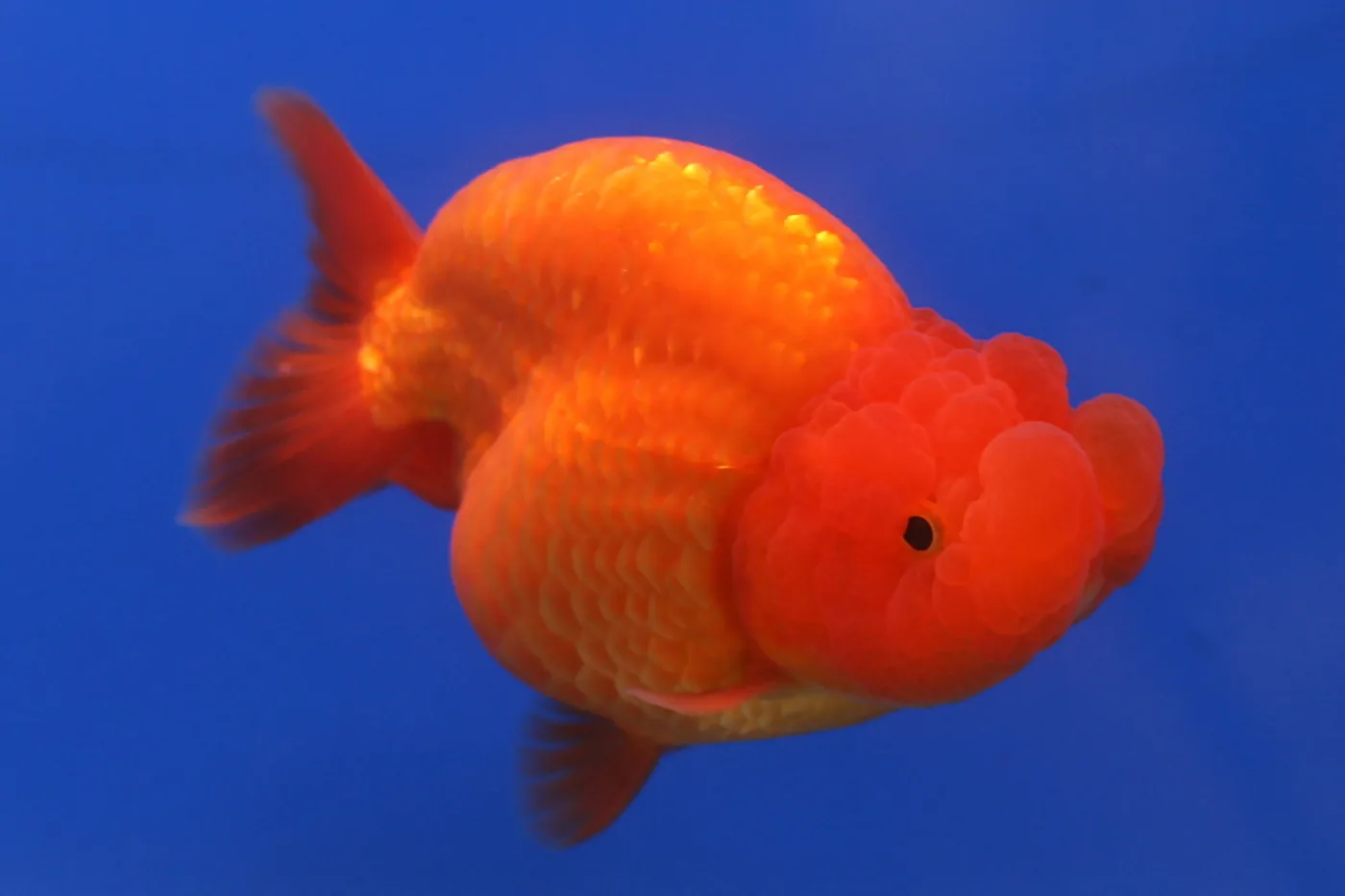
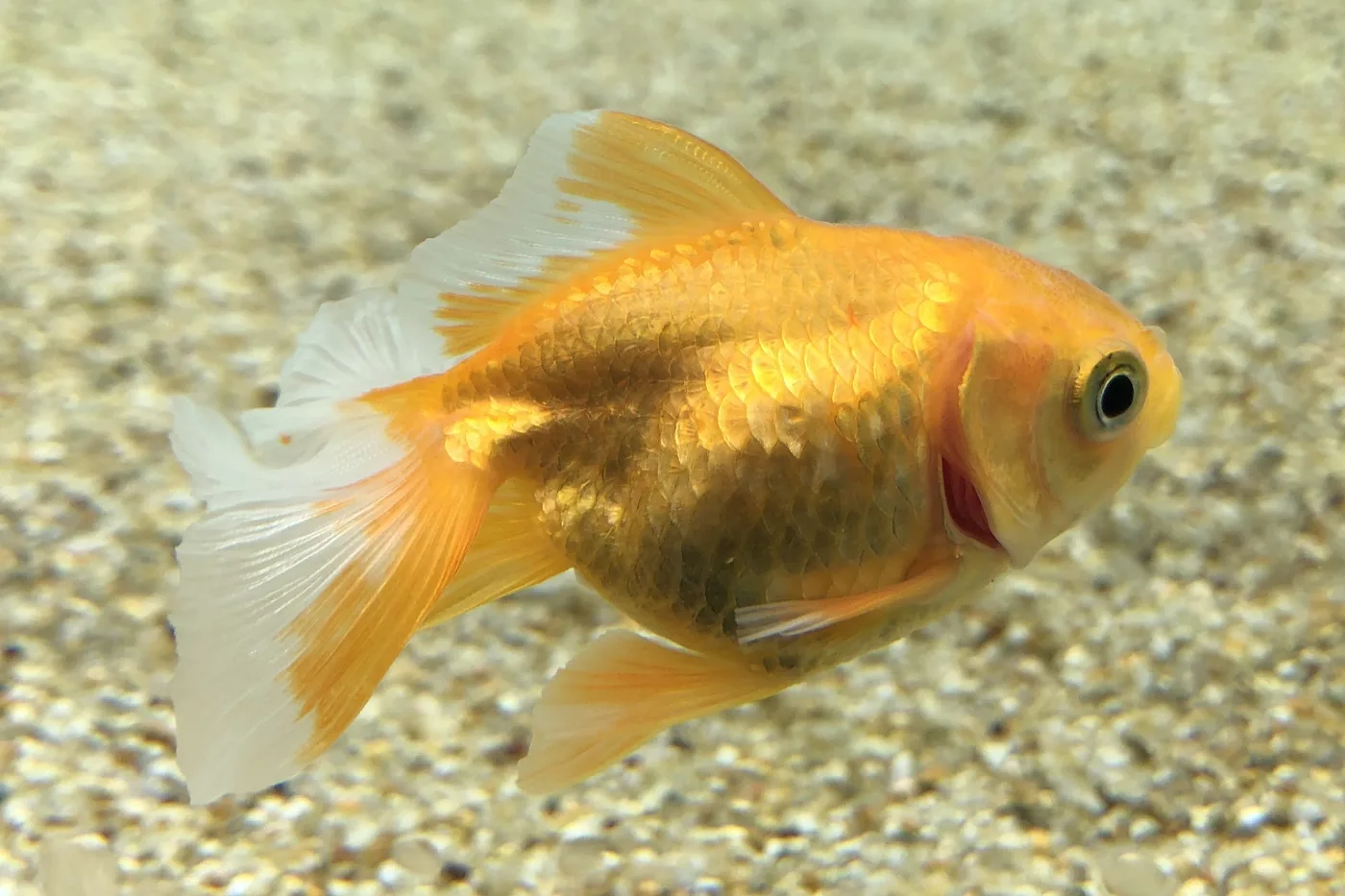
No. 1219th century, in Tosa
Tosakin
A tail spread flat as a fan, its edges curled forward, made for a round bowl and a view from above.
Also known as Curly fantail · Tosa goldfish · Tosakin goldfish
- Specimen
- Fancy goldfish, Japan
- Adult size
- 10–18 cm
- Lifespan
- 6–12 years
- Water
- 18–24 °C
- Care
- Demanding
- Swimming
- Weak
- First fish needs
- 100 litres
Photograph: Totti, CC BY-SA 4.0 · Wikimedia Commons
About this pictureSeen from the side, as here, the tail's flat spread and forward curl are hard to make out. They read from above.
About these figures Size, lifespan and water are the ranges keepers' guides give for a fish in good care, not measurements of this breed, and swimming and care are this site's own ratings of the published advice. Lifespan is where the sources differ most: how long goldfish live sets them side by side. First fish needs is a middle figure for one fish, from advice that runs from 50 litres to about 300; tank size sets that out.
The specimen
Quick facts
- Classification
- Fancy goldfish
- Body type
- Short, rounded body with a dorsal fin, carrying a very large tail whose two halves are attached at the centre and spread horizontally into a fan, the outer edges curled forward
- Tail and dorsal
- Double tail, dorsal fin present
- Swimming ability
- Weak
- Keeper experience
- Experienced
- Temperament
- Gentle and easygoing, a weak swimmer under a very large tail, and pushed aside by any faster fish
- Adult size
- 10–18 cm (4–7 in)
- Temperature
- 18–24 °C (64–75 °F)
- Minimum aquarium
- 100 L (26 US gal) for one fish
- Origin
- Tosa (now Kōchi Prefecture), Shikoku, Japan, 19th century, about 1845
How to recognise one
- A very large tail that spreads horizontally into a fan, best read from directly above
- A tail that is technically divided, but with its two halves attached at the centre, so that from above it is one continuous fan
- The leading edges of the tail flipped under and curled forward, towards the head, once or even twice, as if the fin had been turned inside out
- A short, rounded body with a full dorsal fin
- Seen from the side the tail's flat spread is hard to read, and the fish passes for a fantail or a ryukin with an unusually big tail
Almost every goldfish on this site shows itself best from the side, through the glass of a tank.
The tosakin shows itself from above. Its tail spreads flat, as wide as the fish is long, and the shape that names the breed, a fan with its edges curled forward, is hard to make out from the side. It was made in shallow round bowls in one Japanese province, it came close to being lost in the 1940s, and it was rebuilt from six survivors.
Identification
From above, one fan. The tail spreads horizontally. Technically it is a divided tail, but its two halves are attached at the centre, so what you see looking down is a single fan rather than two lobes. On a good fish it spreads as wide as the fish is long: in theory a circle drawn around the fish, seen from above, touches its nose and the tips of the tail on both sides. It has been described as a triple-lobed, or cherry-blossom, tail.
The edges turn under and forward. The leading edges of the tail flip under, once or even twice, and the outer lobes are twisted towards the head, so that the tail looks as if it had been turned inside out along its rim. The English name “curly fantail” describes this.
From the side, a fancy with a big tail. A short, rounded body, a full dorsal fin, and a tail whose flat spread and curl are hard to read from this angle. In profile a tosakin passes for a fantail or a ryukin with an unusually large tail, and the identification key works from the side for most breeds, which is why it cannot place this one.
Colour does not decide it. Red, red and white, and a dark form called iron black are the traditional colours. Calico tosakin exist, but not every purist accepts them.
The bowl that makes the tail
The tosakin is a top-view fish, like the ranchu, and the showing guide explains why a fish bred to be judged from above has a standard nobody can see through aquarium glass. The tosakin’s container is part of how it is raised as well.
The traditional bowl is round and shallow: earthenware, about 60 cm across, with sloping sides, and kept outdoors. The unwritten rule for the water in it is a depth of 20 cm or less.
The round shape is the point. Young tosakin are raised from their first year in round, mortar-shaped bowls, so that they swim along the curved wall, and it is said that the waves bouncing back off the sides encourage the tail to take its curl. How much of the tail the bowl makes and how much the parents give is not settled.
Outdoors, the same container is a shallow tub, and a tub or patio pond sets out what one needs through the year. The difference for this breed is that it wants the tub’s shallowness rather than tolerating it.
How it develops
There is no published timetable for a tosakin’s tail, so there is no table of ages here. What can be said is short. The breed is slow-growing compared with other fancies, which lengthens the wait, and a young fish’s tail is a prediction, as every fancy feature is: goldfish genetics explains why such features do not breed true.
Breeders cull early for the breed’s own fault, a tail that develops so far that it runs back along the body, covered under health below. Breeding goldfish covers culling in general and why it is part of keeping any line true.
Colour moves on its own timetable, as in any goldfish.
Aquarium requirements
About 100 litres for a first fish, the fancy row of the tank size guide, but spread flat: water about 20 cm deep in a container around a metre by half a metre. Footprint matters for every goldfish. For this one it is the whole specification.
Still water. A sponge filter, or an outflow returned gently across the surface, and nothing that pushes the fish around. Goldfish filtration covers how to keep a tank clean without a current, and it is the same problem the dorsal-less breeds pose, made harder by a tail that acts as a sail.
18 to 24 °C, and steady. Shallow water follows the air closely, so a tosakin container in a warm room or in summer sun changes temperature faster than a deep tank would, and goldfish water temperature explains why a swing is worse than either end of the range.
Bare or fine-bottomed, and smooth. Nothing sharp for the tail to meet, and nothing for food to disappear into.
Personality and behaviour
Slow and gentle. The breed is described as a weak, even clumsy swimmer, and as an easygoing fish: the tail is broad, flat and set sideways, and it is a lot to move around.
None of that is a sign of illness in this breed, and all of it decides the company. A tosakin is not an aggressor, and in a mixed tank it is simply the last fish to anything, which is the mechanism the chasing and bullying page identifies as the one that actually harms slow fish.
Company, then, is other tosakin. Specialist sources say to keep the breed only with its own kind, so that it is not outcompeted for food or chased around in a spawning frenzy, and one care guide recommends a fish on its own. If a tosakin must share, the least bad neighbours are the slowest fancies, a ranchu, a lionhead or a pompom, in water kept still for all of them. That is a judgement from their pace, not the advice of the breed’s keepers.
Feeding
A short-bodied fancy’s regime, done carefully. Sinking food, in small amounts, so that the fish is not gulping air at the surface: the reasons are in sinking versus floating food. Soak dry pellets before feeding.
Feed little and often rather than one large meal, as how often to feed goldfish sets out, and feed where the fish is. A tosakin will not race across the container for a pellet that has landed on the far side, and in a shared container it will not get it.
Common health considerations
Buoyancy trouble is the breed’s known weakness: it is described as especially prone to swim bladder problems, even among the short, round fancies. A fish that floats tail-up after eating, or struggles to leave the bottom, is covered by floating upside down, and the first answers are usually about food and water rather than medicine.
Tail curl taken too far is a fault particular to the breed. The tail develops so far that it runs back along the body, and it can catch in the gill when the fish is at rest. Breeders cull the fish likely to develop it while they are young. On a fish you already own it is a case for an aquatic vet, not for home treatment.
Fin damage, because the tail is the fish. A tear heals, but regrown fin rarely comes back to the same outline, and on a tosakin the outline is the point: torn fins covers what heals and how fast. Anything with an edge, from rock to a resin ornament, is a risk, which aquarium decorations sets out with the fingertip test.
Water that changes fast. A small, shallow volume fouls and warms more quickly than a deep tank, so the routine of testing and changing water matters more, and in summer, so does shade. Heaters and cooling covers keeping shallow water from overheating.
What goes wrong, in order
| What you see | What it usually is | Where to go |
|---|---|---|
| Floating tail-up after meals | Buoyancy, from food or gulped air | Floating upside down |
| The tail running back along the body, or catching at the gill | Tail curl taken too far, the breed’s own fault | Finding an aquatic vet |
| The fish pushed into a corner by the outflow | Current too strong for the tail | Filtration |
| Thinning while tankmates thrive | Outcompeted at every meal | Tankmates |
| A split or notch in the fan | Decor, or a faster fish | Torn fins |
| The fan uneven after an injury | Healed, but not to the same outline | What heals |
| Gasping on a hot day | Shallow water overheated | Heaters and cooling |
Choosing one
- Look from above, or do not judge. Ask to see the fish in a bowl or a bucket, looked down into. A tosakin shown only from the side, or only in photographs taken from the side, could be a fantail with a large tail.
- Read the tail’s centre and its edges. The two halves should be attached at the centre, spread evenly to both sides, and turned forward on both edges, not on one.
- Watch it swim. Slowly is right; tilting, floating or resting on its side is not.
- Buy from a breeder or a club, not a shop. Genuine tosakin are rare outside Japan, and finding a goldfish no shop stocks covers where to look. Then quarantine it, as any new fish, and more carefully than most, because it is not easily replaced.
Is a tosakin right for you?
Yes, if you can give it a wide, shallow container and look down into it, you will keep it with its own kind, and a fish that asks for stillness and patience appeals to you more than one that performs at the glass.
No, if it would live in a tall tank against a wall among faster fish. You would be paying for a feature you will hardly see, and a fantail gives you a hardy fancy with a double tail for a fraction of the trouble.
History and origin
The tosakin comes from Tosa, the old province that is now Kōchi Prefecture on the island of Shikoku. One chronology has a low-ranking samurai breeding the first at Kōchi Castle in the early nineteenth century, and a document and the first painting of one in 1845, with the breed established by the Meiji era. Its parents are usually given as the ryukin and the Osaka ranchu, itself a very rare breed, though the origin is not certain, and a mutation of the ryukin is the other account. It probably did not reach the rest of Japan until the mid-twentieth century.
It was very nearly lost. Air raids on Kōchi in 1945 and the Nankai earthquake of 1946 were thought to have wiped the breed out. A hobbyist, Hiroe Tamura, found six surviving fish at a restaurant, two breeding adults and four two-year-olds, obtained them for a large bottle of shōchū, and bred the tosakin back from them.
In 1969 it was designated a natural monument of Kōchi Prefecture, and by 1971 it had reached Tokyo, where enthusiasts took it up. It has been kept since by breeders and preservation societies, and outside Japan it is still seldom seen.
The tosakin is a breed made for a place and a way of looking. The domesticated goldfish traces how much of goldfish history was shaped by the view from above, and this fish, bred in round bowls in one province, is a case in point.
Before you bring one home
- The tail is the breed and it reads best from above, so the fish belongs in a shallow, wide container looked down into
- A weak swimmer under a heavy tail, it needs still water, from a sponge filter or a gently returned outflow
- Specialist sources keep it only with other tosakin, so that it is not outcompeted for food or chased
- Described as especially prone to swim bladder trouble, so it is fed sinking food in small amounts
- Rare outside Japan and expensive, and a young fish's tail is only a prediction
Suitable companions
Round-bodied goldfish should live with fish of similar speed. These breeds share the same pace, water and food.
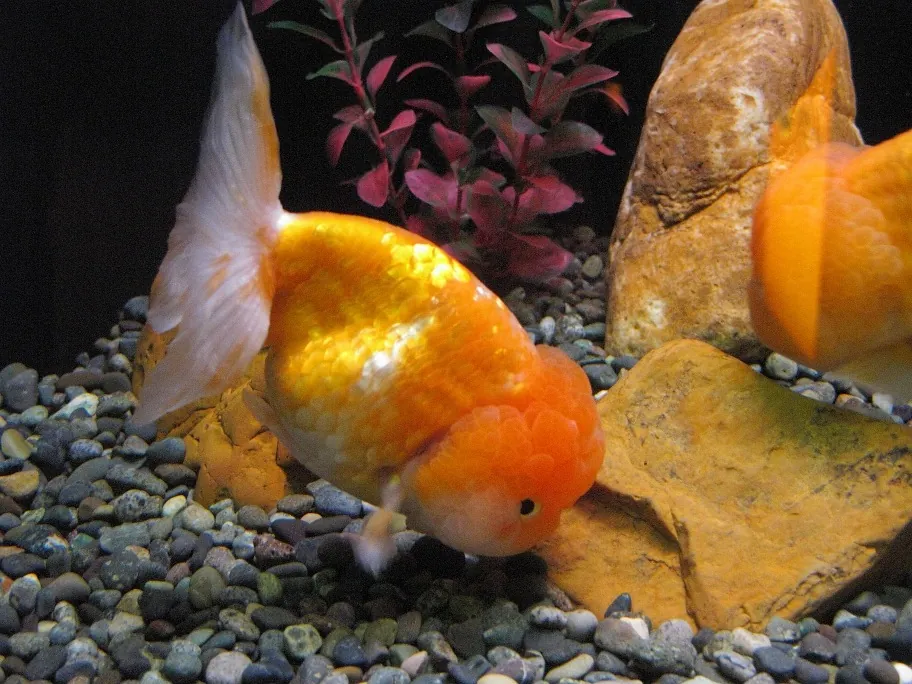
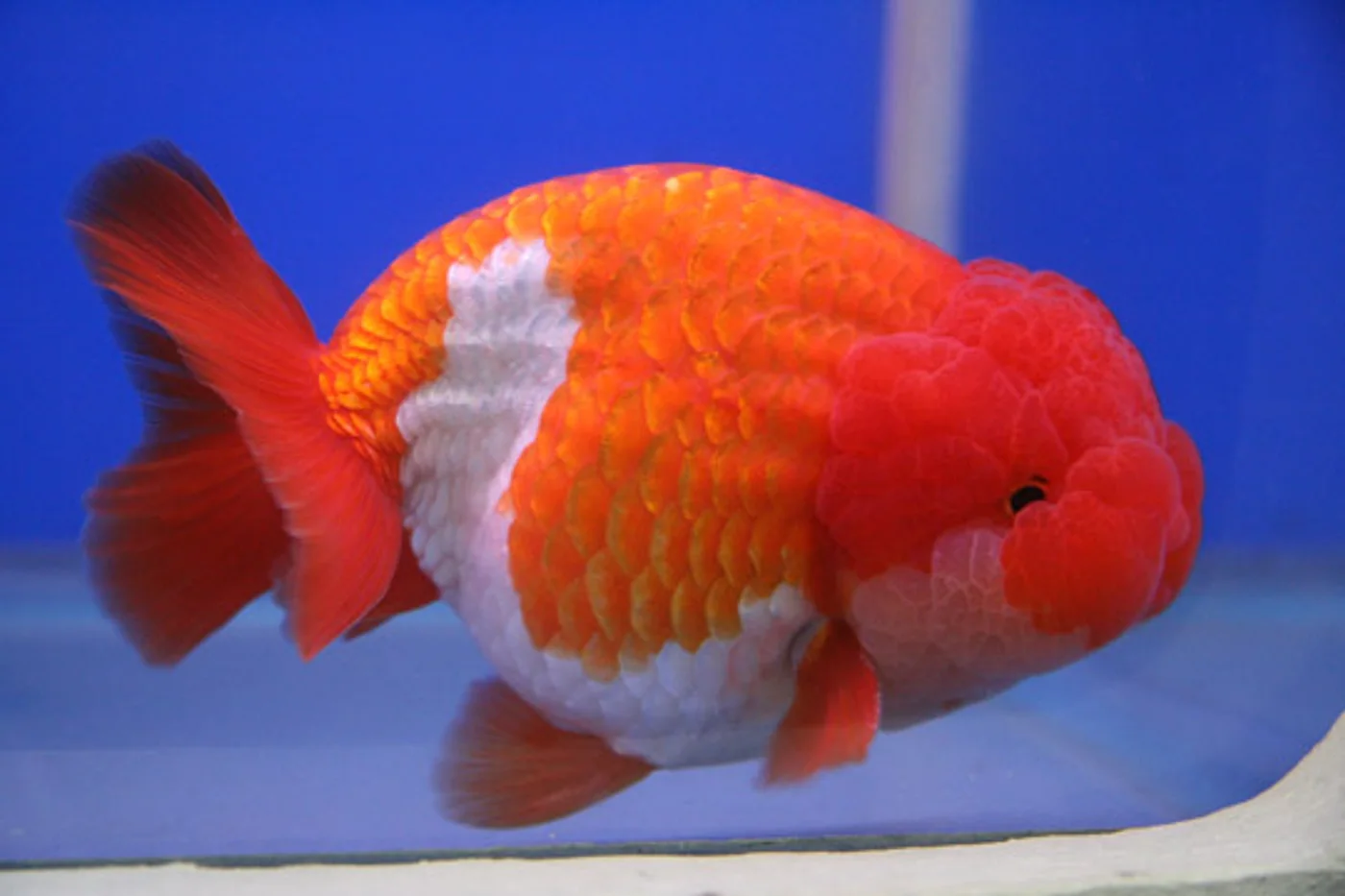
Best kept apart from: Common Goldfish, Comet, Shubunkin, Wakin, Jikin, Ryukin, Fantail. Speed and appetite differences leave the slower fish underfed.
Thinking about other species? Try the compatibility checker.
Similar breeds
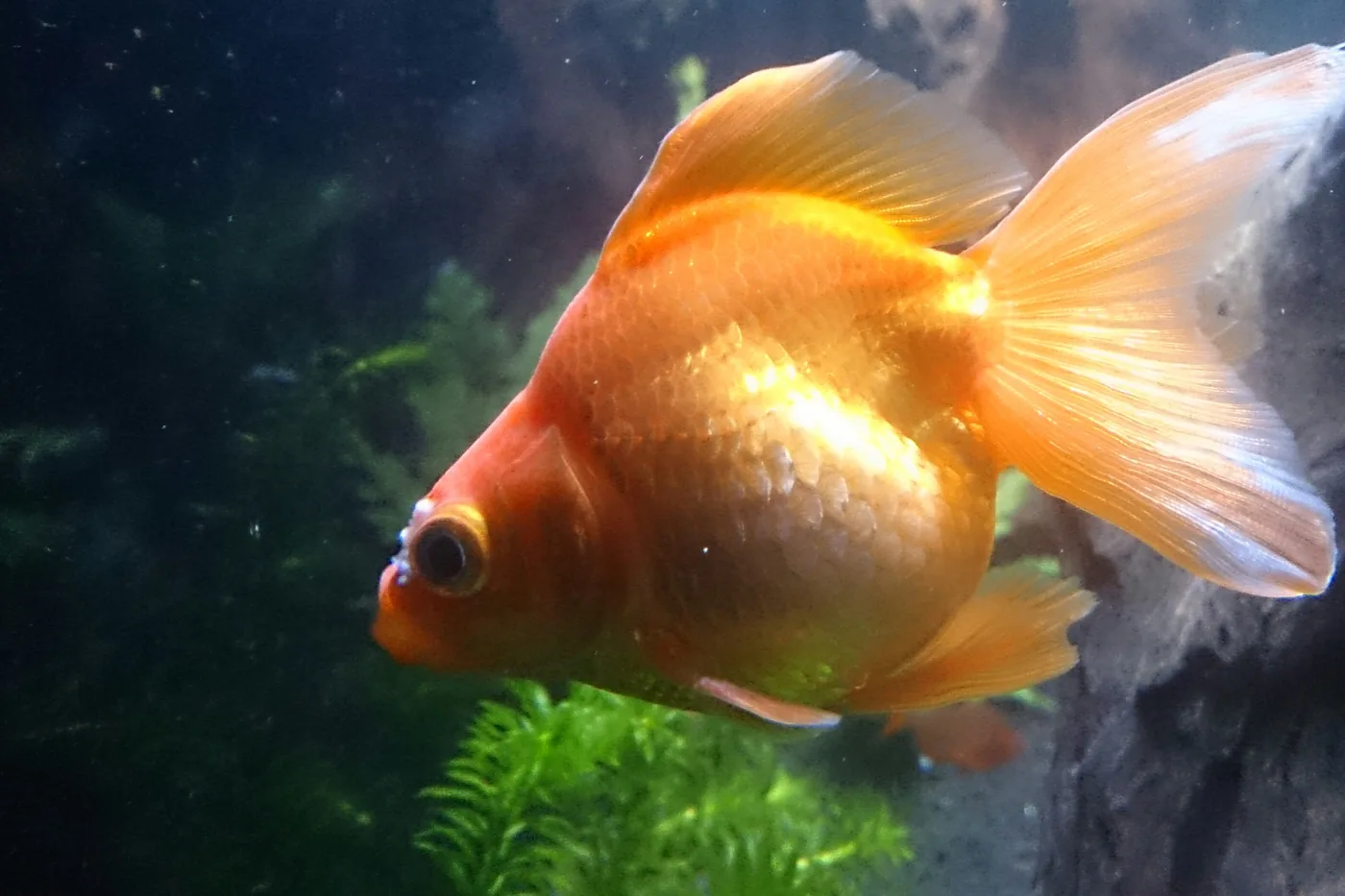
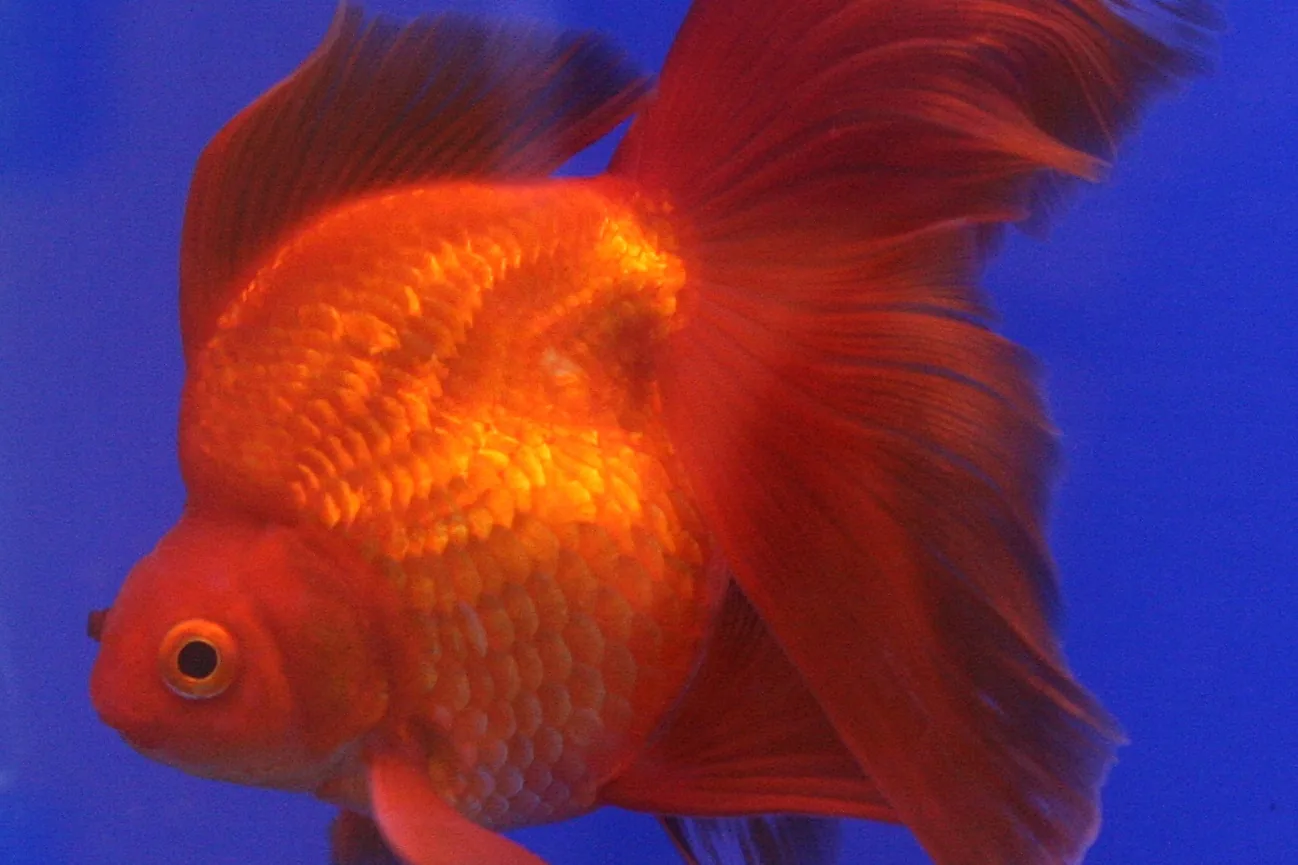
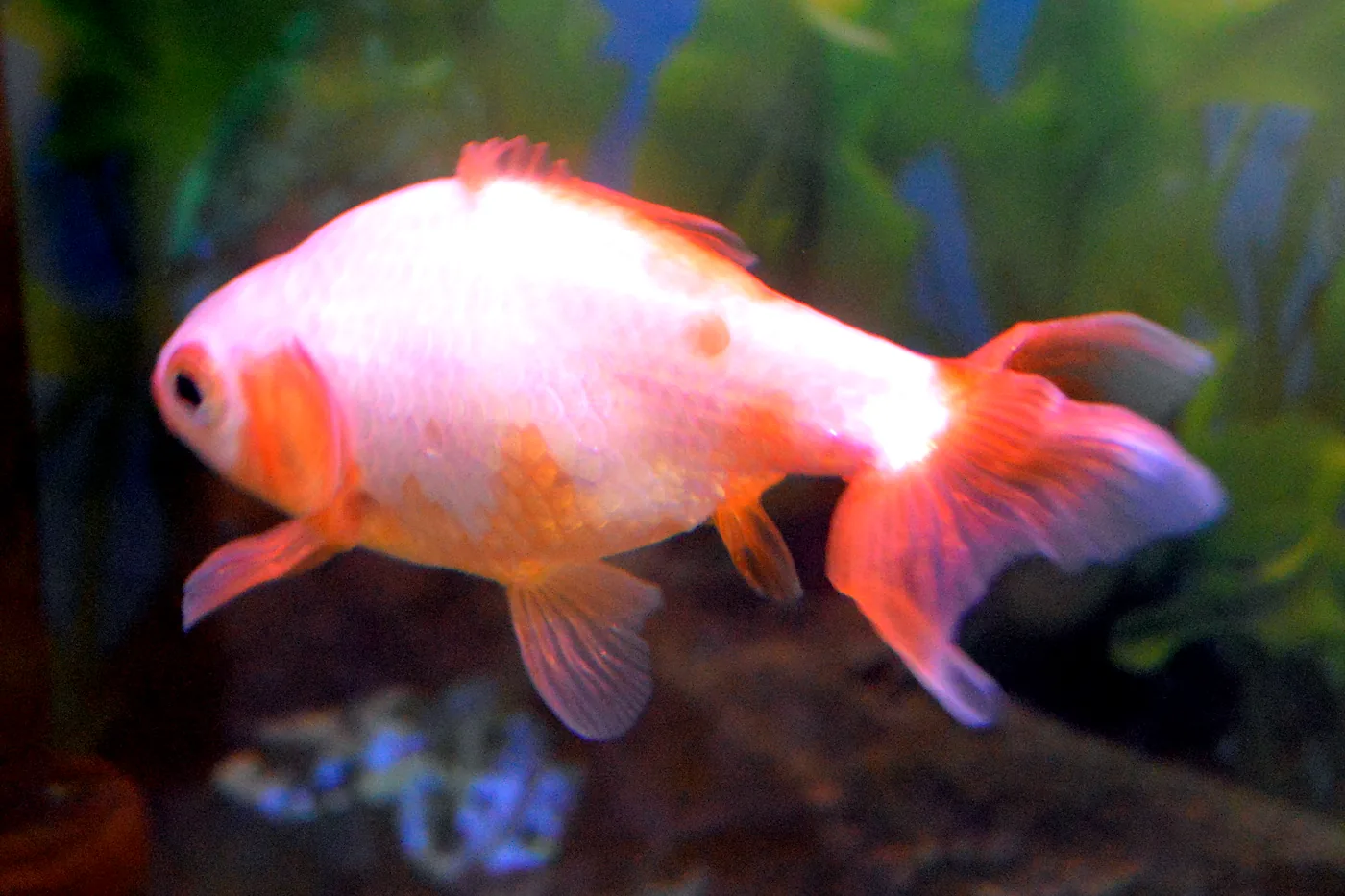
Of the breeds most like the tosakin, the ranchu is pictured above among its companions. The others:
Frequently asked questions
What is a tosakin goldfish?
A Japanese fancy goldfish from Kōchi Prefecture on Shikoku, the old province of Tosa, bred for one feature: a very large tail that spreads flat, technically divided but with its two halves attached at the centre, and with its outer edges flipped under and curled forward towards the head. It is a top-view fish, kept in shallow round bowls and looked down on, and it has been a natural monument of Kōchi Prefecture since 1969.
Why is a tosakin viewed from above?
Because that is the angle from which its tail reads. The fin spreads horizontally, so a tall tank shows it badly. From above it opens into a fan as wide as the fish is long, with its outer edges curled forward. The breed was made in shallow bowls looked into from above, and what is prized in it is the view from there.
Can a tosakin live in an ordinary aquarium?
It can live in one, but it is kept badly there in two ways. A tall tank gives a weak swimmer more depth than it wants, and it hides the shape of the tail. A wide, shallow container with still water about 20 cm deep, seen from above, suits both the fish and the reason for keeping it.
How do I tell a tosakin from a fantail or a ryukin?
Look down on it. From above, a fantail's or a ryukin's tail shows two lobes divided down the middle. A tosakin's is one flat fan, its two halves attached at the centre, spreading sideways with the outer edges curled forward. From the side the three can be hard to separate, and a fish sold as a tosakin that has only ever been photographed from the side is worth asking about.
Can a tosakin live with other goldfish?
Specialist sources say to keep it only with other tosakin, so that it is not outcompeted for food or chased around in a spawning frenzy. Any fast fish reaches the food first and brushes past a tail that cannot get out of the way. If it must share, the least bad company is the slowest of the fancies, such as a ranchu, in water kept still for all of them.
Why are tosakin so rare and expensive?
The breed came close to being lost in the 1940s, was rebuilt from six fish, and has been kept going since by breeders and preservation societies. Outside Japan a tosakin is found through keepers and clubs, not in shops, and the few that change hands are priced accordingly.
Is the tosakin a delicate fish?
Less than its reputation says. It is about as hardy as the other deep-bodied fancies, and in a mild climate it can be kept outdoors all year. What it will not forgive is current, competition and careless feeding: a weak swimmer, easily pushed about and described as especially prone to swim bladder trouble. Kept still, with its own kind and fed carefully, it does well.