04 Aquarium
Heaters and cooling a goldfish tank
Most goldfish tanks do not need heating for warmth. Where a heater earns its place is stopping a cold room dragging the tank around — and in summer the problem reverses, which is the half nobody plans for.
A goldfish tank is one of the few aquariums where the heater is not the point. Goldfish are temperate fish — 18 to 24 °C for fancies, 10 to 24 °C for single-tails — and most rooms sit inside that range without help. The temperature guide makes the case that large, fast swings are what to avoid, more than any particular value.
So this page is about equipment for an unusual job: not heating water, but stopping a room from dragging it around. And about the half of the problem that catches people out, which is summer.
Does this tank need a heater?
| Situation | Heater? |
|---|---|
| Living room, steady 19–23 °C year round | No |
| Room that drops several degrees overnight | Yes, set as a floor |
| Conservatory, porch, unheated hallway | Yes |
| House where heating is off all day or while away | Yes |
| Garage or outbuilding | Yes, and check the range is achievable |
| Single-tails in a cool but stable room | Usually no |
| Tank near a radiator or in direct sun | No — the problem is the position |
The pattern is that a heater answers variation, not cold. Large, fast swings are what is known to do harm, and a sudden drop is a classic trigger for ich; no study has ranked a steady but slightly cool tank against a gently swinging one, so the heater’s job is simply to stop the fall.
Setting it as a floor
The useful way to think about a goldfish heater is as a safety net rather than a thermostat.
Goldfish temperature ranges
- Cold below about 8 °C Pond fish slow right down; stop feeding (a pond convention, about 8–10 °C).
- Cool about 8–18 °C Fine for single-tails; fancies eat and move less.
- Comfortable about 18–24 °C The range most keepers aim for.
- Warm about 24–27 °C Metabolism up, oxygen down. Watch aeration.
- Hot above about 27 °C Oxygen runs short and parasites cycle fast. Goldfish survive it, but aerate and cool.
Set it a degree or two below the room’s normal temperature. If the room usually holds the tank at 21 °C, set the heater to 19. On an ordinary day it never switches on. When the heating goes off, a window is left open, or a cold snap arrives, it catches the tank before the drop becomes the kind of change that matters.
This is the opposite of tropical practice, where the heater does the work continuously, and it has a useful side effect: a heater that is idle most of the time is a heater doing very little wear, and its failure has much less consequence.
Sizing
You need less power than a tropical tank of the same volume, because you are closing a small gap rather than a large one.
A common rule of thumb for holding a meaningful gap above room temperature is around 1 watt per litre, or roughly 4 watts per US gallon. For the floor-setting job described above you can reasonably go below that, since the heater only has to arrest a fall rather than sustain a difference.
Work from your tank’s real volume rather than the figure on the box, which ignores substrate, decor and the gap below the rim — the volume calculator will give you the real number.
Undersizing is the safer error. A heater slightly too small fails to hold the floor on the coldest night of the year, which is a minor problem. A heater considerably too large, with a thermostat that sticks closed, can take a tank well past the point goldfish tolerate before anyone notices — and heat is the direction this animal handles worst.
Two heaters rather than one
In any tank with room for them, two smaller heaters beat one larger heater, and the argument is entirely about how they fail.
If a thermostat sticks on, the rate of temperature rise depends on the wattage behind it. If one of a pair of 50-watt units sticks, the tank warms at half the rate a stuck 100-watt unit would give, and settles lower, which is the difference between noticing and not.
If one fails off, the other continues holding a partial floor. A single failed heater leaves the tank with none.
The cost difference is negligible and the redundancy is genuine. Place them at opposite ends of the tank so the warmth distributes rather than forming a pocket.
Types, briefly
Briefly, because the choice between them turns on one specification this page does not need to rank: how low the thermostat will set. The best heaters for a goldfish aquarium works through that and the guard question with specific models.
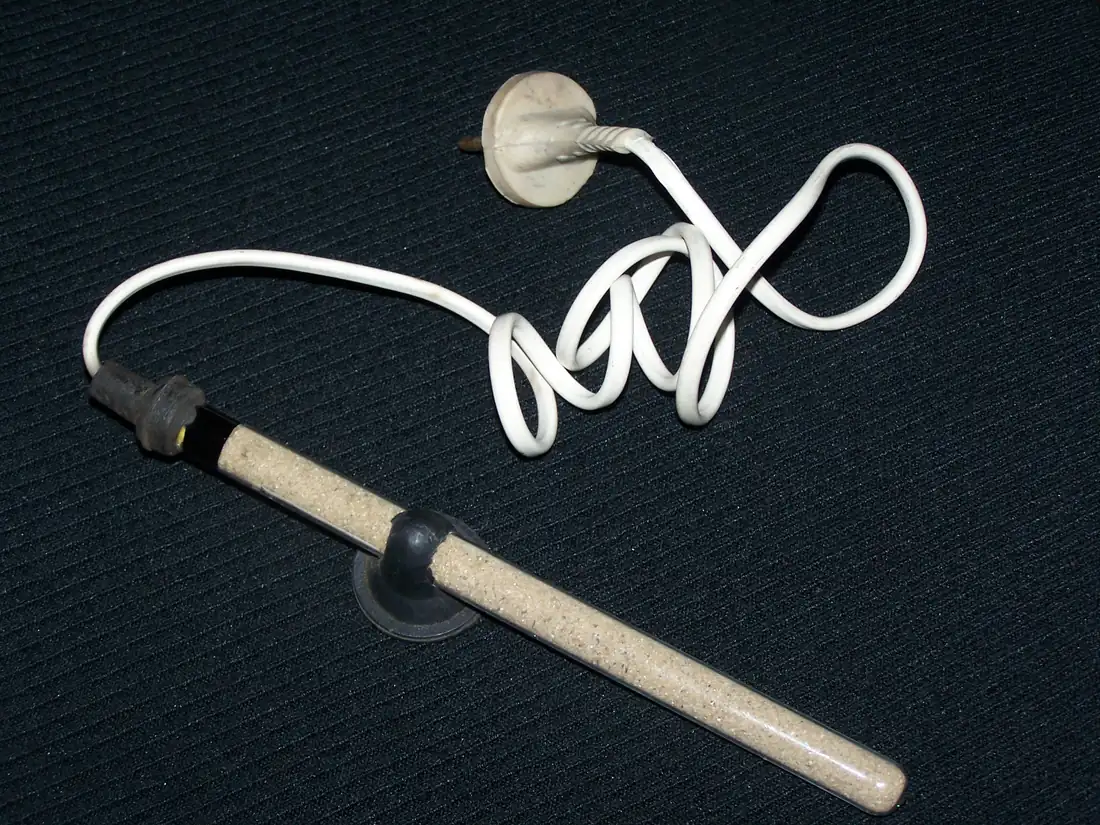
Submersible glass is the standard and the cheapest. It works well and it breaks — a knock from a large goldfish, a careless hand during maintenance, or thermal shock from a water change.
Shatterproof or plastic-bodied heaters cost a little more and suit goldfish tanks specifically, because a 20 cm fish that bumps into things is exactly the animal that breaks glass tubes.
In-line heaters sit in the hose of an external canister filter and heat the water on its way back, which puts no equipment in the tank at all. They are the tidiest option for a canister-filtered goldfish tank and the most expensive.
Preset heaters with no adjustment, usually fixed around 25 °C, are designed for tropical tanks and are a poor fit here — that setting is at or above the top of the fancy goldfish range, and there is no way to set it as a floor.
Fitting it properly
Near the flow. Water must move past the heater or the heat stratifies and the thermostat reads a warm pocket while the far end of the tank stays cold. Beside the filter outflow or the intake is the usual position.
Fully submerged, unless it is a very old design with a waterline mark. Most modern heaters are rated for full submersion; none are rated for running in air.
Horizontal, low in the tank, is marginally better than vertical for distributing heat, since warm water rises through the volume rather than straight to the surface.
With a guard, particularly in a fancy tank. A poor-swimming round-bodied fish that drifts or rests against a hot tube can take a contact burn, and a burn on a fish is a wound that can become an ulcer.
Unplugged before every water change. Make this mechanical rather than a decision. A dropping level exposes the heater, a hot tube meets cold refill water, and the glass cracks — the water change guide puts it first in the sequence for this reason.
The dial is not a thermometer
Heater dials are approximate, and the discrepancy between the mark and the actual water temperature is frequently two degrees or more. They also drift with age.
Use a separate thermometer — digital or glass, it makes little difference — positioned away from the heater, and set the heater by what the thermometer says rather than by what the dial claims. Check it occasionally rather than never; a heater whose thermostat is slowly drifting gives no other warning.
Summer, which is the harder problem
Nobody plans for this and it is the more common emergency.
A goldfish above roughly 27 °C is nearing the point where the oxygen budget gets tight, and the reason is not the temperature itself but what it does to that budget, described in full on the anatomy page. Warm water holds less dissolved oxygen. A warm fish has a faster metabolism and needs more. The two curves move in opposite directions at exactly the wrong moment, Goldfish tolerate low oxygen better than most fish, but they are large, heavily fed and densely stocked, so a warm tank can still run short.
The signs are the ones on the gasping page: fish at the surface, crowding the filter outflow, breathing fast, worst in the early morning after a night of respiration with no photosynthesis.
What actually cools a tank
In order of effect per pound spent.
A fan across the surface. An effective cheap intervention. A small clip fan angled across the water cools by evaporation and can typically pull a tank a degree or two below room temperature, more in dry air. It costs almost nothing to run. Two caveats: evaporation accelerates, so the level needs topping up more often, and topping up with plain water is correct — the minerals stay behind, so replacing evaporation with tap water gradually concentrates hardness, which the pH and hardness page explains.
Lights off, lid open. Aquarium lighting adds real heat, and a closed lid traps both heat and the moisture a fan needs to carry away. Running the light for four hours instead of eight during a hot spell costs the fish nothing.
Blinds closed, tank out of the sun. Direct sunlight is the largest single heat input a tank can receive, and it is also the algae problem. A tank beside a south-facing window in July has a structural problem rather than a seasonal one.
Extra aeration. This does not cool anything. It addresses the reason warmth is dangerous, by keeping the surface moving and the oxygen at its maximum for the temperature. During a heatwave it is the first thing to do while you arrange the rest.
Frozen bottles. Sealed bottles of frozen water floated in the tank do work as a stopgap and have an obvious drawback: they produce a sawtooth, cooling sharply and then rebounding as they thaw, which is precisely the instability the whole temperature argument is against. Use them for an emergency afternoon, not as a routine. And never drop loose ice into the tank, which chills unevenly and dilutes as it melts.
Smaller, more frequent water changes with slightly cooler water help, provided “slightly” is respected — a few degrees, not a bucket of cold.
Chillers
An aquarium chiller is a refrigeration unit plumbed into the water flow. It works, and for most home goldfish keepers it is the wrong purchase.
They are expensive, they are noisy, and they dump the heat they remove into the room the tank is in, which means a chiller in a small warm room is partly fighting itself. They are sized and priced for systems considerably larger than a home aquarium.
Where they genuinely earn their place: large ponds, fish rooms with many tanks, and climates where ambient temperature sits above the goldfish range for months rather than days. For a tank that runs three degrees too warm for three weeks in August, a fan is the answer.
The heat you did not install
A tank warmer than the room is not necessarily a heater problem. Equipment adds heat, and in a goldfish tank the equipment tends to be substantial.
Canister filters are the main contributor. A powerful external pump running continuously transfers a meaningful share of its electrical consumption into the water as heat, and a large canister on a moderate tank can hold it a degree or two above ambient year-round. This is invisible in winter and awkward in August.
Lighting adds heat directly, and the older the fixture the more of it. An LED strip contributes little; an old fluorescent hood with a ballast contributes a good deal, and in a closed hood the heat has nowhere to go.
Air pumps add a small amount, and powerheads a little more.
None of this is a fault. It matters in two situations: when working out why a tank sits above room temperature with the heater unplugged, and when planning for summer, since equipment heat is a constant that adds to whatever the weather does. If a tank runs consistently warm, switching the lights off for a day with everything else unchanged separates the two contributors quickly.
A heatwave, in order
Hot weather is the temperature emergency most keepers actually meet, and it rewards having a sequence rather than improvising.
- Aerate first. Before anything that cools, increase surface agitation — an air stone, the filter outflow angled to break the surface, the water level dropped slightly so the return splashes. This does not lower the temperature and it addresses the thing that is actually harming the fish.
- Lights off. Lid open. Removes an input and lets heat and moisture leave.
- Fan across the surface. The workhorse. Angle it over the water rather than at the glass.
- Close the blinds in the room, and keep the door shut if the rest of the house is cooler.
- Feed less, or not at all, for a day or two. Digestion generates demand, and a fasted fish needs less oxygen. An adult goldfish loses nothing by skipping meals, as the feeding guide sets out.
- Top up for evaporation with plain conditioned water, which the fan will accelerate considerably.
- Only then consider frozen bottles, and only as an afternoon measure.
The order matters because the first item is free, instant and addresses the mechanism, while the last is fiddly and introduces instability. A great many heat losses are really oxygen losses, and the keeper who reaches for ice before aeration has solved the less important half.
When the power goes out
A cut in winter is a temperature problem as well as a filtration one, and the two want opposite handling.
Insulate rather than heat. A tank is a large thermal mass and loses heat slowly. Wrapping it in blankets, duvets or even cardboard — sides first, then the top — will hold a goldfish tank within a safe range for many hours in a cold house. Do not try to warm it with anything improvised; the risk of overshooting is worse than the cold.
Keep the surface moving if you can. A battery air pump matters more than warmth, because oxygen runs out before temperature becomes critical for a cold-tolerant fish. The absence guide covers the equipment worth owning.
Do not feed while the filter is down. Nothing being processed means nothing should be added.
When power returns, restore the heater last and let the tank come back gradually rather than switching everything on at once. And test the water over the following days, since a stopped filter loses bacteria and the tank may be partly uncycled.
Conservatories, porches and other extreme rooms
Some rooms are not rooms for this purpose. A conservatory can swing fifteen degrees between a July afternoon and a January night, which is outside what any single heater setting can absorb.
If a tank must live in one, the realistic measures are structural rather than electrical. Keep it out of direct sun entirely, which addresses the summer half. Insulate the back and sides, which slows both directions. Accept a wider seasonal drift than you would indoors — goldfish handle slow seasonal change well, as pond fish demonstrate every year — and concentrate on preventing rapid change rather than holding a number.
Single-tailed goldfish suit these rooms considerably better than fancies, tolerating 10 to 24 °C against the fancy’s 18 to 24. A conservatory that would be a poor home for a ranchu can be a perfectly good one for comets.
What it costs to run
Worth knowing, because the fear of running costs pushes people toward the wrong choices.
A heater set as a floor in a normally warm room is idle most of the time and costs very little — it draws its rated wattage only while actually heating, which may be minutes a day. A heater working continuously to hold a large gap in a cold room is a different proposition and is the situation where insulating the tank or moving it pays for itself quickly.
A clip fan running through a hot week costs a negligible amount. A chiller does not, and the gap between the two is the practical half of the argument made above.
The largest hidden cost is the one nobody bills for: a tank sited badly — in the sun, by a radiator, in an unheated room — spends money and equipment life fighting its position. Moving the tank is free and permanent, and the setup guide covers placement before any of this becomes necessary.
Ponds
Ponds handle temperature better than tanks in both directions, because volume is thermal inertia. A pond of a few thousand litres moves slowly and buffers a hot day or a cold night far better than a 150-litre tank.
The two things worth knowing are seasonal. In summer, a pond’s risk is the same oxygen problem in a different container — a shallow pond in full sun with a heavy fish load can run short, and a fountain or waterfall is the standard answer. In winter, the concern is gas exchange under ice rather than cold itself: goldfish overwinter perfectly well at the bottom of a pond, but a completely sealed ice cover traps the products of decomposition. The answer is to melt a hole rather than smash one, since the shockwave of breaking ice carries into the water. The pond guide covers the year in more detail.
What to check, and when
Twice a year is enough for most tanks, and the checks take a minute.
Confirm the thermometer and the heater dial still roughly agree, and that neither has drifted. Look at the heater body for cracks, condensation inside the tube, or corrosion at the seal. Check that the suction cups still hold, since a heater that has fallen onto the substrate can heat the glass or a resting fish. And before summer, work out what your plan is — where the fan would go, whether the lid can open — because a heatwave is not the moment to start solving it.
Frequently asked questions
Do goldfish need a heater?
Usually not for warmth. A room that sits between roughly 18 and 24 °C keeps a fancy goldfish comfortable with no heating at all, and single-tails tolerate considerably cooler. What a heater earns its place for is stability: a room that drops sharply at night, a conservatory, an unheated hallway, a house whose central heating goes off while nobody is home. Set below the room's normal temperature, the heater does nothing most of the time and catches the tank when the room falls.
What wattage do I need?
Less than you would for a tropical tank, because you are buffering a few degrees rather than holding a large gap. Roughly 1 watt per litre — about 4 watts per US gallon — is a generous starting point for that job, and for a goldfish tank you can reasonably size down from there. Oversizing is the mistake worth avoiding: a heater with more power than the tank needs is a heater that can raise the temperature dangerously fast if its thermostat sticks, and heat is harder on goldfish than cold, because warm water holds less oxygen while their demand for it rises.
Should I use one big heater or two small ones?
Two small ones, in any tank large enough to fit them. The reasoning is entirely about failure. If a thermostat sticks closed, the damage depends on how much power is behind it — a stuck 50-watt heater adds half the heat of a stuck 100-watt one, so the tank warms more slowly and settles lower, which gives you time to notice. If one fails off, the other holds a partial floor rather than leaving the tank unheated. The cost difference is small and the redundancy is real.
My tank is too warm in summer. What actually helps?
In order of effectiveness per pound spent: a clip fan blowing across the water surface, which cools by evaporation and can pull a tank down a degree or two; the lights off and the lid opened to let heat and moisture escape; blinds closed on the room during the day; and extra aeration, which does not cool but addresses the reason warmth is dangerous. Frozen bottles of water floating in the tank work as a stopgap but produce a sawtooth temperature that is its own problem. Never drop ice cubes straight into the tank.
Can a heater burn a goldfish?
Yes, and round-bodied fancies are the ones it happens to. A poor swimmer that rests on the substrate or drifts against equipment can end up lying against a hot glass tube, and a contact burn on a fish is a wound like any other — it can become an ulcer. A heater guard costs very little and removes the risk entirely, and it is worth fitting as a matter of course in a tank with ranchus, pearlscales, bubble eyes or any fish with buoyancy trouble.
Do I need a chiller?
Almost certainly not. Chillers are expensive, noisy, generate heat into the room and are sized for systems far larger than a home goldfish tank. They make sense for large ponds, for fish rooms, and in climates where ambient temperature sits above the goldfish range for months. For a tank that runs a few degrees too warm for a few weeks a year, a fan and a lid does the same job for a fraction of the cost and noise.
Should I unplug the heater during a water change?
Yes, and make it a habit rather than a judgement. Lowering the water level can leave a heater running in air, and while most modern units have a thermal cut-out, not all do and cut-outs fail. A hot glass tube meeting cold refill water is how heaters crack. Switch it off at the wall before you start, and switch it back on only after the level is restored — which also means waiting a few minutes before restarting, as the water change guide describes.