01 Care guide
Goldfish genetics: colour, scales and what actually breeds true
Goldfish genetics is better understood than it was, and it is not quite what most keepers repeat. A few of the big traits are single recessive genes, others have not been mapped, and what is worth knowing is which traits are stable, which drift with age, and what a spawn from two beautiful parents is likely to look like.
Start with the fact that makes the rest make sense: every goldfish you have ever seen is the same species. A three-centimetre feeder comet, a show ranchu worth more than the tank it sits in, a bubble eye, a pond common the length of your forearm — all Carassius auratus, all able to breed with each other, all producing fertile offspring when they do.
That is unusual. Dogs manage it too, and the comparison is a good one: the difference between a ranchu and a comet is roughly the difference between a bulldog and a whippet, and it was produced the same way, by people choosing which animals bred, for about a thousand years.
It also means the genetics is not a question of which species contributed what. It is a question of which variants of the same genes a particular fish happens to carry, and — this is the part the confident tables online get wrong — how many genes are involved in the thing you actually care about.
The headline: a few traits are simple, and the rest has not been mapped
There is a genre of goldfish article that presents inheritance as a Punnett square. For some traits that is right. Cross a metallic with a matt, get nacreous; cross two nacreous, get one to two to one. The twin tail turns out to be one recessive mutation in a single gene, and telescope and celestial eyes have been traced to single recessive genes too. Loss of the dorsal fin involves several loci.
For the features a keeper actually shops for, it is less tidy. Wen growth, body depth, the bubble eye’s sacs, the tail’s shape and carriage, the back’s curve in a ranchu — no study has mapped these, and they probably involve several genes, with the environment contributing as well, so the result is a continuous range rather than a set of boxes. There is no known allele for “good oranda”.
This is not a gap in the article. It is the state of the knowledge, and it is why breeding goldfish is a matter of grading hundreds of fish over a year rather than predicting a cross on paper. A breeder works statistically, not deterministically: raise enough fish from good parents and a few will be good.
Where the colours come from
A goldfish’s colour is not paint. It is four kinds of pigment-bearing cell, layered in the skin, each doing something different:
| Cell type | Carries | Reads as |
|---|---|---|
| Melanophores | Melanin | Black, and brown when sparse |
| Xanthophores | Carotenoid-based yellows | Yellow |
| Erythrophores | Carotenoid-based reds | Orange and red |
| Iridophores | Guanine crystals | Metallic sheen, silver, the reflective layer |
Two things follow from that list, and both surprise people.
There is no blue pigment. The blue of a good shubunkin is melanin sitting deep in the skin, viewed through tissue that scatters short wavelengths — the same optical trick that makes veins look blue through skin. That is why blue is the slowest colour to arrive, why it is the one most often absent from a juvenile, and why a shubunkin sold at 5 cm tells you very little about the adult.
The reds and yellows come partly from the diet. Carotenoids are not synthesised by the fish; they come in through food and are deposited in the skin. That is why a good food deepens colour and why the colour section of the pale or faded page puts the diet question before anything else. Genetics decides whether a fish can be red. What it eats decides how red.
“Going colour” is the black being withdrawn
Almost every goldfish hatches a drab olive-bronze, the wild colour of a wild Carassius auratus in a muddy river, and for good reason: a bright orange fry in open water is a meal.
What we call going colour is not the arrival of orange. It is the withdrawal of melanin, revealing the yellow and orange that were underneath the whole time. It usually begins somewhere between three months and a year and finishes unevenly, which is why a fish mid-change looks blotchy and alarming for weeks. The genetics of it is the best-studied part of goldfish colour: going colour is a heritable loss of melanophores, and in the classic cross studies the depigmenting alleles are dominant at two loci, so only a fish that carries the recessive form at both keeps its larval melanophores for life.
Because the change is a loss, it is largely one-way. A fish that has gone orange does not usually go back. This is the mechanism behind a common disappointment in the hobby, which deserves its own section.
Genetics sets the ceiling; the tank decides how close you get
The timetable above is heritable, but it is not the whole story, and the parts that are not genetic are the only parts a keeper holds.
Light. Keepers report that a fish kept bright colours up more strongly than the same fish kept dim, and that goldfish in a dark or heavily shaded tank often stay drabber than their line would suggest, but the effect is unmeasured in goldfish. A regular day and night is better supported than any particular brightness.
Background. Fish adjust their overall darkness to their surroundings over days and weeks, and keepers report that a fish moved into a bare white tank tends to pale and one in a planted tank with dark substrate looks richer. That is a short-term response layered on top of the permanent colour, and the pale or faded colour page covers it properly, including the part that matters most — how to tell a background response from a fish that is losing colour because something is wrong.
Diet. The reds and yellows are built from carotenoids the fish cannot make for itself, so a diet without them caps the colour regardless of what the genetics would allow. A quality pellet with vegetables and the occasional frozen food does this without any special colour product, and the nutrition page explains why the premix in a complete food matters more than any single ingredient.
Temperature. Development generally runs faster warm and slower cold, so a pond fish in a cool climate often colours later than a tank fish of the same line. That is a difference in timing rather than in outcome.
None of this changes what a fish is. It changes how much of it you get to see, which for a trait as slow as blue can be the difference between a shubunkin that is worth the wait and one that never looks like the photograph.
Why black often does not last
A black moor is a telescope-eyed goldfish that has kept its larval melanophores. In the genetics that is close to a switch rather than a degree: a moor from a line fixed for black keeps it for life, while a dark telescope from a line that was never fixed turns bronze or orange. The two cannot be told apart as juveniles, which is why so many keepers meet the second kind and conclude that black never lasts.
The usual course for the second kind is that a fish bought at 6 cm is genuinely black, stays black for a while, then thins patchily and ends bronze or orange with black remnants. Nothing caused it and nothing reverses it. How long it takes varies between fish and lines, and no published figure gives a typical age.
The same applies to black patches on any goldfish, which is a separate and more confusing thing — black patches can be pigment arriving, pigment leaving, or a healing response to an injury, a burn from ammonia among them, and telling those apart matters because one of them can be a water-quality warning.
The practical consequence when buying: if a permanently black fish is the point, buy an adult that has already held its colour for several years, from a line sold as fixed for black, and expect to pay for it. Paying more for a juvenile buys nothing, because no one can tell you which way that fish will go.
Scale type, and the other single-gene traits
Scale type is the best-known case — the trait where the conventional account is tidy, and it is worth knowing because it explains why calico exists across many breeds.
The variable is the iridophore layer, the guanine crystals that make a fish look metallic:
- Metallic. A full reflective layer. The familiar shiny orange goldfish.
- Nacreous. A partial layer — some scales reflective, some not. Pigment below shows through in patches, giving the blues, blacks and speckled reds of a calico. Often called “pearly”.
- Matt. Essentially no reflective layer. The fish looks flat, often pinkish, and the eyes are noticeably different. Matt fish are less commonly kept.
A calico, scale by scale
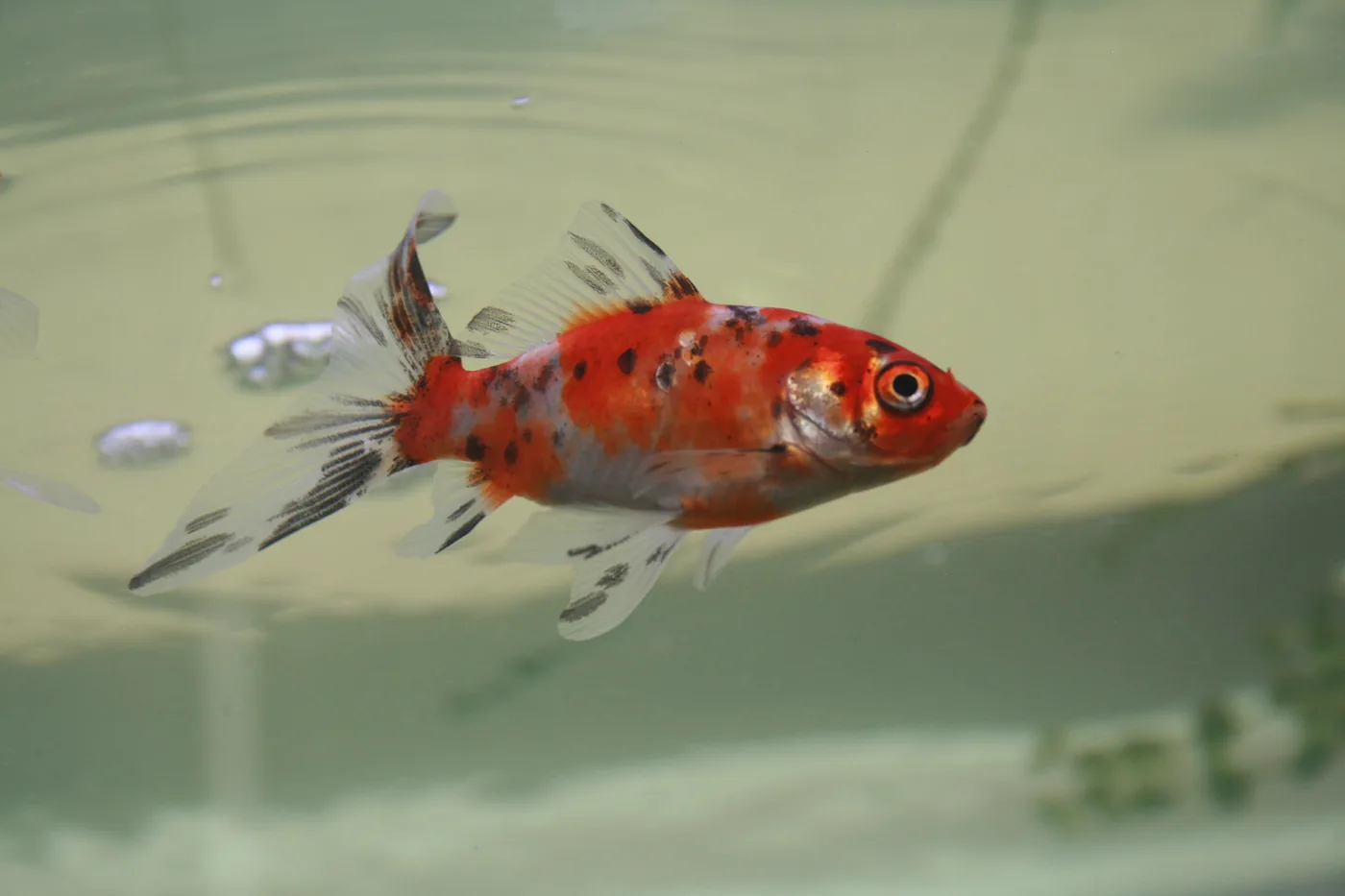
Photograph: Michelle Jo, CC BY-SA 3.0 · Wikimedia Commons. Numbers and lines added.
- A reflective scale. One of the few that kept its layer of guanine crystals, and shines as every scale on a metallic fish does.
- A see-through scale. No reflective layer, so the red pigment beneath shows flat, without the metallic gleam.
- Black speckles. Black pigment near the surface. Blue, which this fish does not show, comes from deeper in the skin and is often the slowest colour to develop.
- A pale patch. No red, yellow or black pigment here. Whether it reads white, silver or pink depends on whether the scales still carry a reflective layer.
- The fins. The pattern does not stop at the body. In a calico it runs into the fins, here as black streaks along the rays.
The conventional account, and the one the breeding studies support, is that this behaves as a single locus with incomplete dominance, where metallic and matt are the two homozygous states and nacreous is the heterozygote. Cross two nacreous fish and you get roughly a quarter metallic, a half nacreous and a quarter matt. The locus has been mapped to a region of one chromosome and there may be modifiers, so treat the ratio as a good working model rather than a guarantee.
It is why calico is a pattern rather than a breed. Calico describes a nacreous fish with the resulting colour; it can sit on a shubunkin, an oranda, a ryukin or a fantail, and it is not a thing a fish either is or belongs to.
The fancy features, and how they are inherited
Everything that makes a fancy goldfish a fancy goldfish is a deviation from the wild form. Some of the deviations are now understood, and some are not.
The twin tail. A very consequential mutation in the hobby: a doubling of the caudal and anal fins. It is recessive, and the twin-tailed strains studied, among them wakin, ryukin, oranda and ranchu, share one mutation in a single gene, which is why two twin-tailed fish give mostly twin-tailed fry and a cross to a single-tail gives single-tailed ones. Most fancies add a shortened, deepened body on top of it, and it is that body shape which crowds the gut and swim bladder and gives them their buoyancy trouble. The long-bodied wakin carries the same twin-tail mutation without it. It is the foundation every fancy breed is built on.
The missing dorsal fin. Ranchu, lionhead, celestial eye and bubble eye have no dorsal fin at all, and the loss involves several loci rather than one. A spawn from two dorsal-less parents can contain fish with a ridge, a partial fin or a full one, and those are culled rather than sold, while a cross between a dorsal-less fish and a finned one gives mostly finned fry.
Telescope and celestial eyes. Both have been traced to single recessive genes, mapped in goldfish and recreated by gene editing. The eyes develop after hatching and vary in degree between fish and between lines.
Wen and bubble sacs. The hood on an oranda, ranchu or lionhead is a growth of tissue that develops over a year or more, is influenced by feeding and water quality as well as genetics, and varies continuously; the bubble eye’s sacs are similar. No study has mapped the genes behind either, and they probably involve several. There is no known wen gene to carry, and both are strongly line-dependent — which is another way of saying that a breeder’s stock matters far more than any single pairing.
The shared consequence: buy the line, not the fish, if the feature is what you are after. The parents predict the offspring better than the juvenile in the bag predicts itself.
What happens when two breeds cross
They cross easily, which is the problem. There is no barrier, no sterility, no difficulty — and goldfish in a pond do not consult the standard before spawning.
What comes out depends on what is crossed. Cross a fancy with a single-tail, such as an oranda with a comet, and the offspring are single-tailed, because the twin tail is recessive, and in studies of dorsal-less by finned crosses the fry were mostly finned. Cross two different fancies and the twin tail is shared, so most fry are twin-tailed, but the other traits scramble: a ranchu crossed with a lionhead gave the lionchu, and a ranchu crossed with a ryukin produces fish with an indifferent back curve and an indifferent hump, which is a worse fish than either parent by both standards.
This is not a moral point about purity. It is a practical one about expectations, and it has two real consequences.
In a mixed pond or tank, you will get a mixture. Fancy-by-single-tail fry are single-tailed and fast, healthy and not what anyone was planning, and they will outcompete their fancy parents at feeding time within a year — which is exactly why mixing fancies with single-tails is discouraged in the first place. Fancy-by-fancy fry are mostly twin-tailed but vary widely.
A spawn is not a supply of the fish you own. The breeding guide makes this case at length, and the genetics is the reason behind it: even when the twin tail comes through, the wen, body depth and eyes spread widely, and a good fish is the exception.
Culling, which is the part nobody enjoys
It follows from everything above that a breeder’s skill is mostly selection. A pair produces hundreds or thousands of eggs. Most of the resulting fish are ordinary, some are poor, and a few are good. The good ones exist because the others were removed from the breeding population — and in practice, often removed altogether.
This is worth stating plainly rather than leaving implied, because it explains the economics a buyer meets. A quality ranchu is not expensive because it eats more. It is expensive because a hundred of its siblings did not make the grade, and the price of one carries the cost of raising all of them.
It also explains why the advice on this site is consistently to buy the adult if the feature matters. You are buying the outcome of the grading rather than a share in it.
If you spawn your own fish, the question arrives whether you like it or not. The breeding guide covers the options plainly, and the rehoming page covers where surplus fish can actually go, which for a hundred bronze juveniles is a harder question than it first appears.
Inbreeding, and what it costs the fish
Fancy goldfish descend from few founders, and domestication passed them through a population bottleneck. Concentrating the traits a breeder wants can also concentrate whatever travels with them: one allele of the twin-tail gene, for instance, lowers embryo survival, and some lines carry others.
What the evidence does not show is that fancies are less genetically diverse than common goldfish, since measured diversity is higher in the fancy lineages, or that inbreeding is behind the swim-bladder, spinal or immune problems that keepers see. Those come mainly from the extreme body shape itself: the shortened, folded gut and the compressed swim bladder that make a round-bodied fancy prone to constipation and buoyancy problems in the first place. No study has compared lifespans, although the figures keepers and welfare bodies quote do put fancies lower, as the lifespan page sets out.
This is the least comfortable part of the subject, and it is the background to the welfare page’s treatment of extreme forms as a welfare question rather than a matter of taste. Keeping a fancy goldfish well is not the problem. Breeding ever more extreme versions of one is where the argument sits.
What to actually take from this
For most keepers, four things:
- Expect the colour to change. Orange arrives late, black may leave, blue arrives latest of all, and a blotchy in-between stage is normal rather than a symptom. The pale or faded colour page separates the genetic changes from the ones that mean something.
- Buy the adult if a feature matters. Wen, eye protrusion, pattern and colour retention are all unfinished in a juvenile, and no one can tell you which way a young fish will develop.
- Do not expect a spawn to resemble its parents closely. Two fancies give mostly twin-tailed fry, but the wen, body depth, eyes and colour spread widely, and the few fish near the standard are the exception, not the rule.
- Diet does real work on colour. Genetics sets the ceiling; carotenoids in the food decide how close a fish gets to it. That is one of the few levers here that a keeper actually holds.
And one thing to be sceptical of: any goldfish genetics table that promises a clean ratio for wen, body shape or finnage. Scale type behaves, and the twin tail and telescope eyes are single genes. The rest has not been mapped, and anyone promising a ratio for it is selling certainty that does not exist.
Frequently asked questions
Will two orange goldfish always have orange babies?
No, and usually the opposite at first. Almost every goldfish fry hatches a drab olive-bronze regardless of what its parents look like, because the wild colouring is the default state and orange is what appears later when the black pigment is withdrawn. Most of a spawn will go colour somewhere between three months and a year, some will take longer, and a proportion will stay bronze for life.
Why did my black moor turn orange?
Probably because it was never a fixed black. A moor from a line fixed for black keeps its melanin for life, but a dark telescope from a line that was never fixed turns bronze or orange, often patchily, and the two cannot be told apart as juveniles. Nothing you did caused it, and nothing available will reverse it.
Can I breed my two fancy goldfish and get more of the same?
You can breed them, and you will get fish, mostly twin-tailed ones, because the twin tail is a recessive trait that two fancies both carry. What you will not reliably get is more of the same: wen growth, body depth, eye protrusion and finnage vary widely, and the genes behind several of them have not been mapped. Two good orandas produce a spawn containing a few good orandas, many indifferent ones and some that look barely like the breed at all — which is why breeders grade the same spawn repeatedly over a year.
What happens if a fancy goldfish breeds with a common goldfish?
You get viable, usually healthy fish that are neither. They are the same species, so the cross works without difficulty, and the offspring are single-tailed, because the twin tail is recessive. Single-tailed crosses are often hardier than their fancy parent and far faster, which matters if they are sharing a tank with the fancy side of the family.
Are calico goldfish a breed?
No, calico is a scale and colour pattern rather than a breed, which is why you meet calico shubunkins, calico orandas, calico ryukins and calico fantails. It comes with the nacreous scale type, where some scales carry the reflective layer and some do not, so pigment below shows through as blues, blacks and speckled reds. The pattern continues shifting slowly for the fish's whole life.
Is the blue in a shubunkin real blue pigment?
No. There is no blue pigment in a goldfish. The blue is structural: dark melanin seen through tissue that scatters short wavelengths, visible only where the full silvery layer is missing. It is usually the slowest colour to develop, and it is the first thing a buyer of a juvenile shubunkin is disappointed about.
Why are goldfish sold in tanks of thousands and good ones expensive?
Because the good ones are rare within a spawn rather than expensive to keep. A pair produces hundreds or thousands of eggs, most of the resulting fish fall short of the breed standard in one way or another, and the few that do not are the ones that carry a price. What you are paying for is the grading, not the fish's upkeep.
Does inbreeding harm goldfish?
It can. Fancy lines descend from few founders, and some carry alleles that lower survival; one allele of the twin-tail gene lowers embryo survival. But measured genetic diversity is higher in the fancy lineages than in common goldfish, and no study ties the swim-bladder, spinal or immune problems of fancies to inbreeding. Those come mainly from the extreme body shape itself.