05 Food
Frozen food for goldfish
Frozen daphnia, brine shrimp, mysis and bloodworms bring variety and enthusiasm to a goldfish diet. A supplement rather than a staple, and handled properly.
Drop a thawed portion of daphnia into a goldfish tank and every fish in it wakes up. Frozen foods are the closest most keepers get to the insect larvae and small crustaceans that goldfish eat in the wild, and the fish respond accordingly. They are also messy, nutritionally uneven and easy to overdo. Used with a little care, they are one of the best additions to a diet built on a good pellet.
What is in the freezer
Aquarium shops sell frozen food in blister packs of cubes or in flat slabs, kept in a chest freezer. The ones relevant to goldfish:
Bloodworms are the larvae of non-biting midges, bright red from the haemoglobin that lets them live in low-oxygen mud. Goldfish find them irresistible. They are relatively high in protein and fat and low in most other things.
Daphnia are tiny freshwater crustaceans, the water fleas of pond dipping. They are low in fat, high in indigestible chitin shell, and are the traditional gentle food for goldfish digestion.
Brine shrimp are small saltwater crustaceans. Adult brine shrimp are well accepted and modest in nutrition; the enriched versions, fed spirulina or other supplements before freezing, are better value.
Mysis are larger cold-water shrimp, richer in protein and fatty acids than brine shrimp and usually a little more expensive. Most goldfish take them readily once they have tried them.
Mixed and spirulina-enriched packs combine several of these with vegetable matter and are a reasonable one-cube compromise if you do not want to keep four packets in the freezer.
The ones worth adding, and the ones to skip
A few more that turn up in the freezer cabinet.
Krill is rich, high in carotenoids and well accepted, which makes it a reasonable occasional food for colour. It is also large, so break or chop it for anything but a big fish.
Cyclops are tiny copepods, useful for small goldfish and for fry, and a gentler option than bloodworms.
Spirulina and vegetable cubes are a convenient way to get greens into a fish that refuses a slice of courgette — vegetables for goldfish covers the fresh version, which is cheaper and takes longer to graze.
Frozen tubifex is best skipped unless it is certified farmed, for the same reason the live version is: the traditional collection method is from polluted mud.
Marine and tropical mixes — the ones built around mussel, squid and marine algae — are formulated for other fish. A goldfish will eat them and gains nothing it could not get more cheaply.
Does freezing make it safe?
Worth answering precisely, because this is a main reason people choose frozen over live and the usual explanation is too simple.
Commercial frozen food carries a lower risk, not none. Commercial producers freeze colder and hold the product frozen longer than a home freezer manages, and some products are also sterilised. That lowers the parasite risk without removing it, which is why this site treats shop-bought frozen food as the lower-risk option throughout.
A domestic freezer cannot be relied on. How much freezing kills depends mainly on the temperature reached, the time held and the parasite; flukes resist more than roundworms. The US FDA’s guidance for fish is -20 °C for 7 days or -35 °C for 15 hours, and one study of herring found live Anisakis roundworm larvae after 24 hours at -15 to -20 °C. Those figures come from food fish, and there is no published figure for aquarium frozen food. So the appealing idea — net some wild daphnia, freeze it, feed it safely — does not follow. Live food for goldfish covers what does reduce the risk of a doubtful source, which is starting from a culture or fish-free water, because neither rinsing, holding nor freezing makes a wild catch safe.
Nothing is a guarantee, and the practical position is the ordinary one: buy frozen food from a shop that keeps its freezer properly cold, and quarantine new fish, because new fish are a common route for disease into a tank.
Thawing and draining
Never drop a frozen cube straight into the tank. It thaws in a cloud, the fish gulp cold fragments, and the liquid that held the food goes into the water with it.
Put the cube in a small cup with a little tank water and leave it for a few minutes until it is fully thawed. Then pour the cup through a fine net or a coffee filter, discard the liquid, and tip the drained food into the tank or lift it in with the net. Release it low in the water if you keep fancy goldfish, so they do not gulp at the surface.
How often
Frozen foods are a supplement. A cube or part of one, two or three times a week, in place of a pellet meal, is the pattern most keepers use, with a quality pellet carrying the rest of the diet and vegetables providing fibre. Fed daily as the main food, most frozen options are too narrow: bloodworms are rich and short on vitamins and minerals, brine shrimp are largely water and shell, and none is formulated to be complete. As a rotation among several they are excellent.
Portion by the usual rule: what the fish finish in a minute or two, adjusted for how many mouths there are. A single adult goldfish rarely needs a whole cube. The general schedule is in how often to feed goldfish.
Portioning a cube
A small practical problem, since a single adult goldfish rarely needs a whole one.
Break it frozen, not thawed. Tip the cube onto a chopping board and cut or snap off the fraction you want with a knife. The remainder is still frozen, has not been compromised, and goes straight back to the freezer.
Then thaw only that piece, in a cup of tank water as above.
Do not thaw a whole cube and refreeze the remainder. It has already begun to break down, and a thawed-and-refrozen portion is both less nutritious and more likely to foul the water. Throw it away; it costs pennies.
Slab packs are easier than blister packs for this, because you can shave off exactly what you want. Blisters are tidier and portion themselves for a group of fish.
And keep a board and knife for it if the smell bothers you, which with bloodworms it might.
Where it fits in a week
“Two or three times a week” is easy to agree with and harder to picture, so here is one arrangement.
| Day | The meal it replaces |
|---|---|
| Monday | Pellets as usual |
| Tuesday | Evening meal is drained frozen daphnia |
| Wednesday | Pellets; evening is a blanched vegetable |
| Thursday | Pellets as usual |
| Friday | Evening meal is frozen mysis or brine shrimp |
| Saturday | Pellets; a small bloodworm feed once a fortnight at most |
| Sunday | Fast day and water change |
The point that matters more than the pattern: it replaces a meal rather than adding one. A frozen feed on top of the usual pellets is overfeeding with extra steps, and overfeeding goldfish covers what that does. The feeding guide covers fitting it into the wider routine.
Soaking and enriching
A technique worth knowing, because frozen food is porous once thawed and will take up whatever it is sitting in.
Garlic is the common one. Thaw the portion in a little tank water with a few drops of a garlic preparation, or garlic juice, and the food arrives smelling strongly of something a reluctant fish recognises as edible. This is a common trick for a fish that has gone off its food, though there is little evidence on garlic itself in goldfish.
Vitamin supplements work the same way, and frozen food is one of the few things you can get them into a fish with — gel food is the other, and is easier if you are doing it regularly.
Do it in the thaw cup, not in the tank, and drain as usual. The point is to get the additive into the food rather than into the water.
And keep it brief. A few minutes is enough; a long soak leaches from the food rather than adding to it, and leaves you with a cup of liquid carrying most of what you intended to feed.
When frozen food earns its keep
Beyond variety, three situations where it does something a pellet cannot.
A fish that has stopped eating. Frozen food smells strongly and is often more tempting than anything dry, and a fish refusing pellets will often take thawed bloodworm or daphnia. That matters twice over: the fish eats, and you learn that its appetite has not gone altogether, though that does not rule out illness, so the cause still needs finding. Loss of appetite covers working through the causes in order, and feeding a sick goldfish covers the rest.
A new or nervous fish. Something highly palatable is a good way to get a recent arrival feeding in quarantine, where eating well is one of the main things you are watching for.
A fish that needs condition. Richer frozen foods can put weight on a thin fish — which is also the reason to be careful with them on a fish that does not need it.
What it does to the water
Worth understanding, because frozen food is the messiest thing most keepers put in a tank.
Even drained, it is wet food, so more of it passes through the fish and into the water than an equivalent weight of pellet. A tank fed frozen food several times a week reads higher for nitrate than the same tank on pellets alone.
The consequences are ordinary rather than alarming:
- Test rather than assume. The testing guide covers reading the trend, and it is the nitrate at the end of the week that tells you whether the routine is keeping up.
- Let the readings set the frequency. If nitrate is climbing faster than the water changes remove it, the frozen feeds are one of the levers — the water change page covers the other.
- Siphon where it lands. Drained frozen food is small and sinks, and what is missed goes into the substrate. A pass with the siphon or a turkey baster after a frozen meal is worth thirty seconds — cleaning a goldfish tank covers the habit.
- And do not feed it before a holiday, or to a tank you will not look at for a few days.
Bloodworms: popular, rich, and worth some caution
Bloodworms are the frozen food every shop stocks and every goldfish wants, and there are three reasons to feed them sparingly.
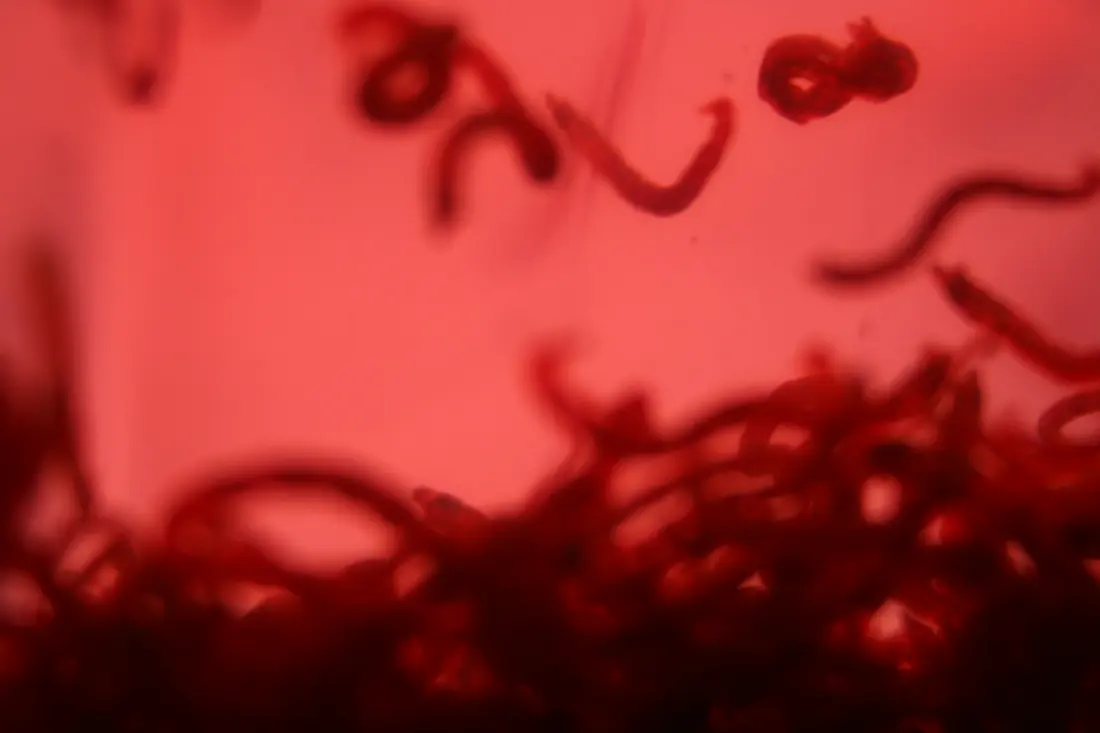
They are rich. High in protein and fat relative to what an adult goldfish needs, they are the frozen equivalent of a dessert. Once a week is plenty; daily bloodworms and a gut built for grazing plant matter do not mix well.
Some keepers report bloating or constipation after bloodworm feeds, particularly in fancy goldfish. Whether the cause is the food itself or simply the quantity fish will eat when offered them is not clear, but the observation is common enough to take seriously. If a fish looks swollen after a meal, read swollen abdomen and drop the bloodworms for a while.
They can affect people. The proteins in midge larvae are a known cause of allergic reactions in those who handle them regularly, ranging from itchy hands and a runny nose to, rarely, more serious symptoms. Wear gloves or use a spoon, avoid touching your face, and wash your hands afterward. If you notice a reaction, stop handling them altogether; there are other frozen foods.
Daphnia as gentle roughage
Daphnia are the opposite of bloodworms. They are low in fat, and the chitin shell that makes up much of each animal passes through undigested, working as roughage in the same way plant fibre does. Traditional goldfish keepers have used daphnia for generations as a mild corrective after heavy feeding, and although the mechanism is more folklore than physiology, the practice is harmless and fish enjoy them. If you keep only one frozen food for a fancy goldfish, daphnia is a good choice. Live daphnia are even better and easy to culture at home; see live food for goldfish.
Freeze-dried is a different product
Sold beside the frozen food, often mistaken for it, and it behaves differently in ways that matter for goldfish specifically.
What it is. The same animals — bloodworms, tubifex, daphnia, krill — with the water removed rather than frozen. It keeps in a tub at room temperature, which is its main appeal.
Two precautions keepers take, mainly with fancy goldfish:
- It floats. A fish tipping up to snap at the surface takes in air along with the food, which keepers suspect of upsetting buoyancy in round-bodied breeds; the sinking versus floating page covers the argument, and there is no controlled evidence either way.
- It may swell after swallowing. Dried food that has not taken on water before it is eaten could do so in the gut, which a compressed fancy body has little room for. This is a precaution rather than something shown.
So soak it first, as a precaution: a few minutes in a cup of tank water until the pieces are soft and sink. That deals with both at once.
And treat it as an occasional treat rather than a regular supplement. The drying process costs some nutrient value, and freeze-dried bloodworms in particular carry the same richness caution as the frozen kind.
One genuine advantage: it needs no freezer, which makes it the practical option for a household without freezer space, for a holiday, or for a fish-sitter who will not be trusted with a blister pack.
Keeping frozen food well
Frozen food is only as good as the freezer chain behind it. Buy from a shop whose freezer is properly cold and whose packs are not furred with frost, get it home quickly, and keep it in the coldest part of your freezer rather than the door. Once a pack is open, use it within a few months; freezer burn dries out the cubes and the food loses value. Never refreeze a thawed portion.
A tank fed frozen food regularly will show it in the nitrate readings, so keep testing the water and let the numbers, not the fish’s enthusiasm, set the pace.
On cost: a blister pack looks expensive on the shelf and is not, because a single adult goldfish uses a fraction of a cube at a sitting. One pack, fed two or three times a week to one or two fish, lasts months — which puts it among the cheapest things in the hobby per feed, alongside a good pellet. What keeping goldfish costs sets out the proportions, and food is not where the money goes.
The practical constraint is freezer space rather than money, which is the real reason most keepers settle on one or two packs rather than five.
Frequently asked questions
How much frozen food should I give?
Enough to be finished in a minute or two, which for a single adult goldfish is often less than half a cube. Thaw a cube, feed part of it, and discard the rest rather than refreezing it. Two or three frozen meals a week in place of a pellet meal is plenty; the bulk of the diet should still be a good pellet with vegetables.
Can I drop a frozen cube straight into the tank?
It is better not to. A cube thawing in the tank releases a cloud of debris and liquid that feeds bacteria rather than fish, and the fish gulp cold fragments at the surface. Thaw the cube in a cup of tank water, drain it through a net, and feed the solids. It takes a couple of minutes and keeps the water noticeably cleaner.
Does freezing kill parasites?
It lowers the risk without removing it, and the distinction that matters is commercial versus domestic. Commercial frozen food is frozen colder and held longer than a home freezer manages, and some products are also sterilised, which lowers the parasite risk without removing it. How much a freezer kills depends mainly on the temperature reached, the time held and the parasite: the US FDA's guidance for fish is -20 °C for 7 days or -35 °C for 15 hours, and home freezers often fall short of it. Those figures come from food fish, and there is no published figure for aquarium frozen food. A home freezer cannot be relied on to make wild-caught food safe, so buy frozen food rather than making it, and treat the commercial product as the lower-risk option it is.
How do I use part of a cube without wasting the rest?
Break it rather than thawing it. Tip the frozen cube onto a chopping board and cut or snap off the fraction you want with a knife, then return the remainder to the freezer immediately — it is still frozen and has not been compromised. Thaw only the piece you are feeding. What you should not do is thaw a whole cube, feed half and refreeze the rest, because a thawed and refrozen portion has broken down further and is best discarded.
Are freeze-dried foods the same as frozen?
No. Freeze-dried bloodworms, tubifex and daphnia have had the water removed, so they float, and dried food could swell once swallowed, which is why keepers rehydrate it first as a precaution; there is no goldfish data on that. Soak them in a cup of tank water for a few minutes before feeding. They keep without a freezer, which is convenient, but they lose some nutrients in processing and are best treated as an occasional treat rather than a regular supplement.