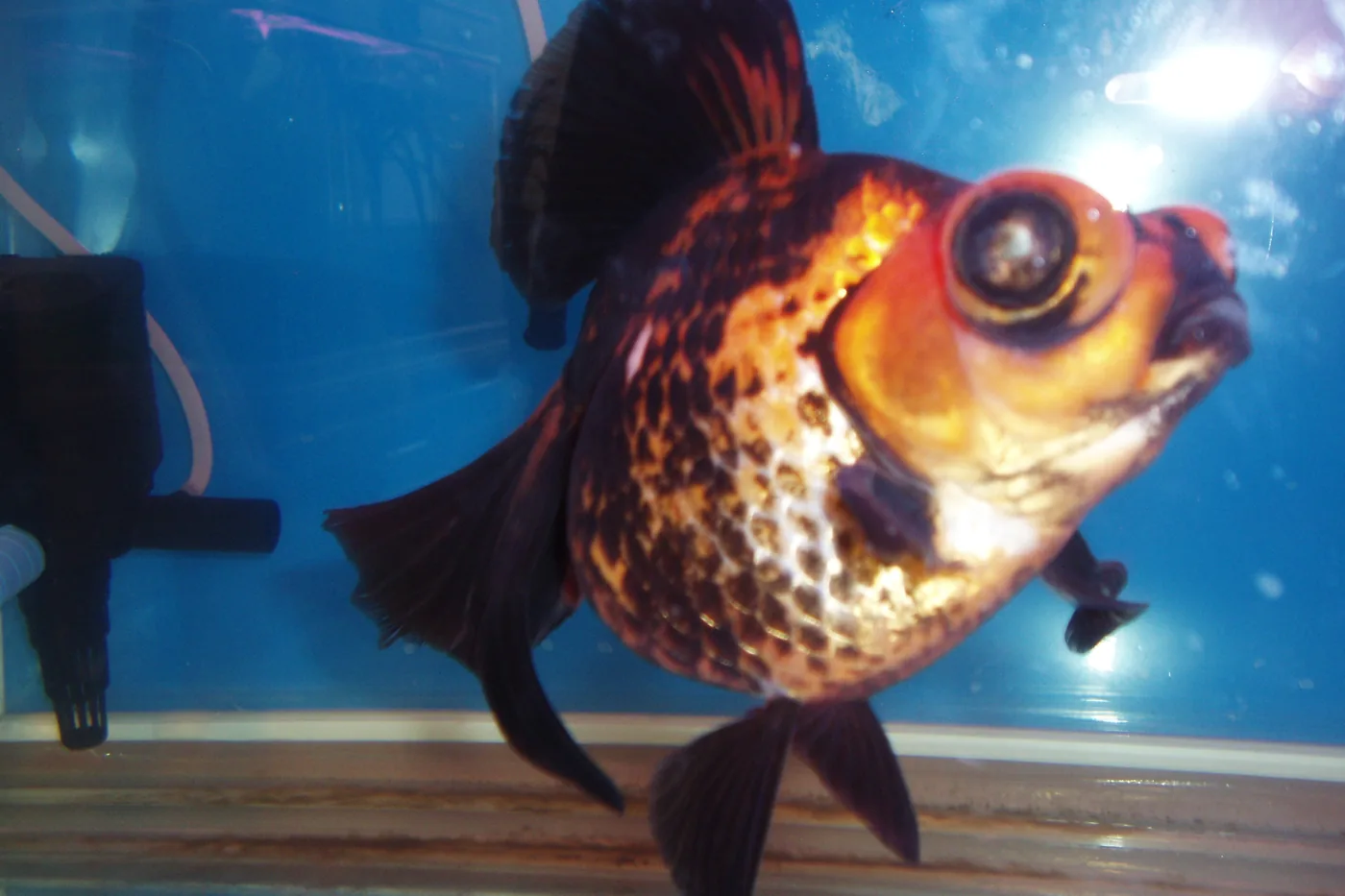
No. 08After the telescope, date unrecorded
Black Moor
The velvet-black telescope, whose colour is as changeable as its eyes are fragile.
Also known as Kuro Demekin · Black Telescope · Broadtail Moor (long-finned lines)
- Specimen
- Fancy goldfish, China
- Adult size
- 15–20 cm
- Lifespan
- 7–10 years
- Water
- 18–24 °C
- Care
- Moderate
- Swimming
- Moderate
- First fish needs
- 100 litres
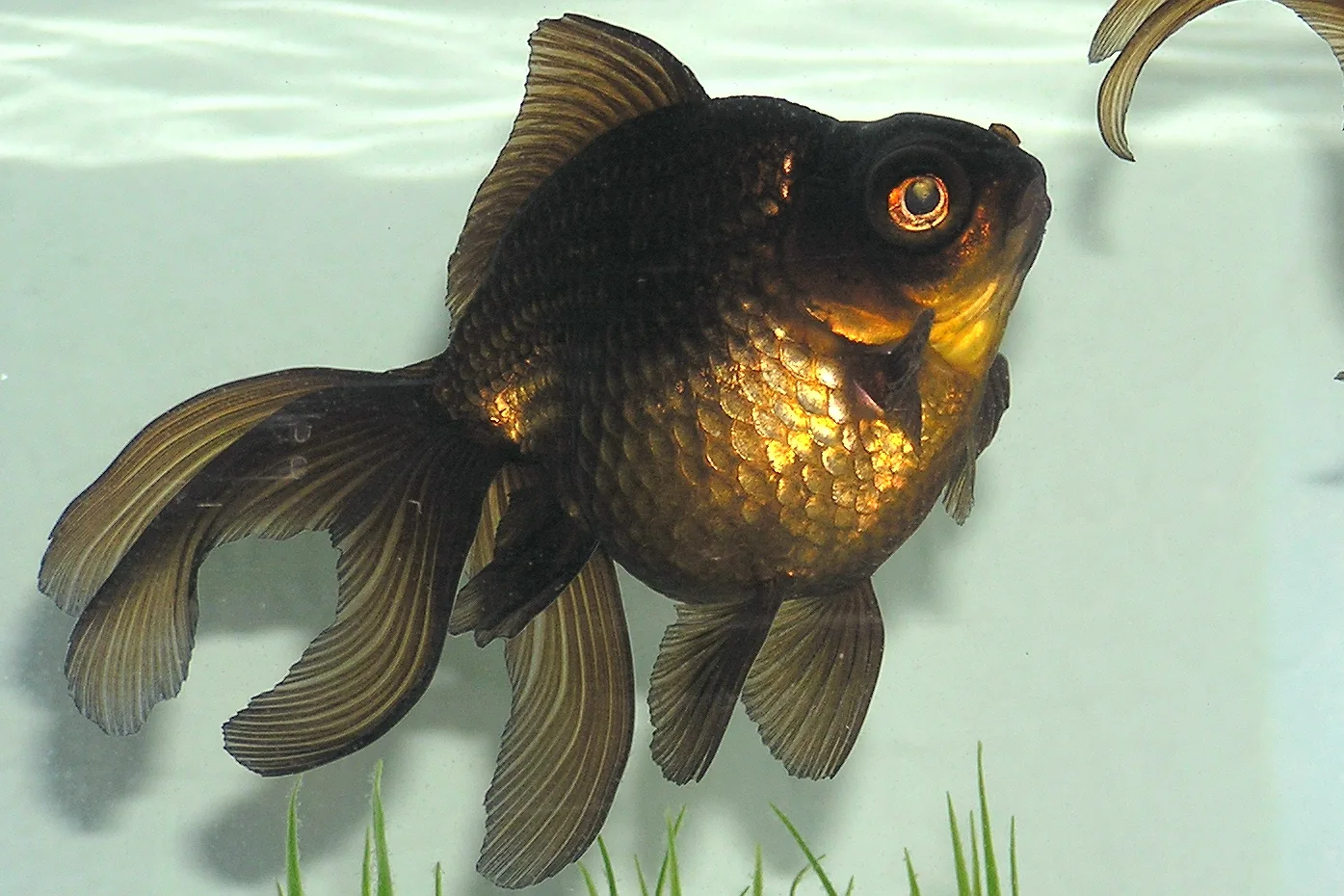
Photograph: KDBlackmore — Public domain · Wikimedia Commons
About this pictureThis adult has drifted bronze along the flank and belly. The page calls that common rather than universal, and the fourth point below covers it - it is not a fault in the fish.
About these figures Size, lifespan and water are the ranges keepers' guides give for a fish in good care, not measurements of this breed, and swimming and care are this site's own ratings of the published advice. Lifespan is where the sources differ most: how long goldfish live sets them side by side. First fish needs is a middle figure for one fish, from advice that runs from 50 litres to about 300; tank size sets that out.
The specimen
Quick facts
- Classification
- Fancy goldfish
- Body type
- Egg-shaped telescope body with a dorsal fin, double tail and protruding eyes, covered in dense black pigment with a velvety finish
- Tail and dorsal
- Double tail, dorsal fin present
- Swimming ability
- Moderate
- Keeper experience
- Intermediate
- Temperament
- Gentle and placid; slow to find food and content in the company of other unhurried fancies
- Adult size
- 15–20 cm (6–8 in)
- Temperature
- 18–24 °C (64–75 °F)
- Minimum aquarium
- 100 L (26 US gal) for one fish
- Origin
- China, popular in Japan and Europe by the 1800s, Date unrecorded
How to recognise one
- Matte, velvety black over the whole body and fins, without the metallic sheen of an orange goldfish
- Protruding telescope eyes on cone- or globe-shaped mounts, often less developed in young fish
- Egg-shaped body with a full dorsal fin and a double tail, short or flowing
- Juveniles often start bronze and darken; adults may drift back toward bronze or orange, often patchily
- Black-and-white panda fish are telescopes in a two-tone pattern rather than true moors
Identification
A black moor is a telescope in mourning dress: the same egg-shaped body, dorsal fin, double tail and projecting eyes, covered from nose to tail tip in dense black pigment. Rather than the metallic glint of an orange goldfish, the black sits in the skin as a matte, velvety layer.
The eyes protrude on cone- or globe-shaped mounts and continue to grow through the first year. Two fin styles are common: a shorter, stiffer tail, and the long, flowing finnage of the broadtail moor. Colour is the least stable part of the description: fry frequently start bronze or dark olive before turning black, and many adults from unfixed lines later shift back toward bronze or orange, often patchily.
The varieties
A moor is defined by its colour, so what varies is everything else.
- Standard moor. Short double tail, the fish most shops sell.
- Broadtail moor. Long, trailing fins that drape rather than fan. Handsome, slower, and more easily damaged on decor.
- Butterfly moor. Tail spread flat and wide, meant to be read from above.
- Panda telescope. Black and white, and not a moor — a two-tone telescope whose pattern is frequently unstable.
Everything about the eyes, the tank and the feeding is the telescope’s, and the telescope page carries it: what the fish can actually see, how the eyes develop, and how to furnish a tank so it cannot injure them. This page is about the colour.
Why black fades, and what that means
The defining fact of the breed, and the one most often mistaken for illness.
Black in a goldfish is melanin, held in pigment cells in the skin. How long it lasts is largely inherited: in the classic cross studies only fish that carry the recessive form of two genes keep their larval melanophores for life, so a moor from a line fixed for black stays black, while a dark telescope from a line that was never fixed turns bronze or orange, and the underlying orange or bronze shows through. The cellular mechanism is not settled, and the two kinds cannot be told apart as juveniles.
It is often patchy, and a fish passes through a mottled stage on the way.
What decides it: genetics, above all. Some lines hold their colour for many years and others begin lightening in the first. No study shows that temperature or light level changes it.
What does not restore it: any food. Colour-enhancing foods work on carotenoids, the pigments behind red and orange, which goldfish nutrition covers — black is a different system and no diet puts it back. Aquarium lighting makes the same point about colour-enhancing lamps.
What to do about it: enjoy it while it lasts. A dark substrate and a dark background may help slightly, because fish do adjust pigmentation to their surroundings, and that is the whole of the available influence.
Fading, against the things that are not fading
The distinction that matters, because three different processes look alike.
| What you see | What it is |
|---|---|
| Slow lightening over months, fish well | Ordinary colour change |
| Sudden pallor, with lethargy or clamped fins | Not colour — test the water |
| Black patches appearing on an orange fish | Often skin darkening over an old injury |
| Dull, greyish film over the body | Excess slime, a skin problem |
Pale or faded colour works through the second row and black patches through the third, which is the same pigment moving in the opposite direction and for a quite different reason. Grey film and excess slime covers the fourth, which is the hardest of the four to catch on a black fish, because the dulling that gives it away on an orange goldfish has far less to show against black.
Spotting illness on a fish that is all black
The genuine practical difficulty of the breed, and it is worth a method.
Redness does not show. Red streaks, inflamed gills and the early stages of an ulcer are the site’s usual early warnings, and on a black fish they are close to invisible.
So watch behaviour instead, which is more reliable anyway:
- Appetite, and whether the fish is actually reaching food.
- Breathing rate, which is the most informative thing on any goldfish — fast or laboured breathing covers counting it, and it works just as well on a black fish as an orange one.
- How the fins are held, open or clamped.
- Where it rests, and whether it rouses.
Then look properly, once a week. Bright light, a pale background behind the tank if you can manage it, and a slow look along both flanks. White spots, cottony patches and lifted scales all show clearly against black even when redness does not. Signs of a healthy goldfish is the checklist, and taking a baseline on a fish you cannot read by colour is worth more than on one you can.
And check the gills, which are red on every goldfish regardless of body colour, and therefore the one place the black does not hide anything.
Choosing one
- Even, matte colour over the body and the fins. A metallic sheen is not what a moor should have.
- Two clear, roughly matched eyes. The telescope page covers what to check.
- Swimming level, fins open, finding food.
- Accept the colour is the least predictable part. A bronze cast on the belly means fading has begun.
- Read the shop, then quarantine for at least four weeks.
Where you will find one. Widely available and inexpensive, usually as juveniles. The one thing worth knowing is that the colour is the least predictable part of the fish and there is no way to buy certainty in a young one: paying more for a juvenile does not make it stay black. If a permanently black fish is the point, buy an adult that has already held its colour, and expect to look harder for it.
Personality and behaviour
Moors are among the gentlest goldfish. They move slowly, forage patiently along the bottom, and will often rest touching a companion. Their vision is limited, as in every telescope: they respond to movement and shadow and find food chiefly by smell.
That pace decides the company. Moors do well with other telescopes, fantails and orandas, and can hold their own with a ryukin provided food is spread around. With single-tailed goldfish they are outpaced at every meal and quietly lose condition.
Aquarium requirements
Allow 100 litres (26 US gallons) for the first moor and 40 to 50 litres for each further fish, in a long tank rather than a tall one. Because the eyes lead the way into every obstacle, the interior should hold nothing that can scratch: rounded stones, smooth wood, silk or soft live plants, and no hollow ornaments a head can wedge into. Sand or a bare bottom is safer than gravel. The decorations guide covers the details.
Fit a sponge pre-filter over the intake and soften the outflow with a spray bar or baffle, since long-finned moors tire quickly in strong current. Aim for a filter that turns the volume over 5 to 10 times an hour; the filtration guide explains how to get that without a torrent.
Many guides give 18 to 24 °C (64 to 75 °F) and some breed societies 15 to 20 °C; keep the water stable. Some keepers say the black holds better in cooler, dimmer conditions, though no study shows it; the water temperature guide covers the ranges. Change 25 to 40 percent weekly, guided by nitrate readings.
Feeding
Build the diet around a quality sinking pellet made for fancy goldfish, dropped in the same place at each meal so the fish learns where to search. Sinking food also spares a round-bodied fish the surface air-gulping that so often precedes a floating episode.
Feed small amounts two or three times daily, only what is finished within a minute or two, and watch that the moor actually reaches some of it if it shares a tank with faster fish. Blanched peas, zucchini and leafy greens, gel food, and occasional frozen daphnia or brine shrimp add variety. Colour-enhancing foods rich in carotenoids are reported to bring out orange in a fading moor rather than preserve the black.
Common health considerations
The eyes take the same care as on any telescope. Scratches from decor or a net can leave a cloudy patch that usually clears in clean water; a bulge that grows, swelling behind the eye or cloudiness in both eyes deserves closer attention, as described in the cloudy eyes guide.
Black fish present a diagnostic problem: the redness of streaks, ulcers or irritated gills that would be obvious on an orange goldfish is hidden. Learn the fish’s normal behaviour, check it under bright light against a pale background now and then, and test the water whenever it seems off. White spots and fluffy patches, by contrast, show up on a moor better than on a paler fish, so the white spots guide is a useful reference for anything pale on the body or fins.
Buoyancy upsets from overeating or gulped air are as common here as in any egg-bodied fancy and often resolve with sinking food and a day’s fast, though vets find other causes too. Torn fins heal in clean water; recurring tears mean something in the tank needs changing.
What goes wrong, in order
| What you see | Usually | Where to look |
|---|---|---|
| Colour lightening over months | Ordinary, and not reversible | Pale or faded colour |
| One cloudy eye | A scrape on decor or an intake | Cloudy eyes |
| A damaged eye | Something in the tank, still in the tank | First aid |
| Floating or tipping after meals | Often diet, though other causes exist | Floating upside down |
| Thin, with no visible cause | Outcompeted at feeding | Chasing and bullying |
| Anything, noticed late | The colour hid it | Watch behaviour, not appearance |
The last row is the breed’s real risk. A moor is not known to get ill more often than a fantail; its problems may simply be found later, and later is what turns a manageable problem into a serious one.
Is a black moor right for you?
It suits you if you like the look and understand you are buying a phase rather than a permanent colour, you will furnish the tank around the eyes as the telescope page describes, and you are willing to judge the fish’s health by how it behaves rather than by how it looks.
It does not suit you if you want a fish that stays black, if the tank holds single-tails, or if it would go in a pond — a moderate swimmer with poor eyesight is badly placed outdoors, where it cannot see a heron coming and cannot outswim anything.
And it is worth reading goldfish welfare on how far selection should go. A moor carries two selected traits at once, the eyes and the finnage, and the moderate versions are a good deal easier to defend than the extreme ones.
History and origin
Black telescopes appeared in China, probably not long after the dragon-eye type itself was established; black is a recurring mutation in goldfish, and breeders selected fish that held the colour into adulthood. During the nineteenth century the fish reached Japan, where it is known as the kuro demekin, and it was among the fancy goldfish arriving in Europe with the expanding trade of the 1800s. The English name “moor” is of uncertain origin, though it plainly refers to the colour.
A moor that is jet black at two years old and bronze at five is not a failure of care but the biology of a line that was never fixed for black, which is why the deepest, most stable blacks are still prized.
Before you bring one home
- The eyes project beyond the head and are easily scratched; use smooth decor and guard filter intakes
- Eyesight is poor, so feed in a consistent spot and confirm the fish is eating
- Black often fades to bronze or orange in lines that were never fixed for it; this is normal and not a disease
- Dark colour hides redness and streaks, so inspect the fish under good light and watch its behaviour
Suitable companions
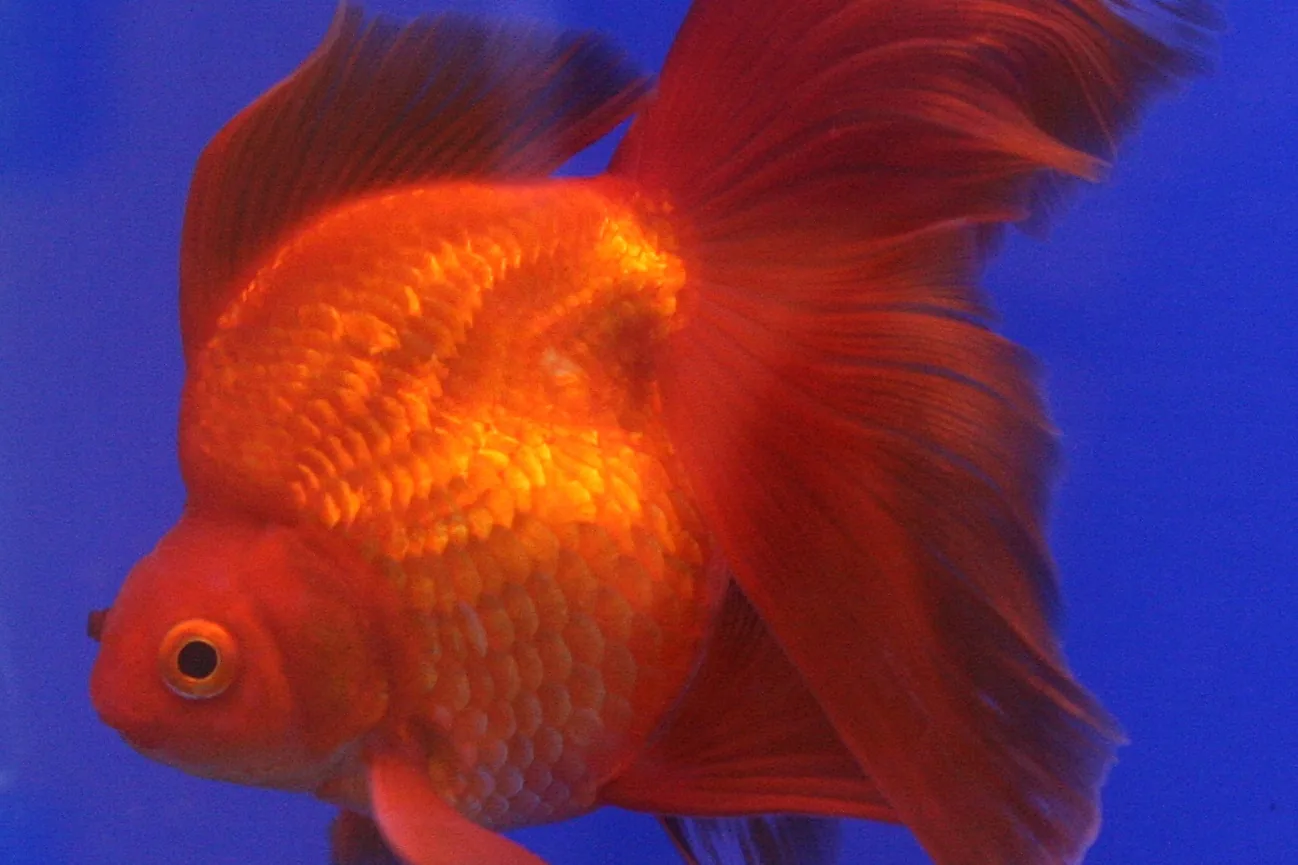
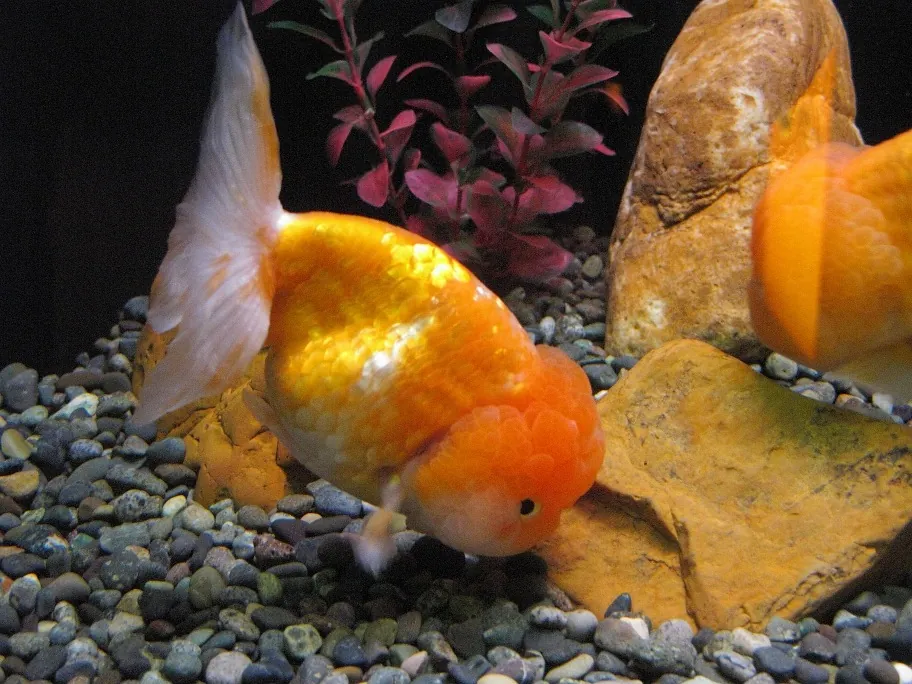
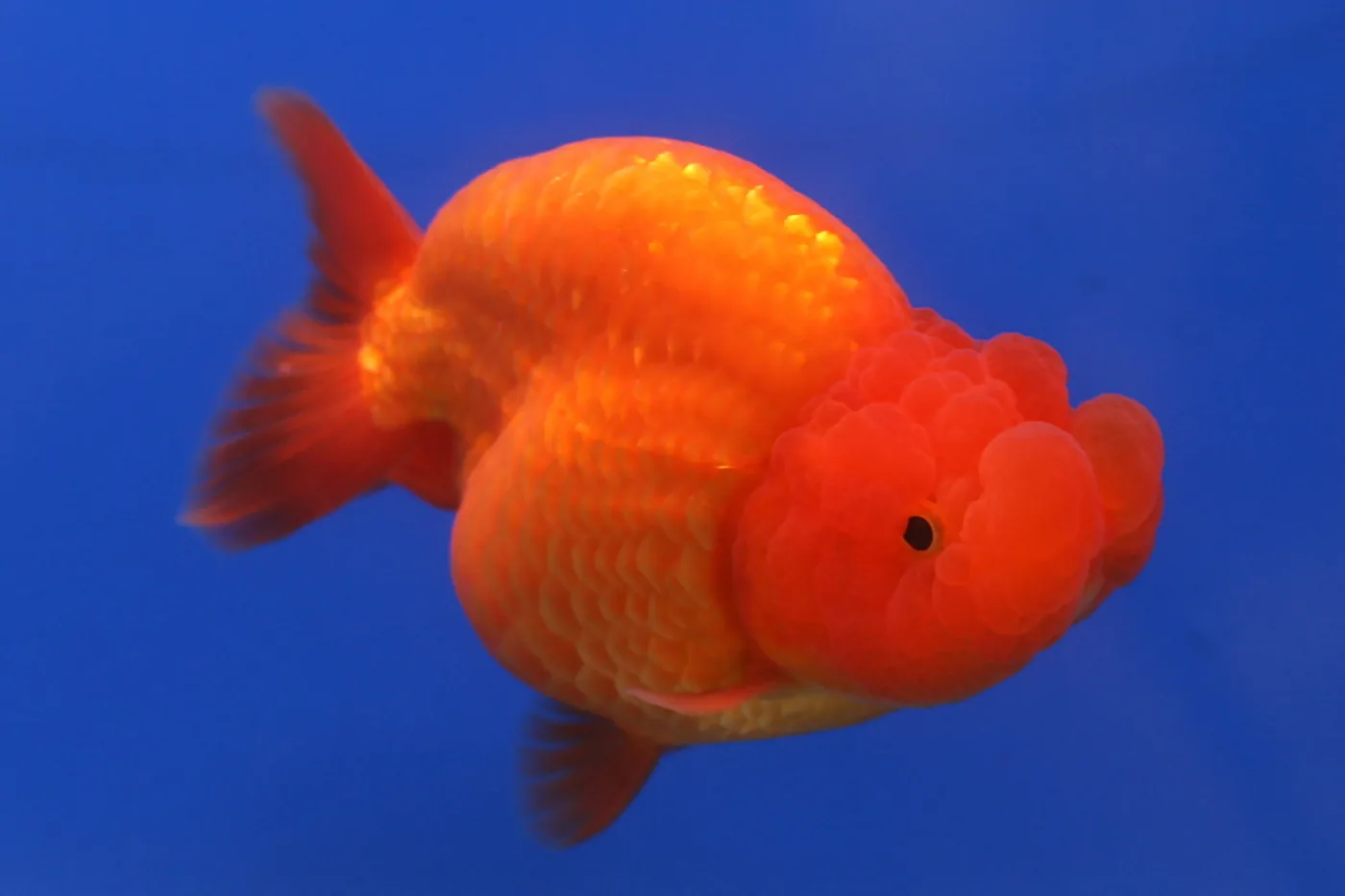
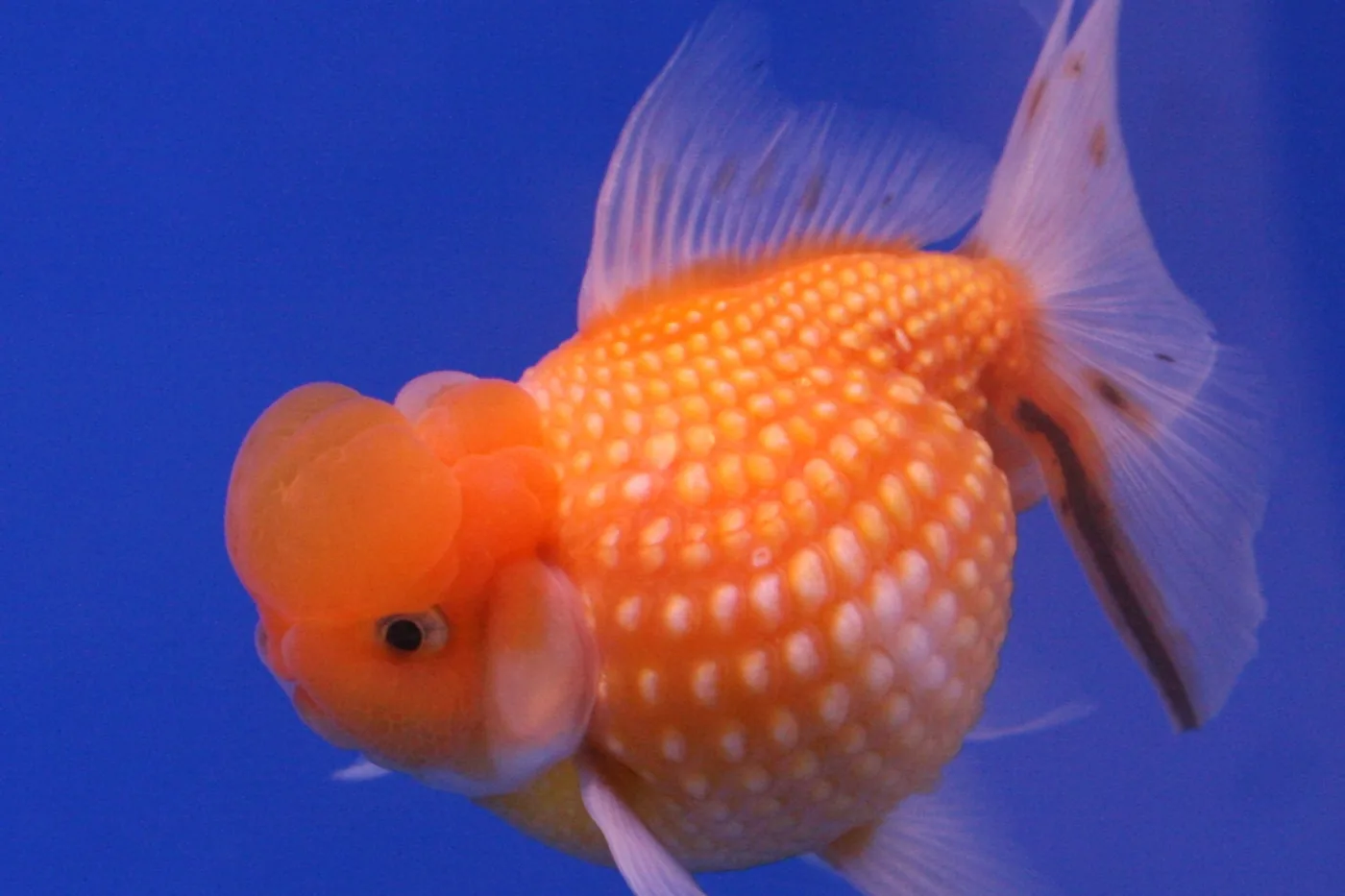
Round-bodied goldfish should live with fish of similar speed. These breeds share the same pace, water and food.
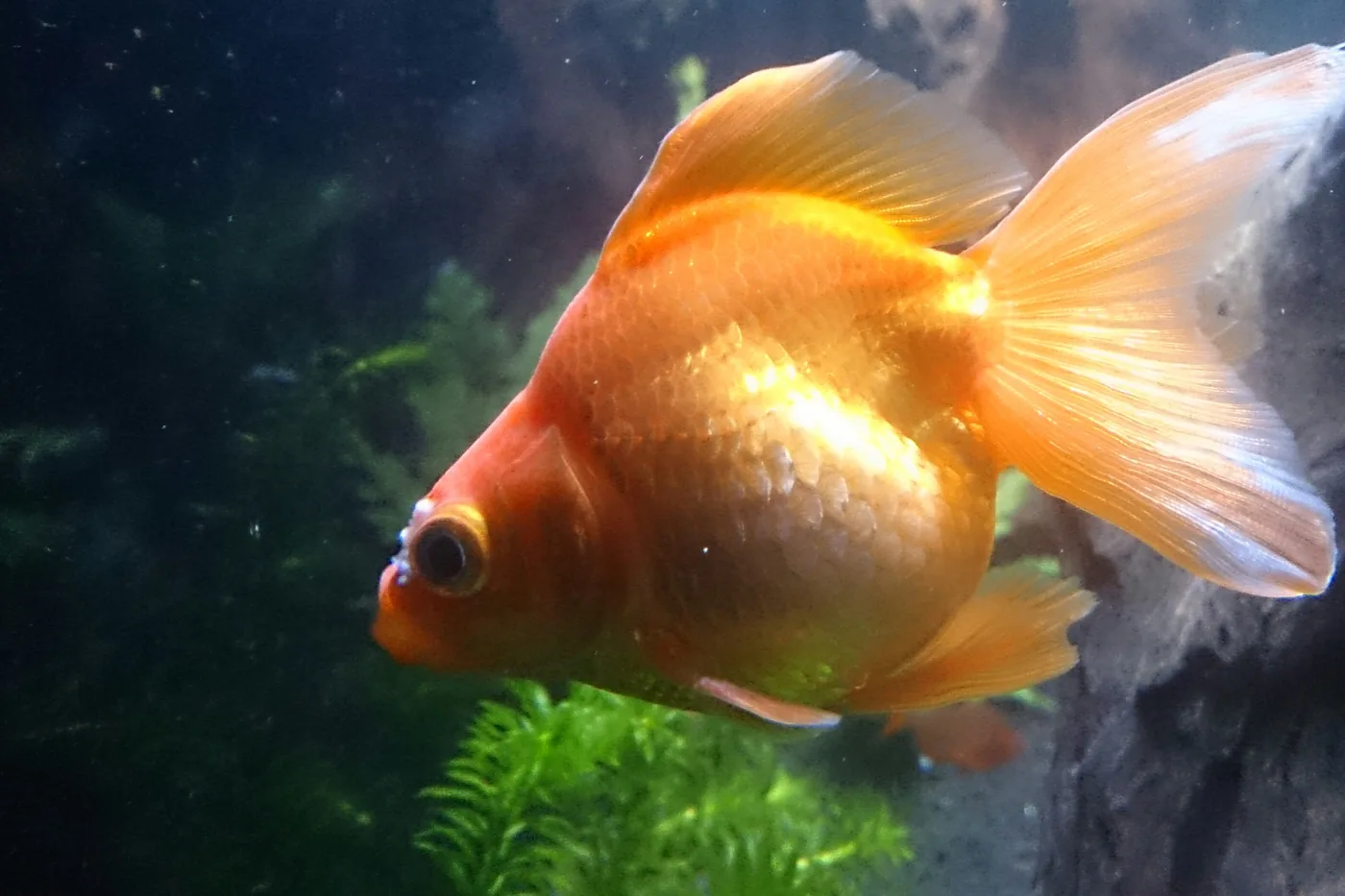
Fantail
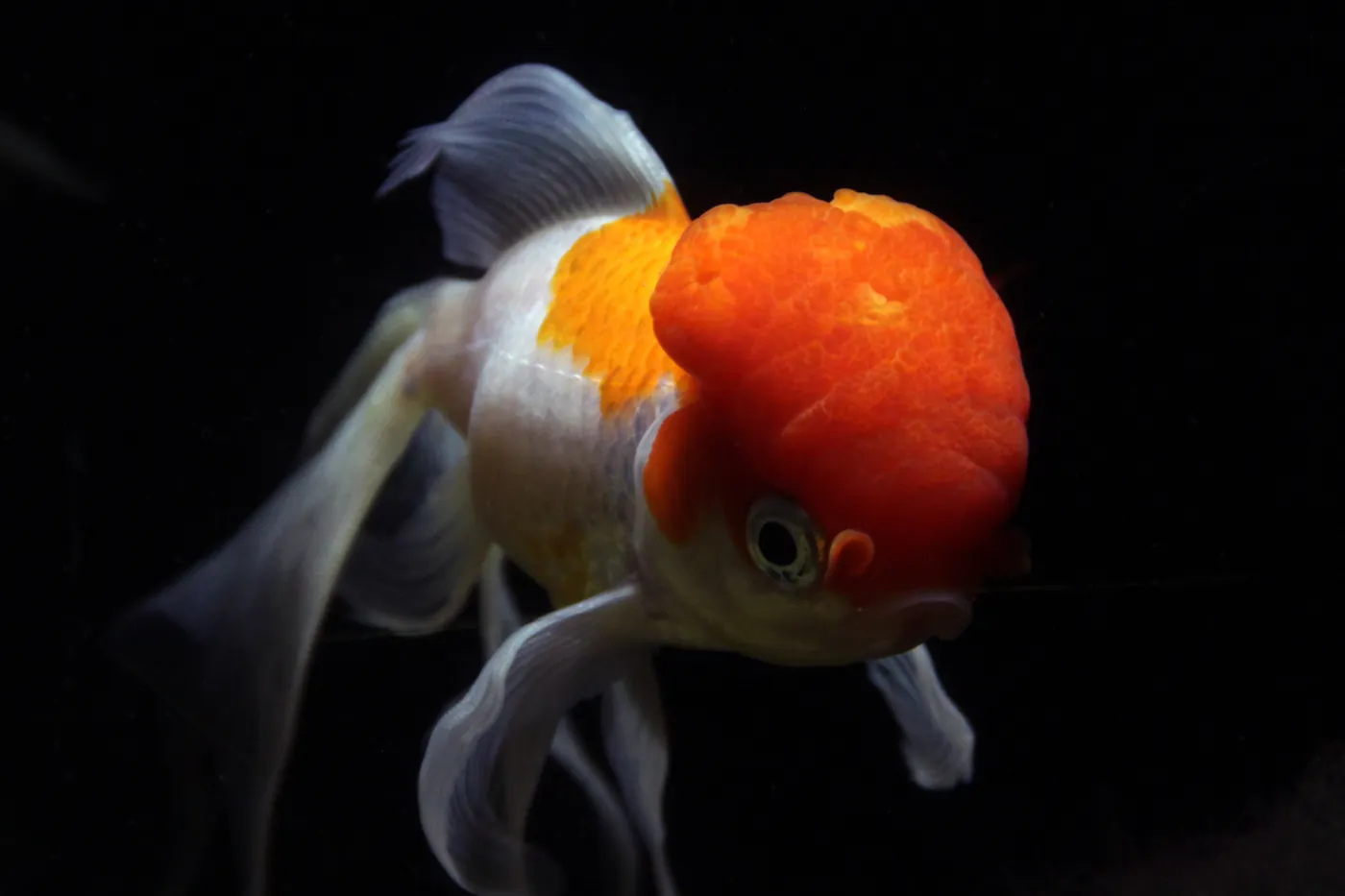
Oranda
Ryukin
Lionhead
Ranchu
Pearlscale
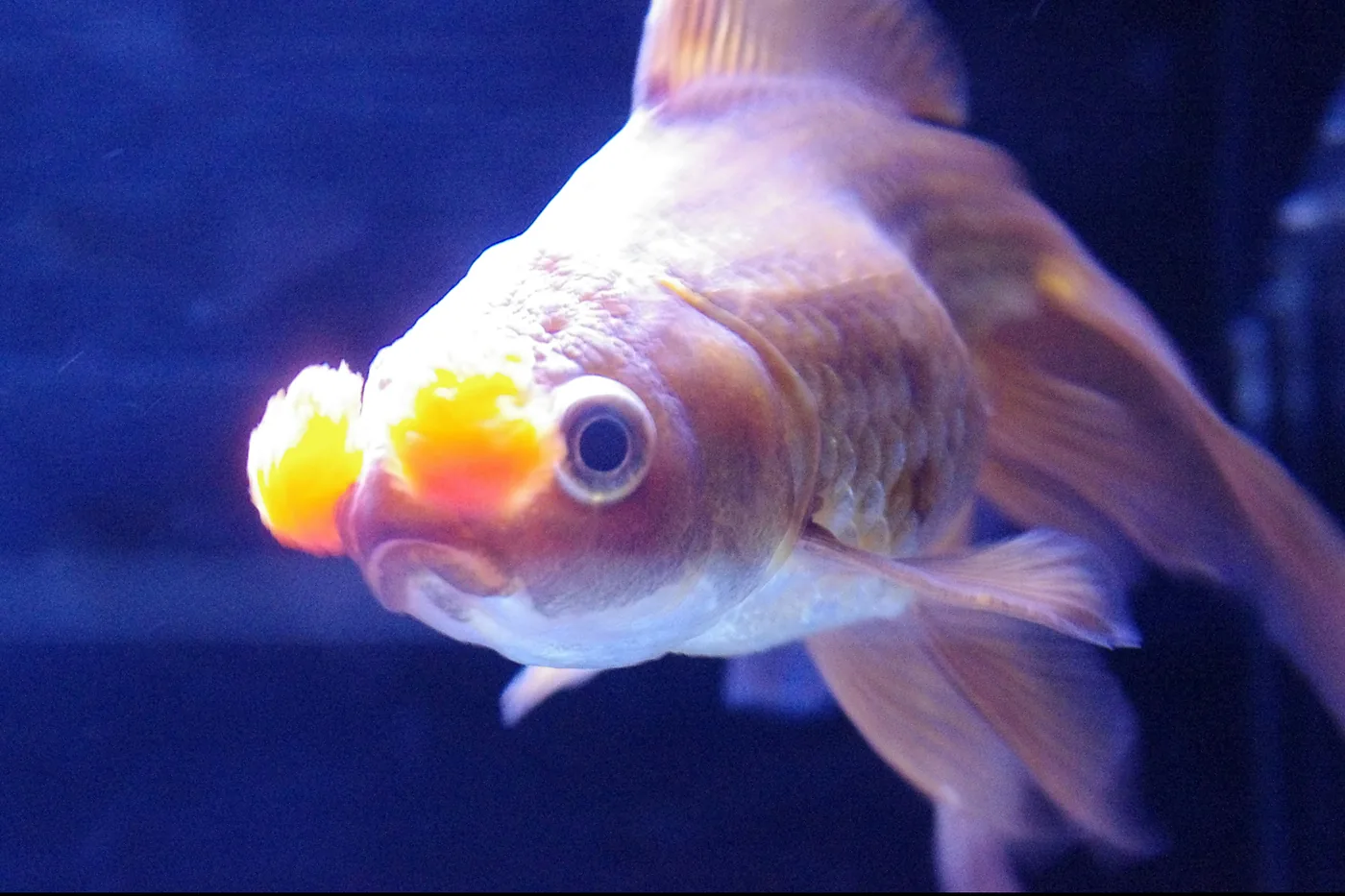
Pompom
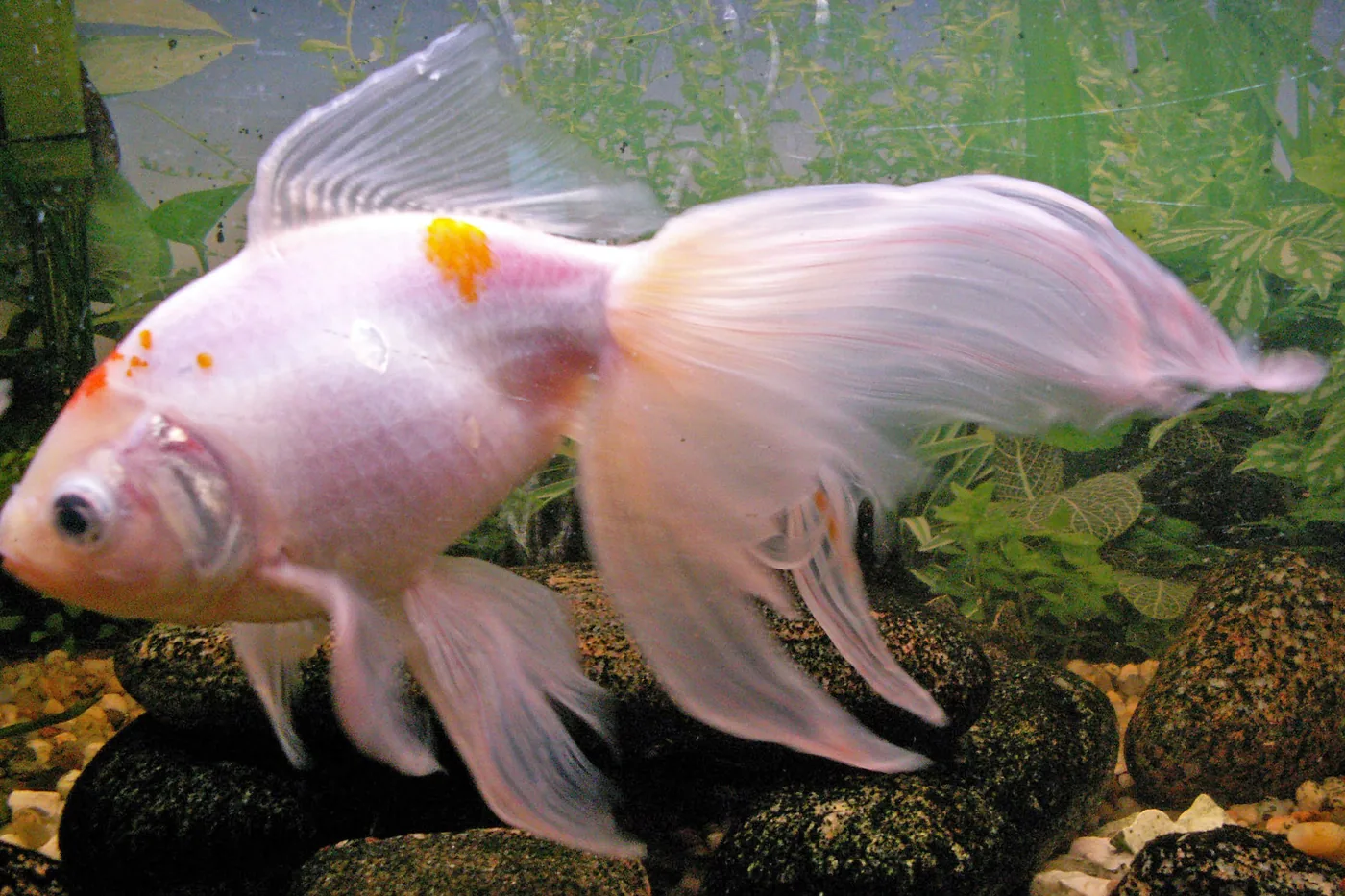
Veiltail
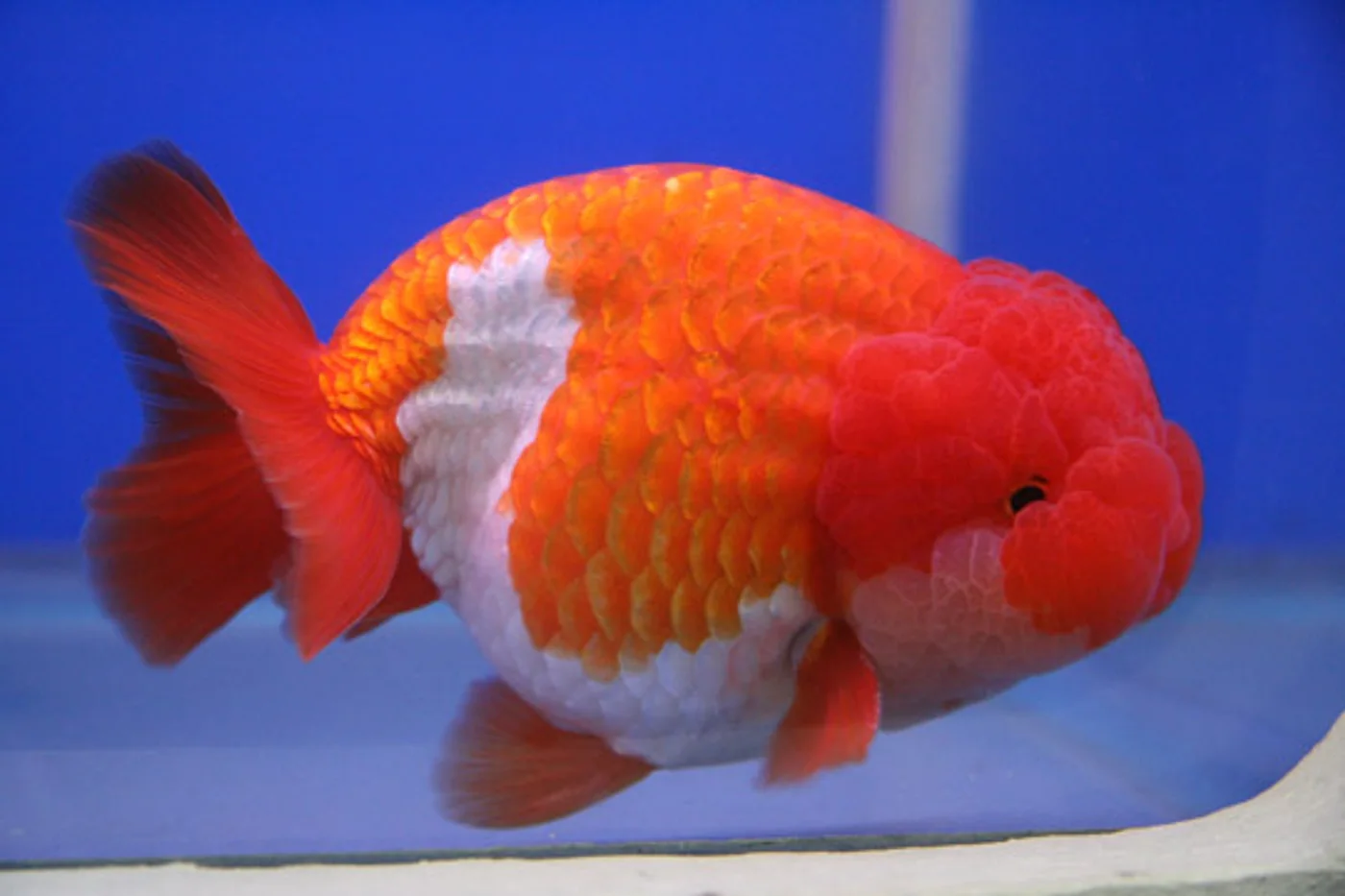
Lionchu
Best kept apart from: Common Goldfish, Comet, Shubunkin, Bubble Eye, Celestial Eye, Jikin. Speed and appetite differences leave the slower fish underfed.
Thinking about other species? Try the compatibility checker.
Similar breeds
The breeds most like the black moor — the telescope, fantail and veiltail — are all pictured above among its companions.
Frequently asked questions
Why is my black moor turning orange?
Probably because the black was never fixed in its line. How long the black lasts is largely inherited: a moor from a line fixed for black keeps it, while a dark telescope from a line that was never fixed turns bronze or orange. The change is normal, usually permanent and not a sign of illness. Colour loss that comes on suddenly with lethargy, clamped fins or refusal to eat is different and calls for a water test.
Is a black moor the same as a telescope?
Yes. The black moor is the solid-black form of the telescope goldfish, with the same egg-shaped body, dorsal fin, double tail and protruding eyes. Everything about its care is the same, from smooth decor and guarded filter intakes to sinking food and unhurried tankmates. The only difference is the colour and its tendency to fade toward bronze or orange with age.
How do I spot illness on a fish that is all black?
Redness, streaks and irritated gills are much harder to see, so watch behaviour instead, including appetite, breathing rate, how the fins are held and where the fish rests. Check the fish under bright light against a pale background, where white spots, fluffy patches and lifted scales show clearly. Test the water whenever anything seems off; most problems start there.
Can I stop my black moor from fading?
Not reliably, and nothing you buy will do it. How long the black lasts is largely inherited, and no food restores it — colour-enhancing foods work on the carotenoid pigments behind red and orange, which is a different system entirely. A dark substrate and background may help a little, because fish adjust their pigmentation to their surroundings, but no study shows that temperature or light level changes it. If the line was never fixed for black, the black is a phase the fish is passing through rather than a property it has.
What should I look for when buying a black moor?
Even, matte colour over the whole fish including the fins, two clear and roughly matched eyes, and a fish that swims level and finds its food. Then accept that the colour is the least predictable thing you are buying — some lines hold black for years and others begin lightening in the first. A bronze cast on the belly suggests that fading may already have begun.
Why did my black moor start out bronze?
Because every goldfish does. Fry hatch in wild-type olive-bronze, and juveniles sold at a few centimetres are often still part-bronze, though a moor usually blackens as it grows. The confusing part is that a dark telescope from a line that was never fixed may lighten again, so it can go bronze, black, and back toward bronze across its life without anything being wrong at any stage.
Can a black moor live in a pond?
It is not a good candidate. Moors are moderate swimmers with poor eyesight and prefer 18 to 24 °C, so an outdoor pond exposes them to cold, currents, predators and competition they cannot handle. A shaded summer tub with stable temperatures can work as a seasonal home, but an indoor aquarium is the safer permanent one.