Symptom
Popeye: a bulging eye on a goldfish
A protruding eye is swelling behind the eye rather than a problem with the eye itself. Whether one or both are affected is a very useful thing you can notice, because it separates an injury from something systemic.
How soon to act
- Watch closely
- Act within a day or two This symptom
- Act today
One bulging eye on an otherwise well fish is usually an injury or a local infection and has a few days of margin. Both eyes bulging, or a bulging eye alongside swelling, raised scales or lethargy, points at something internal and deserves a vet.
What you may observe
- Whether one eye is affected or both — the most informative single detail
- How far it protrudes, and whether that has changed since yesterday
- Whether the eye itself is clear or has gone cloudy or grey
- Redness, ragged tissue or a ring of inflammation around the socket
- The breed, since telescopes, moors and celestials protrude by design
- Anything else wrong — belly swelling, scales standing out, breathing, appetite, behaviour
Common possible causes
In rough order of how often they turn out to be the answer. None of these is a diagnosis.
-
Injury
CommonOften one eye. A goldfish that struck the glass, was caught in a net, scraped a decoration or was chased into something can swell behind the eye as a straightforward response to trauma. The fish is otherwise well and eating, the eye may look bruised or reddened around the socket, and it may settle in clean water without anything being added, though how long that takes varies.
-
Bacterial infection behind the eye
CommonOne eye more often than both. Bacteria entering through an injury, or reaching the socket from an infection elsewhere, produce swelling and often cloudiness of the eye itself. This is the version that does not settle on clean water alone and is the reason a bulging eye that is still growing after a week needs attention rather than patience.
-
A systemic problem
PossibleUsually both eyes. When fluid accumulates through the body — the same mechanism behind dropsy — the sockets are one of the places it shows. This is not an eye condition at all but organ failure or a whole-body infection becoming visible, and the prognosis depends entirely on what is behind it rather than on the eye.
-
Chronic poor water quality
PossibleSustained ammonia, nitrite or a long-neglected nitrate level damages tissue generally and suppresses the fish's ability to hold anything off. Ammonia toxicity is itself a recognised cause of a bulging eye, and poor water is also the background that lets an injury or a bacterium win, which is why the water test comes before anything else.
-
Gas bubble disease
Less commonWater supersaturated with dissolved gas releases it as bubbles inside the fish, including behind the eye. It comes from a mains supply under pressure filled straight into a tank, or from a pump drawing air through a leak on its intake side. The tell is fine bubbles visible in the fins, the skin or the eye itself, and often more than one fish affected at once.
-
The breed, and nothing else
Less commonTelescopes, black moors and celestial eyes have permanently protruding eyes as a breed characteristic, and a keeper new to them can mistake normal anatomy for disease. The distinguishing question is change: breed eyes grow in over the first months, are often slightly uneven, and then stay as they are, while popeye is a new bulge in an eye that was normal.
Water checks to do first
Poor water mimics or worsens almost every goldfish illness. Test before you treat.
- Ammonia and nitrite, which must read zero; either one both causes damage and prevents healing
- Nitrate, as the record of how long the tank has gone under-maintained
- pH, and whether it has drifted, since a fish fighting an infection has nothing spare
- Temperature and its stability, because healing is slow in cold water
- Whether the last water change was conditioned, and whether it was filled straight from a pressurised line
An eye pushing out of a goldfish’s head is one of the more alarming things a keeper can find, and the alarm is often disproportionate. The condition — properly exophthalmia, universally called popeye — is often not a disease of the eye itself. The cause is frequently swelling in the socket behind it, pushing the eye forward, though parasites or gas bubbles inside the eye can do the same, and what caused it is the actual question.
There are two things to establish before anything else, and both take a moment.
First: is this the breed?
Telescopes, black moors and celestial eyes have protruding eyes by design. It is the defining feature of those breeds, arrived at over centuries of selection, and a keeper meeting one for the first time can reasonably mistake normal anatomy for a symptom.
The distinction is straightforward. A breed eye grows in over the first months, is often slightly uneven, and then does not change from week to week. Popeye is a new bulge in an eye that was normal, and it can progress.
Telescope, celestial or bubble eye?
-
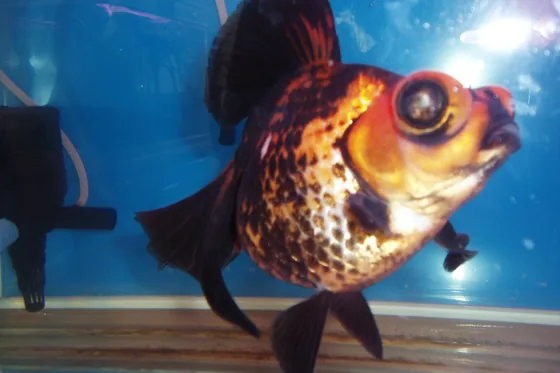
Eyes pushed out to the sides
-
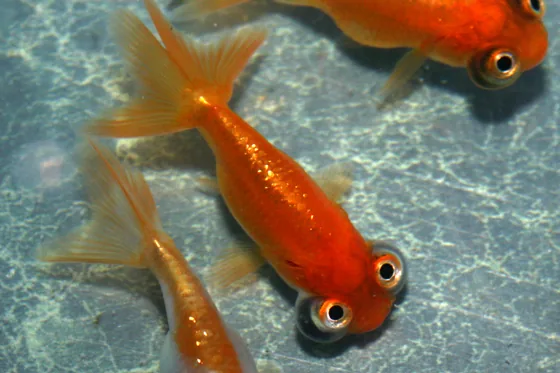
Eyes turned to the sky
-
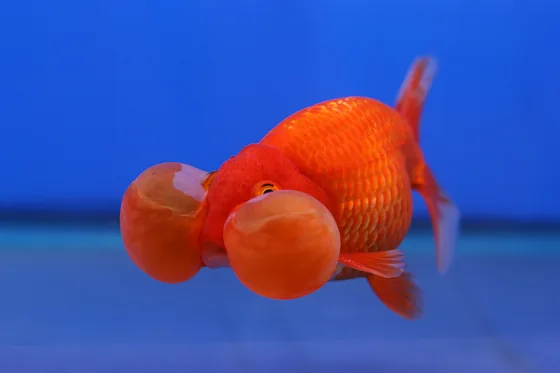
A sac beneath each eye
Three eye breeds side by side: a telescope with an eye projecting from the side of its head ringed, a celestial seen from above with an upturned eye ringed, and a bubble eye with the fluid sac beneath its eye ringed.
- Telescope. Eyes that project outward from the sides of the head. The black moor is the black form of the telescope (the British show standard judges it as a separate type).
- Celestial Eye. No dorsal fin in the standard, and eyes turned upward to gaze at the surface, with no sac beneath them.
- Bubble Eye. No dorsal fin in the standard, upturned eyes, and a fluid-filled sac beneath each one that trembles with every movement.
Photographs: Telescope, Fanghong, CC BY 2.5; Celestial Eye, Michelle Jo, CC BY 3.0; Bubble Eye, Lerdsuwa, CC BY-SA 4.0. Rings added.
What these breeds do need is the care their anatomy implies — smooth decor, guarded filter intakes, nothing that can scratch — because an eye projecting beyond the body line is an eye that meets obstacles first. The decorations guide covers what is safe.
Second: one eye, or both?
This is the most informative thing you can notice, and it costs nothing.
One eye points at something that happened — an impact with the glass, a scrape, a netting, a bacterium that entered through a small wound. First aid for an injured goldfish covers finding what it hit, which is what stops a second one. If the eye has also gone cloudy, that narrows it further. Events are one-sided.
Both eyes points at something the fish has — fluid accumulating throughout the body because the systems that manage it are struggling. Conditions are symmetrical.
It is not an absolute rule. But as a first cut without a microscope or a vet, it separates the common and usually-resolving case from the serious one better than any other observation.
| Reading it | One eye | Both eyes |
|---|---|---|
| Most likely | Injury, or local infection | Systemic fluid retention |
| Fish otherwise | Usually well, eating, active | Often lethargic, off food |
| Often alongside | Bruising, a bit of cloudiness | Belly swelling, raised scales |
| Typical course | May settle in clean water, at a variable pace | Depends entirely on the cause |
| First response | Clean water, remove the hazard | Test, then a vet |
What is actually swelling
The eye itself is usually intact. What has changed is the volume of fluid in the socket behind it, which pushes the globe forward — the same kind of oedema that makes a bruised human eye swell, in an animal whose eye sits in a shallow socket with little room to absorb it.
That is why the appearance is dramatic and the underlying problem is often modest, and it is also why the treatment is rarely aimed at the eye. Nothing you apply to the surface reaches behind it. What resolves the swelling is resolving whatever produced it.
The under-known cause
Worth naming because it is genuinely missed and the fix is nothing to do with the fish.
Water under pressure holds more dissolved gas than water at atmospheric pressure. Fill a tank directly from a mains line, or run a pump with a small leak on its intake side drawing air in, and the water in the tank can become supersaturated. That excess gas comes out of solution wherever it can — including inside the fish, forming small bubbles in the fins, the skin, and behind the eyes.
The clues are distinctive:
- Fine bubbles visible in the fin membranes or just under the skin, sometimes in the eye itself
- More than one fish affected at the same time
- A recent large fill straight from a pressurised supply, or a pump that has started making a different noise
The fix is plumbing. Let new water stand, or spray it through the air rather than piping it straight in, so the excess gas escapes before the fish meet it. Find and seal the leak on the pump’s suction side. No medication addresses this, and treating it as an infection wastes the time in which more fish develop it. Bubbles on the fins, skin or eyes covers the whole picture, including the bubbles in the fins that usually show first.
What to do
Test the water first, as always. Ammonia and nitrite at zero, nitrate low, pH steady. Ammonia toxicity can itself cause popeye, and chronic poor water is also often the background that let an injury or a bacterium win, and the testing guide covers what the readings mean.
Change water and keep changing it if anything reads wrong. Thirty to fifty percent, and at least half if ammonia reads 2 mg/L or more (unless the pH is below about 6, when smaller daily changes are safer), conditioned and temperature-matched.
Find the hazard. If the eye is on one side and the fish is otherwise well, something in the tank probably caused it: a sharp ornament, an unguarded intake, a rough net, a tankmate chasing at spawning time. Leaving it in place means a second eye later.
Then wait, and watch. A single injured eye in clean water may settle, though how long it takes varies. Photograph it, as the baseline argument suggests, because the only thing you actually need to know is whether it is getting better, holding steady or getting worse — and that is exactly the judgement memory is worst at over a fortnight.
When it is not about the eye
A bulging eye alongside a swollen belly, scales lifting away from the body, lethargy or refusal to eat is not an eye problem. It is the picture described on the swollen abdomen page — systemic fluid retention, usually from organ failure or a whole-body infection — and the eye is simply one of the places it shows.
That version needs a vet rather than a shop remedy, and the fair position is that the outlook depends on how far the underlying problem has progressed. The diseases reference explains why dropsy is a sign rather than a diagnosis, and the same logic applies here.
If the eye does not recover
Some do not. A badly injured eye can stay permanently enlarged, go cloudy and lose its sight, or rupture and be lost. None of that regrows.
It is worth saying plainly that a goldfish copes with this far better than the appearance suggests. A goldfish uses sight, smell, taste and its lateral line together: the lateral line gives it a continuous map of water movement and nearby objects, and smell does a large share of the work in finding food. One-eyed and even blind goldfish can feed, navigate and live for years, though a blind fish finds food more slowly.
What such a fish needs is a tank adapted slightly — nothing sharp, nothing it can wedge into, and attention at feeding time to make sure it is not being consistently outcompeted by a fish that can see the pellet land.
Preventing it
Most popeye traces back to two things, and both are ordinary tank management.
Remove the hazards. Smooth decor, no sharp resin edges, a sponge over the filter intake, a lid that does not let a startled fish strike anything. This matters most in tanks with telescope-eyed breeds, whose eyes are structurally exposed.
Keep the water right. Ammonia and nitrite at zero, nitrate down with regular water changes, temperature steady. A goldfish in good water heals a knock and never shows you it happened; the same knock in a neglected tank becomes the swelling you are reading about.
When to see a vet
- Both eyes are affected, particularly alongside belly swelling or scales standing out
- The eye is still enlarging after a week of clean, stable water
- The eye has gone cloudy, grey or ruptured, or the tissue around it looks eroded
- The fish is lethargic, off its food or breathing hard, which places the problem beyond the eye
What not to do
- Do not attempt to drain, press or otherwise treat the eye physically
- Do not assume one bulging eye means the fish is dying; a single eye is usually an injury
- Do not medicate a telescope or a moor for having the eyes its breed has
- Do not dose antibiotics on suspicion before testing the water and giving clean water a few days
- Do not leave sharp decor or an unguarded intake in place while waiting for the eye to settle
Frequently asked questions
My goldfish has one eye sticking out. Is it serious?
Usually less serious than it looks. A single protruding eye on a fish that is eating, swimming normally and otherwise well is often an injury — a collision with the glass, a scrape on decor, a rough netting — and the swelling behind the eye may settle in clean water, though how long that takes varies. What changes the assessment is the eye continuing to enlarge after a week, the eye itself going cloudy, or anything else being wrong with the fish. Both eyes is a different situation entirely.
Why does one eye versus two matter so much?
Because it separates local from systemic, and that distinction is most of the diagnosis. Something that happened to the fish — an impact, a scrape, a bacterium entering a wound — happens on one side. Something happening throughout the fish, such as fluid accumulating because the organs that manage it are failing, shows on both. A single eye points at an event; a pair points at a condition. It is not an absolute rule, but it is a useful first cut available without a vet.
Is popeye the same as dropsy?
Not the same, but they can be the same underlying problem seen in two places. Dropsy is fluid accumulating in the body until scales lift away; bilateral popeye is fluid accumulating behind both eyes. When they appear together, the fish is showing systemic fluid retention — usually failure of the systems that manage it — and the outlook depends on the cause rather than on either sign. A bulging eye with a swollen body and raised scales is a veterinary case, not a shop-remedy one.
My black moor's eyes have always stuck out. Is that popeye?
No. Telescopes, black moors and celestial eyes carry protruding eyes as the intended result of selective breeding, described on their breed pages. The eyes grow in over the first months, are often slightly uneven, and then nothing about them changes week to week. Popeye is a new bulge in an eye that was normal, and it can progress. What these breeds genuinely need is smooth decor and guarded intakes, because an eye that projects beyond the body line is an eye that meets things first.
Will the eye go back to normal?
Often, if it was an injury and the water is good — swelling behind the eye recedes over a few weeks and the fish is left as it was. A severe case can leave a permanently enlarged or cloudy eye, and an eye that ruptures or is lost does not regrow. A goldfish manages remarkably well with one eye or none, navigating by its lateral line and finding food by smell, so a lost eye is a cosmetic outcome rather than a welfare crisis provided the tank is smooth and the fish is not outcompeted at feeding.
What is gas bubble disease?
Water can hold more dissolved gas than it should when it is under pressure — in a mains supply, or on the suction side of a leaking pump. Released into a tank, that gas comes out of solution inside the fish, forming small bubbles in the fins, skin and behind the eyes. It is uncommon and under-recognised, and the clues are fine visible bubbles, several fish affected at once, and a recent fill straight from a pressurised line. The fix is the plumbing rather than the fish: let new water stand or spray it through the air before it goes in, and find the leak on the pump.