No. 18Early 20th century; one account says 1908
Bubble Eye
One of the most fragile goldfish ever bred, and one that repays a carefully planned aquarium.
Also known as Suihogan · Water Bubble Eye · Bubble-eye goldfish
- Specimen
- Fancy goldfish, China
- Adult size
- 12–15 cm
- Lifespan
- 5–8 years
- Water
- 18–24 °C
- Care
- Demanding
- Swimming
- Weak
- First fish needs
- 100 litres
Photograph: Lerdsuwa, CC BY-SA 4.0 · Wikimedia Commons
About these figures Size, lifespan and water are the ranges keepers' guides give for a fish in good care, not measurements of this breed, and swimming and care are this site's own ratings of the published advice. Lifespan is where the sources differ most: how long goldfish live sets them side by side. First fish needs is a middle figure for one fish, from advice that runs from 50 litres to about 300; tank size sets that out.
The specimen
Quick facts
- Classification
- Fancy goldfish
- Body type
- Egg-shaped body with a smooth, finless back, a double tail and a large fluid-filled sac beneath each eye
- Tail and dorsal
- Double tail, no dorsal fin
- Swimming ability
- Weak
- Keeper experience
- Experienced
- Temperament
- Docile and slow; harmless to every other fish and hopelessly outpaced by most of them
- Adult size
- 12–15 cm (5–6 in)
- Temperature
- 18–24 °C (64–75 °F)
- Minimum aquarium
- 100 L (26 US gal) for one fish
- Origin
- China, Early 20th century
How to recognise one
- A translucent, fluid-filled sac beneath each eye that wobbles as the fish swims and can grow large enough to obscure the face
- No dorsal fin; the back is a smooth, even curve from head to tail
- Eyes that point upward
- Egg-shaped body with a double tail, usually short and held clear of the sacs
- Sacs are absent in fry, begin to form in the first few months and keep growing; a matched pair is prized
Identification
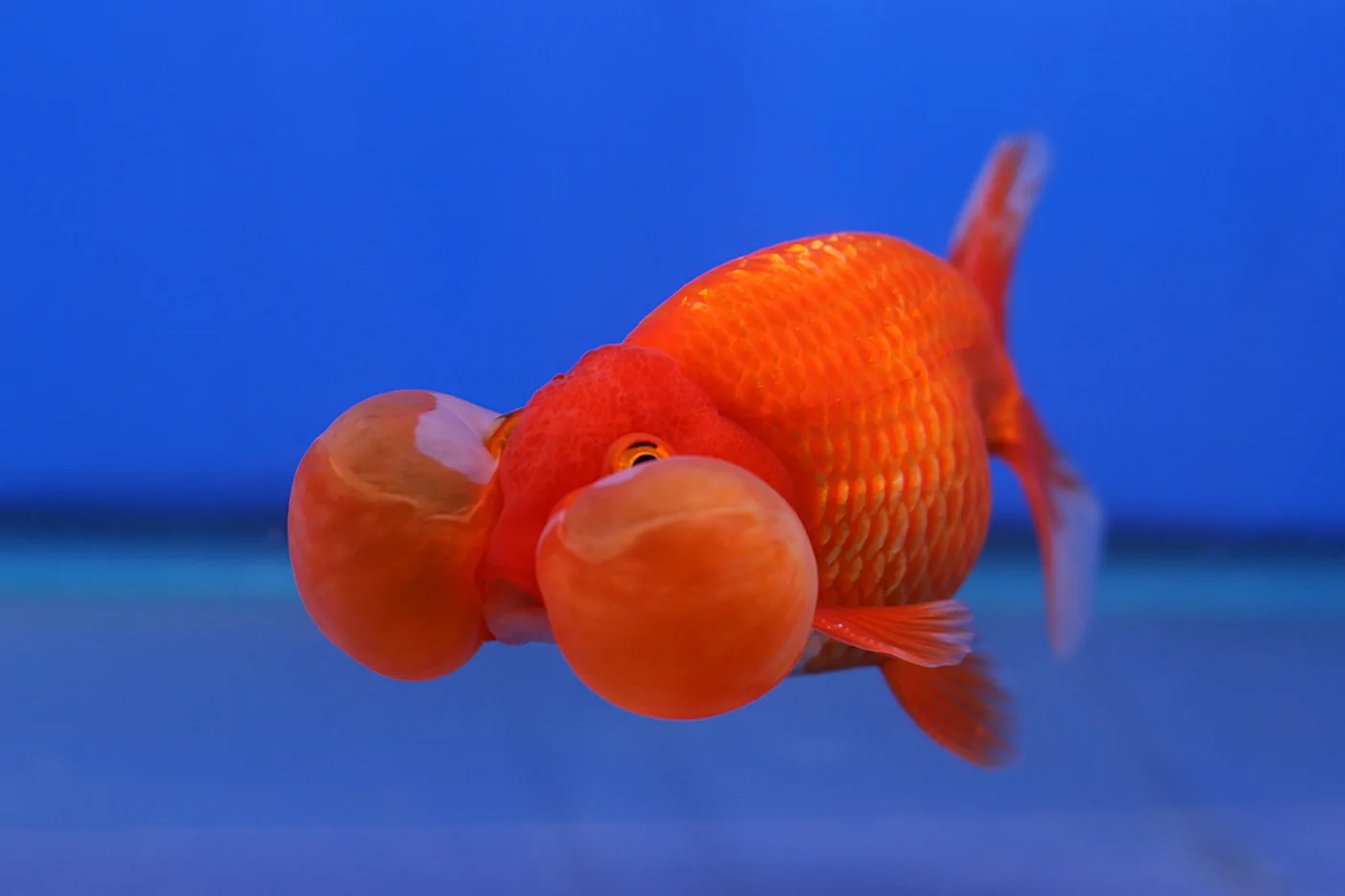
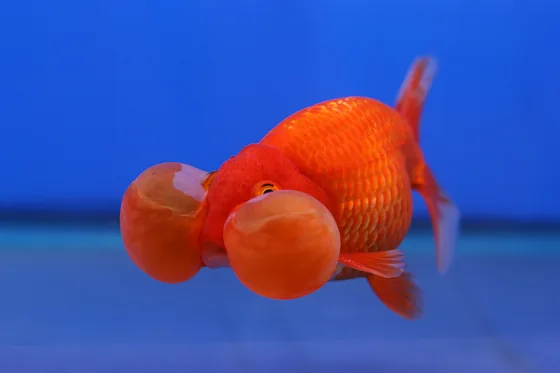
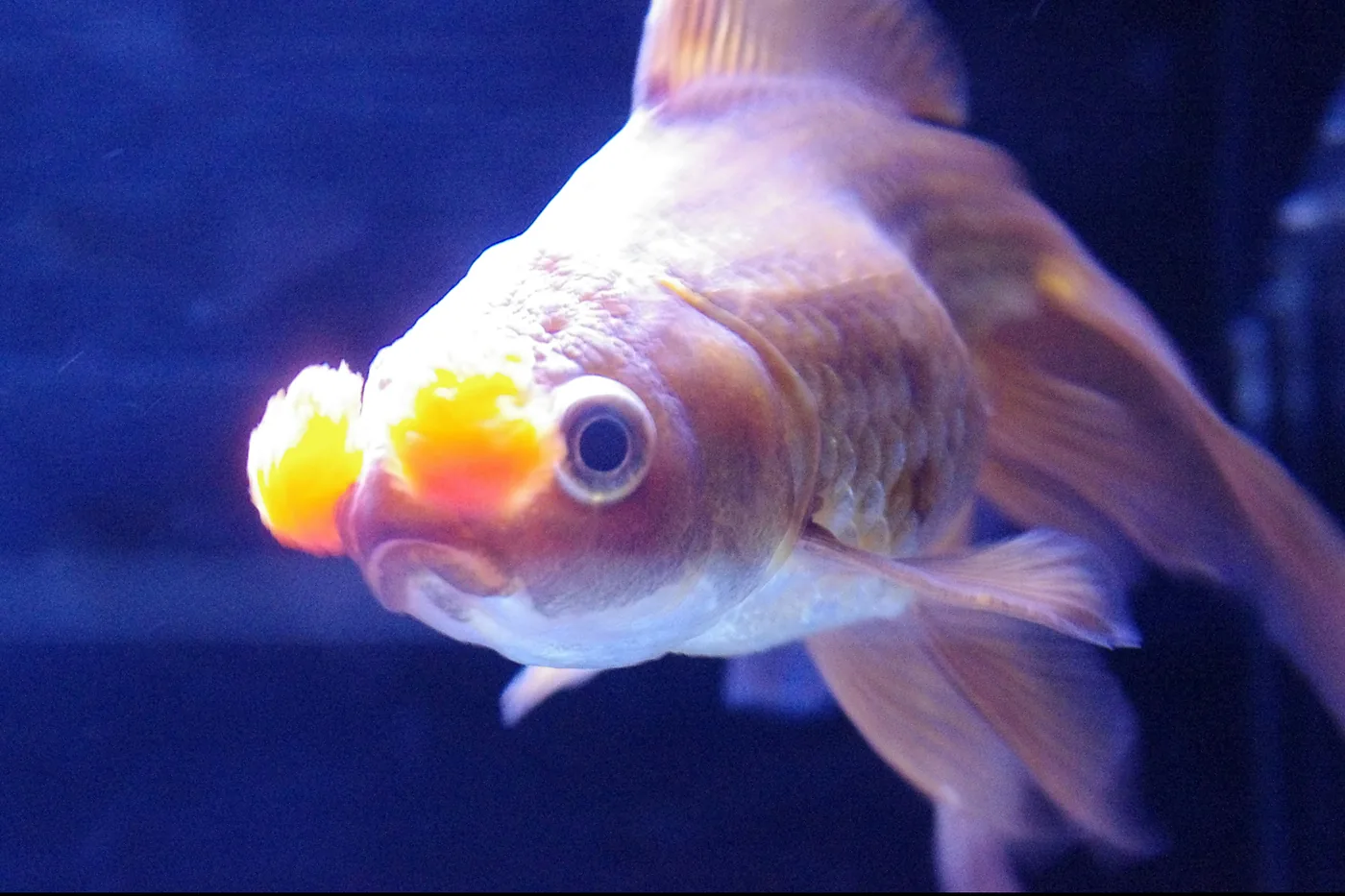
The bubble eye carries a fluid-filled sac beneath each eye that trembles with every movement and, in a mature fish, can be larger than the head it hangs from. The sacs begin to form a few months after hatching and keep growing; a matched pair is what breeders aim for.
The back is smooth, with no dorsal fin, curving from behind the head to a double tail that is usually short and stiff. The eyes point upward, which is why a bubble eye seems to be looking at the ceiling. Colours include orange, red, red-and-white, calico, chocolate and black, with the sacs a paler version of the body colour.
A celestial eye shares the finless back and the upward gaze but has no sacs; ranchus and lionheads share the back and carry a head growth instead.
Telescope, celestial or bubble eye?
-
Eyes pushed out to the sides
-
Eyes turned to the sky
-
A sac beneath each eye
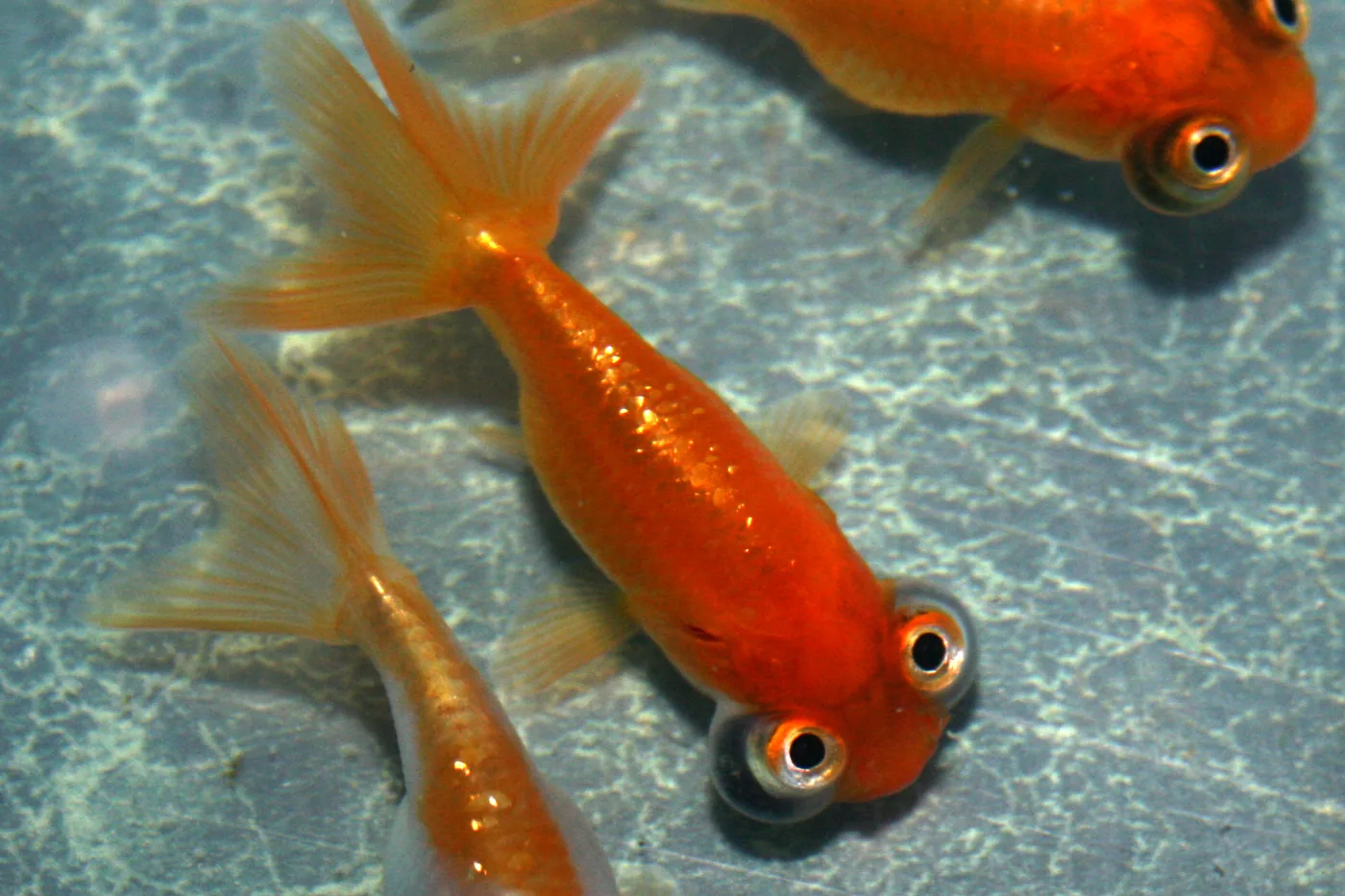
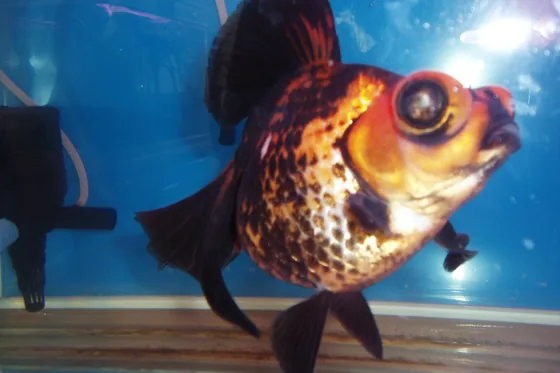
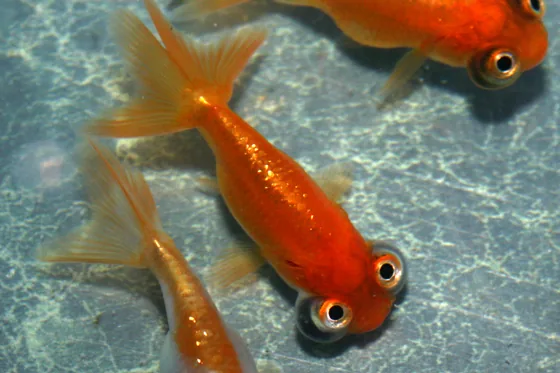
Three eye breeds side by side: a telescope with an eye projecting from the side of its head ringed, a celestial seen from above with an upturned eye ringed, and a bubble eye with the fluid sac beneath its eye ringed.
- Telescope. Eyes that project outward from the sides of the head. The black moor is the black form of the telescope (the British show standard judges it as a separate type).
- Celestial Eye. No dorsal fin in the standard, and eyes turned upward to gaze at the surface, with no sac beneath them.
- Bubble Eye. No dorsal fin in the standard, upturned eyes, and a fluid-filled sac beneath each one that trembles with every movement.
Photographs: Telescope, Fanghong, CC BY 2.5; Celestial Eye, Michelle Jo, CC BY 3.0; Bubble Eye, Lerdsuwa, CC BY-SA 4.0. Rings added.
The sacs, and what they are
The defining feature, and the one most misunderstood.
They are fluid-filled extensions of the tissue around the eye socket, not blisters and not swellings. They are part of the fish, filled with its own lymph-like fluid, and they are supposed to be there.
They grow with the fish. A fry has none. They begin to form in the first few months and keep growing, and in mature fish they can become large enough to obstruct the face. A matched pair is what breeders select for.
They do nothing useful for the animal. There is no function to point at, which is worth saying plainly.
And they wobble, visibly, as the fish swims, which is the charm of the breed and also a reminder of how little protects them.
When a sac ruptures
The thing every bubble eye keeper eventually deals with.
It is not usually a disaster, but treat it as an injury. The sac deflates, and in clean water it usually refills within weeks to a couple of months.
The real risk is infection, because a torn sac is an open wound on a fish in water. First aid for an injured goldfish covers the response, and the short version applies here with particular force: clean water does more than anything applied, and the cause must be found or it will happen again.
Find what tore it. An intake without a sponge, a sharp ornament, gravel with edges, a net. Something in that tank did it and is still in there.
And never net the fish. Submerge a container, guide the fish in with a cupped hand, and lift it out in water. This is a very important handling rule for the breed — handling and netting covers the general technique, and a bubble eye is the exception where a net is never the answer.
How it develops
Fry have ordinary eyes and no sacs; the sacs begin to form in the first few months and keep growing, and large ones may obscure the face.
So a young bubble eye looks almost ordinary, and how large the sacs will become is a property of the line. It also means the fragility increases with age rather than being constant.
The fragility is not constant, which is the part that catches people out. A young bubble eye with small sacs is a reasonably robust fish. The same fish at two years, with sacs that may be a third of its head, snags on things that were never a problem before and is slower to get out of the way of anything. A tank that was safe when you set it up is not automatically safe three years later.
The practical consequence is that the tank has to be re-checked as the fish ages rather than once at the start: intakes covered, decor blunt or removed, flow kept gentle, and tankmates reconsidered if the bubble eye is now losing every race to the food. Sacs that do tear usually refill within weeks to a couple of months, so a fish that has burst one is not necessarily marked for life.
Designing the tank
Every object in this tank is a decision, and together they are the whole of keeping one well.
- Nothing sharp, anywhere. Run a hand over every surface — aquarium decorations covers the test.
- Sponge over every intake. Non-negotiable. The filter buying guide treats the pre-filter sponge as part of the purchase.
- Very gentle flow. No dorsal fin plus two drag-inducing sacs is a notably unstable arrangement — goldfish filtration covers getting turnover without current.
- Sand or bare glass. Never gravel with edges — substrate for goldfish.
- No plastic plants, which have harder edges than they look.
- A consistent feeding spot, since vision is poor.
- Ideally a species tank, or company as slow as itself — a celestial eye or a ranchu, never a ryukin or anything single-tailed, for the reasons chasing and bullying sets out.
Choosing one
- Two intact sacs, roughly matched, clear rather than clouded.
- No scab, tear or wrinkle suggesting a rupture and refill.
- Level swimming, deliberate rather than laboured.
- Look at the shop’s tank, not just the fish. Sharp decor, an uncovered intake or a net in the water tells you what the fish has been exposed to.
- Ask them not to net it, and take a container.
- Quarantine for at least four weeks — quarantining a new goldfish.
Where you will find one. A specialist, in practice. More importantly, this is the breed to avoid buying unseen: the sacs are fragile, transport is exactly when they get damaged, and a fish that arrives with a torn sac has arrived with a problem you did not choose. Collect in person where you can, inspect both sacs under good light before money changes hands, and if you must have one shipped, buy from somewhere that will make it right.
Personality and behaviour
Bubble eyes are as gentle as goldfish come. They drift more than swim, steering with their pectoral fins, and they cannot see well: the eyes are angled upward and the sacs obscure much of what lies ahead and below. A bubble eye finds food by smell and by feeling along the bottom, and quickly learns where meals arrive.
They must be kept only with fish that are equally slow and harmless: other bubble eyes, celestial eyes, and at a stretch ranchus or lionheads. Anything faster will eat first and, in bumping past, put the sacs at risk; run any planned combination through the compatibility checker first.
Aquarium requirements
Volume follows the usual fancy rule, 100 litres (26 US gallons) for the first fish and 40 to 50 litres for each further one, but the layout is what matters. Think of it as furnishing a room for someone who cannot see and bruises easily: nothing sharp, no narrow gaps, no rough rock and no plastic plants. Sand or bare glass is the substrate, and smooth river stones and soft live plants such as anubias are the limit of safe decoration; the decorations guide and the substrate guide explain why.
The filter is a common cause of injury. An uncovered intake will draw a sac against the slots and can tear it, so every intake needs a sponge pre-filter, and the outflow must be gentle enough that the fish is never pushed. Air-driven sponge filters are the classic choice because they have no intake to guard and produce almost no current; the filtration guide covers the alternatives.
Many guides give 18 to 24 °C (64 to 75 °F) and some breed societies 15 to 20 °C; keep the water stable, with 25 to 40 percent changed weekly, and keep the substrate clean, because bubble eyes rest on the bottom. Never use a net: guide the fish into a container underwater when it needs moving.
Feeding
Sinking food only. A bubble eye that tries to feed at the surface struggles to reach it and gulps air when it does. Use a good sinking pellet made for fancy goldfish, dropped at the same spot every time so the fish can home in by smell, and consider gel food, which stays where it lands; the sinking food guide has more on why this matters.
Feed small amounts two or three times a day and watch each meal through to the end, since bubble eyes eat slowly. Blanched peas and leafy greens and occasional frozen daphnia or bloodworm add variety, and many bubble eyes learn to take food from a fingertip, which is the surest way of knowing they have eaten.
Common health considerations
Sac injuries dominate, and first aid for an injured goldfish covers what to do and, more importantly, what not to. A ruptured sac leaks fluid and collapses, and in clean water it generally heals and usually refills within weeks to a couple of months. The risk meanwhile is infection, which shows as redness, swelling or fuzz around the wound. Pristine water is the treatment that matters; anything more is a veterinary decision.
The eyes behind the sacs are exposed too, and cloudiness after a knock is common; the cloudy eyes guide explains what to look for. Without a dorsal fin the fish is less able to right itself, so buoyancy upsets look more dramatic than they are; sinking food and small meals prevent most. Resting on the bottom is normal for the breed, but sustained lethargy is not.
What goes wrong, in order
| What you see | Usually | Where to look |
|---|---|---|
| A deflated or torn sac | Something sharp, an intake, or a net | First aid |
| A cloudy or reddened sac | Infection in damaged tissue | Cloudy eyes |
| A sac that has refilled | Normal after a rupture | Cosmetic only |
| Struggling against the flow | The filter, not the fish | Goldfish filtration |
| Not finding food | Vision, and possibly competition | Chasing and bullying |
| Floating or tipping after meals | Often diet, though other causes exist | Floating upside down |
The top three rows are the same event at three stages, which is why the prevention — a tank with nothing in it that can tear a sac — matters more here than any treatment does.
Is a bubble eye right for you?
It suits you if you have kept fancy goldfish for years, you will build a tank around the fish rather than furnishing it first, you will never reach for a net, and you are content with a species tank or a very slow group.
It does not suit you if you want to keep it with anything quicker, if the tank already has ornaments you like, or if this is not your third or fourth goldfish. Few goldfish ask more of a keeper.
And the welfare argument lands hard on it. A bubble eye carries no dorsal fin, poor vision, weak swimming and two fragile sacs that do nothing for it. Goldfish welfare sets out the framework; applied here, the fair conclusion is that the breeding is difficult to defend and the individual fish still deserves the best tank you can build. Those two things are not in conflict.
History and origin
The bubble eye is among the youngest classic Chinese breeds. Fish with fluid sacs beneath the eyes were being bred in China in the early twentieth century, one account giving 1908, apparently from dorsal-less, upward-eyed stock with tiny sacs, and the type was fixed within a few decades. Its Chinese name means water-bubble eye, carried into Japanese as suihogan when the fish reached Japan in 1958.
Outside Asia it arrived late and was long confined to specialist keepers, and experienced keepers regard a bubble eye that lives a long life with both sacs intact as an achievement.
Before you bring one home
- The sacs rupture on anything sharp, on filter intakes and in nets; a burst sac usually refills within weeks to a couple of months, but the wound can become infected
- Never net a bubble eye; guide it into a container underwater instead
- Filter intakes must be covered with sponge and the outflow kept very gentle
- Very weak swimmer with poor vision; it cannot compete with faster fish and needs food it can find by smell
- No dorsal fin means poor stability; it tires quickly in any current
Suitable companions
Round-bodied goldfish should live with fish of similar speed. These breeds share the same pace, water and food.
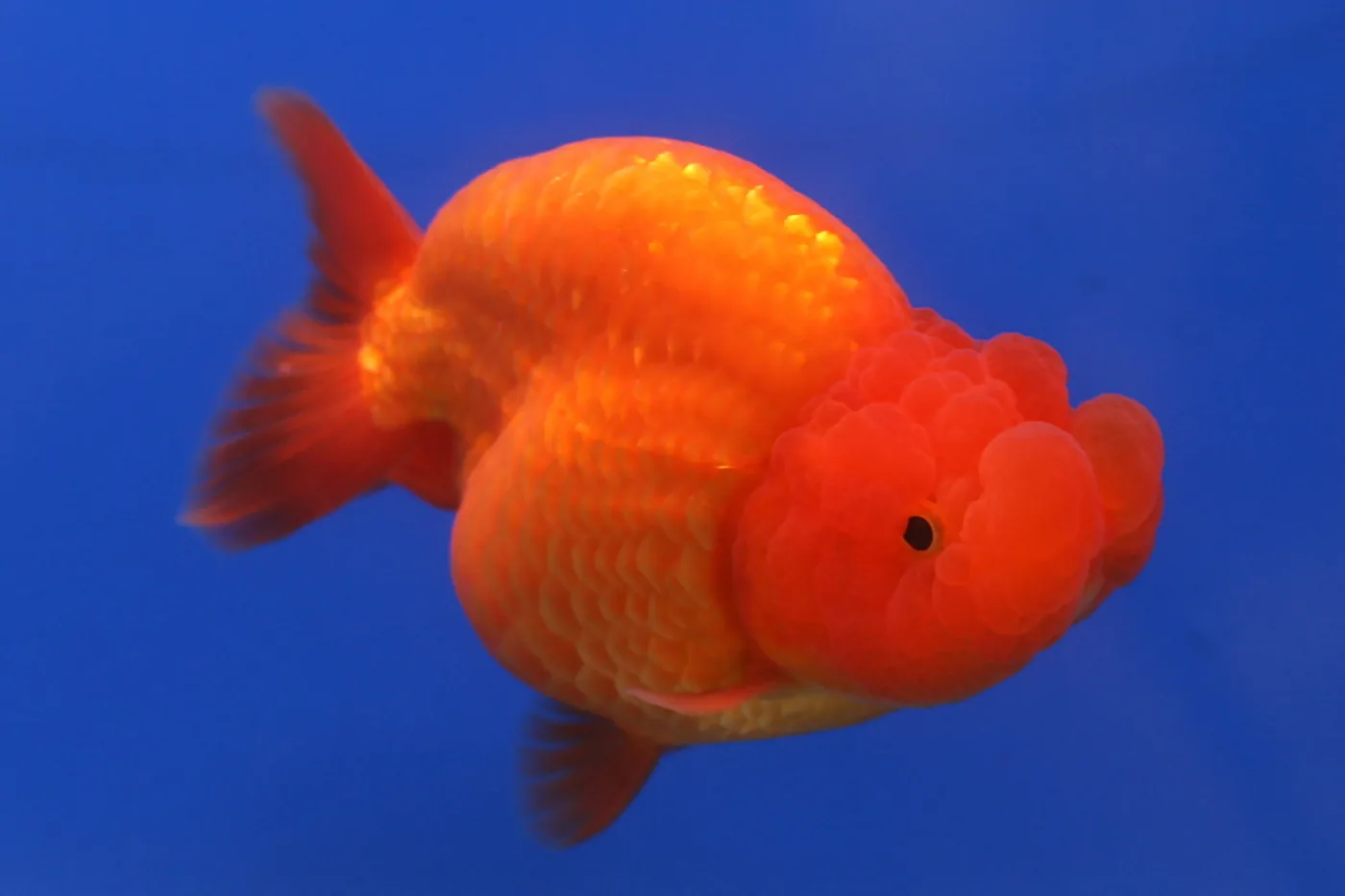
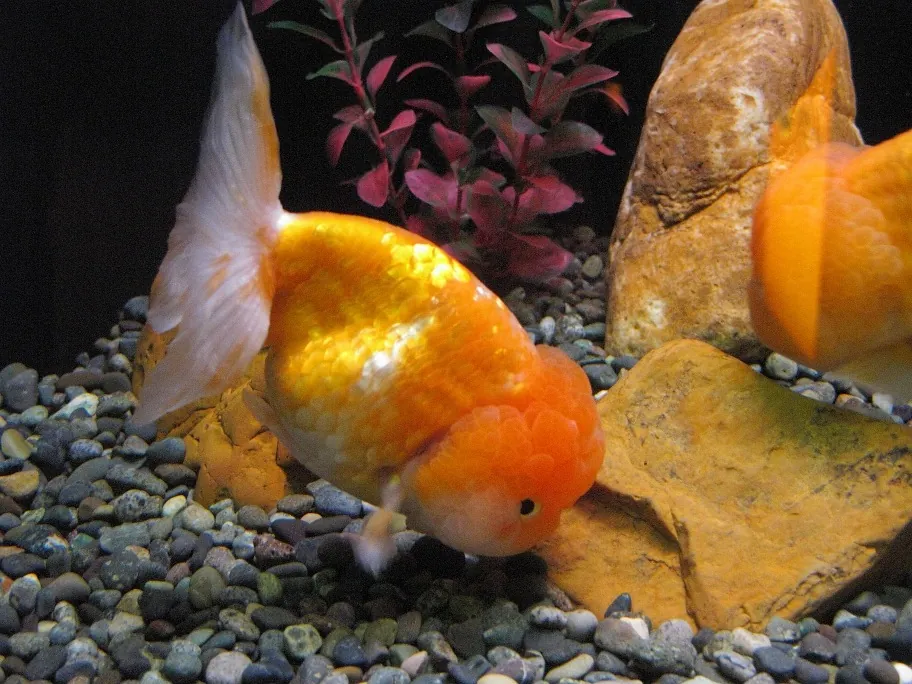
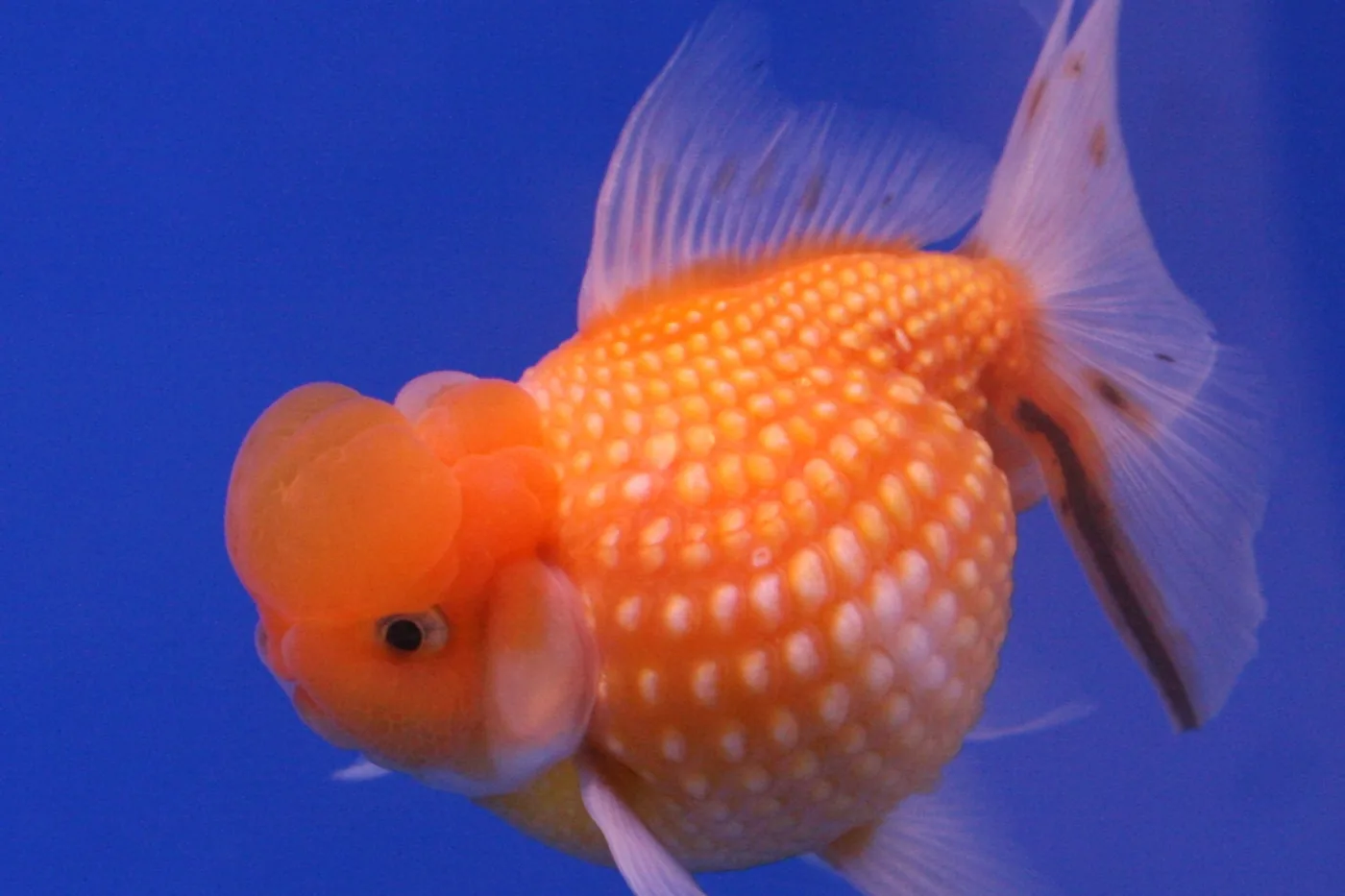
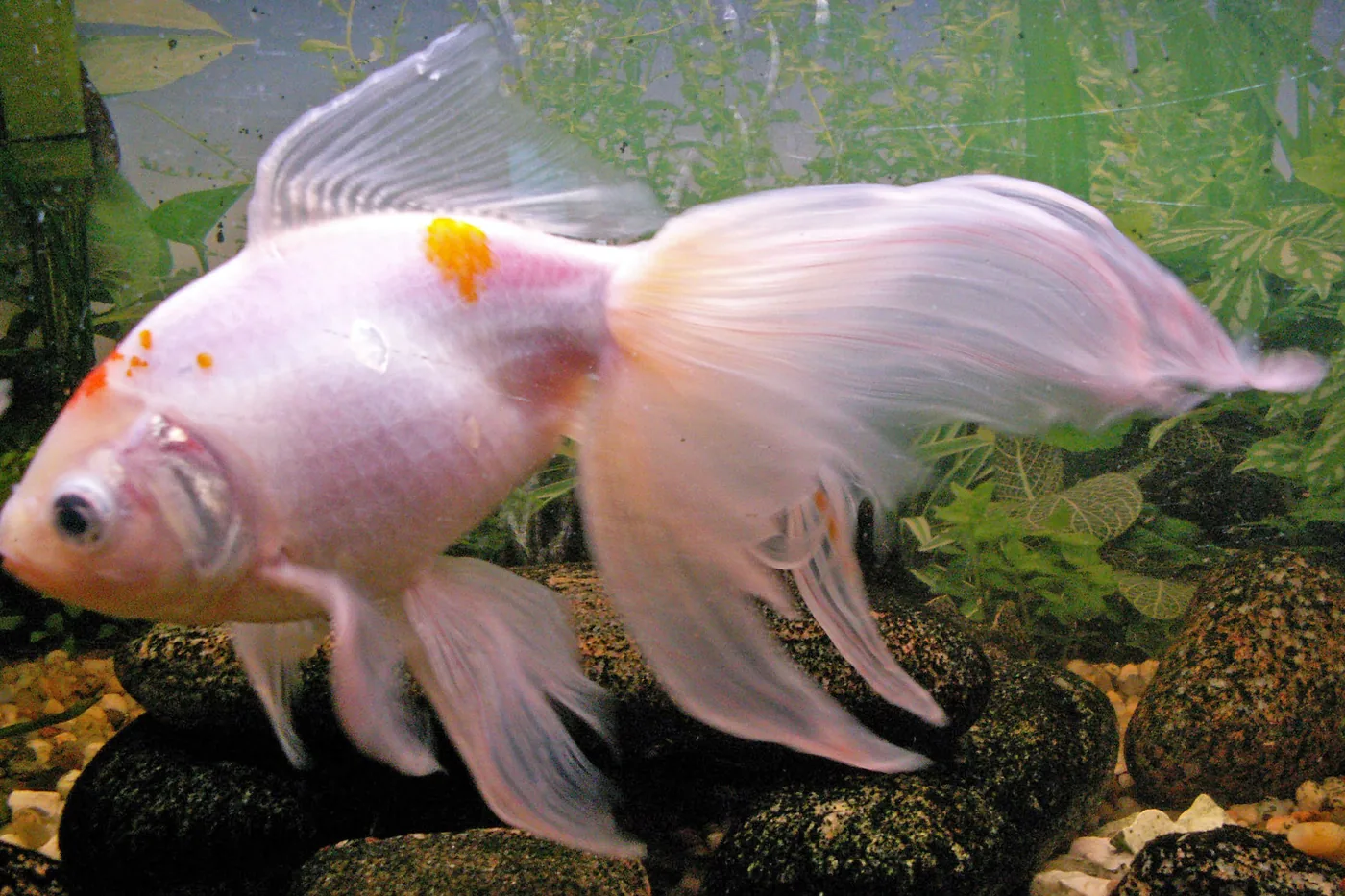
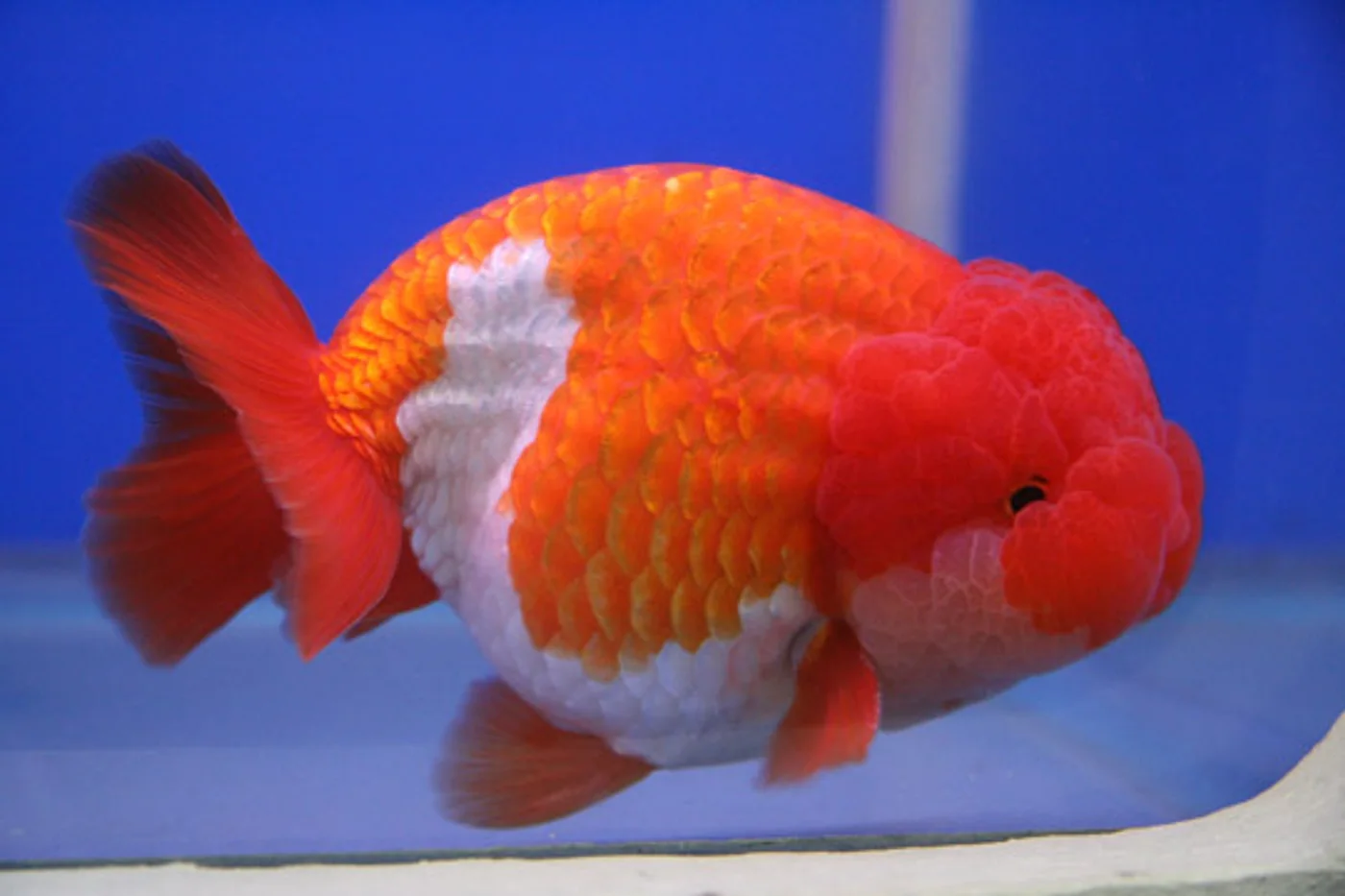
Best kept apart from: Common Goldfish, Comet, Shubunkin, Ryukin, Fantail, Oranda, Telescope, Black Moor, Jikin, Tamasaba, Wakin. Speed and appetite differences leave the slower fish underfed.
Thinking about other species? Try the compatibility checker.
Similar breeds
The breeds most like the bubble eye — the celestial eye, ranchu and lionhead — are all pictured above among its companions.
Frequently asked questions
What happens if a bubble eye's sac pops?
The fluid drains and the sac collapses. In clean water it usually heals and refills within weeks to a couple of months. The danger is infection through the open skin, so keep the water pristine, remove whatever caused the injury, and watch for redness or fuzzy growth. Never puncture a sac deliberately.
Can bubble eye goldfish see?
Poorly. The eyes point upward and the sacs block much of the view ahead and below, so a bubble eye finds food by smell and by feeling along the bottom. Feed sinking food in the same spot each time and watch that it eats; many keepers hand-feed to be certain. It will still react to shadows and movement above the tank.
Which fish can live with a bubble eye?
Only fish that are as slow and as gentle as it is, meaning other bubble eyes, celestial eyes and, with some caution, ranchus or lionheads. Anything with a dorsal fin is faster, and single-tailed goldfish should never share the tank. Even peaceful fish bumping past can tear a sac, so a species-only tank is the safest choice.
What should I look for when buying a bubble eye?
Two intact sacs of roughly matching size, clear rather than clouded, with no scab, tear or wrinkle suggesting one has ruptured and refilled. Then a fish that holds level and moves deliberately without listing, and eyes that look clean above the sacs. Watch it feed if the shop will let you. And look hard at the tank it is in — sharp decor, an uncovered intake or a net hanging in the water are all reasons the fish in front of you may be damaged by the time you get home.
How do I move a bubble eye without hurting it?
Never with a net. Submerge a jar, a bag or a small container, guide the fish into it with a cupped hand or the container itself, and lift the whole thing out with the fish in water the entire time. A net tears sacs — the mesh catches, the fish struggles, and the damage is done in a second. This is a very important handling rule for the breed, and it applies to every move, including a routine transfer between tanks.
Is it cruel to keep a bubble eye?
It is the sharpest version of a question this site takes seriously. A bubble eye is one of the most extreme goldfish: no dorsal fin, poor vision, weak swimming and two fragile fluid-filled sacs that serve no purpose for the animal. The Universities Federation for Animal Welfare's species page describes partial blindness, extra drag and energy cost, and a lifespan about half that of other goldfish. Kept properly — a smooth species tank, gentle flow, sinking food in a consistent place, no faster company — it can live well within those limits. Kept as an ordinary goldfish it does not. The fair position is that the breeding is hard to defend and the individual fish in front of you still deserves the best tank you can give it.
Do bubble eyes need a filter?
Yes. Goldfish produce far too much waste for an unfiltered tank. The difference with a bubble eye is how the filter is set up. Every intake must be covered with a sponge so the sacs cannot be drawn against the slots, and the outflow must be gentle. Air-driven sponge filters are the classic choice because they have no exposed intake and almost no current.