No. 19Described in 1917, then lost
Meteor
A goldfish defined by a missing tail, known now from one 1917 drawing.
Also known as Tailless goldfish · Tailless meteor
- Specimen
- Fancy goldfish, Philadelphia
- Adult size
- Not recorded
- Lifespan
- Not recorded
- Water
- Not recorded
- Care
- Not recorded
- Swimming
- Not recorded
- First fish needs
- 100 litres
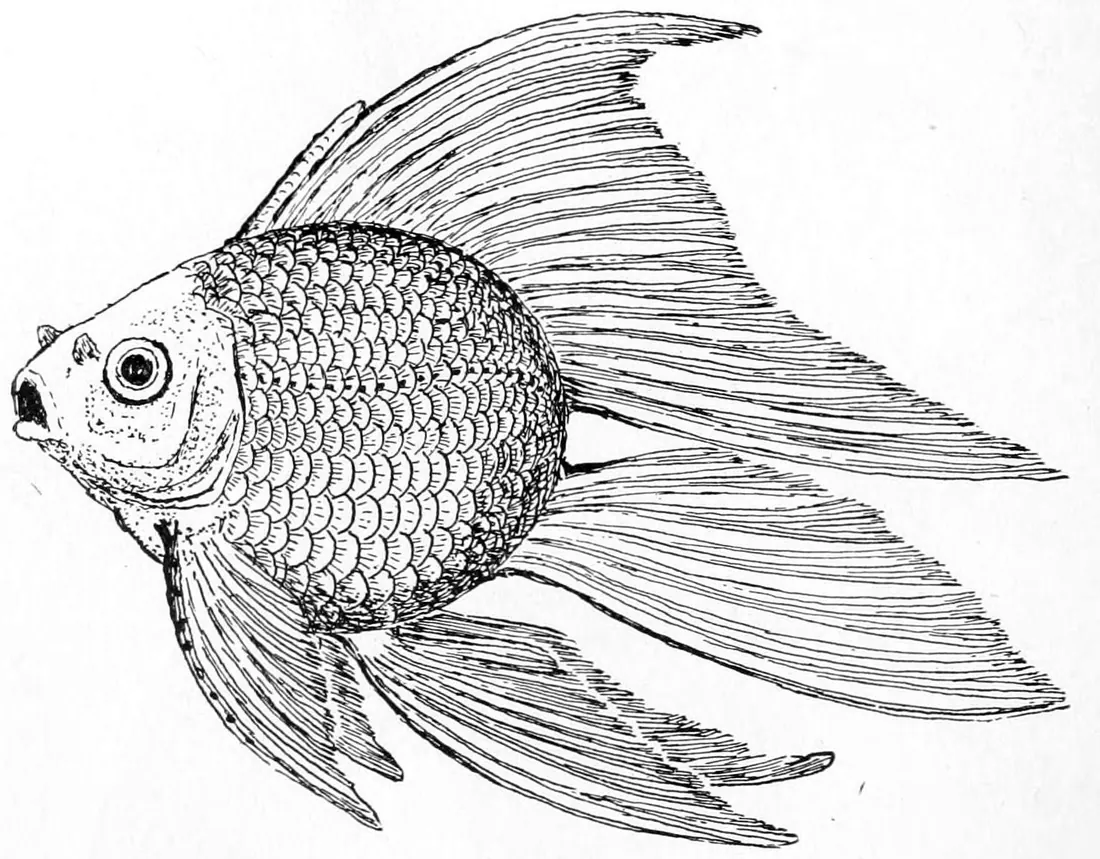
Fig. 23, The Meteor. Original drawing from life, in W. T. Innes, Goldfish Varieties and Tropical Aquarium Fishes (Philadelphia, 1917), p. 38. Plate: Franklin Barrett — Public domain · Wikimedia Commons
About these figures No source records a size, lifespan, water range or care rating for the meteor, so none is shown. First fish needs is a middle figure for one fish, from advice that runs from 50 litres to about 300; tank size sets that out.
The specimen
Quick facts
- Classification
- Fancy goldfish
- Body type
- A deep, rounded fancy body ending at the peduncle with no caudal fin whatever, the dorsal and lower fins drawn long and trailing behind it
- Tail and dorsal
- No caudal fin at all, dorsal fin present
- Swimming ability
- Not recorded
- Keeper experience
- Not recorded
- Temperament
- Unrecorded beyond a single remark that the fish swam better than onlookers expected
- Adult size
- Not recorded
- Temperature
- Not recorded
- Minimum aquarium
- 100 L (26 US gal) for one fish
- Origin
- Described in Philadelphia in 1917; who bred it, and where, is not recorded, Fixed by selective breeding shortly before 1917
How to recognise one
- No caudal fin at all - the body ends at the peduncle, and nothing follows it
- The other fins described as well developed, and drawn long and trailing behind the body
- A deep, rounded, heavily scaled body in the one drawing
- A single anal fin, which the 1917 text notes, where a twin-tailed fancy normally carries a paired one
- Known only from one 1917 paragraph and one drawing made from a living fish
- No verified population is known to exist today
Most breeds in this atlas are described by what they have: a hood, a pair of sacs, a doubled tail, a hump behind the head. The meteor is described by a missing tail. Its body stops at the peduncle, and where the tail should begin there is nothing at all.
It is also a breed that cannot be photographed, kept or bought, because no verified population of meteor goldfish is known to exist. What survives is a short passage of text, a sentence about how it swam, and one drawing, made from a living fish and published in Philadelphia in 1917. Where the record is silent this page says so rather than filling the gap, and where later writers added something it says that too.
What the record actually shows
The meteor enters the literature in William T. Innes’s Goldfish Varieties and Tropical Aquarium Fishes, published in Philadelphia in 1917, under the heading The Meteor, or Tailless Goldfish. The entry is one paragraph long. It is worth quoting most of it, because it is close to the whole of what is known:
In breeding for long-tailed fishes a strange perversion sometimes occurs in the form of a tailless fish, the other fins being well developed. The anal is single. Some of these have recently been bred together, and by a few generations of selective breeding the type has become quite well fixed. At first regarded as a mere freak, the Meteor has been accorded a place in a number of competitive exhibitions.
Four things come out of that paragraph, and each is worth separating from the others.
The mutation arose inside stock bred for long tails, not from anywhere exotic. It was initially dismissed as a freak. It was then deliberately bred, over a few generations, until it came true reliably enough for Innes to call the type quite well fixed. And it was shown: the fish had been given a place in a number of competitive exhibitions, although Innes says nothing about what a judge looked for.
One detail in that passage is easy to skim past and shouldn’t be. The anal is single. A twin-tailed fancy goldfish normally carries a paired anal fin, doubled in the same way its caudal is. Innes writes of stock bred for long-tailed fishes, which may mean twin-tailed fancies, though he does not say; if it does, a single anal fin is a note on how this fish differed from its parents. It is the kind of observation that only someone handling the fish would make.
The drawing
The illustration at the top of this page is the entire visual record of the breed this site knows of. It is figure 23 from the 1917 edition, and the book’s own list of illustrations credits it as an original drawing from life by Franklin Barrett, an aquarist of the Philadelphia circle who is credited elsewhere with developing the veiltail.
Drawn from life matters here. It means Barrett had a meteor in front of him, and what the drawing shows is a particular animal rather than an idea of one.
What it shows is a deep, rounded, heavily scaled body of the kind every long-finned fancy is built on, ending abruptly. Behind it there is no caudal fin — not a short one, not a stump, nothing. The dorsal fin is drawn long and swept backwards, and the lower fins long and trailing, reaching back into the water the tail would have occupied. The overall effect is of a round fish towing a bundle of streamers, which may be where the name came from; Innes does not say.
Innes set out his purpose for the illustrations in the preface of the same book, and the sentence has aged strangely well:
The illustrations used are, in nearly all cases, either drawn or photographed from life, thus establishing records which should be of value for present or future reference.
He was making a general claim about documentary standards. For this one variety it turned out to be close to literally true: the record he established is very nearly the only one there is.
How a tailless fish could arise
Innes’s account of the origin is short and unmysterious: the tailless fish turned up in breeding for long-tailed fishes, and some were put together. That is the whole of the process, and it is the same one by which every goldfish variety is made: an oddity appears in a spawn, a breeder notices it, and the oddity is bred until it comes true.
The genetics of this particular oddity has never been studied, and nothing on this page should be read as a mechanism. For comparison, the twin tail every fancy carries is now known to be one recessive mutation in a single gene, and the loss of the dorsal fin involves several loci. What distinguishes the meteor from the hundreds of malformed fry that must have been culled over the same decades is only that somebody kept the tailless ones and bred them together. A ranchu exists because breeders did the same thing with a missing dorsal fin. The difference is that the one study that measured the cost found dorsal-less goldfish swim almost as efficiently as finned ones, though they roll and yaw more, whereas nobody has measured what losing the tail would cost.
How it swam
There is exactly one contemporary observation, and it is a single sentence:
A specimen such as illustrated can swim better than would be imagined, and makes quite a streaming effect passing through the water.
The phrasing reads as mild surprise: better than would be imagined is what you write when the expectation was that the fish would barely manage, and the streaming effect describes how it looked rather than how it moved. A later source, as summarised on Wikipedia, calls the fish a competent swimmer, which fits.
Anatomy fills in a little. In most fish the tail supplies the bulk of the forward thrust, while the pectoral fins do most of the braking and steering and the median fins steady the body. A meteor had lost the engine and kept much of the controls, and long dorsal and anal fins may have added some propulsion of their own. How much it mattered is not recorded, and any claim that the fish was slow, poor at turning or unable to hold station in a current is inference rather than observation.
This is also why this page leaves the swimming rating, the care rating and the keeper-experience rating blank. Those are measurements and judgements about living fish, and nobody has made them for this one.
What later writers added
Innes says nothing about the meteor being weak. That idea appears later, in books that repeat the name without documenting any living fish. A 1965 handbook lists the fish as not hardy, and a later account, as summarised on Wikipedia, says it can be very weak and sickens easily at low temperatures.
Neither is a record of how the fish did when it was kept. They are summaries passed from book to book, and a modern reference work from the Bristol Aquarists’ Society wonders whether the meteor was ever more than a self-perpetuating rumour. The 1917 entry is the only first-hand document, and it is a paragraph about a fish that was bred, fixed and shown.
It is worth being clear about what is guesswork. A variety fixed from a handful of related fish, bred together for a few generations, can carry whatever else those fish carried, and a fish with no tail may have struggled to compete for food or to keep clear of harassment. Both are reasonable inferences from how goldfish varieties are made and how fish swim. Neither is recorded, and the second would matter in a tank because a fish that sits on the substrate is a fish at risk of ulcers and of the other problems on the sitting on the bottom page.
What keeping one would have meant
This section is reconstruction by analogy and should be read as one. No modern keeper has had the chance to test any of it, and the figure of 100 litres in the quick facts is borrowed from the floor this site sets for the weak-swimming fancies, not measured on a meteor.
If the fish was as poor a swimmer as its missing tail suggests, it would have wanted what the weakest fancies want now: still water, filtration baffled to a gentle flow, and room it does not have to cross quickly. A deep-bodied fancy already has a folded gut and a tendency to take in air at the surface, which is one route to buoyancy trouble, and a fish that cannot manoeuvre would lose every race to the food, so soaked or sinking food delivered where it could reach it without chasing would be the sensible approach.
Tankmates are the one question with a clean answer by that logic: none that swim faster. There is no goldfish on this site slow enough to be a fair companion for a fish with no tail, and the compatibility rules that keep a celestial eye safe would not have been sufficient here. A meteor would have had to be kept alone or with its own kind, if the analogy holds.
What happened to it
The sequence is legible even though the details are not recorded. It was found, as an accident inside long-tailed stock. It was fixed, by breeding the accidents together until the trait came true. It was shown at exhibitions. And then the record goes quiet.
The entry is missing from later editions of Innes’s own book, the 1921 and the fifteenth, according to a search of the digitised texts. The name recurs in handbooks from 1965 onward and in several later reference books, none of which documents living stock. A New York Zoological Society bulletin of about 1920–21 lists tailless goldfish among the rarer fish occasionally imported from the Orient, which sits oddly with an American origin and shows how thin the evidence on where the fish came from really is. In 2024 an online post claimed a rediscovered meteor, and a magazine report on it treated the claim as unverified.
No source gives a reason or an end date. Varieties do vanish when nobody continues them, and a record that says only that a fish was fixed, shown and then absent from later editions cannot say more than that.
Can you buy one?
No, and the answer is worth being firm about.
No verified breeding population of meteor goldfish is known to exist. Whether tailless fry still appear in spawnings of long-tailed fish, as Innes described, is not documented; an individual tailless fry would not be the breed in any case, only the raw material it was once made from.
If you see a goldfish sold as a meteor, the overwhelmingly likely explanations are a mislabelled fancy, or a fish that has lost its caudal fin to damage or disease. The second case is the one to watch for, because it means buying an injured animal at a premium. Everything in choosing and bringing home a goldfish applies with extra force to any fish sold as a rarity.
Is the meteor right for you?
The answer is that the question cannot arise, and that is the point of including the breed at all.
The meteor belongs on this site the way a specimen belongs in a cabinet. It is a case worth knowing: a trait that one generation of breeders fixed and exhibited, and that did not last. It is worth holding in mind when weighing up a bubble eye or a celestial eye, because those breeds also ask how much a fish can lose and still be kept well.
If what draws you to it is the history, that history is readable: Innes’s book has been scanned and is freely available, and Barrett’s drawing is on the page above.
History and origin
The meteor was described in Philadelphia in 1917 by William T. Innes, who was secretary and later president of the Aquarium Society of Philadelphia, with a drawing by Franklin Barrett, who is credited elsewhere with the veiltail. Innes names no country, breeder or aquarium for the fish itself, so calling it an American breed is an inference from where the book was published, and the New York bulletin mentioned above points the other way.
By 1917 the variety was, in Innes’s words, quite well fixed, and it had been given a place in a number of competitive exhibitions, which is enough to have earned it a heading of its own in a general reference work. After that the trail is a name repeated in later books and nothing else.
What remains is a paragraph, a sentence about how it swam, and figure 23. For a breed that was defined by an absence, there is something fitting about that being the whole of it.
Before you bring one home
- The breed is not obtainable. Nothing described here is a shopping list, and anything sold under the name is something else
- Later writers call the fish weak and prone to illness in cool water; no source records why the variety vanished
- A goldfish with no caudal fin has lost the fin that supplies most of its thrust, so any keeping advice here is reconstruction by analogy, not experience
- Whether tailless individuals still turn up in spawnings is not documented, and a 2024 online claim of a rediscovered meteor was never verified
Suitable companions
Round-bodied goldfish should live with fish of similar speed. These breeds share the same pace, water and food.
Thinking about other species? Try the compatibility checker.
Similar breeds
Frequently asked questions
Can I buy a meteor goldfish?
No. There is no verified population anywhere, and although the name is repeated in goldfish books from the 1960s on, none of them documents living stock. A fish offered for sale under the name will be something else - most often a fancy goldfish that has lost its tail to injury or to fin rot, which looks superficially similar and is a welfare problem rather than a rarity.
What did the meteor actually look like?
A deep-bodied fancy goldfish whose body simply stops at the peduncle, with no caudal fin behind it. One drawing survives, made from a living fish by Franklin Barrett for the 1917 edition of Innes; it shows a deep, scaled body with a long dorsal fin and long lower fins trailing behind. It is the only depiction of the breed this site knows to have been made from a living fish.
Is a tailless goldfish the same as a meteor?
Not by itself. Innes describes the tailless fish appearing as what he calls a perversion in breeding for long-tailed fishes, and says some were then bred together until the type had become quite well fixed. A single tailless fish today is far more likely to be an injured or diseased fancy than a descendant of that line, and it is a different thing from the breed.
Could a goldfish really swim without a tail?
The one contemporary remark says a specimen could swim better than would be imagined, and later writers call it a competent swimmer, so it did swim. How well is not recorded. In most fish the tail supplies the bulk of the thrust while the pectoral fins do most of the braking and steering, so a meteor lost its engine and kept much of its controls; nobody measured how it coped, and an enlarged dorsal or anal fin may have helped.
Why did the breed disappear?
No source records why. Later writers call the fish weak and prone to illness in cool water, and one modern reference work wonders whether the meteor survives now only as a self-perpetuating rumour. Innes himself does not mention weakness, and the entry is missing from his later editions, but a variety that stops being bred leaves no notice when it ends.
Is the meteor likely to be recreated?
Whether tailless fry still turn up in spawnings is not documented, so there may be nothing to start from. In principle a determined breeder could begin again from a tailless fry, as the original breeders did, but the later accounts of the fish as weak, and the loss of the fin it would swim with, make it a doubtful project, and nobody has shown it can be done.
Why is there no photograph of a meteor?
Photography existed in 1917, and Innes used photographs elsewhere in the same book. For this variety he ran a drawing credited as original, drawn from life, and no photograph of a verified meteor has surfaced since. Whether none was taken or none survived is not recoverable, so the visual evidence for a whole goldfish breed is one page of pen-and-ink work.