01 Care guide
How to breed goldfish on purpose
A spawn is easy to cause and hard to finish. This is the part between deciding to breed and having fish worth keeping — conditioning, the spawning tank, the eggs, and the year after the eggs that nobody warns you about.
Goldfish are easy to spawn and difficult to breed, and the distance between those two statements is most of this page.
Causing a spawn takes two mature fish and a trigger, traditionally a cool winter followed by a warm spring. Ending up with a handful of goldfish you would be proud to have made takes a year, a great deal of water, and a series of decisions that most people meet for the first time with hundreds of fry already swimming.
Is my goldfish breeding? covers the spawn you did not plan — what it looks like, how to protect the female, and why letting the adults eat the eggs is a reasonable outcome. This page is the other half: the project you chose.
Before you decide
The arithmetic is on the other page and it is worth reading first. What follows is what the arithmetic means in floor space and time.
A mature female can release thousands of eggs, commonly 2,000 to 4,000, in batches a week or two apart. Many are infertile or eaten, but fry that survive their first month are goldfish, and goldfish reach 15 to 20 cm as fancies and 25 to 35 as single-tails. Fancies commonly live 7 to 10 years or more, and single-tails often longer.
The space requirement climbs, and it climbs early. Fry can be crowded for the first weeks and cannot be crowded after that; growth stalls, deformities appear, and the water becomes impossible to hold. By three months you need real volume, and by six you need the kind of space set out in how many goldfish you can keep — which is the page that makes the number concrete rather than theoretical.
The homes question has no good answer at scale. Shops rarely take fish. Rehoming a hundred goldfish is much harder than it sounds. Releasing them into a pond, stream or lake is ecologically destructive and illegal in many places; goldfish have spread through stocking, bait and pond escapes as well as aquarium release, and a released fish adds to that.
The time commitment is a year, not a season. Several feeds a day for the first weeks, water changes on a scale you are not currently doing, and grading sessions as the fry grow. The interesting part — seeing what you made — arrives last.
What you are breeding for
A common reason a deliberate spawn disappoints is that nobody decided what it was for.
“Two pretty fish” is not a plan. Some goldfish traits are single recessive genes, the twin tail and telescope eyes among them, but most of the ones people admire, wen, body depth and the bubble eye’s sacs for a start, have not been mapped and vary widely. A pair of good-looking fish with no shared background will throw a spawn that spreads widely around them, and the interesting ones will be accidents you cannot repeat.
Breeders work with a line, which is a group of related fish selected over generations for the same small set of traits. That is why serious stock comes from a breeder rather than a shop, and why the answer to “where do I get good fish” is usually a club, a society, or someone’s waiting list. Choosing and bringing home a goldfish covers assessing an individual fish; assessing a line means looking at its parents and its siblings.
Pick two or three traits and ignore the rest. Body shape and finnage are judged first, because colour patterns, though inherited (some by one or two genes), show late. Wen growth, back curve, tail spread and caudal peduncle strength are the sort of thing a line is built on.
Do not cross breeds hoping for the best of both. Every goldfish is Carassius auratus and they interbreed freely, which is exactly the problem: a fancy crossed with a single-tail gives single-tailed fry, because the twin tail is recessive, with the other traits scattered unpredictably. The named varieties exist because somebody spent generations removing that variation, and the domesticated goldfish is the history of how much work that took.
Conditioning: the winter before the spring
A cool winter followed by a warming spring is the natural cycle and the traditional preparation. A fish held at a constant twenty degrees with the same light and food every day gets none of that, but it is not hopeless: fish kept at 15 to 20 °C on long days can mature without a winter, and a temperature rise, planted media or a water change can each trigger ovulation, the release of ripe eggs.
Give them a cool period first if you can. Several weeks in the low teens Celsius is the usual advice, and a pond or an unheated room does it naturally. Goldfish water temperature sets out the safe ranges, and feeding through the seasons covers what to feed — which in cool water is less, and easier.
Then raise it steadily. A few degrees over a week or two, not overnight. The rise is the signal; a jump is a shock, and it lands on fish whose immune systems are still slow from the cold.
Lengthen the light with it, either by extending the aquarium photoperiod or simply by letting a pond follow the season.
And feed richer as the water warms. This is the one time in a goldfish’s year when generous feeding is the right instruction rather than the wrong one: females are producing eggs, which is expensive, and conditioning food is protein-heavy for that reason. Live and frozen foods do this better than dry.
Condition the sexes separately if you can. Two or three weeks apart makes the reintroduction itself part of the trigger, and it spares the female the chasing until you are ready for it. Telling them apart is easiest in exactly this state, and sexing goldfish covers the three signs that work.
Where the difference shows
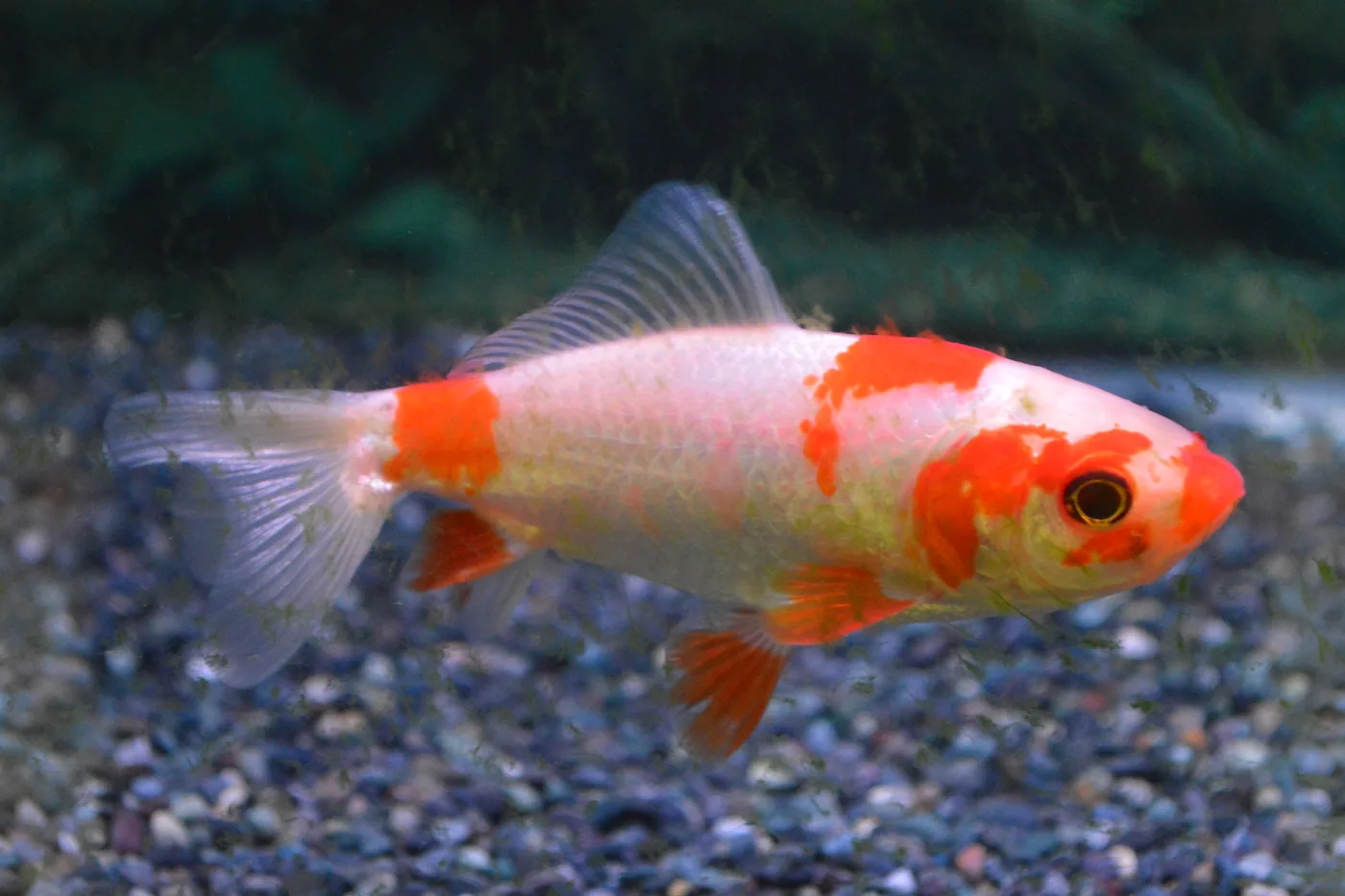
Photograph: Yatokin, CC BY-SA 4.0 · Wikimedia Commons. Numbers and lines added.
- Gill covers. Small, hard, white tubercles: the clearest external sign of a male in breeding condition, when it is there.
- Pectoral fins. The same tubercles, in a row along the leading ray. Together with the gill covers, a neat pattern on a well fish usually means a male, not white spot.
- Vent. Just in front of the anal fin. In condition, a male’s is small, narrow and slightly concave, a female’s rounder and slightly protruding.
- Belly. Not a reliable sign. A full outline can be eggs in condition; out of season it can be a well-fed fish, but fluid and illness swell the belly too, so a swollen fish with raised scales or lethargy needs a vet.
Use fish that are actually ready. Goldfish mature at one to two years. Spawning a fish in its first year, or a female who has already spawned twice that season, is how you get thin, exhausted animals and poor eggs.
The spawning tank
You can watch a spawn in a community tank. You cannot run one there.
Bare bottom, and shallow. Twenty-five to thirty-five centimetres of water is plenty. A bare floor lets you see and remove what is happening; substrate swallows eggs and rots the ones it keeps.
Mature, gentle filtration. A sponge filter on an air pump, moved across from an established tank so it arrives already colonised. Nothing with an intake that can take eggs or, later, fry — aeration and oxygen covers why the sponge is the right answer here as well as in a hospital tank.
Media you can lift out whole. This is the point of the exercise. Goldfish are egg scatterers and their eggs are adhesive, so they stick to the first thing they touch. Give them something you can pick up:
- Spawning mops — bundles of acrylic yarn tied at one end, floating or weighted. Cheap, washable, and the standard answer.
- Dense plants, real or artificial. Hornwort and similar are traditional, and plants for goldfish tanks covers which survive the fish.
- Spawning brushes or ropes, if you prefer something that holds its shape.
Put the media where the fish will drive into it — along one end, or as a floating raft across a corner. Spawning is a chase, and the eggs go wherever the chase ends.
Match the water to what they are already in. Same temperature, same source, same parameters. A spawning tank is not the place to change anything, and testing goldfish water is worth running before the fish go in rather than after.
Triggering the spawn
With conditioned fish and a tank ready, the last step is short.
- Move the fish in the evening, gently — netting a fish full of eggs deserves the care set out in handling and moving a goldfish.
- Use a sensible ratio. Two or three males to one female is common practice, and it helps fertilisation rather than the female. One male can spawn a female; the more males there are, the harder the night is for her.
- Give them a trigger. A large water change, a few degrees of warming or fresh planting can each set off ovulation. Keep any change in temperature gentle, not a shock.
- Then leave them alone. Spawning usually follows in the dark or early morning and runs for several hours: the males drive the female into the media, she releases in bursts, they release milt over the eggs.
- Remove the adults when it stops, or remove the media. Either way it happens as soon as the spawn ends, because goldfish eat eggs enthusiastically and will clear a spawn within hours.
If nothing happens, check that the fish are mature and in condition, and that they had a clear trigger: a steady rise in temperature, fresh planting or a large water change. Wait a fortnight and repeat the ramp rather than raising the temperature further.
Hand spawning, and why most people should not
Hand stripping — holding the fish and expressing eggs and milt directly — is a real technique used in koi and goldfish breeding when a specific cross matters and natural spawning is unreliable.
It is also a procedure that damages fish in inexperienced hands: internal injury from pressure, scale and slime-coat loss, and a female stripped before she is genuinely ripe. It requires a fish that is fully conditioned, a firm and brief handling technique learned from someone who does it, and a reason better than curiosity.
For almost everyone reading this, the natural spawn is the right method. It works, it costs the fish less, and the fertilisation rate from a healthy natural spawn is perfectly adequate.
The eggs
Fertile goldfish eggs are small, round and clear to faintly amber, stuck fast to whatever they landed on. Within a day the infertile ones turn opaque white and start to fungus.
Move the media, not the eggs. Lift the mop or plant clump straight into a prepared tank of the same water at the same temperature. Trying to detach individual eggs damages them.
Expect to lose the infertile ones, and remove them as they whiten, because the fungus on a dead egg spreads to the live ones touching it. A pipette or a turkey baster does this without disturbing the rest.
Keep gentle water movement across the clutch. An air stone positioned near but not on the eggs is the traditional arrangement. Still water over a clutch is how a whole spawn is lost.
On antifungals: methylene blue in the egg water is the long-established approach and it works, but it also stains everything and will knock back a filter’s bacteria, so it belongs in a bare container rather than in a cycled tank. Removing dead eggs promptly and keeping the water moving achieves most of the same result. If you do use anything, the cautions in using medications safely apply to eggs as much as to fish.
Do not tidy. No cleaning, no gravel, no starting a fresh filter, no handling. Eggs need to be left alone.
Hatching, by temperature
| Water temperature | Eggs hatch in | Notes |
|---|---|---|
| 15–17 °C | About a week, sometimes more | Slow, and hatch rates are poorer in cooler water |
| 18–20 °C | Four to five days | The usual working range |
| 21–24 °C | Three to four days | Hatch rates were best here; fungus moves fast too |
Warmer is not better past a point. 28 °C and above gave poor eggs or deformed larvae. Hold whatever you choose steady, within a degree.
The first fortnight
Newly hatched fry are slivers with a yolk sac, and for the first days they do almost nothing: they hang on the glass, the media and the surface film, absorbing the yolk. They are not ill and they do not need feeding.
Start feeding as soon as they are free-swimming, which is when the yolk is gone and they begin moving horizontally in the water column, about three to five days after hatching depending on the temperature. Feeding fry and young goldfish covers what to give them and in what order, which is the part of this that has to be ready before the eggs hatch rather than after.
The water is the other half. A tank of fry fouls quickly and cannot take a sudden change, so small, frequent, temperature-matched changes are the routine — the principles in water changes hold, at a gentler scale and with the siphon end covered.
Colour, and the long wait
This is the part that surprises everyone breeding goldfish for the first time.
Goldfish fry are mostly bronze. Nearly all hatch dark olive-bronze, whatever the parents looked like; albino fry and some mutant lines are the exceptions. Wild-type olive-brown is the colour the species still produces.
Colour arrives when the dark pigment recedes, a change breeders call going colour. It typically begins somewhere between three months and a year and finishes over weeks or months.
Some fish never change, and stay bronze or olive for life. They are not defective; they are goldfish wearing the original colour.
So you cannot judge a spawn on colour for most of a year, which is why breeders select on body and fin long before they select on appearance. It is also why a tank of unremarkable brown fry is the normal midpoint of a successful project rather than a sign it has gone wrong.
Selecting, and when
Selection is the work. It starts earlier than most people expect and happens in several passes, with timing that varies by line and water, so what follows is an order rather than a timetable.
- Early on, remove the obvious failures: fish with bent spines, missing or fused fins, in a double-tail spawn the fry whose tail has not divided, and the runts that are conspicuously behind. This is as much about giving the rest room as about the individuals.
- As they grow, body shape becomes readable. For fancies this is where the back curve, the depth of body and the set of the tail start to mean something.
- Later still, finnage and breed-specific traits — wen development, dorsal presence, tail spread — become assessable.
- After colour, you are choosing between fish that are already good.
Each pass should reduce the number, and each reduction should buy the remainder more space. A grow-out that stays crowded produces stunted, misshapen fish, and no amount of selection later recovers that — the pattern in goldfish tank size applies to young fish with more force than to adults, because this is when the body is being made.
On the fish you do not keep: the options are rehoming to people who know what they are taking on — rehoming a goldfish covers finding them, and aquarist societies are the route that actually absorbs numbers — keeping them yourself in adequate space, or humane despatch. Humane euthanasia covers the last one properly, and it is covered because pretending the decision does not exist is how fish end up in a bucket or a stream.
What goes wrong
The failures cluster, and most of them are recoverable next season.
No spawn at all. Check that the fish are mature and in condition and that they had a trigger: a temperature rise, fresh planting or a large water change.
A spawn with no fertile eggs. Usually no mature male in condition, or a male too young. Every egg goes white within a day.
Fungus through the clutch. Dead eggs left in place, or still water. Both are fixable and both are about attention rather than equipment.
The adults ate everything. They will, within hours. The media comes out as soon as the spawn ends; there is no later.
Losses at the swim-up stage. Often food — either not ready when the fry were, or too large for them to take.
A crash among the growing fry. Test the water first. A tank of growing fry produces more waste than its size suggests.
And the one that is not a failure: a female who spawns and then looks rough. Torn fins and lost scales after a heavy chase are normal. Watch, keep the water clean, and do not reach for a treatment.
A year of a breeding project
| When | What is happening | What you are doing |
|---|---|---|
| Late autumn | Fish go into the cool period | Feeding down, holding them cool |
| Late winter | The rest ends | Conditioning food, sexes apart |
| Early spring | The ramp | Raising temperature, lengthening light |
| Spawning day | Several hours, in the dark or early morning | Lifting the media out as soon as it ends |
| Days 1–7 | Hatch and yolk absorption | Removing dead eggs, leaving the rest alone |
| Weeks 1–4 | Free-swimming and growing | Several feeds a day, constant small changes |
| Early months | Grading begins | Reducing numbers, adding space |
| Months 3–12 | Going colour | Selecting on body and fin, then on colour |
Then it starts again, because the fish you kept are the beginning of the next year rather than the end of this one. That is what distinguishes breeding from having bred: the second spawn is where a line starts to exist.
The short version
Give them a convincing spring, with a real winter first if you can, spawn them in a shallow bare tank onto media you can lift out, move the eggs as soon as the spawn ends, and be ready with fry food before the eggs hatch. Then spend a year selecting, and expect the fish to be brown for most of it.
And settle the difficult question first. Going into it on purpose is respectable. Drifting into it because the eggs were there is how most people end up with a problem they did not choose.
Frequently asked questions
How do I make my goldfish breed?
Give them the cue that spring has arrived. The traditional preparation is a cool winter — several weeks somewhere in the low teens Celsius, or a winter outdoors — then a steady rise of a few degrees over a week or two, lengthening daylight, and richer feeding as the water warms. It is not the only route: fish kept at 15 to 20 °C on long days can mature without a winter, and a temperature rise, planted spawning media or a large water change can each trigger ovulation, the release of ripe eggs.
How long do goldfish eggs take to hatch?
Between about three days and a week, and the water temperature decides which. At around 22 °C eggs hatch in three to four days; at 18 °C it is more like four to six, and cooler water is slower still. Warmer is not simply better: hatching was best at about 22 to 24 °C and poorer in cooler water, and 28 °C and above gave poor eggs or deformed larvae. Keep the temperature steady. Infertile eggs turn opaque white within a day and never hatch.
What do I do with the eggs after spawning?
Lift the media out rather than chasing the eggs, and move it to a separate tank filled with water from the spawning tank, at the same temperature. Goldfish eat their own eggs within hours, so this happens the same day. Then remove the opaque white ones as they appear, keep gentle water movement over the clutch, and leave the rest alone. Do not clean the tank, do not start a filter that has not been running, and resist the urge to handle them.
Why are my baby goldfish grey or bronze?
Because that is what young goldfish usually look like. Nearly all goldfish fry hatch in the wild-type dark olive-bronze (albino and some mutant lines are the exceptions), and the orange, red, white and calico colours appear later when the dark pigment recedes — a change keepers call going colour. It usually begins somewhere between three months and a year, and some fish never change at all. A tank of drab fry is not a failed spawn.
How many goldfish fry should I keep?
Far fewer than hatch, and the number is set by the space you actually have rather than by sentiment. A spawn can be thousands of eggs; a hundred surviving fry become a hundred adult goldfish, fancies commonly living 7 to 10 years or more and single-tails often longer. Serious breeders select hard and early, keeping a small fraction. If you are not prepared to make that decision, the right course is not to raise the spawn in the first place.
Can I breed two goldfish of different breeds?
They will interbreed readily — every goldfish is the same species — and the result is usually worse than either parent. Crossing a fancy with a single-tail gives single-tailed fry, because the twin tail is recessive, with the other traits scattered unpredictably, and crossing two fancy breeds scatters the traits each line was built around. Deliberate crosses are how new varieties were made, but they take generations of selection rather than one spawn.
Do goldfish need a separate tank to breed?
Not to spawn — they will do it in a community tank, a pond, or anywhere the cue reaches them. You need a separate tank to breed successfully, which is a different claim. A dedicated spawning tank lets you control the temperature ramp, put the media where you want it, keep the chase away from the rest of the stock, and lift the eggs out before they are eaten. Without it you are watching a spawn rather than running one.
Is it cruel to breed goldfish?
Breeding itself is not — goldfish spawn on their own whenever conditions allow. What can be cruel is what follows: raising fry in crowded, undersized water, keeping fish you cannot house, or rehoming badly. A spawn also takes a real toll on the female, who is chased hard for hours. Breed deliberately, plan the grow-out space first, decide in advance how you will handle the fish you do not keep, and it is a defensible thing to do.