01 Care guide
Showing goldfish: standards, judging and what the judge is actually looking at
A breed standard is a written description of an ideal that no fish fully meets, written by a society rather than handed down. Knowing what judges weigh explains most of what the breed pages describe, including the parts that are uncomfortable.
Nearly every breed page on this site refers at some point to a standard — what a ranchu’s back should do, what separates a London shubunkin from a Bristol, what a judge would say about a wen. This is the page that explains what those references mean, because a standard is a more interesting and more contingent thing than it sounds.
A standard is a description, not a law
A breed standard is a written description of an ideal fish, agreed and published by a goldfish society. It covers body shape and proportion, finnage, colour and pattern, and bearing. It is prose and measurement rather than photographs, because a photograph would fix the ideal to one particular fish.
Three things follow, and they explain most of the confusion people meet:
No living fish meets it. The standard describes a fish that does not exist. Every real fish falls short somewhere, and judging is the business of deciding whose shortfalls matter least.
There is no single authority. Societies in Britain, the United States, Japan and China have written their own, and they differ. There is no governing body that outranks the others.
It changes. Standards are revised as fashion and breeding move, which means a fish that would have won forty years ago might not place today, and not because it got worse.
Where the standards came from
Standards are younger than the breeds they describe, which is part of why they disagree.
Goldfish were bred selectively in China for centuries and in Japan for several more before formal breed standards were written, and the varieties arrived as living traditions rather than documents. The history of the domesticated goldfish covers that long stretch, and the relevant point here is that the fish came first and the paperwork followed.
Written standards belong mostly to the societies formed from the late nineteenth century onward, as goldfish keeping spread and as shows created a need for consistency between judges who had never met. The British shubunkin is a case in point: separate London and Bristol standards both survive, and the Bristol standard was written in 1934.
So a standard is a snapshot of what one society agreed was the ideal at a particular moment, revised since. It carries authority because breeders have worked to it for decades, not because anyone was ever in a position to make it official.
How a show actually runs
Smaller and quieter than people imagine. Fish are benched — brought in and placed in identical bare containers, plain tanks or shallow bowls, so that nothing about the presentation flatters one fish over another. No gravel, no plants, no decoration.
They are grouped into classes: by breed, then by variety, sometimes by size or age, so that a first-year fish is not measured against a mature one. A judge works through a class comparing each fish against the standard. British standards use points (the Bristol shubunkin standard has five equal headings, including special characteristics), while some shows only place the fish. Class winners go on to compete for best in show.
Owners are generally not identified to the judge during judging. The fish is assessed as a fish.
What the judge is weighing
Standards differ in their headings and weights. The Bristol shubunkin standard, for example, scores five equal headings: body, fins, colour, condition and deportment, and special characteristics. The five below are a general grouping rather than any one society’s list.
Body. Shape and proportion against the standard: the depth of a ryukin’s shoulder, the curve of a ranchu’s back, the roundness of a pearlscale. This is where most of the decision usually sits, and it is almost entirely genetic and already settled by the time you own the fish.
Finnage. Length, shape, carriage and symmetry. A twin tail should be properly paired and carried without collapsing to one side; a fantail’s tail lobes fused along the top is a fault that does not improve with age.
Colour and pattern. Depth, evenness, and — for calico fish — the distribution. Colour is judged as it is on the day, which matters for a fish still going through its changes; the genetics page explains why a young fish’s colour is not yet the fish’s colour.
Deportment. How the fish carries and moves itself: level, unhurried, fins held open, composed rather than cowering in a corner.
Condition. Whether the fish is in hard, well-fed, unblemished health — not thin, not bloated, no missing scales, no torn fins, no signs of recent illness.
The faults a judge marks down
This is the part worth reading even if you will never enter a show, because it is a checklist for looking at any fish in any tank.
What the judge looks at
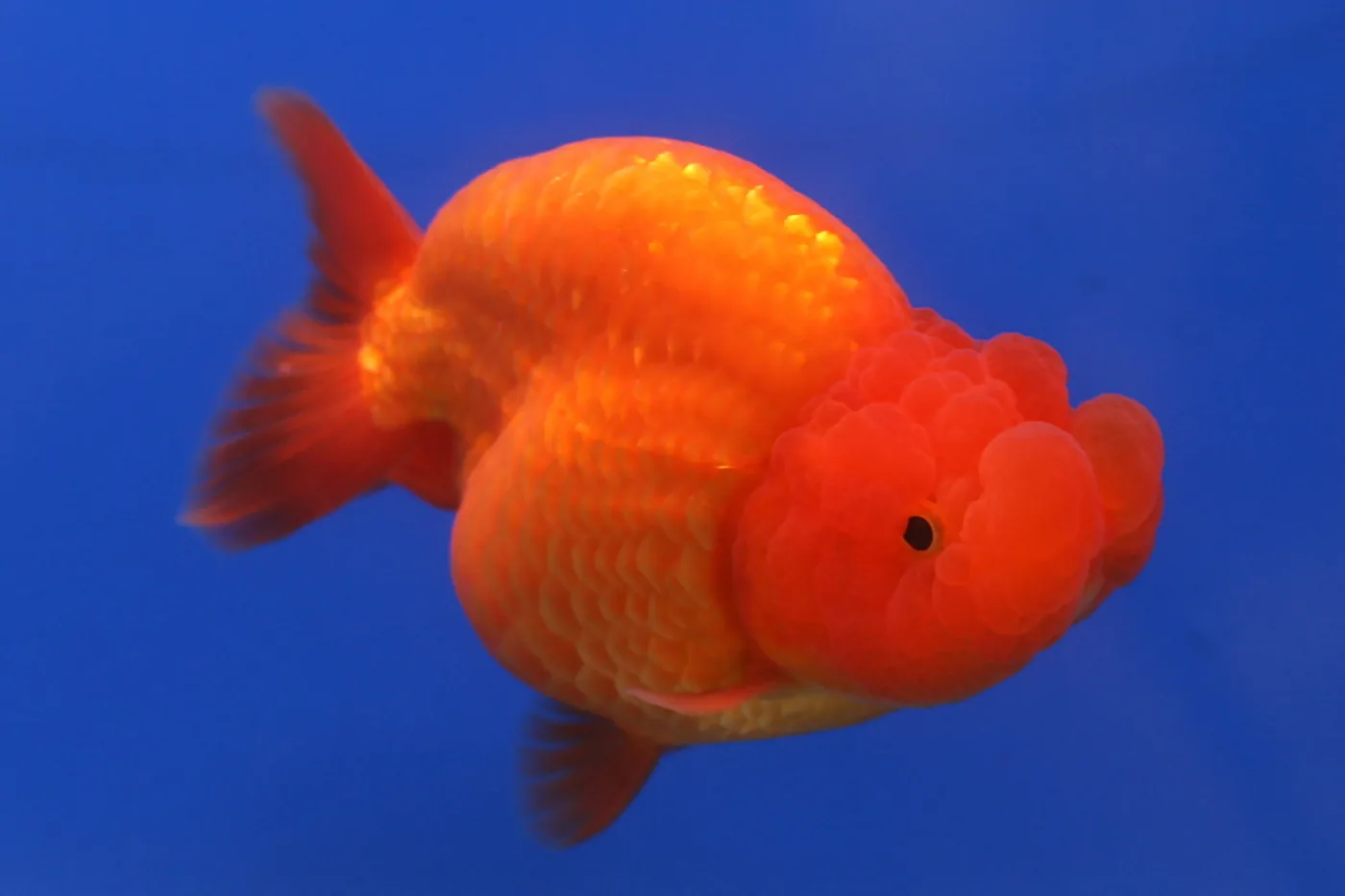
Photograph: Lerdsuwa, CC BY-SA 4.0 · Wikimedia Commons. Numbers and lines added.
- The back. A smooth, even curve with no dorsal fin, and no ridge where one would be. A dip or a hump is marked down.
- The wen. Even on both sides, and clear of the eyes. A hood heavy to one side, or already crowding the eyes, is a fault.
- The tail. Two lobes, separate along the top in the UK standard, and carried square rather than to one side.
- The tail set. The angle at which the tail meets the body, judged side-on, and how roundly it joins the back, judged from above.
- The body. Broad, deep and the same on both sides. One shoulder fuller than the other is a common fault, and it shows from above.
- Condition. No missing scales, no torn fins, not thin and not bloated: the part of the score the keeper decides.
On the body
- Asymmetry. Seen from above: one shoulder fuller than the other, a body that curves off the centre line. Very common and usually congenital.
- A spine that dips or humps where the standard does not call for it. The bent spine page covers the health side; as a fault it is judged on whether the outline is what the breed describes.
- A body too long for the breed. A fantail or ryukin that has grown slim can be carrying single-tail ancestry.
On the fins
- A fused or partly joined twin tail. The two lobes should be separate along the top. Fused lobes do not separate with age and affect how the fish swims, not only how it looks.
- A tail carried to one side permanently, rather than held square.
- A dorsal fin, or a ridge of one, on a dorsal-less breed. On a ranchu, lionhead, celestial or bubble eye, the back should be smooth. A ridge can indicate a cross somewhere back in the line.
- Ragged or split finnage, which is usually condition rather than conformation and is worth separating from the faults above: a split heals, a fused lobe does not.
On the head and eyes
- A wen growing unevenly, heavily to one side, or already crowding the eyes.
- Mismatched eyes on a telescope: different sizes, different angles, or one clouded.
On colour
- Patchiness that is mid-change rather than pattern. A fish going colour is not faulted for it in a young class, but it will not win an adult one.
- Thin or washed colour, which is as often diet as breeding — the genetics page covers which is which.
The useful habit for a buyer: look from above as well as from the side. Many of the faults on that list are easier to see from overhead than through the glass, which is part of why show fish are often benched in bowls.
Deportment, which surprises everyone
Newcomers expect a show to be a beauty contest and find that it is substantially a swimming test.
A fish with excellent conformation that swims badly is not demonstrating its breed. A ranchu that cannot hold itself level, an oranda that lists, a fantail that struggles against its own tail — these are marked down regardless of how well shaped they are, and reasonably so, because the whole point of the breed is a fish that carries that shape well.
This is also the quality most affected by how the fish has been kept. A fish raised in cramped water, pushed too hard on food, or kept at the wrong temperature is a fish that moves worse. Deportment is where the ordinary business of good fishkeeping shows up in the judging.
Why Japanese ranchu are judged from above
In the Japanese tradition ranchu are judged from above, which is the view they were bred for, and it is the clearest example of a standard carrying its own history.
Japanese breeders raised ranchu in shallow outdoor tubs and assessed them looking down. The standard therefore describes the overhead outline: a broad head, a back that widens and then tapers evenly, and the way the tail is set and tucked beneath. A ranchu’s most important line is one you cannot see properly through the side of an aquarium. British standards for ranchu, lionhead and oranda illustrate both side and top views, and Western societies tend to judge in glass tanks, so the view that counts depends on the standard and the show.
It is worth knowing this as a keeper rather than as a competitor. If you own ranchu, a tank that is wide and shallow shows them as the Japanese tradition intends — which is also, conveniently, the shape that suits goldfish for surface area and swimming room.
Classes, and why a young fish competes separately
Classes exist so that fish are compared with fish that have had the same opportunity to become themselves.
By breed and variety. A ranchu does not compete against an oranda. Within a breed, varieties are usually split too — metallic from calico, and in the case of the shubunkin, London type from Bristol type, because they are judged to different standards.
By age or size. This matters more in goldfish than people expect, because so much of what is judged keeps developing for years. A one-year oranda has a young wen; a three-year one is much further on. Comparing them would be comparing a fish to a different stage of the same fish, and the age calculator sets out how far apart those stages actually are.
Open and members’ classes. Many shows run classes open to anyone alongside classes restricted to society members or to fish bred by the exhibitor. The bred-by classes are where the breeding is really being judged, since buying a good fish is no achievement there.
What happens on the day
Worth knowing before you go, because the logistics are most of it.
Fish arrive bagged, are benched into the show’s own containers, and are left to settle — often for an hour or more — before judging begins. Settling matters: a fish that has just been moved will not show its deportment, and deportment is being judged.
Judging itself is unhurried and usually done without the owners present or identified. In many shows a judge will talk through the placings afterwards, which is a very useful hour available to anyone learning, because it is the only time you hear the standard applied out loud to real fish.
Then the fish go home, which is another transport, and the sensible expectation is a quiet week afterwards: no changes, no new arrivals, and a close eye on the signs that a stressful day sometimes brings out a day or two later.
Preparing a fish, and why it takes years
The short version: you cannot prepare a fish for a show in a fortnight, because the things being judged are the accumulated result of how it has been grown.
Time. Wen, body depth and finnage keep developing for years, and keepers generally allow two or three before judging what a fish will become. The age calculator sets out what to expect at each stage, and the practical consequence is that a show fish is a multi-year project rather than a purchase.
Growing space. Fish grown in generous water grow better shapes. This is not a show trick; it is the same reason the tank size guidance on this site is what it is.
Feeding. Steady and adequate rather than forced. Pushing growth with rich food produces a deeper body faster than the fish’s gut and swim bladder are comfortable with, and overfeeding shows up as a physical problem in exactly the breeds most often shown.
Condition in the weeks before. Stable water, no upheaval, no rearranging, nothing new introduced. A fish that has had a recent illness will not be in hard condition however well it has recovered.
The journey. Transport is the part that undoes preparation — the same rules as any other move, covered in handling, netting and moving a goldfish. Bag in its own water, dark and stable, and let it settle in the benching container rather than expecting it to show well immediately.
Where standards and welfare pull against each other
This deserves saying plainly rather than being left as an undertone.
A standard rewards a feature. Breeders select for it. Selection over generations makes the feature more pronounced. And several of the features goldfish are judged on are, past a point, things that make the fish’s life harder: a wen heavy enough to crowd the eyes, a body round enough that the gut folds and buoyancy fails, eyes protruding enough to be injured on ordinary decor.
None of that is an argument against showing, which at its best keeps lines, knowledge and breeds alive that would otherwise be lost. It is an argument for noticing which direction a standard is pushing. The welfare page sets out the position this site takes, and the genetics page covers why selecting hard for one trait drags others along with it.
The healthiest standards describe balance — a hood in proportion to the body, a tail the fish can actually carry — rather than maximum. Where a standard rewards a maximum, the fish pays for it.
If you want to start
Four steps, in order, and the first two cost nothing:
- Go to a show without entering. It is a small world and a generally welcoming one. An hour on the benches with someone who knows the breed teaches more than any written standard.
- Join a society. That is where the standards, the shows and the breeders are, and where you find out which standard your local shows judge to.
- Buy from a breeder. The fish decides most of the outcome, and a breeder’s fish comes with a known line and an accurate account of what it is. The choosing and bringing home page covers the inspection; the difference here is that you are also buying the parents’ record.
- Then wait. Keepers generally allow two to three years, kept well, before the fish is what it is going to be.
And for everyone not showing: the standards are still worth reading, because they are the clearest available description of what each breed is supposed to be. Knowing what a good ryukin looks like makes you a better judge of the fish in the shop tank, which is the only judging most keepers will ever do.
Frequently asked questions
What is a goldfish breed standard?
A written description of an ideal fish for a given breed, covering body shape, finnage, colour and bearing, agreed and published by a goldfish society. It is a reference point rather than a rule, and no living fish meets all of it. Standards exist so that judges at different shows assess fish consistently and so breeders working separately are aiming at the same thing.
Why do breed descriptions disagree between sources?
Because different societies wrote different standards, and none of them is the official one. A ranchu is judged to a Japanese standard that differs from a British one; shubunkins split into distinct London and Bristol types with separate standards. When two sources describe the same breed differently, they are usually both right about different standards rather than one being wrong.
How does a goldfish show actually work?
Fish are benched individually in bare tanks or shallow bowls, grouped into classes by breed, variety and sometimes size or age. A judge assesses each against the written standard, by points in some shows and by placing in others, and the class winners go forward to compete for best in show. Owners are typically not identified to the judge while judging is in progress.
Why are Japanese ranchu judged from above?
In the Japanese tradition that is the view they were bred for. Breeders raised ranchu in shallow outdoor tubs and looked down at them, so the standard describes the outline seen from overhead - the breadth of the head, the width and taper of the back, and the way the tail is set and tucked. Western societies tend to judge in glass tanks, and British standards show both side and top views, so the view that counts depends on the standard and the show.
What is deportment and why does it matter so much?
Deportment is how the fish carries and moves itself: whether it swims level and unhurried, holds its fins properly rather than clamped, and looks composed rather than anxious. It surprises newcomers by how much weight it carries, because a fish with excellent conformation that swims badly is not demonstrating the breed. It is also the quality most affected by how the fish was kept.
Can an ordinary pet goldfish be shown?
It can be entered, and in a small open show it may do perfectly well. What decides the result is mostly conformation, which was settled before you bought the fish, so a shop fancy competing against fish from a breeder's line is at a disadvantage that no amount of care closes. The part you control is condition, and a well-kept fish in hard condition beats a neglected better one.
Do shows harm the fish?
A well-run show is a day of handling, transport and a night in unfamiliar water, which is a real cost and a manageable one. The larger welfare question is not the show itself but the standards: where a standard rewards an ever more extreme feature, breeding toward it produces fish that swim, see or digest worse. That argument is worth having openly rather than pretending it does not exist.
How do I start showing goldfish?
Join a goldfish society, go to a show without entering, and talk to people on the benches - it is a small and generally welcoming world. Then buy from a breeder rather than a shop, because the fish decides most of the outcome. Expect to wait: the features that are judged, particularly wen and body, are slow to develop, and keepers generally allow two or three years.