01 Care guide
Wen care for orandas, ranchus and lionheads
The hood is the reason people buy these breeds and the thing least often explained. It is normal tissue, it develops over months and years, and almost all of its maintenance is water quality — with a handful of genuine problems that look alarming and a couple of alarming things that are not problems at all.
The wen is the reason people buy an oranda, a ranchu or a lionhead, and it is the part of those fish least often explained. It generates two opposite mistakes: treating a perfectly normal growth as a tumour, and treating a genuine problem as a cosmetic quirk.
Almost all of its care is water quality. The rest is knowing which of the alarming things are not problems, and which of the unremarkable ones are.
What a wen actually is
A thickened growth of the skin over the skull, cheeks and gill covers, with a texture usually described as raspberry-like or like a cap of small beads.
It is soft tissue, normal in these breeds. It is mostly skin, grown thick and folded, with a build-up of collagen in the layer beneath the surface. The bone of the skull under it thickens too, which is part of what holds the hood on. Goldfish anatomy and biology covers what the skin layers normally do, including the slime coat that is the fish’s first defence and that the wen carries like everywhere else.
Overgrown wens can contain tumours. A 2021 report on four orandas operated on for overgrown wens found a tumour in three of them. It was a small surgical series, so it says nothing about how often this happens. A wen that bleeds, ulcerates or changes quickly is a question for a vet, and not for the water test.
It is selected for, not a deformity of an individual. The head growth is one of the fancy traits developed over centuries of Chinese and later Japanese breeding, and the domesticated goldfish sets out where it sits among the others.
It has a folded surface and little blood supply. That is the reason this page exists: folds trap debris, and soft tissue with limited circulation is prone to infection when the water is poor.
The breeds that carry it, and how they differ:
| Breed | The wen | Judged |
|---|---|---|
| Oranda | Covers the head, often spreading to cheeks and gill covers; has a dorsal fin | Side and top views in British standards |
| Ranchu | Neater and more compact; no dorsal fin, arched back | From above in the Japanese tradition; side and top views in British standards |
| Lionhead | The largest and loosest of the three; no dorsal fin, flatter back | Side and top views in British standards |
How it develops
Buying a young hooded goldfish means buying a prediction, and the timeline is worth knowing before you are disappointed.
- In the first two months or so: little or nothing visible. A juvenile oranda looks like a fantail.
- From roughly two to four months: a faint thickening across the top of the head, easy to miss and easy to mistake for nothing. The timing depends on temperature and on the line.
- Over the following months: the recognisable growth thickens, spreading down the cheeks in the breeds that do that.
- Later: keepers report that the wen is still developing for years, with many fish still filling out at two years and some past three.
Which means a shop tank tells you very little. A six-month-old fish with barely a bump may end up with a better hood than the one that looked impressive beside it. If it matters to you, look at the parents rather than the fish — the argument for buying from a breeder rather than a shop, made at length in breeding goldfish.
And a wen is not symmetrical by obligation. Uneven growth, a heavier side, a gap over one eye: all common, none a health problem in itself.
What it costs the fish
Every fancy trait costs something, and the real accounting for this one is short but real.
Where the wen grows
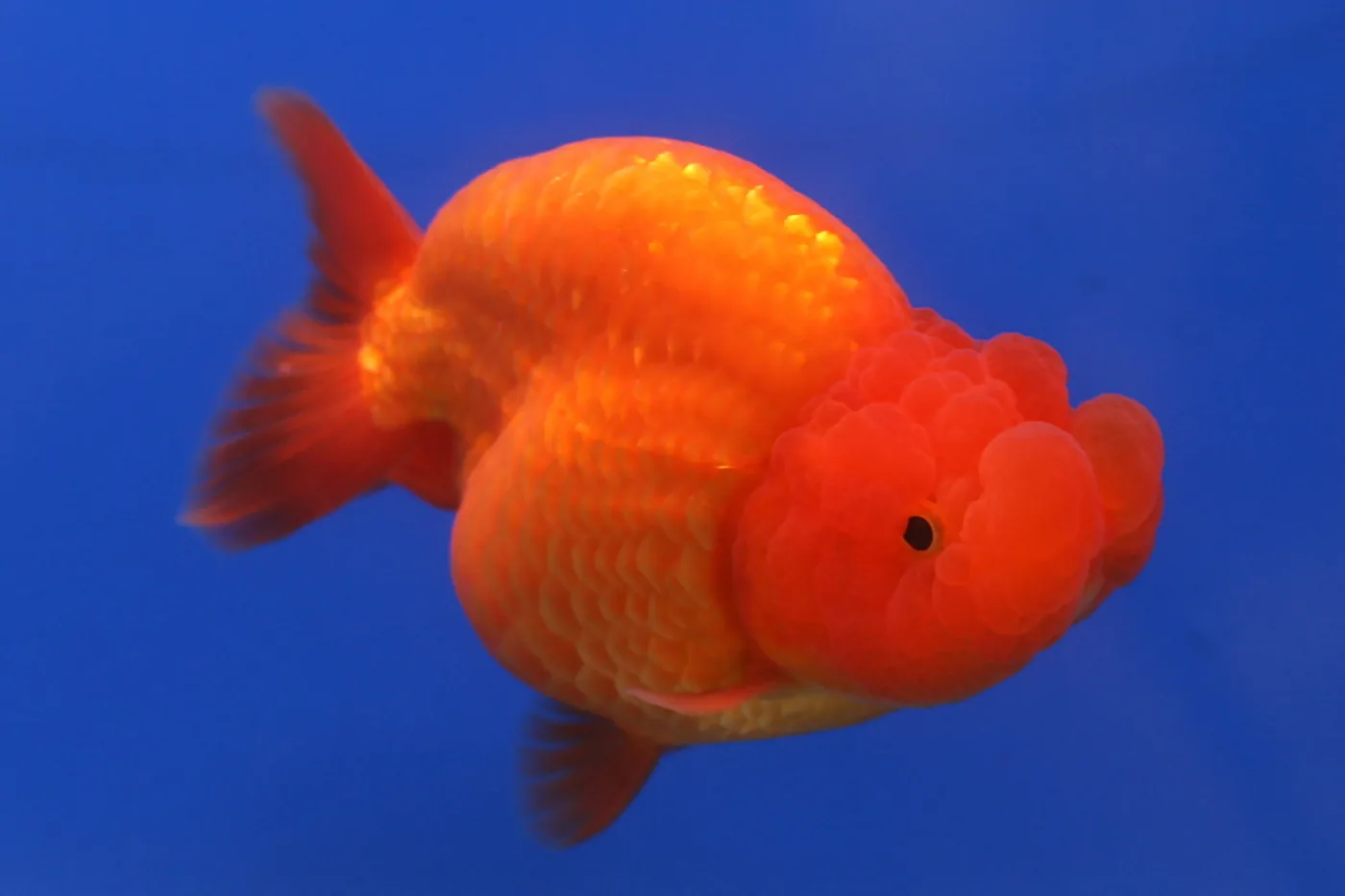
Photograph: Lerdsuwa, CC BY-SA 4.0 · Wikimedia Commons. Numbers and lines added.
- Crown. Where it starts, as a faint thickening across the top of the head in the first months.
- Cheeks. Where it spreads next, over the following year or so, in the breeds that grow it there.
- Over the eyes. A heavy hood can grow down over them and, in extreme cases, shut out most of the sight. The fish then finds food by smell, has to be fed accordingly, and needs a vet if the eyes are covered.
- Gill covers. In the extreme cases, growth across them enough to restrict the gills.
- The folds. Soft, folded tissue with little blood supply and prone to infection: look here first for redness or raw patches, and keep the water clean.
Sight. A heavy wen can grow down over the eyes and, in extreme cases, shut out most of the sight. The fish is not helpless — it has a lateral line, a good sense of smell and functional hearing — but it stops finding food by sight, which changes how it must be fed, and a hood that covers the eyes is a case for a vet.
Gill movement, in extreme cases, where growth extends across the gill covers enough to restrict them.
Food, day to day. This is the practical one and it is bigger than the dramatic ones. A hooded fish is slow, cannot see well, and loses every race to a faster tankmate — exactly the mechanism described in chasing and bullying, where a fish starves without anything that looks like conflict.
Vulnerability to poor water. Folded tissue with little blood supply is prone to infection when ammonia, nitrite or nitrate climb.
Keeping it healthy, which is mostly water
There is no wen regime. There is a water regime, and the wen is where keepers often see it show first.
Keep nitrate low and ammonia and nitrite at zero. In keepers’ experience a hooded fish shows the consequences of drifting water quality before a comet in the same tank does. Testing goldfish water and how often to change goldfish water are the whole maintenance plan for a wen.
Filter well and gently. Enough biological capacity for a messy fish, and an outflow that does not push a weak swimmer around — goldfish filtration covers getting both.
Remove sharp decor. A fish that cannot see clearly will bump into things, and a graze on a wen is slower to heal than one anywhere else. Aquarium decorations covers choosing smooth-edged items and avoiding gaps a fish can wedge into.
Do not clean the wen. The folds do trap debris. Handling them strips the slime coat and opens precisely the entry point you were trying to protect. The answer to a dirty-looking wen is a cleaner tank.
Quarantine new arrivals properly. External parasites settle in wen folds where they are hard to see and hard to reach — quarantining a new goldfish is worth more on a hooded-breed tank than on most.
Feeding a fish that cannot see its food
The day-to-day work of keeping a wenned goldfish, and the part that decides whether it thrives.
- Use sinking food. A surface feed is a race that this fish loses. Sinking versus floating food covers why that matters for round-bodied fancies anyway.
- Feed in the same place every time. These fish learn location quickly, and a consistent spot substitutes for eyesight.
- Allow more time. A hooded fish finds food by smell, and smell is slower than sight. A one-minute rule written for a comet does not apply.
- Watch one fish through a whole feed, occasionally, and count what it actually eats rather than assuming.
- Keep it away from faster fish. A single-tail in the same tank will beat it to everything, every day, for years.
- Feed properly rather than richly. Goldfish nutrition covers what the gut can use; there is no food that grows a wen a genetics will not support.
Growing a good wen
Worth addressing directly, because it is what people want to know and there is a lot of nonsense attached to it.
Genetics set the ceiling. A fish from a line with modest head growth will not develop a heavy hood whatever you do. That is the fact to start from, and it is often talked around.
What you control is whether it reaches that ceiling:
- Water quality, consistently, over years rather than weeks.
- Space. A fish grown in a cramped tank does not develop well in any respect, and the head is no exception.
- Temperature held steadily in the upper part of the comfortable range. Growth is temperature-driven, and goldfish water temperature covers where that band sits and why large, fast swings matter more than the exact number.
- A good, varied diet with real animal protein, fed consistently through the growth years rather than in bursts.
- Time. Most of it is time.
What does not work, and two things that actively harm:
- Dirty water. It is a persistent piece of folk advice that poor water encourages wen growth. There is no evidence for it, and it is a reliable way to infect the tissue.
- Force-feeding high protein produces a fat fish with digestive problems, not a bigger hood.
- Supplements. No supplement has been shown to grow a wen; treat anything sold as one as a normal food at a premium.
Why these fish are kept in tubs
A digression that explains a lot of what you see in serious collections, and that changes how you might house one.
The Japanese ranchu tradition judges from above. A ranchu is assessed on the outline of its back and the spread of its tail seen in plan view, with the wen framing the head as part of that outline. British standards for ranchu, lionhead and oranda illustrate both side and top views, so the view that counts depends on the standard and the show.
That is not an arbitrary convention. As the domesticated goldfish sets out, goldfish were bred for centuries in ponds, bowls and ceramic tubs, looked down into rather than through. The traits were selected largely in plan view because that is how fish in tubs and bowls are seen, which is why some breeds look better from above than through glass.
What follows practically:
- A shallow, wide container suits these fish better than a deep tank. Ranchu and lionheads are weak swimmers with no dorsal fin to stabilise them, and depth is work.
- A tub, trough or stock tank is a legitimate home rather than a compromise — the tank buying guide makes the case for them generally, and for wenned breeds it is stronger than usual.
- You will see problems earlier from above. An uneven wen, a developing lean, the first change in body condition: all clearer in plan view than through the side of a tank.
- And lid it. A top-view setup is an open-topped setup, and goldfish jump.
The other hooded varieties
Useful context, and one distinction that prevents a common misreading.
Redcap orandas carry the wen confined to the top of the head as a single red patch on an otherwise white body. Same tissue, selected for placement rather than bulk.
Tigerhead and goosehead describe oranda types with heavier cheek and snout development respectively — regional naming rather than separate breeds, and the terms are used inconsistently between sellers.
Lionchu is a ranchu and lionhead cross, with a ranchu’s arched back under a lionhead’s heavier hood. Its care is the care of its parents, and everything on this page applies to it.
Pompoms are not wenned, and this is the distinction worth holding. The bouquets on a pompom’s face are enlarged nasal septa — a different structure in a different place, growing from the nostrils rather than over the skull. They do not thicken into a hood, they are not subject to the same fold infections, and advice written for a wen does not transfer to them. The pompom page picks the subject up: what they need instead is protection rather than cleaning, because they sit at the front of the fish and heal lopsided.
And a plain-headed oranda is not a failed oranda. Head growth varies enormously within a spawn, which is the whole subject of breeding goldfish.
When something is wrong with it
The genuine problems, and how to tell them from the false alarms.
Bacterial infection in the folds. Redness, a raw or ulcerated patch, tissue that looks eroded rather than beaded. This is a common real wen problem, and it usually follows poor water. Ulcers and sores covers it, and the treatment is the water before it is anything else.
Fungus. White or grey cotton-like tufts, usually settling on tissue that was already damaged — fungus and cotton growth explains why it is a consequence rather than a cause.
Parasites hiding in the folds. Flukes and similar are hard to see on a smooth fish and harder on a wenned one. Flashing, clamped fins and rubbing on decor point there, and goldfish diseases explained covers what is actually being dealt with.
A wen that is shrinking. Keepers report that wen tissue can recede when the fish is doing badly — poor water, a long cold spell, underfeeding, or a chronic illness. That is experience rather than anything measured, but it makes a shrinking wen worth investigating even when nothing else looks wrong.
Overgrowth across the eyes or gill covers. The one genuine welfare problem of the trait. Covered below.
And the false alarms:
- White pimples on the wen are often new growth, in keepers’ experience, and on a male can be breeding tubercles. White spots works through the distinction from ich, which scatters over the body and fins and multiplies in a day or two; spots that multiply or reach the body should be treated as ich.
- Lumps that are not the wen — waxy seasonal growths, cysts, anchor worm — are a separate question entirely, and lumps, growths and tumours sorts them out.
- An uneven or lopsided wen is normal variation.
- A darker or lighter wen than the body is normal, and changes with age.
Living with an overgrown wen
Most fish never reach this point. For the ones that do, the fish usually manages far better than its owner expects.
It still finds food — by smell, by the lateral line, and by learning where food appears. The adaptations in the feeding section above are the whole intervention for most fish.
Give it a simple tank. Fewer obstacles, no sharp edges, no narrow gaps, and nothing it can wedge itself into while navigating by touch.
Keep the company appropriate. Other slow fancies, or its own kind. Goldfish tankmates sets out why a fast single-tail is the wrong company for a fish that cannot see.
Watch the body, not the head. The measure of whether this is working is body condition, appetite and behaviour — the checklist in signs of a healthy goldfish — rather than how the wen looks.
And treat a breathing problem as urgent. Growth restricting the gill covers is rare, and it is the version of this that needs help rather than adaptation.
Before you buy one
A short, plain section, because the trait is bought more often than it is understood.
These fish need better water than a comet does, not worse, and the wen is where that shows.
They are poor competitors and do best with their own kind or with other slow fancies.
The hood you are buying may not arrive, and a juvenile tells you far less than its parents do.
And the extreme versions carry a real cost. There is a legitimate argument, made in goldfish welfare, about how far selection for a trait should go when the trait impairs the animal. A moderate wen on a well-kept oranda is not that argument; a hood grown across both eyes is.
The short version
A wen is normal tissue that develops over years, and many keepers treat it as an early signal of how the water is doing. Keep the water clean, feed sinking food in a consistent place and give the fish time to find it, keep faster fish away from it, and leave the hood itself alone.
White pimples confined to the head are often growth, but spots that multiply or reach the body are ich. A shrinking wen can mean the fish is doing badly somewhere else. And a hood growing over the eyes, or a wen that bleeds or changes fast, is worth a vet rather than an experiment.
Frequently asked questions
What is a goldfish wen?
A thickened growth of the skin over the skull, cheeks and gill covers, with a texture usually described as raspberry-like. It is soft tissue, mostly skin with a build-up of collagen beneath it, that these breeds have been selected for over centuries, and it is as normal on an oranda as a long tail is on a comet. It is not a disease, although the skull beneath it thickens too, and overgrown wens can contain tumours (three of four in one small surgical series; how often is not known), so one that bleeds, ulcerates or changes fast is worth a vet's eye. Orandas, ranchus and lionheads carry it; so do several less common varieties bred from them.
When does a wen start to grow?
It begins to show at roughly two to four months, depending on temperature and line, as a faint thickening across the top of the head that is easy to miss. Keepers report that it keeps developing for years, with many fish still filling out at two years and some past three. This is why a young oranda in a shop tank often looks like a plain fantail with a slightly domed head. Buying a juvenile means buying a prediction, and the parents tell you more than the fish does.
Are the white spots on my oranda's head ich?
Possibly not, if they are confined to the wen. Keepers often find that new wen tissue comes through as small white or pale pimples on the hood itself, and spots on the head can also be a male's breeding tubercles, so on a fish that is otherwise eating, swimming and breathing normally they may be growth rather than disease. Ich scatters untidily over the body and fins as well, multiplies within a day or two, and comes with flashing and clamped fins, so treat spots that multiply or reach the body as ich. Treating spots that are not ich puts a healthy fish through chemicals for nothing.
How do I make my goldfish's wen grow bigger?
Mostly you do not, because genetics set the ceiling. What you control is whether the fish reaches it: stable warm water at the upper end of the comfortable range, excellent water quality, generous space, a good varied diet with real protein, and time. Nothing on that list is a trick, and the things sold as tricks are not worth doing. In particular, the folk advice that dirty water encourages wen growth has no evidence behind it and is a good way to infect the tissue you are trying to grow.
My oranda's wen is growing over its eyes. What do I do?
First, adapt the feeding, because a fish that cannot see is a fish that is not eating enough: sinking food, delivered in the same place every time, with unhurried access and away from faster tankmates. Then get a proper assessment. Wen reduction is done, by aquatic vets and some experienced breeders, under sedation and with attention to bleeding and infection afterwards. It is not a home procedure and it is not urgent enough to justify improvising — the page on finding an aquatic vet covers who to ask.
Can I trim a wen myself?
No. It is living tissue on an animal's head, close to the eyes and gill covers, and cutting it without sedation, sterile technique and a plan for bleeding and aftercare is how a manageable problem becomes a fatal one. The advice circulating in hobby forums about doing it with nail scissors is genuinely dangerous. If the wen is impairing sight or gill movement, that is a veterinary consultation, and most wens never need one.
Why has my oranda's wen shrunk?
Keepers report that wen tissue can recede when a fish is doing badly — poor water, a long spell in cold water, underfeeding, or an illness that has been running for weeks. That is experience rather than anything measured, but it makes a shrinking wen worth investigating even when everything else looks fine. Test the water first. A wen that recovers as conditions improve suggests the cause was environmental.
Does a wen need cleaning?
No, and do not attempt it. The folds do trap debris and infection can take hold in them, but the answer to that is clean water rather than intervention. Handling a wen removes the protective slime coat and creates exactly the entry point you were worried about. If a fold looks red, raw, or is developing a white or grey tuft, that is a health problem to treat as one rather than something to wipe.