01 Care guide
Stress in goldfish
Stress is a response, not a disease: a surge of hormones that readies a fish for an emergency. Brief, it passes. Kept up by poor water, crowding or a bully, it turns down the immune system that holds a tank's everyday infections in check, which is why so much goldfish advice ends at the water.
Stress comes up in almost every conversation about a sick goldfish, and it usually arrives as an explanation. The new fish is stressed. The fish died of stress. It is just stress, and it will settle. Sometimes that is right, but as an explanation it is nearly always incomplete, because stress is not a cause. It is what the fish does in response to one.
That distinction is the point of this page. Stress is a real and measurable response, and it matters a great deal, because a goldfish kept under it for long enough fights off infections less well. But it is always a response to something, and the something is often in the tank, often in the water. Knowing what stress is, how it shows and what causes it turns a vague word into a list of things to check.
What stress actually is
When a goldfish meets a threat, whether a net, a sudden chill or a larger fish bearing down on it, its body prepares for an emergency. The response runs through two routes, the same two that run it in a mammal.
The fast route is a surge of adrenaline and noradrenaline, released within seconds from cells in the head kidney. The heart speeds up, the gills pump harder and blood sugar climbs, so there is fuel and oxygen for a burst of escape. The slower route runs from the brain through the pituitary gland to tissue in the same part of the kidney, which releases cortisol within minutes. Cortisol keeps energy flowing for longer, and if it stays high it turns several of the body’s other jobs down: growth, digestion, reproduction and the immune system among them.
The goldfish is one of the fish in which parts of this were worked out. It has been a laboratory animal for decades, and the speed of the cortisol rise, the effect on the immune system and the link between rough handling and ulcer disease have all been measured in it. So has the finding that matters most to a keeper: the brain signal that starts the stress response also turns appetite down. A stressed goldfish that ignores its food is not being fussy. It is running the same chemistry that tells it to run. Some of the detail further down, such as what happens at the gills, comes from trout and carp.
Physiologists describe the response in three layers, and the layers are a useful way to think about what a keeper actually sees.
| Layer | How soon | What happens in the fish | What you see |
|---|---|---|---|
| Primary | Seconds to minutes | Adrenaline and noradrenaline, then cortisol | A startle, a dart, then stillness |
| Secondary | Minutes to hours | Blood sugar rises, the gills work harder and leak salts, the skin makes extra mucus | Fast breathing, clamped fins, a change of colour |
| Tertiary | Days to weeks | Appetite and growth fall, breeding falls off, the immune system stays turned down | A fish that stops eating, stops growing and falls ill |
The first two layers are the response working as intended. A fish that has been netted and moved runs through them and comes out the other side within hours. The third layer appears when the cause does not go away, or when short stresses are repeated or stacked, and it is the one that does the harm.
Where stress lands
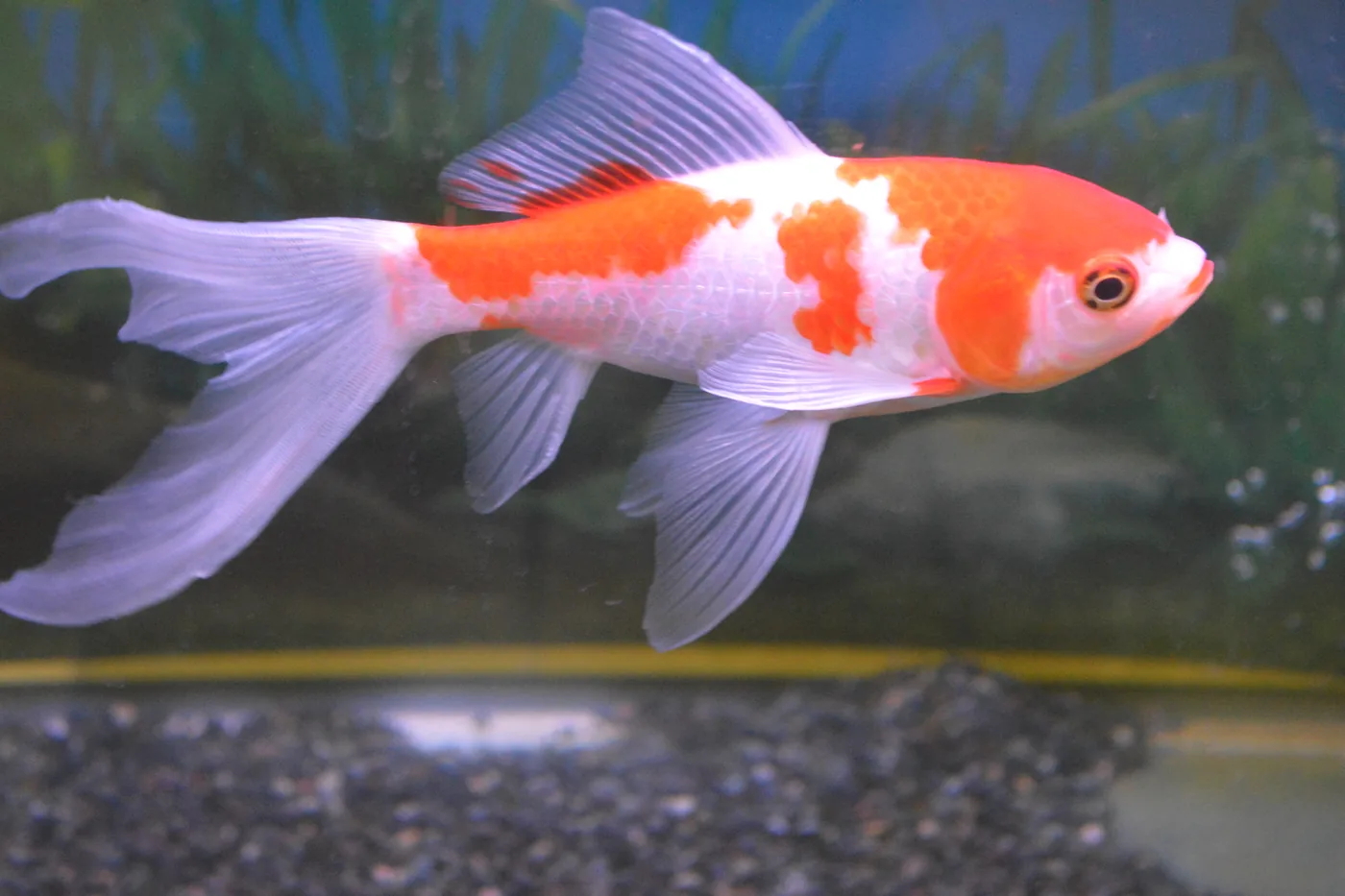
Photograph: Yatokin, CC BY-SA 4.0 · Wikimedia Commons. Numbers and lines added.
- Brain. Where the alarm starts. It signals the pituitary gland, and stress often lowers appetite.
- Head kidney. Catecholamines (adrenaline and its relatives) and cortisol, which rise within minutes, come from cells here. It is also one of the main organs of the fish’s immune system, the system cortisol turns down.
- Gills. They work harder at once, and leak salts faster while they do. Fast breathing at rest is the sign to watch.
- Skin and slime coat. More mucus at first, and the coat changes with prolonged stress. Colour can blanch.
- Gut. Digestion often slows along with appetite, so a stressed fish may ignore its food or spit it out.
- Fins. Folded against the body: the posture that says something is wrong, but not what.
Why a stressed goldfish falls ill
Every tank holds bacteria and water moulds that cause disease when a fish’s defences drop: Aeromonas and the other bacteria behind fin rot and ulcers, the columnaris bacterium, and the moulds. Parasites arrive with new fish and plants, and a few can sit unnoticed on a healthy fish. A healthy goldfish lives among all of this without trouble, because its slime coat, its skin and its immune system keep it out. Many of the named diseases are opportunists. They take hold when those defences drop.
Chronic stress is a common reason they drop. If it stays high, cortisol turns the immune system down in fish much as it does in mammals, and a goldfish kept under stress for weeks is fighting its everyday bacteria with less. The skin changes too. A stressed fish first makes more mucus, and if the stress goes on the skin’s barrier can weaken, which is an open door for the bacteria and water moulds waiting in the water.
The gills pay a second price. A goldfish lives in water far less salty than its own blood, so it is always losing salts across the gills and taking on water, and it spends energy every minute reversing both. In most freshwater fish, stress makes the gills open up to take in more oxygen, which also makes them leakier: salts are lost faster, and the fish has to work harder to replace them. It is the same workload that aquarium salt is used to ease for a fish under strain, and it is part of why a stressed fish is a tired one. The anatomy page covers how the gills, kidneys and slime coat work when nothing is wrong.
All of this takes time to build and time to undo, which explains a pattern that keepers meet over and over: the problem appears days after the event that caused it. A goldfish netted and moved is often fine for a few days and then shows fin rot or white spots. A new fish brought home in a bag, into a new tank at a new temperature, is at its most vulnerable in the first fortnight, which is why bringing a goldfish home treats those weeks as the dangerous ones, and why a quarantine tank exists at all. White spot in particular is the classic follow-on from a chill or a move.
Short stress, and stress that stays
Not all stress is a problem, and a goldfish kept with no stress at all is not the goal. Netting, water changes, a new tankmate, a move to a bigger tank and the occasional fright are part of any fish’s life. Each one runs through the first two layers and passes, and a healthy goldfish is back to normal within hours.
What does the damage is a cause that stays in place:
- ammonia or nitrite that never quite reaches zero, in a tank that looks clean;
- a tank that was big enough a year ago and is not now;
- a faster fish that takes every meal, or one that chases another all day;
- a room that drops several degrees every night;
- a filter outlet that a round-bodied fancy has to fight whenever it swims;
- a tank beside a door that slams, or on a cabinet with a speaker in it.
A goldfish living with one of these can look normal most of the time. The response does not stop because the fish stops showing it. Appetite, growth and resistance to disease drift down together, and the first thing anyone notices is often the infection at the end of the process rather than the stress at the start of it.
Stress also stacks. A move on its own is manageable, and so, separately, are a new tank, a temperature a few degrees off and a first meeting with other fish. All four at once is the standard way a newly bought goldfish falls ill, and it is why the advice for any change is to make one change at a time.
How stress shows
The signs of stress are postures and habits rather than marks on the body, and none of them is specific. Each says that something is wrong without saying what. They are also easiest to read against the fish’s own normal, which is why it pays to know how a healthy goldfish looks and behaves on an ordinary day, from the way it carries its fins to how fast its gills move.
| What you see | What it looks like |
|---|---|
| Clamped fins | Fins folded against the body, the dorsal fin lowered |
| Sitting low | Resting on the bottom or hanging in a corner, not foraging |
| Hiding | A fish that never hid now staying behind the decor |
| Not eating | Food ignored, or taken and spat out |
| Fading colour | Washed out, sometimes unevenly |
| Fast breathing | Gills working hard while the fish is at rest |
| Darting | Sudden bursts, swimming into the glass, jumping |
| Extra slime | A grey or cloudy film over the skin |
Two of these carry more information than the rest. Clamped fins are the goldfish’s general-purpose signal that something is wrong, and they are often the first sign to appear and the last to go. Fast breathing at rest points more narrowly, to the water or the gills: ammonia or nitrite, too little oxygen, or parasites on the gill filaments.
Rubbing against the decor and the gravel is often listed as a sign of stress, and it can come with it, but it is really a sign of irritation. It points to the water or to skin parasites, not to stress on its own.
A very useful moment to notice stress is before any of these is obvious. A fish that is a little slower to come to food, a little lower in the water or a little paler than it was last week is at the start of the process, and that is when a water test changes the outcome most.
What causes it, in the order worth checking
The causes are many, but they are not equally likely. This is the order that finds the answer soonest in most tanks, and it starts with the one that cannot be seen.
- The water. Ammonia or nitrite above zero, nitrate that has crept up for months, or a pH that has slid down in a tank that has not been changed enough. This is a common chronic stress, and a tank can look spotless while it happens. Testing the water is the only way to know.
- Temperature. Goldfish tolerate a wide range and dislike sudden movement across it. A room that cools sharply at night, a tank in a sunny window, or water changes made with colder water all count, and a fast swing does more harm than a steady value within the range, as the temperature guide explains.
- Oxygen. Warm water holds less of it, goldfish use a lot, and a still, crowded tank in summer can run short. Fish hanging near the surface are the late sign. Aeration and oxygen covers how oxygen actually gets into the water.
- Space. A tank that is too small or too full stresses its fish twice, through the waste it cannot dilute and the competition for food and room. How many goldfish a tank can hold sets out the arithmetic.
- Tankmates. One fish that chases another, fast single-tails outcompeting slow fancies at every meal, or a spawning chase that goes on for days. Chasing and bullying separates the harmless from the harmful, and choosing tankmates covers which fish belong together.
- Handling and moves. Every net, bag and new tank is an acute stress, and several at once add up. Handling and moving a goldfish is largely about keeping each one short.
- Disturbance. Tapping on the glass, vibration through the stand, a speaker in the same cabinet, or a light that snaps on in a dark room. Goldfish hear unusually well and have no eyelids, and their senses explain why these land harder than they look.
- Treatment. Medication and strong salt are stressors in themselves. They are worth it against a named disease and a cost with nothing to show for it otherwise, which is the argument of using medications safely.
What to do about it
The order matters here as much as it does for the causes.
Test first. Before moving anything, adding anything or treating anything, test for ammonia, nitrite, nitrate and pH. If any of them is wrong, a temperature-matched, dechlorinated water change is the first treatment, and often the only one needed.
Then remove the cause. Separate the bully rather than the victim, reduce the stocking or move to a bigger tank, steady the temperature, move the tank away from the door or the speaker. Stress that has a cause stops when the cause does, and not before.
Add nothing new while the fish recovers. No rearranging, no new fish, no second move, and no medication for stress itself. Each of these is another stress stacked on the first.
Keep unavoidable stress short. Some stress cannot be avoided, but most of it can be shortened:
- match the temperature and treat the water at every change;
- catch a fish with a container rather than chasing it with a net;
- make one change at a time and let a few days pass before the next;
- after a move, leave the tank light off for the rest of the day.
How you know it has passed
Recovery runs in roughly the order the damage arrived, and knowing the order stops a keeper from giving up, or treating, too soon.
Breathing and fins come back first. Once the cause is gone, a fish that was breathing hard often settles within a day, and fins held clamped begin to open within a few days.
Then position and appetite. The fish comes back up off the bottom, starts foraging again and begins taking food, at first cautiously. Offer small amounts and remove what is left, because uneaten food in a tank that has just been put right is the quickest way to put it wrong again.
Colour comes back last. A fish that blanched in a sudden fright colours up within hours to days of the cause being fixed, because no pigment was lost, only drawn together inside the skin’s colour cells; the pale or faded colour page separates that blanching from real fading. A goldfish that faded over weeks of stress, eating little the whole time, has lost pigment it needs food to rebuild, and can take weeks to colour up again, sometimes a month. A fish that is eating, swimming and holding its fins normally is recovering even if it is still pale.
Anything physical that the stress allowed in heals on its own timetable after that. Fins regrow and scales return, and what heals and what does not sets out which marks go and which stay.
What stress costs over a lifetime
The tertiary layer is the one that shapes a whole life. A goldfish kept under chronic stress grows less, and a fish held back for long enough may never fully catch up; the growth guide explains why a stunted fish is not an adapted one. It breeds less or not at all, which is why conditioning fish for spawning is mostly a matter of clean water, space, rich food and a proper winter. And it meets every infection with less, so the illnesses come more often and the recoveries take longer.
This is also where stress meets welfare. The framework the welfare page uses ends in the animal’s mental state, and its conclusion is that a goldfish kept well is one that is not chronically stressed. That is a useful test because it is practical. It does not ask whether a fish is happy, which nobody can measure. It asks whether anything in its tank is keeping the emergency response switched on, and that is a question a water test, a thermometer and a few minutes of watching can answer.
Frequently asked questions
Can goldfish get stressed?
Yes, and measurably. Fish mount a stress response through the same families of hormones as mammals, adrenaline and noradrenaline within seconds and cortisol within minutes, and the goldfish is one of the species it has been studied in for decades. The response readies the fish for an emergency. What matters to a keeper is not whether it happens, since it happens at every net and every water change, but whether it is allowed to continue.
What are the signs of a stressed goldfish?
Changes in how the fish holds itself and behaves: fins clamped to the body, sitting on the bottom or hanging in a corner, hiding when it never used to, ignoring food, fading colour, breathing fast at rest, or bursts of darting. None of these is specific. Each says that something is wrong without saying what, which is why the next step is always a water test rather than a guess.
Can a goldfish die from stress?
Rarely from the response itself, though a hard chase, rough netting or a bad journey can exhaust a fish and kill it within hours. The usual pattern is slower: a cause that stays, weeks of a suppressed immune system, and then an infection the fish would normally have fought off. A goldfish said to have died of stress has usually died of that infection, or of the cause itself, such as ammonia, heat or a lack of oxygen.
How long does a goldfish take to recover from stress?
It depends on how long the stress lasted. After a short event such as a net or a water change, the hormones settle within hours. The slime coat and the immune system take days, which is why problems from a move tend to appear two or three days later and why the first fortnight in a new tank is the risky one. After weeks of chronic stress, expect breathing and fins to recover within days of fixing the cause, appetite soon after, and colour over weeks.
Do stress coat and other stress-relief products work?
Not shown to. Products with stress in the name are water conditioners, slime-coat polymers or bacterial cultures, and they do what those do. A conditioner that removes chlorine removes a real cause, which is useful. Salt and slime-coat polymers have some support from transport trials on other fish, but no product has been shown to lower a goldfish's stress response in a home tank, the rest add little that a water change does not do better, and none replaces finding out what the fish is reacting to.
Is a water change stressful for goldfish?
Much less than the water it replaces, if the new water matches. The stress comes from mismatch: water several degrees colder than the tank, untreated tap water, or a very large change in a tank that has been left for months, where the new water may differ a long way from the old in pH and hardness. Regular, matched water changes are one of the least stressful things that happen to a goldfish.
Is a single goldfish stressed by being alone?
Not in the way people fear. Goldfish are sociable fish, and a tank with room for more than one suits them, but nobody has shown that a single goldfish in a well-kept tank is chronically stressed by being alone. A second fish added to a tank too small for two is the surer cause of stress, through the extra waste and the competition for food.
Does tapping on the glass stress goldfish?
Yes. Goldfish hear unusually well for a fish and feel pressure through the lateral line along each flank, so a knock on the glass arrives as a loud noise and a physical jolt at once. One startle is soon over. A tank beside a door that slams, a speaker standing on the same cabinet, or a child tapping every time they pass can keep the fish startled, and very loud noise can damage its hearing, although goldfish do get used to a steady background of sound.