01 Care guide
What a goldfish can see, hear and smell
A goldfish is a hearing specialist with four-colour vision in bright light, a good chemical sense and a lateral line that reads water movement. Most of what looks like odd behaviour in a tank makes sense once you know which sense it is using.
Most of what looks strange about goldfish behaviour stops looking strange once you know which sense the fish is using. A goldfish that finds food in a planted tank it cannot see into, that arrives at the glass before you have reached the tank, that flinches at a door slamming in the next room — none of that is mysterious. It is just a different set of instruments from yours.
And the instruments are good. A goldfish sees more colours than you do in bright light and hears better than most fish.
Where the senses sit
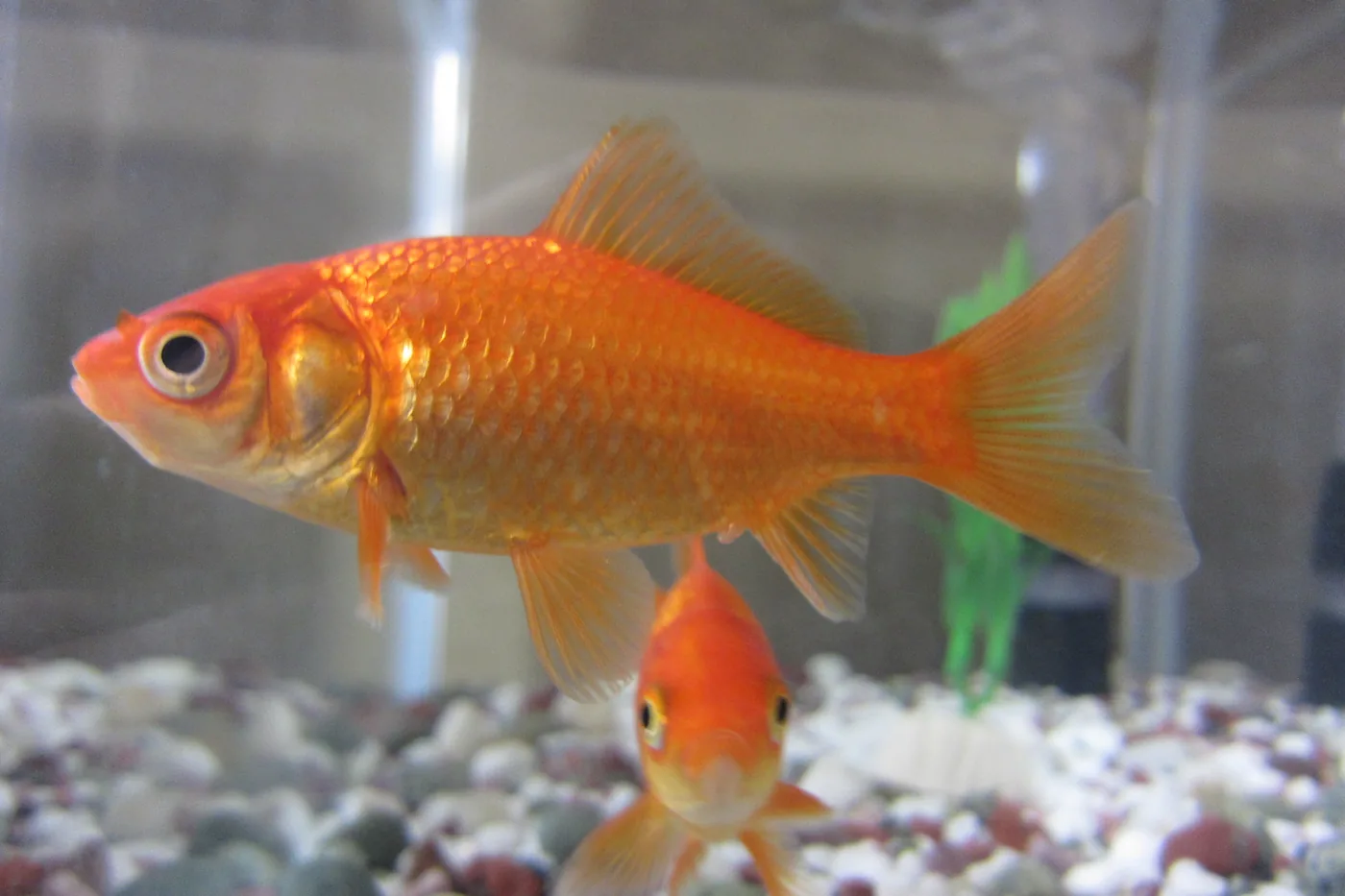
Photograph: ぱたごん, CC BY-SA 3.0 · Wikimedia Commons. Numbers and lines added.
- Nostrils. A pit each side of the snout, not joined to the mouth. Smell picks up food from a distance, and taste decides whether it is eaten, which is why a fish that cannot see well still eats.
- Eyes. Four kinds of colour cell against your three, one of them for ultraviolet, and no eyelids, so a light snapping on is a jolt.
- Lips. Taste buds, here and across the skin as well. There are no barbels, which is the quickest way to tell a goldfish from a koi.
- Inner ear. Inside the skull behind the eye. Nothing of it shows on the outside.
- Swim bladder. A chain of small bones joins it to the ear and turns it into an amplifier: the reason goldfish hear so much better than most fish.
- Lateral line. A row of pores down each flank that feels pressure and movement in the water, and finds the way in the dark.
Hearing, which is the surprise
Goldfish hear better than most fish, and the reason is anatomical.
Goldfish belong to a large group of freshwater fishes that possess a Weberian apparatus: a chain of small bones connecting the swim bladder to the inner ear. The swim bladder is a gas-filled space, so it vibrates readily in response to sound in water, and the bone chain carries those vibrations to the ear — functionally much like the ossicles in your own middle ear.
The result is a fish that is genuinely sensitive to sound across a useful range of low and mid frequencies. That covers most household noise: doors, footsteps, music through a floor, and the running noise of the tank’s own equipment.
Three practical consequences follow, and they are the reason this section comes first.
Where the tank goes matters. A tank sharing a wall with a door that slams, sitting on a floor above a speaker, or beside a washing machine is a tank in a noisy environment by the fish’s standards. The placement guide covers the structural side; this is the other reason to think about the location.
Equipment noise reaches the fish. A rattling pump is not only irritating to you. It is a constant sound in the space the fish cannot leave, which is one of the reasons the aeration guide suggests standing a pump on something soft.
Tapping the glass is worse than it looks. It is a loud noise and a pressure shock arriving together, and the fish has nowhere to go.
Vision: four primaries, and no eyelids
Goldfish have four types of cone cell, including one sensitive to ultraviolet, against the three a human has. In bright light they are, in the technical sense, tetrachromatic: they distinguish colours that do not exist as far as you are concerned. In dim light their colour vision has been found to be trichromatic. Goldfish are widely used in vision research.
Their eyes are placed on the sides of the head, which buys a very wide field of view at the cost of a narrow region of overlap in front and a blind spot directly behind — good for noticing movement anywhere around them, less good for judging distance to a single point.
Two things about goldfish eyes matter every day:
No eyelids. A goldfish cannot blink, squint or shut out light. Adjustment to a change in brightness happens through the eye itself and is slow. A tank light snapping on in a dark room is a jolt, and the lighting guide makes the case for a timer set so the tank light comes on after the room is already light and goes off before the room is dark.
Sight is one of several senses a goldfish feeds with. Smell, taste and the lateral line help too, and a blind goldfish relies on the others, which is part of how the fancy breeds that trade vision for shape manage. How well a telescope sees is not well established, and a celestial eye’s vision should be treated as unreliable, but keepers often find both do well with a fixed feeding spot. Blind and one-eyed fish, too, often settle well in a stable tank.
Smell, and the chemistry of the water
Water carries dissolved chemicals extremely well, and a goldfish samples it continuously through the nares — the paired openings on the snout, which are for smelling only and have nothing to do with breathing.
Smell does two jobs that matter in a tank:
- Finding food. Smell works alongside sight, taste and the lateral line. A fish that cannot see well can often still find food, particularly at a spot where it is always fed, which is one reason to keep to one feeding spot.
- Detecting alarm. Goldfish and their relatives release a substance from damaged skin that produces a fright response in others nearby. It is a real, documented phenomenon in this group of fishes, and it may be part of why an injury or a death in a tank visibly unsettles the remaining fish.
The lateral line, which is the one with no human equivalent
Run your eye along the flank of a goldfish and you may see a faint line of pores from behind the gill cover to the tail. That is the lateral line, a row of sensory organs that detect water movement and pressure changes.
It gives the fish something people find hard to imagine: a sense of water movement across the whole flank, from currents to the wake of another animal moving nearby. Whether it also lets a goldfish sense nearby objects in the dark is not well established.
A few ordinary observations may involve it:
- A fish reacting to your hand approaching the glass may be picking up the push of water ahead of it, alongside what it sees and hears.
- A blind goldfish finding its way around a tank whose layout has not changed. How much of that is the lateral line, and how much is memory of the layout, is not known.
- Strong flow masks the signals that the receptors on the skin surface pick up. Whether that tires a fish has not been tested, but it is one more argument for the gentle current the filtration guide recommends for fancies.
It is also relevant to health: the lateral line is tissue, and it can be damaged. Persistent flashing and rubbing usually points at water quality or parasites rather than the line itself, but the skin the sense sits in is the same skin those problems attack.
Temperature, and why a change matters more than a figure
A goldfish has no single temperature organ; it senses thermal change through the skin, across a large surface area, in water that conducts heat away from it far faster than air would.
The consequence is that a goldfish responds strongly to rapid change. Given time to acclimate it tolerates a wide range, and it does choose preferred temperatures when offered a gradient, but a fish kept steadily at 12 °C and a fish kept steadily at 22 °C are both fine; the same fish moved between those two in an afternoon is not. That is the whole argument the temperature guide makes, and the physiology is why.
It is also why two ordinary jobs need care:
The water change. New water more than about two degrees off the tank is felt immediately, and it is a common avoidable cause of a fish clamping its fins. Mixing to temperature by hand takes a minute and removes the problem.
Any move. Floating a sealed bag lets temperature equalise before the fish meets the new water at all, which is the reason the handling guide puts the float before the mix.
Taste, and the absence of barbels
Goldfish have taste receptors on the lips and distributed across the body surface, rather than confined to the mouth. In a loose but fair sense, a goldfish tastes with its skin as well as its mouth.
This is why a goldfish will mouth something, reject it, and mouth it again — it is sampling rather than being indecisive, and it is the normal way a fish sorts food from gravel. A fish picking up substrate and spitting it out is doing its job, not choking.
What goldfish do not have is barbels. Koi have two pairs; goldfish have none, and it is a quick way to tell a young koi from a goldfish in a shop tank. Koi or goldfish? sets out the other differences, and the hybrids that carry one small pair.
What the fancy breeds have traded away
Every fancy goldfish is a trade, and several of the trades are sensory. Worth knowing as the keeper of one, because it changes what the fish needs rather than what is wrong with it.
Telescope eyes. More eye, with no evidence of better vision — and the eye now protrudes into the space the fish leads with, which is why the telescope page is largely about designing a tank that cannot damage it.
Bubble eye sacs. The bubble eye carries fluid-filled sacs beneath the eyes that both obstruct the view and snag on things, and the eyes point upward. It can struggle to find food in competition, and needs feeding deliberately.
Celestial eyes. Permanently upward, and in the strain studied the retina degenerates in the first months, so a celestial’s vision should be treated as unreliable. That makes a single fixed feeding point more important still.
A heavy wen. On an oranda, lionhead or ranchu, hood tissue can eventually crowd the eyes and grow over the nostrils. Unlike the eye shapes this one keeps growing, which puts it in a different category — worth an aquatic vet’s view rather than simply accommodating.
What none of the eye changes touches is smell, hearing or the lateral line, which is part of why many fancies manage; only a heavy wen, which can grow over the nostrils as well as the eyes, reaches the sense of smell. A bubble eye that cannot see its food can still smell it, still hear you arrive and still feel the water move. Feed it at a consistent spot with sinking food and feeding gets much easier.
Rest, which is not quite sleep
Goldfish do not sleep in the mammalian sense, but behavioural sleep is documented in fishes and a goldfish’s night-time rest looks like it. A resting fish hangs almost motionless, often lower in the tank, colour sometimes slightly muted, fins relaxed but open rather than clamped. The eyes stay open because there are no eyelids to close.
This matters for two reasons. A dark, quiet period is worth giving them, which is the third argument for a light on a timer. And knowing what your own fish looks like at rest is what stops a resting fish being mistaken for a sick one — the difference between resting and sitting on the bottom is mostly in the fins and the response when you approach.
A new fish and its senses
A goldfish introduced to a tank usually spends its first day or two subdued, often low down, often behind something, and frequently not eating. People read this as illness or unhappiness. It is often just settling in.
Everything is unfamiliar at once: the water, the shape of the space and the sounds of the room. Exactly what a goldfish is doing in those first days is not well established, but a settling fish often has little interest in food.
What follows from that:
- Give it a day or two before worrying, provided it is breathing normally and not showing other signs. The bringing home guide says the same thing from the other direction.
- Do not feed into an empty tank. Food nobody eats becomes a water quality problem within days, and it is a common own goal of a first week.
- Do not rearrange anything while a fish is settling. It already has an unfamiliar space to get used to, and a second change on top is more to cope with.
- Keep the light low at first, since the fish has no eyelids and is already dealing with enough that is new.
A fish that is still hiding and refusing food after three or four days is a different question, and that one belongs with loss of appetite and a water test.
Designing a tank for the senses a goldfish actually has
Most aquarium decoration is chosen for the human looking in. It is worth spending a little of it on the fish, and the senses above say what is worth spending it on.
Things to explore and forage in. Goldfish forage constantly, and a bare tank gives them nothing to do with the senses they forage with. A substrate they can sift, smooth stones to work around, and planting they can graze all give a fish a day. The behaviour page is blunt about what a bare tank costs.
Food that requires finding. Scattering sinking food rather than dropping it in one lump turns thirty seconds of eating into several minutes of foraging, which is one of the cheapest enrichments there is. The exception is a fish that needs the consistency more than the challenge — a sight-impaired or slow fish wants one reliable spot, not a search.
Line of sight, and somewhere to be out of it. A tank with no visual break gives a fish nowhere to be unobserved. One planted corner or a piece of decor tall enough to stand behind is enough, and a fish that has somewhere to retreat to spends less time using it.
Quiet, and darkness on a schedule. Covered above, and worth repeating here because it is the part most often left out of a decoration plan: the dark period is part of the environment.
What is not worth much: bright ornaments chosen for colour, and anything that moves or makes noise. The fish is not enjoying the colour the way you are, and it cannot get away from the noise.
What this changes in practice
Five things, none of them expensive:
- Put the tank somewhere quiet, away from slamming doors, speakers and washing machines.
- Put the light on a timer, set to fall inside the room’s own daylight so neither transition is abrupt.
- Feed at the same spot. A fish learns where food appears, and it makes feeding a slow or sight-impaired fish much easier.
- Do not rearrange the tank often. A settling or sight-impaired fish has enough that is unfamiliar already, and a changed layout adds to it.
- Do not tap the glass, and give a child the better version of the same game: stand still and let the fish come to you, which it will learn to do.
The behaviour and intelligence page picks up where this one stops — what the fish does with the information these senses bring in, which is considerably more than the reputation suggests.
Frequently asked questions
Can goldfish hear?
Unusually well for a fish. Goldfish belong to a group that has a chain of small bones linking the swim bladder to the inner ear, which works rather like the bones in your own middle ear and gives them hearing far better than most fish manage. They are sensitive across a useful range of low and mid frequencies, which covers most household noise and all of the sounds a tank makes.
Do goldfish see colour?
More of it than you do, in bright light. Goldfish have four types of cone cell against your three, including one sensitive to ultraviolet, so they distinguish colours that are literally invisible to a human. The four cone types are well established, and goldfish are widely used in vision research; in dim light their colour vision has been found to be trichromatic. What they see is not simply a brighter version of your view; it is a different set of primaries.
Why does tapping the aquarium glass upset them?
Because it arrives as a loud noise and a physical shock at once. Goldfish hear well, and they also feel pressure changes through the lateral line along each flank, so a knock on the glass is both heard and felt through the whole body. The fish cannot leave the room, and repeated startling has a real cost. Teaching a child to make the fish come to them works better and is more interesting.
Can goldfish smell?
Yes, and smell works alongside taste and sight in finding food. Water carries dissolved chemicals efficiently and a goldfish samples it continuously through the nares on its snout. A fish with poor vision can often still find food that is dropped in the same place each time, which is why a fixed feeding spot is the usual advice for a sight-impaired fish.
What is the lateral line?
A row of pressure-sensing organs running down each flank, visible as a faint line of pores. It detects water movement, such as currents and the wake of other animals nearby. Whether it also lets a goldfish sense obstacles and find its way in the dark is not well established. Blind goldfish often settle well in a stable tank with a fixed feeding spot, though long-term outcomes are not well documented.
Do goldfish sleep?
Not as a mammal does, but behavioural sleep is documented in fishes and a goldfish's night-time rest looks like it. A resting goldfish hangs almost still, often lower in the tank, with its colour sometimes slightly faded and its fins relaxed but not clamped. It has no eyelids so the eyes stay open. A dark, quiet period is worth giving them, which is the argument for a timer on the light rather than lighting the tank whenever someone is in the room.
Do goldfish have barbels like koi?
No, and it is a quick way to tell the two apart. Koi have two pairs of barbels; goldfish have none. Goldfish do have taste receptors on the lips and across the body surface as well as in the mouth, so in a sense they taste with their skin, but there is no external whisker to see.
Does the lighting in the room matter to them?
Yes, more than most people expect, because a goldfish has no eyelids and adjusts to a change in brightness slowly. A tank light snapping on in a dark room is a genuine jolt. Put the tank light on a timer set to come on after the room is already light and go off before it is dark, which removes the abrupt transitions at both ends of the day.