04 Aquarium
Filter media: what goes in, in what order, and what never to throw away
A filter is a box with a pump. What you put in it is the actual filter, and a common mistake is throwing the important part away on a monthly schedule because the packaging said to.
A filter is a box with a pump in it. What actually does the filtering is the material you put inside, and choosing it is where most of the confusion in fishkeeping lives — partly because the subject is genuinely layered, and partly because a good deal of what is sold is designed to be replaced rather than to work.
The filtration guide covers the filters themselves: types, sizing, turnover and flow. This page is about their contents.
Three jobs, three kinds of media
| Job | What it does | Typical media |
|---|---|---|
| Mechanical | Traps solid particles so they can be removed | Coarse and fine sponge, floss, polishing pads |
| Biological | Houses the bacteria that convert ammonia to nitrite to nitrate | Sponge, ceramic, sintered glass, plastic bio-media |
| Chemical | Adsorbs dissolved substances | Activated carbon, resins, ammonia-adsorbing media |
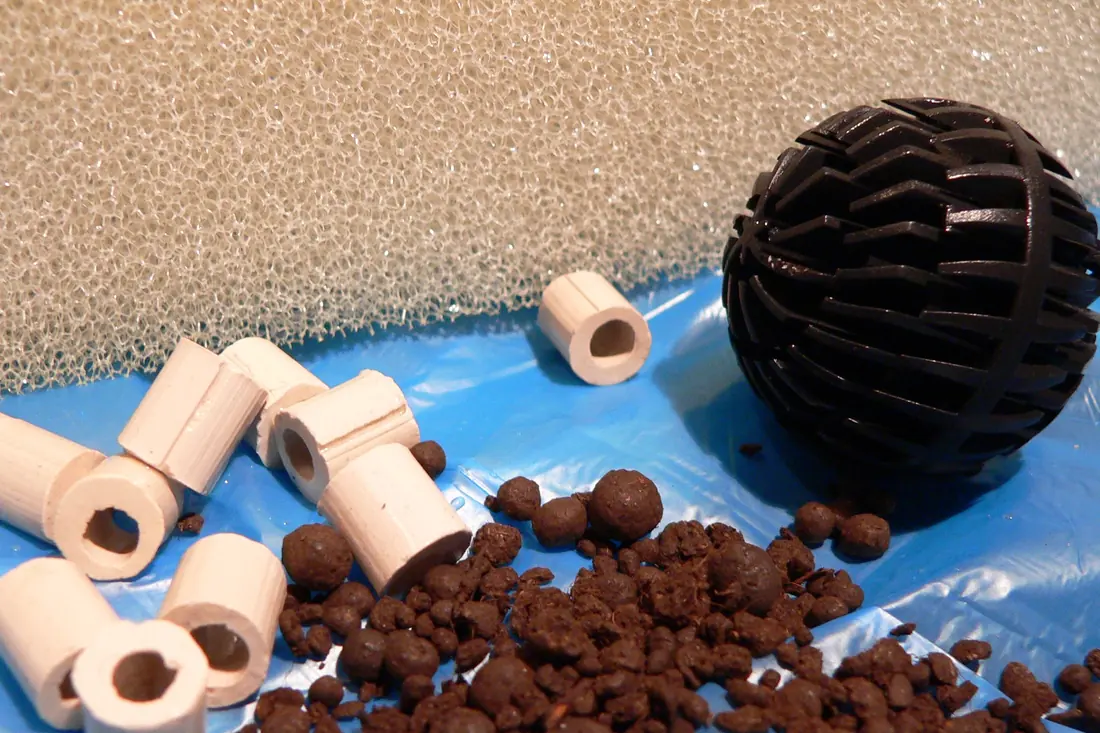
Only the first two are necessary. The third is a tool for specific jobs and is treated by a great many keepers as a permanent requirement, which it is not.
In a goldfish tank the biological stage is the one that matters most and is also easy to destroy by accident, for reasons the cartridge section below sets out.
Order of flow
Water should meet the media in this order:
- Coarse mechanical — catches the large debris, protects everything downstream
- Fine mechanical — catches what got through
- Biological — now receiving relatively clean water and good flow
- Chemical, if used at all — last, so it is not clogged by particulate
The reasoning is entirely practical. Biological media buried under trapped detritus loses flow, and a filter’s bacteria depend on water moving past them. Putting the fine mechanical stage first means it clogs immediately. Putting carbon first means it fouls before it has done anything useful.
In a canister this is a matter of stacking the baskets correctly. In a hang-on-back it is usually built in. In a sponge filter there is only one stage, which does all three jobs at once and does them well enough that sponge filters are the standard recommendation for quarantine tanks.
How water moves through a filtered tank
- Intake with a sponge pre-filter. Catches debris before the media and protects fins, eyes and bubble sacs.
- The filter itself. Water passes through mechanical media first, then biological media where bacteria live.
- Gentle return. A spray bar or baffled outflow spreads flow so fancies are not pushed around the tank.
- Whole-tank circulation. Intake at one end and return at the other means fewer dead spots where waste settles.
Turnover Filter flow ÷ tank volume. A 200 L tank with a filter moving 1,200 L/h turns over six times an hour. Keepers commonly aim for roughly five to ten turnovers an hour.
Rated flow is optimistic Manufacturers quote flow with clean, empty filters. Real flow drops as media fills, so size up rather than exactly.
Mechanical media
Coarse sponge is the workhorse: it traps debris without clogging immediately, it lasts for years, and it doubles as biological media because bacteria colonise it thoroughly — which is also why an air-driven sponge filter works as a filter at all rather than merely as an aerator. For a goldfish tank, which produces a lot of solid waste, generous coarse sponge is among the most useful things in the filter — and the filters buying guide notes which models come with enough of it.
Fine sponge catches what the coarse stage misses. It clogs faster and needs rinsing more often.
Filter floss and polishing pads produce visibly clearer water by catching very fine particulate. They clog quickly — days to a couple of weeks in a goldfish tank — and are the one media genuinely intended to be replaced rather than cleaned. They are also the right answer to the particulate haze described on the cloudy water page.
The trade-off with all mechanical media is that trapping waste does not remove it. A filter full of trapped detritus is still producing ammonia into the tank until you rinse it out, which is why the rinsing schedule matters more in a goldfish tank than in a lightly stocked one.
Biological media
This is where the cycle lives, and it is also a heavily marketed category in the hobby.
The claims usually centre on surface area — square metres per litre, pore structure, proprietary geometry. Treat them with mild scepticism. A large share of the internal surface area of very porous media is not reliably colonised, because bacteria need oxygenated water reaching them and the deepest pores do not get it. More importantly, and as the filtration guide argues from the other direction, surface area is rarely the limiting factor in a home aquarium; volume of media and flow through it are.
What this means practically is liberating. Sponge, ceramic rings, sintered glass and plastic bio-media all work. In a goldfish tank, a filter with plenty of sponge and decent flow will out-perform one with a small quantity of expensive media, and it costs a fraction as much.
Chemical media, and the carbon question
Activated carbon adsorbs dissolved organic compounds, tannins, odours, some dyes and most medications. It is genuinely good at that, and it exhausts — its capacity fills within a few weeks, after which it sits inertly in the filter as additional biological media, doing no harm and no chemical work.
That exhaustion is the whole argument against permanent carbon. A filter with carbon in it permanently is a filter with slightly less space for media that is actually doing something, on the strength of a component that stopped working a month ago.
Carbon is worth using:
- After a course of medication, to strip the residue from the water
- After adding driftwood, to clear the tannin tint
- When water has a persistent smell or yellow cast you want gone
- Before a house move or a photograph, for polish
And it must be removed before any medication, or it will adsorb the dose you just paid for — a point the diseases reference makes as well, because it is a common reason a treatment appears not to work.
What carbon does not do: remove ammonia, nitrite or nitrate. It has no effect on the nitrogen cycle at all.
The cartridge trap
This deserves naming plainly, because it is an industry practice rather than a mistake keepers make on their own.
Many hang-on-back filters are sold with disposable cartridges — a sponge or floss sleeve with carbon inside, on a plastic frame — and the packaging instructs replacement every four weeks. Follow that instruction and here is what happens: after a few weeks, that cartridge is where a large share of your nitrifying bacteria live. Replacing it removes them. Ammonia rises over the following days, the fish suffer, and the tank partially re-cycles. A month later it happens again.
The instruction exists because the cartridge is a consumable and the business model depends on it being consumed. The carbon inside it genuinely is exhausted by then; the sponge and the bacteria on it are not.
What to do instead, in order of preference:
- Add permanent biological media to the filter — a sponge, a bag of ceramic, anything that stays — so the colony has a home that is never thrown away. Then the cartridge can be replaced without consequence.
- Rinse the cartridge in tank water and keep using it until it physically disintegrates. They last months.
- If you must replace it, add the new one alongside the old for two weeks before removing the old, so the bacteria transfer.
Ammonia-adsorbing media
Zeolite and similar products adsorb ammonia directly from the water, which sounds like it solves the central problem of fishkeeping and in one sense does.
As an emergency measure it is legitimate and useful: a tank cycling with fish in it, a filter that has crashed, a transport container, a quarantine tank set up in a hurry. It buys time while water changes do the real work.
As a permanent fixture it is self-defeating. Ammonia is what the nitrifying bacteria eat. Remove it continuously and the colony never establishes, which means the tank never cycles, which means you are committed to recharging or replacing the media forever — and the day you stop, there is no biological filter underneath.
Use it deliberately and temporarily, and take it out once the crisis has passed so the cycle can finish.
The specialist resins
Organic-adsorbing resins such as the synthetic polymers sold for water polishing remove dissolved organics more selectively than carbon and can be regenerated rather than replaced. They are a genuine product and an optional one; in a goldfish tank, water changes do the same job.
Phosphate removers are sold against algae. In a goldfish tank the phosphate is coming from food and waste continuously, and the algae page makes the case that light duration and feeding are the effective levers. A phosphate remover treats a symptom at running cost.
Nitrate-removing resins and media exist and work partially. They are worth considering only where tap water itself carries high nitrate, which sets a floor no water change can go below. Otherwise the tool for nitrate is a bucket.
Cleaning, without breaking anything
Three rules cover almost everything.
Rinse in tank water. Take a bucket of water out during a water change and rinse the media in that. Tap water carries chlorine or chloramine, which can damage the biofilm; nitrifiers resist them better than many bacteria, but there is nothing to gain by risking it.
Rinse to restore flow, not to clean. Squeeze coarse sponge until the water runs less filthy and stop. Media that looks dirty is media that is working.
Never all at once. Stagger it — mechanical stages one month, biological media gently the next, and never the whole filter in a single session. The colony is distributed across everything in the box, and disturbing all of it simultaneously is how a stable tank produces a sudden ammonia reading.
Frequency is judged by flow rather than by calendar. On a goldfish tank the filter as a whole usually wants attention every two to six weeks, which is the figure cleaning a goldfish tank works to; within that, a fine sponge clogs faster than a coarse one, and the table below gives a starting interval for each. Biological media is rinsed gently and rarely — twice a year is plenty for most setups, and only if it has become clogged.
How long each thing lasts
| Media | Rinse | Replace |
|---|---|---|
| Coarse sponge | Every 2–4 weeks, in tank water | When it tears; years |
| Fine sponge | Every 2–3 weeks | When it stops springing back; a year or two |
| Filter floss / polishing pad | Not worth rinsing | When clogged; days to weeks |
| Ceramic, sintered glass, bio-media | Gently, twice a year at most | Effectively never |
| Activated carbon | Never | Exhausted in 3–6 weeks; remove rather than replace |
| Zeolite | Recharge in salt solution, or replace | When capacity is reached, weeks |
The row worth dwelling on is the last-but-one. Carbon is the only item on the list with a genuine expiry, and the correct response to it expiring is usually to take it out rather than to buy more — which is the opposite of how it is marketed.
Buying media without buying the brand
Filter media is one of the few areas of fishkeeping where the cheap option is genuinely as good as the expensive one, and a goldfish tank needs a lot of it.
Filter foam by the sheet. Sold for pond filters in large slabs, cut to size with a bread knife, and a fraction of the price of the same foam in a branded cartridge shape. This is a large saving, and many experienced keepers use it.
Plastic pot scourers — the unbranded, uncoated kind — are cheap, inert, high-surface-area biological media used widely in pond filtration. Check they carry no soap, detergent or antibacterial treatment.
Lava rock and similar works as biological media in a bag, though it is heavy and sheds grit on first rinse.
Pillow stuffing versus filter floss is the one false economy of the group. Polyester filter wool sold for aquariums is untreated; craft and bedding stuffing may carry fire retardants or other finishes, and you cannot tell by looking.
The useful principle is that for the biological stage you are buying inert surface area, and inert surface area has no brand.
What not to put in a filter
Anything with a coating. As above, and including some scourers and cloths.
Gravel. It is dense, it packs, it restricts flow badly and its surface area is poor for the volume. It is also heavy enough to damage an impeller if it migrates.
Cotton wool. Compacts to a plug within days and can shed fibres.
Anything soluble. Crushed coral is a legitimate exception used deliberately to raise carbonate hardness, but it belongs there as a decision rather than as filler, and only in tanks whose water genuinely needs it.
More media than the filter was built for. Cramming baskets so full that the lid strains is how seals fail and canisters leak.
When something goes wrong, it is often the media
A short diagnostic table, because a surprising share of tank problems trace back to the filter’s contents rather than to the fish.
| What you see | Likely media cause |
|---|---|
| Flow has dropped noticeably | Mechanical stages clogged; rinse them |
| Flow dropped and rinsing did not help | Impeller fouled, or media packed too tightly |
| Ammonia reading days after maintenance | Too much media rinsed at once, or rinsed in tap water |
| Ammonia reading a month into a new tank | Cartridge replaced, colony gone with it |
| Water cloudy with fine particles | No fine mechanical stage; add floss or a polishing pad |
| A treatment had no effect | Carbon left in the filter, adsorbing the dose |
| Yellow water that will not clear | Tannins; carbon will fix it in days |
| Filter noisy, rattling | Air trapped in the canister, or media shifted into the impeller |
Both ammonia rows point at the same habit, and the way to catch either is testing a day or two after any filter work rather than assuming. They are worth committing to memory, because in both cases the fish are being harmed by an act of maintenance that felt responsible at the time.
Media bags, and keeping it tidy
Loose media in a canister basket is a nuisance — it migrates, it falls out during servicing, and small pieces find the impeller. Mesh media bags cost very little and make the whole system manageable: one bag per media type, lifted out and rinsed individually, which also makes staggering the cleaning schedule trivial.
Leave slack rather than filling a bag tight. Media packed hard inside a bag has the same flow problem as media packed hard in a basket, and the bag adds a layer of its own restriction as it silts up. Rinse the bags themselves occasionally, since a clogged mesh restricts flow while the media inside looks perfectly clean.
For a hang-on-back filter with no baskets, a bag is what lets you add permanent biological media alongside a cartridge — which is the fix for the cartridge problem described above, and it takes about a minute to set up.
Seeding, moving and upgrading
The most valuable thing an established filter contains is transferable, which is worth knowing at three moments.
Setting up a new tank. A sponge or handful of media from a mature filter turns a multi-week fishless cycle into something far shorter. Anyone with a second tank can lend you one.
Preparing a quarantine tank. Run its sponge filter in the main tank for three or four weeks before you need it, so the new fish never sits in uncycled water. This is the single piece of preparation that makes quarantine practical rather than theoretical.
Upgrading the filter. Run the old and new together for a month, then remove the old. Or move as much mature media into the new filter as will fit. What fails is swapping in one step: the new filter is sterile, and the tank spends a fortnight re-cycling with fish in it.
What a goldfish filter should actually contain
Working from the flow inward, for a typical goldfish tank:
- Plenty of coarse sponge at the inlet end. Goldfish produce solids; this is the stage that matters most and the one people under-provide.
- A layer of finer sponge or floss after it, replaced or rinsed when flow drops.
- A generous volume of biological media — sponge, ceramic, sintered glass, whatever is affordable in quantity — receiving clean water and good flow.
- Nothing else, most of the time. A bag of carbon kept in a drawer for when it is needed, rather than a bag of exhausted carbon occupying a basket permanently.
That is the whole specification. It matches what the ideal aquarium page describes from the other direction. It is unglamorous, it is cheap, and the only part that needs protecting is the part nobody can sell you.
Frequently asked questions
Should I replace my filter cartridge every month like the box says?
No. A disposable cartridge is a sponge with some carbon on a plastic frame, and after a few weeks it is also where a large share of your biological filter lives. Throwing it away monthly throws that colony away with it, and the tank re-cycles — ammonia rises, fish suffer, and the keeper is told to buy another cartridge. Rinse it in tank water instead and keep using it until it physically falls apart, and add a sponge or some biological media to the filter so the bacteria have somewhere permanent to live.
Do I need carbon in my filter all the time?
No. Carbon adsorbs dissolved organic compounds, tannins, odours and medications, and it exhausts within a few weeks — after which it is simply more biological media, doing no harm and no chemical work. It is genuinely useful after a treatment course, to clear medication; after adding driftwood, to strip tannins; and where water has a persistent smell or yellow tint. It is not useful as a permanent fixture, it does nothing about ammonia, nitrite or nitrate, and it must be removed before any medication or it will strip the dose.
Which biological media is best?
For a home goldfish tank, the differences matter far less than the marketing suggests. Sponge, sintered glass, ceramic rings and plastic bio-balls all work; what actually limits a biological filter in practice is the volume of media and the flow and oxygen reaching it, not the surface area claimed on the packet. Much of the internal surface area advertised for porous media is not reliably colonised anyway. Cheap sponge in sufficient quantity outperforms a small amount of expensive media, and it has the advantage of doing mechanical work at the same time.
Can I rinse filter media under the tap?
Better not. Chlorine and chloramine are disinfectants, and a long soak or hard scrub in tap water can damage the nitrifying biofilm. Nitrifiers resist them better than many bacteria, so a quick rinse may do little harm, but there is nothing to gain by risking it. Rinse in a bucket of water you have just taken out of the tank during a water change — it is the right temperature, the right chemistry, and it costs nothing since you were removing it anyway. Squeeze until the media is cleaner rather than clean; the object is to restore flow, not to sterilise.
How do I upgrade to a bigger filter without losing the cycle?
Run both at once for a month. The new filter starts sterile, the old one keeps the tank safe, and over four weeks or so the bacteria colonise the new media. Then remove the old one. If that is not practical, move as much of the old biological media as will fit into the new filter and run it there — a mature sponge squeezed into a canister basket is unattractive and entirely effective. What does not work is swapping filters in one step and hoping, which is a fish-in cycle nobody planned.
Is ammonia-removing media a good idea?
As an emergency measure, yes. As a routine, no — and the reason is subtle. Zeolite and similar resins adsorb ammonia directly, which is genuinely useful in a crisis or while a tank is cycling badly with fish in it. But ammonia is what the nitrifying bacteria eat, so removing it continuously prevents the biological filter from establishing. Using it permanently means the tank never cycles and you are committed to replacing or recharging the media indefinitely. Use it to buy time, and let the cycle finish once the crisis passes.
Can I pack the filter completely full of media?
You can, and it is usually counterproductive. Bacteria need water moving past them, carrying oxygen and ammonia and taking nitrate away; media packed so tightly that flow drops is media that is partly not working, and a filter fighting its own restriction wears its pump faster. Adequate media with unrestricted flow beats maximum media with poor flow every time. If the outflow has visibly weakened, the answer is usually less media or a rinse, not more of either.